Results by title
1295 books match the query 'Women authors' and 40 start with i
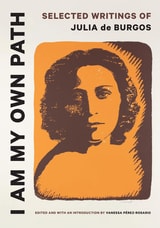
I Am My Own Path
Selected Writings of Julia de BurgosEdited and with an introduction by Vanessa Pérez-Rosario
University of Texas Press, 2023
2026 Silver Medal for the Victor Villaseñor Best Latino Focused Nonfiction Book Award – Spanish, Conference on Latin American History (CLAH)
A definitive, bilingual selection of poetry, essays, and letters by one of Puerto Rico’s most beloved poets.
Julia de Burgos (1914–1953) is best known for her poetry, but she is also an important cultural figure famous for her commitment to social justice, feminist ideas, and the independence of Puerto Rico. Admirers cultivated her legacy to bring to light the real Julia de Burgos, the woman behind the public figure, which this remarkable collection further illuminates by supplying a complex portrait using her own powerful and imaginative words.
Beginning with a critical introduction to Burgos's life and work, Vanessa Pérez-Rosario then presents a selection of poems, essays, and letters, that offer a glimpse into this formidable talent and intellect. Burgos left Puerto Rico, spending the 1940s in both New York City and Havana, where she cultivated a new kind of identity refracted through her pathbreaking work as a poet and journalist. Both poetry and prose are alive with politically charged insights into the struggle of national liberation, literary creation, and being a woman in a patriarchal society. I Am My Own Path is essential reading for anyone interested in Puerto Rican literature and culture as well as a foundational text of Latinx literature and culture in the United States.
I Live in the Country & other dirty poems
Arielle Greenberg
Four Way Books, 2020
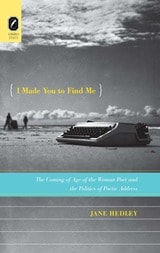
I Made You to Find Me
The Coming of Age of the Woman Poet and the Politics of Poetic AddressJane Hedley
The Ohio State University Press, 2009
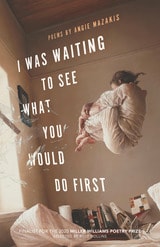
I Was Waiting to See What You Would Do First
PoemsAngie Mazakis
University of Arkansas Press, 2020
Like nesting dolls, the poems in I Was Waiting to See What You Would Do First contain scenes within scenes, inviting the reader over and over again to sharpen focus on minute details that, though small, reveal much about human perception and imagination.
Angie Mazakis handles these layers of revelation with great tenderness. Her poems wander in the way that a curious mind wanders, so that even though they often end very far from where they started, they are anchored in the familiar, referring to experiences we all share: a moment of distraction in a coffee shop imagining a conversation with someone across the room, or a narrative built around the expressions of the cartoon people on the airplane seatback safety guide.
I Was Waiting to See What You Would Do First is a testament to the notion that whether through a cosmic or microscopic lens, “You just see one moment; you just see now.”
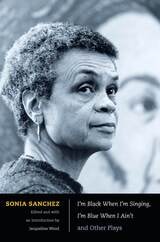
I'm Black When I'm Singing, I'm Blue When I Ain't and Other Plays
Sonia Sanchez
Duke University Press, 2010
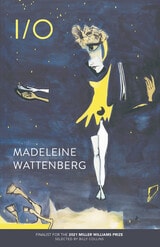
I/O
Madeleine Wattenberg
University of Arkansas Press, 2021
Finalist for the 2021 Miller Williams Poetry Prize.
Madeleine Wattenberg’s debut collection I/O, finalist for the 2021 Miller Williams Poetry Prize, alternates between epistolary poems to the mythical figure Io and lyrical interrogations of science, myth, and the historical record. Wattenberg casts Io—the priestess of Hera who was turned into a heifer—as a woman struggling to navigate the terrain between choice and coercion. Accompanying the letters to Io are poems whose explorations range from laboratories to airships in their pursuit of answers. Here the poetic imagination emerges as its own laboratory, drawing inspiration as much from ancient myth as from science and steampunk as it refuses to be constrained by a final conclusion.
IN THE PRESENCE OF AUDIENCE
THE SELF IN DIARIES AND FICTIONDeborah Martinson
The Ohio State University Press, 2003
As a diary writer imagines shadow readers rifling diary pages, she tweaks images of the self, creating multiple readings of herself, fixed and unfixed. When the readers and potential readers are husbands and publishers, the writer maneuvers carefully in a world of men who are quick to judge and to take offense. She fills the pages with reflections, anecdotes, codes, stories, biographies, and fictions. The diary acts as a site for the writer’s tension, rebellion, and remaking of herself.
In this book Martinson examines the diaries of Virginia Woolf, Katherine Mansfield, Violet Hunt, and Doris Lessing’s fictional character Anna Wulf, and shows that these diaries (and others like them) are not entirely private writings as has been previously assumed. Rather, their authors wrote them knowing they would be read. In these four cases, the audience is the author’s male lover or husband, and Martinson reveals how knowledge of this audience affects the language and content in each diary. Ultimately, she argues, this audience enforces a certain “male censorship” which changes the shape of the revelations, the shape of the writer herself, making it impossible for the female author to be honest in writing about her true self.
Even sophisticated readers often assume that diaries are primarily private. This study interrogates the myth of authenticity and self-revelation in diaries written under the gaze of particular peekers.

Ice Hours
Marion Starling Boyer
Michigan State University Press, 2023
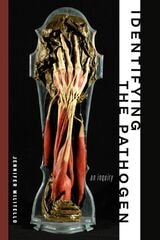
Identifying the Pathogen
Jennifer Militello
Tupelo Press, 2026
Composed as a lab notebook recording various surgeries, autopsies, and experiments, Identifying the Pathogen tells the story of a scientist on an obsessive quest to document an ailment that resists classification. The book considers the body in response to the COVID-19 pandemic, woven through with the story of Anna Morandi Manzolini—an eighteenth-century Italian anatomist and artist who struggled to support a husband suffering from depression—as well as several essays detailing accounts of a ruptured appendix, a splintered cello, and an ill-fated rock climbing excursion.
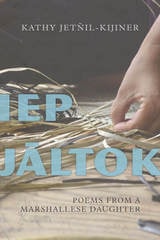
Iep Jaltok
Poems from a Marshallese DaughterKathy Jetnil-Kijiner
University of Arizona Press, 2017
As the seas rise, the fight intensifies to save the Pacific Ocean’s Marshall Islands from being devoured by the waters around them. At the same time, activists are raising their poetic voices against decades of colonialism, environmental destruction, and social injustice.
Marshallese poet and activist Kathy Jetnil-Kijiner’s writing highlights the traumas of colonialism, racism, forced migration, the legacy of American nuclear testing, and the impending threats of climate change. Bearing witness at the front lines of various activist movements inspires her work and has propelled her poetry onto international stages, where she has performed in front of audiences ranging from elementary school students to more than a hundred world leaders at the United Nations Climate Summit.
The poet connects us to Marshallese daily life and tradition, likening her poetry to a basket and its essential materials. Her cultural roots and her family provides the thick fiber, the structure of the basket. Her diasporic upbringing is the material which wraps around the fiber, an essential layer to the structure of her experiences. And her passion for justice and change, the passion which brings her to the front lines of activist movements—is the stitching that binds these two experiences together.
Iep Jāltok will make history as the first published book of poetry written by a Marshallese author, and it ushers in an important new voice for justice.
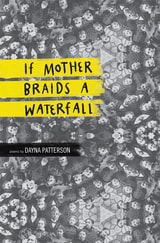
If Mother Braids a Waterfall
Dayna Patterson
Signature Books, 2020
Dayna Patterson has produced a book obsessed with motherhood and daughterhood, ancestry, and transition—of home, family, faith, and the narratives woven to uphold the Self. In her debut collection of poetry and lyric essay, Patterson grapples with a patriarchal and polygamous heritage. After learning about her mother’s bisexuality, Patterson befriends doubt while simultaneously feeling the urge to unearth a feminist theology, one that envisions God the Mother taking pride in her place at the banquet table.

If Some God Shakes Your House
Jennifer Franklin
Four Way Books, 2023
Jennifer Franklin reimagines an Antigone for our times in her third collection, If Some God Shakes Your House, where filial devotion and ossified roles of gendered labor become the engine of her defiance. Franklin’s Antigone is ferocious, feeling, and unafraid of the consequences of speaking the truth to power about the political atrocities she has witnessed and personal traumas she has withstood. With a sensitivity that equally elevates the quotidian and the classical, and an attention that moves from the ancient ruins of Pompeii to the right of bodily autonomy and agency stripped away by our own Supreme Court, Franklin reveals the high stakes of our moment where “the one who does the judging judges things all wrong.” Franklin’s Antigone has embraced the sacrifice of self for something greater—a dual devotion to her disabled daughter and to her art. “For twenty years, I have been disappearing,” she writes in the book’s final poem, yet she continues to sing.
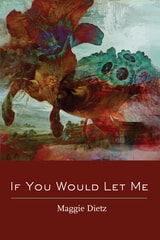
If You Would Let Me
Maggie Dietz
Four Way Books, 2026
If You Would Let Me uses the myth of Persephone and Demeter to explore, in an utterly contemporary idiom, the hellish descents and unequivocal love of a mother and an adolescent child. The old story is reimagined in new terms—a present-day Persephone’s cycles of psychic affliction giving rise to botched facial piercings, social media ghostings, and squalls of physical fury—and revoiced in poems that sing Demeter’s rage, the depths of maternal grief, the seasons of erasure and renewal. In an electric transposition of classic lore onto modern descriptive modes, Dietz casts the imperiling pubescence and anxiety of middle school as canonically significant and dangerously chimerical: “Persephone and her friends brought / Waxed paper cups of ice cream / To the meadow by the river,” where “Their laughter made ripples a heron / Mistook for alewives underwater” while “Under some of their shirts” grew “The first hiccups of puffy nipples.” Throughout these teenage transformations and the distances they grow, Dietz remains as constant as a lodestar, offering unwavering light for her child to see by in order to return. “You must know what I mean even if / You do not know you know: Child, // When you called my name I heard you / Though your cries could find no wind.” Formally meticulous and sonically intricate, these poems hear as much as they make themselves heard, harnessing ancient energies to create a picture of our recycled world—a story for our own times, one not only familiar but perennially, timelessly true.
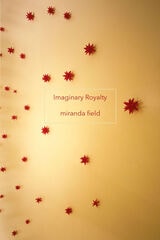
Imaginary Royalty
Miranda Field
Four Way Books, 2017
Imitations of Life
Fannie Hurst’s Gaslight SonatasAbe C. Ravitz
Southern Illinois University Press, 2009
In the early 1920s, Fannie Hurst’s enormous popularity made her the highest-paid writer in America. She conquered the literary scene at the same time the silent movie industry began to emerge as a tremendously profitable and popular form of entertainment. Abe C. Ravitz parallels Hurst’s growing acclaim with the evolution of silent films, from which she borrowed ideas and techniques that furthered her career. Ravitz notes that Hurst was amazingly adept at anticipating what the public wanted. Sensing that the national interest was shifting from rural to urban subjects, Hurst set her immigrant tales and her "woiking goil" tales in urban America. In her early stories, she tried to bridge the gap between Old World and New World citizens, each somewhat fearful and suspicious of the other. She wrote of love and ethnicity—bringing the Jewish Mother to prominence—of race relations and prejudice, of the woman alone in her quest for selfhood. Ravitz argues, in fact, that her socially oriented tales and her portraits of women in the city clearly identify her as a forerunner of contemporary feminism.
Ravitz brings to life the popular culture from 1910 through the 1920s, tracing the meteoric rise of Hurst and depicting the colorful cast of characters surrounding her. He reproduces for the first time the Hurst correspondence with Theodore Dreiser, Charles and Kathleen Norris, and Gertrude Atherton. Fellow writers Rex Beach and Vachel Lindsay also play important roles in Ravitz’s portrait of Hurst, as does Zora Neale Hurston, who awakened Hurst’s interest in the Harlem Renaissance and in race relations, as shown in Hurst’s novel Imitation of Life.

Immortal Sofa
Maura Stanton
University of Illinois Press, 2008

Imperial Bibles, Domestic Bodies
Women, Sexuality, and Religion in the Victorian MarketMary Wilson Carpenter
Ohio University Press, 2003
Of the many literary phenomena that sprang up in eighteenth-century England and later became a staple of Victorian culture, one that has received little attention until now is the “Family Bible with Notes.” Published in serial parts to make it affordable, the Family Bible was designed to enhance the family’s status and sense of national and imperial identity.
Imperial Bibles, Domestic Bodies reveals in its study of the production and consumption of British commercial Family Bibles startling changes in “family values.” Advertised in the eighteenth century as providing the family with access to “universal knowledge,” these Bibles suddenly shifted in the early nineteenth century to Bibles with bracketed sections marked “to be omitted from family reading” and reserved for reading “in the closet” by the “Master of the family.” These disciplinary Bibles were paralleled by Family Bibles designed to appeal to the newly important female consumer. Illustrations featured saintly women and charming children, and “family registers” with vignettes of family life emphasized the prominent role of the “angel in the house.”
As Mary Wilson Carpenter documents in Imperial Bibles, Domestic Bodies, the elaborate notes and “elegant engravings” in these Bibles bring to light a wealth of detail about the English commonsense view of such taboo subjects as same-sex relations, masturbation, menstruation, and circumcision. Her reading of literary texts by Charlotte Brontë, George Eliot, and Elizabeth Barrett Browning in the context of these commercial representations of the “Authorized Version” or King James translation of the Bible indicates that when the Victorians spoke about religion, they were also frequently speaking about sex.
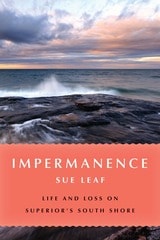
Impermanence
Life and Loss on Superior's South Shoreleaf
University of Minnesota Press, 2024
A personal journey through the ever-changing natural and cultural history of Lake Superior’s South Shore
Lake Superior’s South Shore is as malleable as it is enduring, its red sandstone cliffs, clay bluffs, and golden sand beaches reshaped by winds and water from season to season—and sometimes from one hour to the next. Generations of people have inhabited the South Shore, harvesting the forests and fish, mining copper, altering the land for pleasure and profit, for better or worse. In Impermanence, author Sue Leaf explores the natural and human histories that make the South Shore what it is, from the gritty port city of Superior, Wisconsin, to the shipping locks at Sault Ste. Marie, Michigan.
For Leaf, what began as a bicycling adventure on the coast of Lake Superior in 1977 turned into a lifelong connection with the area, and her experience, not least as owner of a rustic cabin on a rapidly eroding lakeside cliff, imbues these essays with a passionate sense of place and an abiding curiosity about its past and precarious future. As waves slowly consume the shoreline where her family has spent countless summers, Leaf is forced to confront the complexity of loving a place that all too quickly is being reclaimed by the great lake.
Impermanence is a journey through the South Shore’s story, from the early days of the Anishinaabe and fur traders through the heyday of commercial fishing, lumber camps, and copper mining on the Keweenaw Peninsula to the awakening of the Northland to the perils and consequences of plundering its natural splendor. Noting the geological, ecological, and cultural features of each stop on her tour along the South Shore, Leaf writes about the restoration of the heavily touristed Apostle Islands National Lakeshore to its pristine conditions, even as Lake Superior maintains its allure for ice fishers, kayakers, and long-distance swimmers. She describes efforts to protect the endangered piping plover and to preserve the diverse sand dunes on the Michigan coast, and she observes the slough that supports rare intact wild rice beds central to Anishinaabe culture.
Part memoir, part travelogue, part natural and cultural history, Leaf’s love letter to Lake Superior’s South Shore is an invitation to see this liminal world in all its seasons and guises, to appreciate its ageless, ever-changing wonders and intimate charms.
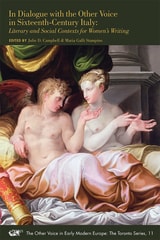
In Dialogue with the Other Voice in Sixteenth-century Italy
Literary and Social Contexts for Women's WritingEdited by Julie D. Campbell and Maria Galli Stampino
Iter Press, 2011
—Elissa Weaver
Professor of Italian, Emerita, University of Chicago
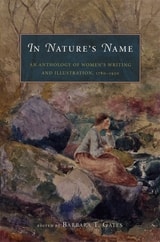
In Nature's Name
An Anthology of Women's Writing and Illustration, 1780-1930Edited by Barbara T. Gates
University of Chicago Press, 2002
The works contained in this volume are as varied as the women who produced them. They include passionate essays on the protection of animals, vivid accounts of travel and adventure from the English seashore to the Indian Alps, poetry and fiction, and marvelous tales of nature for children. Special features of the book include a detailed chronology placing each selection in its historical and literary context; biographical sketches of each author's life and works; a comprehensive bibliography of primary and secondary literature; and over sixty illustrations.
An ideal introduction to women's powerful and diverse responses to the natural world, In Nature's Name will be treasured by anyone interested in natural history, women, or Victorian and Edwardian Britain.
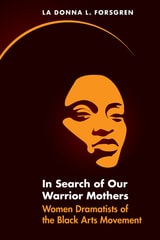
In Search of Our Warrior Mothers
Women Dramatists of the Black Arts MovementLa Donna L. Forsgren
Northwestern University Press, 2018
The Black Arts Movement (1965–76) consisted of artists across the United States deeply concerned with the relationship between politics and the black aesthetic. In Search of Our Warrior Mothers examines the ways in which black women playwrights in the movement advanced feminist and womanist perspectives from within black nationalist discourses. La Donna L. Forsgren recuperates the careers, artistic theories, and dramatic contributions of four leading playwrights: Martie Evans-Charles, J.e. Franklin, Sonia Sanchez, and Barbara Ann Teer. Using original interviews, production recordings, playbills, and unpublished manuscripts, she investigates how these women, despite operating within a context that equated the collective well-being of black people with black male agency, created works that validated black women's aspirations for autonomy and explored women's roles in the struggle for black liberation.
In Search of Our Warrior Mothers demonstrates the powerful contributions of women to the creation, interpretation, and dissemination of black aesthetic theory, thus opening an interdisciplinary conversation at the intersections of theater, performance, feminist, and African American studies and identifying and critiquing the gaps and silences within these fields.
In an Angry Season
Lisa D. Chávez
University of Arizona Press, 2001
A white woman navigates her fear and uncertainty to learn the ways of the people she called savages, until she begins to dream “in Dakota, syllables sliding / on my tongue like tender pieces of meat.” An African man, on display as a cannibal at the World’s Columbian Exposition in 1893, sees into the future: “humiliations heaped up / as on overfilled plates . . . / . . . a country that casually / consumes its own.” A woman holds the gray-blue barrel of a gun in her mouth, “the taste familiar / as her own blood.”
With an unexcelled command of narrative verse, Lisa Chávez tells the stories of American lives across more than a century. Whether retelling nineteenth-century captivity narratives or depicting contemporary American women confronting addiction and despair, Chávez investigates issues of identity and self-definition in the face of an often harsh and unremitting history.
Her story-poems explore the ways in which people have been made captive—whether to racism or national policy, to bad marriages or alcoholism, to poverty or emotion—from the Inuit woman birthing a son among strangers to the wife now deranged by desire for another man: “He’s the smoky slow-burn of chipotle on the tongue. My golden idol. My gospel revival. He’s hashish sweet and languorous—my body’s one desire.”
In the end, Chávez shows us a New World of promise in which an alchemist’s assistant summons stories from stones by calling their names with “clicks of her tongue, / syllables of silver, turquoise, and jade,” and a Native woman discovers her true power in an Alaskan bar. Passionate and political, In an Angry Season is a work of startling depth and breadth—an American history in poetry—that asks us what it means to be civilized.
In an Invisible Glass Case Which Is Also a Frame
Julia Guez
Four Way Books, 2019

In the Company of Radical Women Writers
Rosemary Hennessy
University of Minnesota Press, 2023
Recovering the bold voices and audacious lives of women who confronted capitalist society’s failures and injustices in the 1930s—a decade unnervingly similar to our own
In the Company of Radical Women Writers rediscovers the political commitments and passionate advocacy of seven writers—Black, Jewish, and white—who as young women turned to communism around the Great Depression and, over decades of national crisis, spoke to issues of labor, land, and love in ways that provide urgent, thought-provoking guidance for today. Rosemary Hennessy spotlights the courageous lives of women who confronted similar challenges to those we still face: exhausting and unfair labor practices, unrelenting racial injustice, and environmental devastation.
As Hennessy brilliantly shows, the documentary journalism and creative and biographical writings of Marvel Cooke, Louise Thompson Patterson, Claudia Jones, Alice Childress, Josephine Herbst, Meridel Le Sueur, and Muriel Rukeyser recognized that life is sustained across a web of dependencies that we each have a duty to maintain. Their work brought into sharp focus the value and dignity of Black women’s domestic work, confronted the destructive myths of land exploitation and white supremacy, and explored ways of knowing attuned to a life-giving erotic energy that spans bodies and relations. In doing so, they also expanded the scope of American communism.
By tracing the attention these seven women pay to “life-making” as the relations supporting survival and wellbeing—from Harlem to the American South and Midwest—In the Company of Radical Women Writers reveals their groundbreaking reconceptions of the political and provides bracing inspiration in the ongoing fight for justice.
In the Forbidden City
An Anthology of Erotic Fiction by Italian WomenEdited by Maria Rosa Cutrufelli
University of Chicago Press, 2000
Now Italian women have turned the tables. With In the Forbidden City, translated from the Italian, acclaimed novelist Maria Rosa Cutrufelli brings together fourteen short erotic stories by contemporary Italian women writers. Well-established voices are juxtaposed with new ones; traditional forms provide a contrast with the experimental. In Sandra Petrignani's dialogue "Body" a women and a former lover engage in a heady debate about desire and indifference; Margherita Ciacobino delivers a tale of lesbian desire, a theme uncommon in Italian literature; Dacia Maraini writes on the literature of eroticism penned by women writers that ingeniously manages to be erotic in its own right; and Rossana Campo, in one of the most entertaining entries, offers a hip-rattling tri-logue on love voiced by some super-cool adolescents. In her introduction, Cutrufelli draws in even more writers such as Jean Baudrillard, Angela Carter, and Georges Bataille in her introductory essay on the theoretical issues of desire and seduction.
Now finally available to English readers, In the Forbidden City constitutes a breakthrough volume in literary erotica by Italian women that is both profound and engaging.
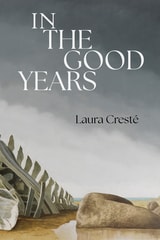
In the Good Years
Laura Cresté
Four Way Books, 2025
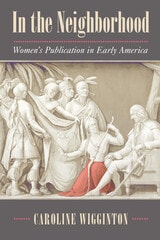
In the Neighborhood
Women's Publication in Early AmericaCaroline Wigginton
University of Massachusetts Press, 2016
Winner of the 2018 Early American Literature Book Prize
In this compelling and original book, Caroline Wigginton reshapes our understanding of early American literary history. Overturning long-standing connections between the male-dominated print culture of pamphlets, broadsides, and newspapers and the transformative ideas that instigated the American Revolution, Wigginton explores how women's “relational publications”—circulated texts, objects, and performances—transformed their public and intimate worlds. She argues that Native, black, and white women's interpersonal "publications" revolutionized the dynamics of power and connection in public and private spaces, whether those spaces were Quaker meeting houses, Creek talwas, trading posts, burial grounds, or the women's own "neighborhoods."
Informed by deep and rich archival research, Wigginton's case studies explore specific instances of “relational publication.” The book begins with a pairing of examples—the statement a grieving Lenape mother made through a wampum belt and the political affiliations created when a salon hostess shared her poetry. Subsequent chapters trace a history of women's publication practice, including a Creek woman's diplomatic and legal procession-spectacles in the colonial Southeast, a black mother's expression of protest in Newport, Rhode Island, and the resulting evangelical revival, Phillis Wheatley's elegies that refigured neighborhoods of enslaved and free Bostonians, and a Quaker woman's pious and political commonplace book in Revolutionary Philadelphia.
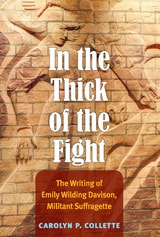
In the Thick of the Fight
The Writing of Emily Wilding Davison, Militant SuffragetteCarolyn P. Collette
University of Michigan Press, 2013
One of the most memorable images of the British women’s suffrage movement occurred on June 4, Derby Day, 1913. As the field of horses approached a turning at Epsom, militant suffragette Emily Wilding Davison ducked out from under the railing and ran onto the track, reaching for the bridle of the King’s horse, and was killed in the collision. While her death transformed her into a heroine, it all but erased her identity. To identify what impelled Davison to suffer multiple imprisonments, to experience the torture of force-feedings and the insults of hostile members of the crowds who came to hear her speak, Carolyn P. Collette explores a largely ignored source—the writing to which Davison dedicated so much time and effort during the years from 1908 to 1913. Davison’s writing is an implicit apologia for why she lived the life of a militant suffragette and where she continually revisits and restates the principles that guided her: that woman suffrage was necessary to improve the lives of men, women, and children; that the freedom and justice women sought was sanctioned by God and unjustly withheld by humans whose opposition constituted a tyranny that had to be opposed; and that the evolution of human progress demanded that women become fully equal citizens of their nation in every respect— politically, economically, and culturally.
In the Thick of the Fight makes available for the first time the archive of published and unpublished writings of Emily Wilding Davison. Collette reorients both scholarly and public attention away from a single, defining event to the complexity of Davison’s contributions to modern feminist discourse, giving the reader a sense of the vibrancy and diversity of Davison’s suffrage writings.
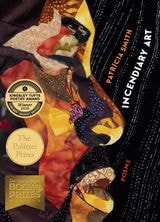
Incendiary Art
PoemsPatricia Smith
Northwestern University Press, 2017
From National Book Award winner Patricia Smith
One of the most magnetic and esteemed poets in today’s literary landscape, Patricia Smith fearlessly confronts the tyranny against the black male body and the tenacious grief of mothers in her compelling new collection, Incendiary Art. She writes an exhaustive lament for mothers of the "dark magicians," and revisits the devastating murder of Emmett Till. These dynamic sequences serve as a backdrop for present-day racial calamities and calls for resistance. Smith embraces elaborate and eloquent language— "her gorgeous fallen son a horrid hidden / rot. Her tiny hand starts crushing roses—one by one / by one she wrecks the casket’s spray. It’s how she / mourns—a mother, still, despite the roar of thorns"— as she sharpens her unerring focus on incidents of national mayhem and mourning. Smith envisions, reenvisions, and ultimately reinvents the role of witness with an incendiary fusion of forms, including prose poems, ghazals, sestinas, and sonnets. With poems impossible to turn away from, one of America’s most electrifying writers reveals what is frightening, and what is revelatory, about history.
Winner, 2017 Los Angeles Times Book Prize
Finalist, 2018 Pulitzer Prize for Poetry
Winner, NAACP Image Award for Outstanding Literary Work in the Poetry category
Winner, 2018 Kingsley Tufts Poetry Award
Winner, 2018 BCALA Best Poetry Award
Winner, Abel Meeropol Award for Social Justice
Finalist, Neustadt International Prize for Literature
Winner, 2021 Ruth Lilly Poetry Prize
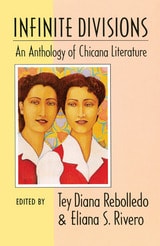
Infinite Divisions
An Anthology of Chicana LiteratureTey Diana Rebolledo
University of Arizona Press, 1993
Through poetry, fiction, drama, essay, and other forms, this landmark volume showcases the talents of more than fifty authors, including Gloria E. Anzaldúa, Ana Castillo, Lorna Dee Cervantes, Denise Chávez, Sandra Cisneros, Pat Mora, Cherríe Moraga, and María Helena Viramontes.
Innovative Women Poets
An Anthology of Contemporary Poetry and InterviewsElisabeth A. Frost
University of Iowa Press, 2007
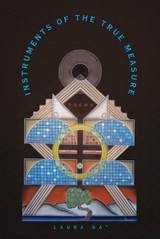
Instruments of the True Measure
PoemsLaura Da'
University of Arizona Press, 2018
Surveying and geography underpin the collection, but even as Da’ investigates these signifiers of measurement, she pushes the reader to interrogate their function within the stark atrocities of American history. Da’ laments this harsh dichotomy, observing that America’s mathematical point of beginning is located in the heart of her tribe’s homeland: “I do not have the Shawnee words to describe this place; the notation that is available to me is 40°38´32.61´´ N 80°31´9.76´´ W.”
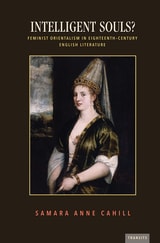
Intelligent Souls?
Feminist Orientalism in Eighteenth-Century English LiteratureSamara Anne Cahill
Bucknell University Press, 2019
Published by Bucknell University Press. Distributed worldwide by Rutgers University Press.
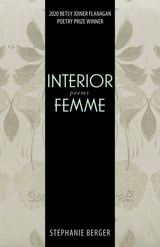
Interior Femme
PoemsStephanie Berger
University of Nevada Press, 2022
The poems offer layered perspectives fused with multiple versions of female representation, as if to underscore the burden of responsibility, inherited shame, and awesome power that comes with the position women have occupied throughout history. Berger reveals a woman critically wounded—representing the totality of the Western feminine imaginary. Lyrically complex, sometimes surreal, and often ekphrastic in style and content, Interior Femme simultaneously offers heartbreak, laughter, comfort, and empowerment.
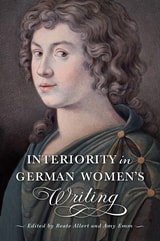
Interiority in German Women's Writing
Beate Allert
University of Delaware Press, 2026
Interiority in German Women’s Writing for the first time systematically gathers and engages with contributions of German women authors to the discourse on interiority (Innerlichkeit) from 1750 to 1850. This volume shifts the recent focus on abstract theoretical and medical discourses on inwardness to the origins of interiority in literature and philosophy as written and experienced by women from the Age of Sensibility (Empfindsamkeit) to the Romantic era. At the same time, it makes a claim for and explores the ramifications of understanding interiority as a feminine discourse. Contributors investigate the works of women authors who searched to find rescue from their cultural and personal entrapment via creative spaces and various modes of interiority in theatrical performances, poetic writings, letters, biographical narratives, prose, and fairy tales. From the case studies and literary analyses in the volume, interiority emerges as a spectrum of approaches to defining, resisting, and transforming the innermost self.
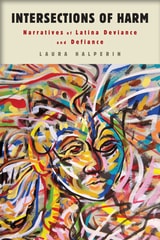
Intersections of Harm
Narratives of Latina Deviance and DefianceHalperin, Laura
Rutgers University Press, 0
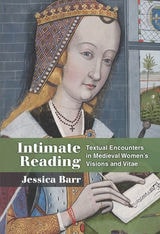
Intimate Reading
Textual Encounters in Medieval Women’s Visions and VitaeJessica Barr
University of Michigan Press, 2020
This new volume is structured around five case studies. Chapters consider the biographies of 13th-century holy women from Liège, the writings of Margery Kempe, Gertrude of Helfta, Mechthild of Magdeburg, Marguerite Porete, and Julian of Norwich. At the heart of Intimate Reading is the question of how reading works—what it means to enter imaginatively and intellectually into the words of another. The volume showcases the complexity of medieval understandings of the work of reading, deepening our perception of the written word’s capacity to signify something that lies even beyond rational comprehension.
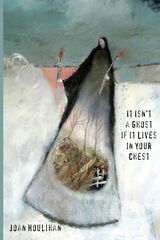
It Isn’t a Ghost if It Lives in Your Chest
Joan Houlihan
Four Way Books, 2021
Houlihan’s sixth collection of lyric poems reflects upon the persistence of what is lost and the accidental ruptures of trauma that allow re-entry into our world. These poems are at once despairing and hopeful.

Italy and American Female Imagination
Debra Bernardi
The Ohio State University Press, 2025

Itch Like Crazy
Wendy Rose
University of Arizona Press, 2002
In her latest work, Rose returns to these major motifs while exploring a new dimension: using poetry as a tool to delve into the buried secrets of family history—and all of American history as well. Confronting questions of personal history that itch like crazy—the irritations that drive human existence—she acknowledges and pays tribute to her Indian and European ancestors without hiding her anger with American society.
Rose's poems are strong political and social statements that have a distinctly narrative flavor. Here are Europeans who first set foot on America's shores while Taino Indians greeted them as if they were visiting neighbors; Hopi and Miwok "Clan Mothers, grand-daughters, all those the missionaries erased"; and European forebears who as settlers pushed their way relentlessly west. Through her vivid imagery, she speaks to and for these ancestors with a sense of loss and an itching caused by the biases provoked by ethnic chauvinism.
Itch Like Crazy is a finely crafted literary work that is also a manifesto addressing contacts and conflicts in the history of Indian-white relations. By presenting another view of U.S. history and its impact on the Native Americans who are her ancestors, it offers a new appreciation of the issue of "tribal identity" that too often faces Native peoples of the Americas—and is too often misunderstood by Euro-American society.