Results by title
28167 books match the query 'History' and 997 start with i
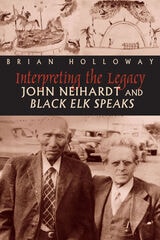
Interpreting the Legacy
John Neihardt and Black Elk SpeaksBrian Holloway
University Press of Colorado, 2020
Using Neihardt's original handwritten notes and early manuscript drafts, Holloway demonstrates the poet's careful and deliberate re-creation of Black Elk's spiritual world in order to induce a transcendent experience in the reader. Through exhaustive research into Neihardt's biographical materials, published philosophical and metaphysical writings, and volumes of taped lectures, Holloway examines the sources of the book's production as well as the reactions to and the implications of his literary portrayal of the spiritual world of the Oglala.
Restoring Neihardt's reputation as a faithful witness to Black Elk's sacred landscape, Interpreting the Legacy: John Neihardt and Black Elk Speaks will be of interest to Neihardt scholars and students of literature, religious studies, and Native American studies.
Interracial Intimacy
The Regulation of Race and RomanceRachel F. Moran
University of Chicago Press, 2003
"A good introduction to an issue too often overlooked. . . . The writing is clear and accessible, the evidence is evocative, and the ideas are challenging."—Beth Kiyoko Jamieson, Law and Politics Book Review
"U. S. government bodies have tried to regulate interracial intimacy from the day Pocahontas married John Rolfe up through Loving v. Virginia, which found antimiscegentation laws unconstitutional in 1967. . . . The weirder anecdotes from our racial history enliven this study, which is likely to become a classic in its field."—Publishers Weekly
"Moran examines the history of U. S. regulation of cross-racial romance, considering the impact of that regulation on the autonomy of individuals and families as well as on racial identity and equality. . . . She is attuned to the nuances of race in this polyglot nation, and supplies thoughtful analysis of these nuances."—Booklist

Interrogating Integration
Sport, Celebrity, and Scandal in the Making of New GermanyKate Zambon
University of Michigan Press, 2025
Using touchstones of public memory, including events surrounding men’s World Cup soccer and the record-breaking success of a book blaming Muslims for Germany’s decline, Zambon examines persistent problems in European conceptions of race, where racializing projects take place under an “ideology of racelessness” and the atrocities of historical and transnational racisms are used to deny current local forms of racism.
Interrogation Of Joan Of Arc
Karen Sullivan
University of Minnesota Press, 1999
A radical reassessment of the trial of Joan of Arc that gives a new sense of Joan in her time.
The transcripts of Joan of Arc’s trial for heresy at Rouen in 1431 and the minutes of her interrogation have long been recognized as our best source of information about the Maid of Orleans. Historians generally view these legal texts as a precise account of Joan’s words and, by extension, her beliefs. Focusing on the minutes recorded by clerics, however, Karen Sullivan challenges the accuracy of the transcript. In The Interrogation of Joan of Arc, she re-reads the record not as a perfect reflection of a historical personality’s words, but as a literary text resulting from the collaboration between Joan and her interrogators.
Sullivan provides an illuminating and innovative account of Joan’s trial and interrogation, placing them in historical, social, and religious context. In the fifteenth century, interrogation was a method of truth-gathering identified not with people like Joan, who was uneducated, but with clerics, like those who tried her. When these clerics questioned Joan, they did so as scholastics educated at the University of Paris, as judges and assistants to judges, and as pastors trained in hearing confessions.The Interrogation of Joan of Arc traces Joan’s conflicts with her interrogators not to differing political allegiances, but to fundamental differences between clerical and lay cultures. Sullivan demonstrates that the figure depicted in the transcripts as Joan of Arc is a complex, multifaceted persona that results largely from these cultural differences. Discerning and innovative, this study suggests a powerful new interpretive model and redefines our sense of Joan and her time.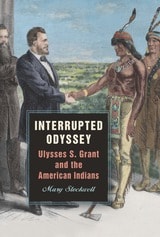
Interrupted Odyssey
Ulysses S. Grant and the American IndiansMary Stockwell
Southern Illinois University Press, 2018
In the late 1860s, before becoming president, Grant collaborated with Ely Parker, a Seneca Indian who became his first commissioner of Indian affairs, on a plan to rescue the tribes from certain destruction. Grant hoped to save the Indians from extermination by moving them to reservations, where they would be guarded by the U.S. Army, and welcoming them into the nation as American citizens. By so doing, he would restore the executive branch’s traditional authority over Indian policy that had been upended by Jackson.
In Interrupted Odyssey, Stockwell rejects the common claim in previous Grant scholarship that he handed the reservations over to Christian missionaries as part of his original policy. In part because Grant’s plan ended political patronage, Congress overturned his policy by disallowing Army officers from serving in civil posts, abandoning the treaty system, and making the new Board of Indian Commissioners the supervisors of the Indian service. Only after Congress banned Army officers from the Indian service did Grant place missionaries in charge of the reservations, and only after the board falsely accused Parker of fraud before Congress did Grant lose faith in his original policy.
Stockwell explores in depth the ousting of Parker, revealing the deep-seated prejudices that fueled opposition to him, and details Grant’s stunned disappointment when the Modoc murdered his peace commissioners and several tribes—the Comanche, Kiowa, Cheyenne, and Sioux—rose up against his plans for them.
Though his dreams were interrupted through the opposition of Congress, reformers, and the tribes themselves, Grant set his country firmly toward making Indians full participants in the national experience. In setting Grant’s contributions against the wider story of the American Indians, Stockwell’s bold, thoughtful reappraisal reverses the general dismissal of Grant’s approach to the Indians as a complete failure and highlights the courage of his policies during a time of great prejudice.
Intersecting Realities and Fictions of Virginia Woolf and Colette
& COLETTEHelen Southworth
The Ohio State University Press, 2004
Intersections in Turkish Literature
Essays in Honor of James Stewart-RobinsonWalter G. Andrews, Editor
University of Michigan Press, 2001
Intersections in Turkish Literature is a collection of essays on Turkish literature by former students of James Stewart-Robinson. The topics and methods cover a broad range--from a careful thematic analysis of a traditional Turkish folktale, which reveals its resemblance to well-known Western tales; to an analysis of the "saint tales" recounted by present-day Albanian Bektasi adepts; to a study of narrative rhythm in Nazim Hikhmet's rendition of an account of a fifteenth-century popular uprising.
Walter G. Andrews has assembled the writings of a number of scholars who bridge traditional chasms, inviting us to rethink our approaches to the study of Turkish and Ottoman literature. This collection forms a nucleus that clearly demonstrates the great potential now existing for study in this area, the essays displaying a variety of unusual approaches that bring together seemingly disparate materials: the Turkish story "The Pomegranate Seed" and Disney's "Snow White"; a fifteenth-century chronicle and the poetry of a modern socialist poet; Albanian dervishes in Detroit; a modern Turkish novel; Virginia Woolf; a Yale critic; traditional Japanese poetry; and Ottoman lyrics.
Intersections in Turkish Literature will provide an important stimulus to work that reaches beyond the limits of area studies, intersecting with the interests of scholars and students of literary theory, folklore studies, anthropology, French, Japanese, and Persian.
Walter G. Andrews is Affiliate Professor of Near Eastern Languages and Civilization, University of Washington.

Interstate '85
The Royals, The Cardinals, and the Show-Me World SeriesMarshall Garvey
University of Missouri Press, 2025
In this blend of baseball and cultural history, Garvey defines the “I-70 Showdown Series” not only by the literal highway that links the two teams’ home cities but the individual and collective roads travelled by the players and others who took part in the event, both before the Series began and well after the last cheers faded.
In addition to gripping human stories and vivid descriptions of on-field action long overshadowed by Denkinger’s monumental blunder, Garvey’s work captures the provincial spectacle of the “Show-Me Series” throughout the state of Missouri. Featuring 27 new interviews conducted by the author, including with George Brett, Ozzie Smith, Don Denkinger, Bud Black, Andy Van Slyke, Ricky Horton, and Mark Gubicza, Interstate ’85 is baseball history writing at its deepest and most captivating.
Interstices
Negotiations at Contemporary Art’s BoundariesAlexander Alberro
University of Chicago Press, 2025
With this book, Alexander Alberro engages decolonial theory to explore the dynamic exchanges that occur where the ideals and values of different artistic frameworks meet. Resisting notions of a singular art world and global contemporary art, Alberro explores what lies outside of Western art’s hegemonic presence, recognizing the rich multitude of art formations at its periphery, each with its own artistic narratives and conventions. Alberro brings into focus the complex negotiations that are cultivating innovation and transformation at the margins of Western art, showing how this seemingly monolithic framework is both crucial to and insufficient for a comprehensive understanding of contemporary art.
His examples include artists and collectives from around the world, including Iosu Aramburu, Subhankar Banerjee, Yto Barrada, Mabe Bethônico, El Colectivo, Maria Galindo and Mujeres Creando, Bouchra Khalili, Multiplicity, Lucy Orta, Raqs Media Collective, Tracey Rose, Doris Salcedo, Yinka Shonibare, World of Matter, and Yin Xiuzhen. As notions of transculturation and decoloniality continue to drive conversations about contemporary art, Interstices offers a critical explanation of what is at stake, showing how the tensions at the edges of the Western art framework are pushing it toward its discursive limits.

Intertextual Encounters in American Fiction, Film, and Popular Culture
Michael Dunne
University of Wisconsin Press, 2001
Intervention Narratives
Afghanistan, the United States, and the Global War on TerrorPurnima Bose
Rutgers University Press, 2020
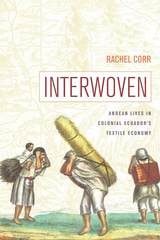
Interwoven
Andean Lives in Colonial Ecuador’s Textile EconomyRachel Corr
University of Arizona Press, 2018
Interwoven is the untold story of indigenous people’s historical experience in colonial Ecuador’s textile economy. It focuses on the lives of Native Andean families in Pelileo, a town dominated by one of Quito’s largest and longest-lasting textile mills. Quito’s textile industry developed as a secondary market to supply cloth to mining centers in the Andes; thus, the experience of indigenous people in Pelileo is linked to the history of mining in Bolivia and Peru.
Although much has been written about colonial Quito’s textile economy, Rachel Corr provides a unique perspective by putting indigenous voices at the center of that history. Telling the stories of Andean families of Pelileo, she traces their varied responses to historical pressures over three hundred years; the responses range from everyday acts to the historical transformation of culture through ethnogenesis. These stories of ordinary Andean men and women provide insight into the lived experience of the people who formed the backbone of Quito’s textile industry.
Intestine Enemies
Robert Emmett Curran
Catholic University of America Press, 2017
Intimacy Across Borders
Race, Religion, and Migration in the U.S. MidwestJane Juffer
Temple University Press, 2013
Examining how encounters produced by migration lead to intimacies-ranging from sexual, spiritual, and neighborly to hateful and violent, Jane Juffer considers the significant changes that have occurred in small towns following an influx of Latinos to the Midwest.
Intimacy across Borders situates the story of the Dutch Reformed Church in Iowa and South Africa within a larger analysis of race, religion, and globalization. Drawing on personal narrative, ethnography, and sociopolitical critique, Juffer shows how migration to rural areas can disrupt even the most thoroughly entrenched religious beliefs and transform the schools, churches, and businesses that form the heart of small-town America. Conversely, such face-to-face encounters can also generate hatred, as illustrated in the increasing number of hate crimes against Latinos and the passage of numerous anti-immigrant ordinances.
Juffer demonstrates how Latino migration to new areas of the U.S. threatens certain groups because it creates the potential for new kinds of families—mixed race, mixed legal status, and transnational—that challenge the conservative definition of community based on the racially homogeneous, coupled, citizen family.
Intimacy in America
Dreams of Affiliation in Antebellum LiteraturePeter Coviello
University of Minnesota Press, 2005
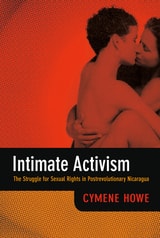
Intimate Activism
The Struggle for Sexual Rights in Postrevolutionary NicaraguaCymene Howe
Duke University Press, 2013
Intimate Communities
Representation and Social Transformation in Women's College Fiction, 1895–1910Sherrie A. Inness
University of Wisconsin Press, 1995
While other scholars have argued that the Progressive Era was the “golden age” for women’s single-sex education, pointing to the many positive depictions of the women’s college student, Inness suggests that these representations actually helped to perpetuate the status quo and did little to advance women’s social rights.
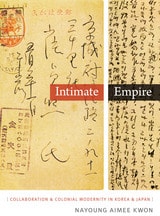
Intimate Empire
Collaboration and Colonial Modernity in Korea and JapanNayoung Aimee Kwon
Duke University Press, 2015
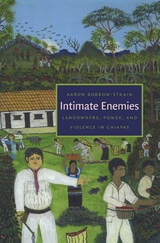
Intimate Enemies
Landowners, Power, and Violence in ChiapasAaron Bobrow-Strain
Duke University Press, 2007
Weaving together ethnography, archival research, and cultural history, Bobrow-Strain argues that prior to the upheavals of 1994 landowners were already squeezed between increasingly organized indigenous activism and declining political and economic support from the Mexican state. He demonstrates that indigenous mobilizations that began in 1994 challenged not just the economy of estate agriculture but also landowners’ understandings of progress, masculinity, ethnicity, and indigenous docility. By scrutinizing the elites’ responses to land invasions in relation to the cultural politics of race, class, and gender, Bobrow-Strain provides timely insights into policy debates surrounding the recent global resurgence of peasant land reform movements. At the same time, he rethinks key theoretical frameworks that have long guided the study of agrarian politics by engaging political economy and critical human geography’s insights into the production of space. Describing how a carefully defended world of racial privilege, political dominance, and landed monopoly came unglued, Intimate Enemies is a remarkable account of how power works in the countryside.
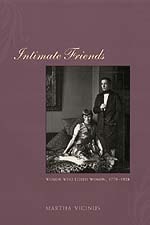
Intimate Friends
Women Who Loved Women, 1778-1928Martha Vicinus
University of Chicago Press, 2004
Vicinus also considers the nineteenth-century roots of such contemporary issues as homosexual self-hatred, female masculinity, and sadomasochistic desire. Drawing upon diaries, letters, and other archival sources, she brings to life a variety of well known and historically less recognized women, ranging from the predatory Ann Lister, who documented her sexual activities in code; to Mary Benson, the wife of the Archbishop of Canterbury; to the coterie of wealthy Anglo-American lesbians living in Paris.
In vivid and colorful prose, Intimate Friends offers a remarkable picture of women navigating the uncharted territory of same-sex desire.
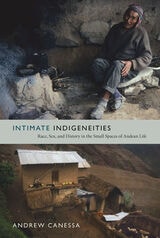
Intimate Indigeneities
Race, Sex, and History in the Small Spaces of Andean LifeAndrew Canessa
Duke University Press, 2012
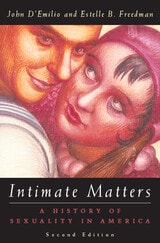
Intimate Matters
A History of Sexuality in AmericaJohn D'Emilio and Estelle B. Freedman
University of Chicago Press, 1997
"The book John D'Emilio co-wrote with Estelle B. Freedman, Intimate Matters, was cited by Supreme Court Justice Anthony Kennedy when, writing for a majority of court on July 26, he and his colleagues struck down a Texas law criminalizing sodomy. The decision was widely hailed as a victory for gay rights—and it derived in part, according to Kennedy's written comments, from the information he gleaned from D'Emilio's book, which traces the history of American perspectives on sexual relationships from the nation's founding through the present day. The justice mentioned Intimate Matters specifically in the court's decision."—Julia Keller, Chicago Tribune
"Fascinating. . . . [D'Emilio and Freedman] marshall their material to chart a gradual but decisive shift in the way Americans have understood sex and its meaning in their lives." —Barbara Ehrenreich, New York Times Book Review
"With comprehensiveness and care . . . D'Emilio and Freedman have surveyed the sexual patterns for an entire nation across four centuries." —Martin Bauml Duberman, Nation
"Intimate Matters is comprehensive, meticulous and intelligent." —Jonathan Yardley, Washington Post Book World
"This book is remarkable. . . . [Intimate Matters] is bound to become the definitive survey of American sexual history for years to come." —Roy Porter, Journal of the History of the Behavioral Sciences
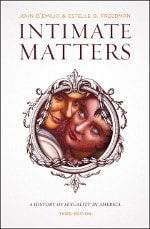
Intimate Matters
A History of Sexuality in America, Third EditionJohn D'Emilio and Estelle B. Freedman
University of Chicago Press, 2012
As the first full-length study of the history of sexuality in America, Intimate Matters offered trenchant insights into the sexual behavior of Americans from colonial times to the present. In this fully up-to-date edition of the classic work, John D’Emilio and Estelle B. Freedman give us an even deeper understanding of how sexuality has dramatically influenced politics and culture throughout our history and into the present.
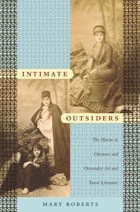
Intimate Outsiders
The Harem in Ottoman and Orientalist Art and Travel LiteratureMary Roberts
Duke University Press, 2007
Roberts draws on a range of sources, including paintings, photographs, and travelogues discovered in archives in Britain, Turkey, Egypt, and Denmark. She rethinks the influential harem works of the realist painter John Frederick Lewis, a British artist living in Cairo during the 1840s, whose works were granted an authoritative status by his British public despite the actual limits of his insider knowledge. Unlike Lewis, British women were able to visit Ottoman harems, and from the mid-nineteenth century on they did so in droves. Writing about their experiences in published travelogues, they undermined the idea that harems were the subject only of male fantasies. The elite Ottoman women who orchestrated these visits often challenged their guests’ misapprehensions about harem life, and a number of them exercised power as patrons, commissioning portraits from European artists. Their roles as art patrons defy the Western idea of the harem woman as passive odalisque.

Intimate Practices
Literacy and Cultural Work in U.S. Women's Clubs, 1880-1920Anne Ruggles Gere
University of Illinois Press, 1997
Winner of the 1995 University of Illinois Press-National Women's Studies
Association manuscript prize
Women's clubs at the turn of the century were numerous, dedicated to
a number of issues, and crossed class, religious, and racial lines. Emphasizing
the intimacy engendered by shared reading and writing in these groups,
Anne Ruggles Gere contends that these literacy practices meant that club
members took an active part in reinventing the nation during a period
of major change. Gere uses archival material that documents club members'
perspectives and activities around such issues as Americanization, womanhood,
peace, consumerism, benevolence, taste, and literature--and offers a rare
depth of insight into the interests and lives of American women from the
fin de siècle through the beginning of the roaring twenties.
Intimate Practices is unique in its exploration of a range of
women's clubs--Mormon, Jewish, white middle-class, African American, and
working class--and paints a vast and colorful multicultural, multifaceted
canvas of these widely-divergent women's groups.

Intimate Radicals
East European Jewish Women and Progressive American DesiresAshley Walters
Rutgers University Press, 2027
In the early 1900s, a handful of unconventional couples emerged within the American radical Left. In Intimate Radicals, Ashley Walters tells the story of a group of young, East European Jewish women and white, Anglo-Saxon Protestant men— such as Jack London, Sinclair Lewis, and William English Walling, among other notable figures in American literature, domestic and international affairs, and early Hollywood—and how they imbued their romances with revolutionary principles. The relationships captivated the public and became a source of intrigue, largely driven by the growth of human-interest journalism. Through individual biographies, historical narrative, and literary analysis, Walters reveals the cultural and political contingencies of desire.
As Progressive Era radicals rebelled against the constraints of an earlier era, East European Jews—and Jewish women in particular— came to embody a new cosmopolitan ideal and European revolutionary spirit. Drawing on letters, newspapers, literature, and film, Walters shows how the public reception of these patrician-immigrant relationships lent credence to a new cultural mythology of Jewish womanhood. The men’s desire for East European Jewish women, she also points out, can be viewed as a form of “radical tourism,” in which men who enjoy a degree of privilege pursue an alluring Other in the hope of obtaining a more worldly identity.
This book is published with the support of the Jordan Schnitzer First Book Publication Award, administered by the Association for Jewish Studies.
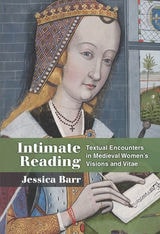
Intimate Reading
Textual Encounters in Medieval Women’s Visions and VitaeJessica Barr
University of Michigan Press, 2020
This new volume is structured around five case studies. Chapters consider the biographies of 13th-century holy women from Liège, the writings of Margery Kempe, Gertrude of Helfta, Mechthild of Magdeburg, Marguerite Porete, and Julian of Norwich. At the heart of Intimate Reading is the question of how reading works—what it means to enter imaginatively and intellectually into the words of another. The volume showcases the complexity of medieval understandings of the work of reading, deepening our perception of the written word’s capacity to signify something that lies even beyond rational comprehension.
Intimate States
Gender, Sexuality, and Governance in Modern US HistoryEdited by Margot Canaday, Nancy F. Cott, and Robert O. Self
University of Chicago Press, 2021
The last few decades have seen a surge of historical scholarship that analyzes state power and expands our understanding of governmental authority and the ways we experience it. At the same time, studies of the history of intimate life—marriage, sexuality, child-rearing, and family—also have blossomed. Yet these two literatures have not been considered together in a sustained way. This book, edited and introduced by three preeminent American historians, aims to close this gap, offering powerful analyses of the relationship between state power and intimate experience in the United States from the Civil War to the present.
The fourteen essays that make up Intimate States argue that “intimate governance”—the binding of private daily experience to the apparatus of the state—should be central to our understanding of modern American history. Our personal experiences have been controlled and arranged by the state in ways we often don’t even see, the authors and editors argue; correspondingly, contemporary government has been profoundly shaped by its approaches and responses to the contours of intimate life, and its power has become so deeply embedded into daily social life that it is largely indistinguishable from society itself. Intimate States makes a persuasive case that the state is always with us, even in our most seemingly private moments.
Intimate Subjects
Touch and Tangibility in Britain's Cerebral AgeSimeon Koole
University of Chicago Press, 2024
When, where, and who gets to touch and be touched, and who decides? What do we learn through touch? How does touch bring us closer together or push us apart? These are urgent contemporary questions, but they have their origins in late nineteenth- and early twentieth-century Britain, when new urban encounters compelled intense discussion of what touch was, and why it mattered. In this vividly written book, Simeon Koole excavates the history of these concerns and reveals how they continue to shape ideas about “touch” in the present.
Intimate Subjects takes us to the bustling railway stations, shady massage parlors, all-night coffee stalls, and other shared spaces where passengers, customers, vagrants, and others came into contact, leading to new understandings of touch. We travel in crammed subway cars, where strangers negotiated the boundaries of personal space. We visit tea shops where waitresses made difficult choices about autonomy and consent. We enter classrooms in which teachers wondered whether blind children could truly grasp the world and labs in which neurologists experimented on themselves and others to unlock the secrets of touch. We tiptoe through London’s ink-black fogs, in which disoriented travelers became newly conscious of their bodies and feared being accosted by criminals. Across myriad forgotten encounters such as these, Koole shows, touch remade what it meant to be embodied—as well as the meanings of disability, personal boundaries, and scientific knowledge.
With imagination and verve, Intimate Subjects offers a new way of theorizing the body and the senses, as well as a new way of thinking about embodiment and vulnerability today.
Intimate Subjects
Touch and Tangibility in Britain's Cerebral AgeSimeon Koole
University of Chicago Press, 2024
This is an auto-narrated audiobook version of this book.
The queer recluse, the shambling farmer, the clannish hill folk—white rural populations have long disturbed the American imagination, alternately revered as moral, healthy, and hardworking, and feared as antisocial or socially uncouth. In Peculiar Places, Ryan Lee Cartwright examines the deep archive of these contrary formations, mapping racialized queer and disability histories of white social nonconformity across the rural twentieth-century United States.
Sensationalized accounts of white rural communities’ aberrant sexualities, racial intermingling, gender transgressions, and anomalous bodies and minds, which proliferated from the turn of the century, created a national view of the perversity of white rural poverty for the American public. Cartwright contends that these accounts, extracted and estranged from their own ambivalent forum of community gossip, must be read in kind: through a racialized, materialist queercrip optic of the deeply familiar and mundane. Taking in popular science, documentary photography, news media, documentaries, and horror films, Peculiar Places orients itself at the intersections of disability studies, queer studies, and gender studies to illuminate a racialized landscape both profoundly ordinary and familiar.

Intimate
An American Family Photo AlbumPaisley Rekdal
Tupelo Press, 2012
Intimations
The Cinema of Wojciech HasAnnette Insdorf
Northwestern University Press, 2017
Wojciech Has’s films are still less known outside of his native Poland than those of his countrymen Andrzej Wajda, Krzysztof Zanussi, and Krzysztof Kieslowski. Yet thanks to his singular vision, many critics rank Has among the masters of world cinema. Some of his movies have developed a cult following, notably The Saragossa Manuscript, the favorite film of the Grateful Dead’s Jerry Garcia, which has been praised by directors such as Luis Buñuel, Francis Ford Coppola, and Roman Polanski.
Has’s films reveal the inner lives of his characters, which he portrays by giving free rein to his own wildly creative imagination. In addition toThe Saragossa Manuscript, his diverse and innovative filmography includes The Hourglass Sanatorium, a vividly surreal depiction of Hassidic life in Poland between the world wars; The Noose, a stark poetic drama about a lucid alcoholic who knows he will not be able to kick the habit; and How to Be Loved, in which an actress remembers her wartime past.
Has made disparate but formally striking movies infused with European strains of existentialism and the avant-garde. With many of his films being restored and rereleased, new generations of film lovers are discovering his artistic genius. Intimations: The Cinema of Wojciech Has is the definitive guide in English to his work.
Into Africa
A Transnational History of Catholic Medical Missions and Social ChangeWall, Barbra Mann
Rutgers University Press, 2015
Awarded first place in the 2016 American Journal of Nursing Book of the Year Award in the History and Public Policy category
The most dramatic growth of Christianity in the late twentieth century has occurred in Africa, where Catholic missions have played major roles. But these missions did more than simply convert Africans. Catholic sisters became heavily involved in the Church’s health services and eventually in relief and social justice efforts. In Into Africa, Barbra Mann Wall offers a transnational history that reveals how Catholic medical and nursing sisters established relationships between local and international groups, sparking an exchange of ideas that crossed national, religious, gender, and political boundaries.
Both a nurse and a historian, Wall explores this intersection of religion, medicine, gender, race, and politics in sub-Saharan Africa, focusing on the years following World War II, a period when European colonial rule was ending and Africans were building new governments, health care institutions, and education systems. She focuses specifically on hospitals, clinics, and schools of nursing in Ghana and Uganda run by the Medical Mission Sisters of Philadelphia; in Nigeria and Uganda by the Irish Medical Missionaries of Mary; in Tanzania by the Maryknoll Sisters of New York; and in Nigeria by a local Nigerian congregation. Wall shows how, although initially somewhat ethnocentric, the sisters gradually developed a deeper understanding of the diverse populations they served. In the process, their medical and nursing work intersected with critical social, political, and cultural debates that continue in Africa today: debates about the role of women in their local societies, the relationship of women to the nursing and medical professions and to the Catholic Church, the obligations countries have to provide care for their citizens, and the role of women in human rights.
A groundbreaking contribution to the study of globalization and medicine, Into Africa highlights the importance of transnational partnerships, using the stories of these nuns to enhance the understanding of medical mission work and global change.
Into God, student edition
Itinerarium Mentis in Deum of Saint BonaventureRegis J. Armstrong
Catholic University of America Press, 0
Into New Territory
American Historians and the Concept of US ImperialismJames G. Morgan
University of Wisconsin Press, 2014
Tracing the emergence of the concept of US imperialism, James G. Morgan shows how radical and revisionist scholars in the 1950s and 1960s first challenged the paradigm of denying an American empire. As the Vietnam War created a critical flashpoint, bringing the idea of American imperialism into the US mainstream, radical students of the New Left turned toward Marxist critiques, admiring revolutionaries like Che Guevara. Simultaneously, a small school of revisionist scholars, led by historian William Appleman Williams at the University of Wisconsin, put forward a progressive, nuanced critique of American empire grounded in psychology, economics, and broader historical context. It is this more sophisticated strand of thinking, Morgan argues, which demonstrated that empire can be an effective analytical framework for studying US foreign policy, thus convincing American scholars to engage with the subject seriously for the first time.
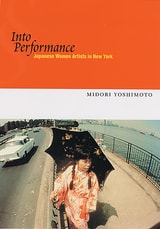
Into Performance
Japanese Women Artists in New YorkYoshimoto, Midori
Rutgers University Press, 2005
The 1960s was a time of incredible freedom and exploration in the art world, particularly in New York City, which witnessed the explosion of New Music, Happenings, Fluxus, New Dance, pop art, and minimalist art. Also notable during this period, although often overlooked, is the inordinate amount of revolutionary art that was created by women.
Into Performance fills a critical gap in both American and Japanese art history as it brings to light the historical significance of five women artists-Yoko Ono, Yayoi Kusama, Takako Saito, Mieko Shiomi, and Shigeko Kubota. Unusually courageous and self-determined, they were among the first Japanese women to leave their country-and its male-dominated, conservative art world-to explore the artistic possibilities in New York. They not only benefited from the New York art scene, however, they played a major role in the development of international performance and intermedia art by bridging avant garde movements in Tokyo and New York.
This book traces the pioneering work of these five women artists and the socio-cultural issues that shaped their careers. Into Performance also explores the transformation of these artists' lifestyle from traditionally confined Japanese women to internationally active artists. Yoshimoto demonstrates how their work paved the way for younger Japanese women artists who continue to seek opportunities in the West today.
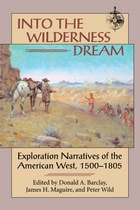
Into The Wilderness Dream
Donald A Barclay
University of Utah Press, 1994
Not just an exploration of our early Western European roots, these rich chronicles read as literature, first-person narratives of the greatest exploration adventures in historic times.
From the Platonic vision of Atlantis to Arthur’s Avalon, pre-Columbus Europeans imagined fabulous lands to the west—and after 1492, initial reports of a new world filled with golden El Dorados, warrior queens, and Fountains of Youth merely provided confirmation.
Although these dreams were soon tempered by reality, explorers continued to set off with expectation that shaped what they say, how they saw, and how they reacted. This complex of attitudes continues to affect the way we view our world, and these accounts provide an excellent source for insight into the metaphorical systems that have permeated European and American writing about the West since the Sixteenth century.
Into the Wilderness Dreams draws from the best of three dozen accounts by the Spanish, French, English, and American explorers who came before Lewis and Clark, and explores the roots of present Western Euro-American culture.
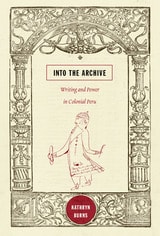
Into the Archive
Writing and Power in Colonial PeruKathryn Burns
Duke University Press, 2010
Kathryn Burns argues that the archive itself must be historicized. Using the case of colonial Cuzco, she examines the practices that shaped document-making. Notaries were businessmen, selling clients a product that conformed to local “custom” as well as Spanish templates. Clients, for their part, were knowledgeable consumers, with strategies of their own for getting what they wanted. In this inside story of the early modern archive, Burns offers a wealth of possibilities for seeing sources in fresh perspective.

Into the Fire
Ploesti, the Most Fateful Mission of World War IIDuane Schultz
Westholme Publishing, 2007
A detailed and vivid account of the World War II disaster."—Booklist
"Into the Fire shimmers with historical parallels and modern resonances. . . . Schultz combed an impressive body of material for this account." —Washington Times
"This bittersweet tale of arrogance, wishful thinking, sacrifice, and heroism is recounted with grace and empathy." —Military.com
"Schultz combines a historian's meticulous research and a novelist's hypnotic prose to produce this memorable popular history... Shultz's intimate account of this controversial episode is a timely reminder of the horrors of war and a moving tribute to Ploestl's heroes." —Publishers Weekly
"We knew it was a disaster and knew that in the flames shooting up from those refineries we might be burned to death. But we went right in." —Lt. Norman Whalen
"We were dragged through the mouth of hell."—from a Ploesti Mission debriefing report
Planned by Winston Churchill, authorized by Dwight D. Eisenhower, and executed by five specially trained American bomber units, the attack on the oil refineries of Ploesti, Romania, was among the most daring and dangerous missions of World War II. If the raid succeeded, the Nazi war machine would suffer a devastating blow. On August 1, 1943, nearly two hundred B-24 bombers flew from Benghazi, North Africa, with directions to descend on Ploesti at treetop level, bomb the refineries, and return. The low-level bombers could evade enemy radar and were thought to be more difficult to shoot down. But despite warnings that a German heavy flak train had been moved into the area and that the secrecy of their mission had been compromised, the bombers were sent out. Minutes from the target, one of the commanders made a wrong turn, leading the formations away from Ploesti. Recovering from this mistake, most of the bombers relocated the refineries, but the mission was doomed. The ensuing air-ground battle claimed dozens of the bombers, and many of those that survived the ordeal were forced to ditch in the ocean or in remote areas due to lack of fuel or structural damage.
In Into the Fire: Ploesti, The Most Fateful Mission of World War II, Duane Schultz re-creates this great battle, combining original research and interviews with survivors in order to capture the tension, drama, and heroics of the warring sides. More Medals of Honor were awarded for this mission than any other aerial combat enterprise in the history of the United States. But the medals are bittersweet testimony to the courage of the 1,726 young men who risked all on a fateful attempt to cut off the Nazi supply of "black gold.
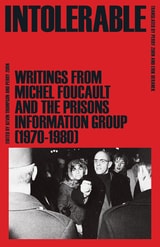
Intolerable
Writings from Michel Foucault and the Prisons Information Group (1970–1980)Michel Foucault
University of Minnesota Press, 2020
A groundbreaking collection of writings by Michel Foucault and the Prisons Information Group documenting their efforts to expose France’s inhumane treatment of prisoners
Founded by Michel Foucault and others in 1970–71, the Prisons Information Group (GIP) circulated information about the inhumane conditions within the French prison system. Intolerable makes available for the first time in English a fully annotated compilation of materials produced by the GIP during its brief but influential existence, including an exclusive new interview with GIP member Hélène Cixous and writings by Gilles Deleuze and Jean Genet.
These archival documents—public announcements, manifestos, reports, pamphlets, interventions, press conference statements, interviews, and round table discussions—trace the GIP’s establishment in post-1968 political turmoil, the new models of social activism it pioneered, the prison revolts it supported across France, and the retrospective assessments that followed its denouement. At the same time, Intolerable offers a rich, concrete exploration of Foucault’s concept of resistance, providing a new understanding of the arc of his intellectual development and the genesis of his most influential book, Discipline and Punish.
Presenting the account of France’s most vibrant prison resistance movement in its own words and on its own terms, this significant and relevant collection also connects the approach and activities of the GIP to radical prison resistance movements today.
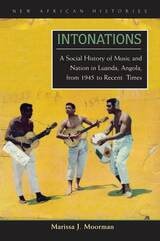
Intonations
A Social History of Music and Nation in Luanda, Angola, from 1945 to Recent TimesMarissa J. Moorman
Ohio University Press, 2008
Intonations tells the story of how Angola’s urban residents in the late colonial period (roughly 1945–74) used music to talk back to their colonial oppressors and, more importantly, to define what it meant to be Angolan and what they hoped to gain from independence. A compilation of Angolan music is included in CD format.
Marissa J. Moorman presents a social and cultural history of the relationship between Angolan culture and politics. She argues that it was in and through popular urban music, produced mainly in the musseques (urban shantytowns) of the capital city, Luanda, that Angolans forged the nation and developed expectations about nationalism. Through careful archival work and extensive interviews with musicians and those who attended performances in bars, community centers, and cinemas, Moorman explores the ways in which the urban poor imagined the nation.
The spread of radio technology and the establishment of a recording industry in the early 1970s reterritorialized an urban-produced sound and cultural ethos by transporting music throughout the country. When the formerly exiled independent movements returned to Angola in 1975, they found a population receptive to their nationalist message but with different expectations about the promises of independence. In producing and consuming music, Angolans formed a new image of independence and nationalist politics.
Intoxicated Ways of Knowing
The Untold Story of Intoxicants and the Biological Subject in Nineteenth-Century GermanyMatthew Perkins-McVey
University of Chicago Press, 2026
Intoxicating substances can be found lurking in every corner of modern life, and Matthew Perkins-McVey’s pathbreaking book offers the untold story of how they were implicated in shifting perceptions of embodiment found in the emerging sciences of the body and mind in late-nineteenth-century Germany. Their use in this experimental context gave rise to a dynamic conception of the subject within the scientific, psychological, philosophical, and sociological milieu of the era. The history of the modern biological subject, Perkins-McVey argues, turns on “intoxicated ways of knowing.”
Intoxicated Ways of Knowing identifies the state of intoxication as a tacit form of thinking and knowing with the body. Intoxicants force us to feel, intervening directly in our perceptional awareness, and, Perkins-McVey contends, they bring latent conceptual associations into the foreground of conscious thought, engendering new ways of knowing the world. The book unfurls how intoxicants affected nineteenth-century German science and how, ultimately, the connection between mental life and intoxication is taken up in the works of Friedrich Nietzsche, Max Weber, and Sigmund Freud, bringing the biological subject out of the lab and into the worlds of philosophy, psychoanalysis, sociology, and politics.
Intrasite Spatial Analysis of Mobile and Semisedentary Peoples
Analytical Approaches to Reconstructing Occupation HistoryEdited by Amy E. Clark and Joseph A. M. Gingerich
University of Utah Press, 2022
This volume includes studies that span archaeological and ethnographic contexts, from highly mobile Paleoindian foragers to semi-sedentary preagriculturalists of the Epipaleolithic and modern pastoralists in Mongolia. The authors hold that commonalities in human behavior lead to similar patterns in the organization and maintenance of space by people. They present a series of ideas and approaches to make it easier to recognize universals in human behaviors, which allow archaeologists to better compare intrasite spatial patterns. The book creates a baseline for new intrasite spatial analyses in the twenty-first century.
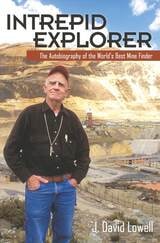
Intrepid Explorer
The Autobiography of the World's Best Mine FinderJ. David Lowell
University of Arizona Press, 2014
An Arizona native with family roots in territorial times, Lowell grew from modest beginnings on a ranch near Nogales to become a major world figure in the fields of minerals, mining, and economic geology. He has personally discovered more copper than anyone in history and has developed multibillion-dollar gold and copper mines that have changed the economies of nations. And although he has consulted for corporations in the field of mining, he has largely operated as an independent agent and explorer, the architect of his own path and success.
His life’s story unfolds in four stages: his early education in his field, on-the-job learning at sites in the United States and Mexico, development of exploration strategies, and finally, the launch of his own enterprises and companies. Recurring themes in Lowell’s life include the strict personal, ethical, and tactical policies he requires of his colleagues; his devotion to his family; and his distaste for being away from the field in a corporate office, even to this day. The magnitude of Lowell’s overall success is evident in his list of mine discoveries, as well as in his scientific achievements and the enormous respect his friends and colleagues have had for him throughout his lengthy career, which he continues to zealously pursue.
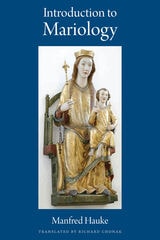
Introducation to Mariology
Manfred Hauke
Catholic University of America Press, 2020
Introducing Don DeLillo
Frank Lentricchia
Duke University Press, 1991
Diversity is the key to this striking assemblage of cultural criticism edited by Frank Lentricchia. Special features include an expanded version of the Rolling Stone interview with the author (“An Outsider in this Society”) and the extraordinary tenth chapter of DeLillo’s Ratner’s Star. Accessibly written and entertaining, the collection will be of great interest to both students and scholars of contemporary American literature as well as to general readers interested in DeLillo’s work.
Contributors. Frank Lentricchia, Anthony Decurtis, Daniel Aaron, Hal Crowther, John A. McClure, Eugene Goodheart, Charles Molesworth, Dennis A. Foster, and John Frow
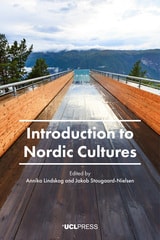
Introduction to Nordic Cultures
Edited by Annika Lindskog and Jakob Stougaard-Nielsen
University College London, 2020
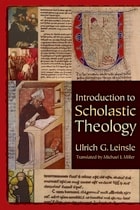
Introduction to Scholastic Theology
Ulrich G. Leinsle
Catholic University of America Press, 2010
Introduction to the History of Indian Buddhism
Eugène Burnouf
University of Chicago Press, 2010
The most influential work on Buddhism to be published in the nineteenth century, Introduction à l’histoire du Buddhisme indien, by the great French scholar of Sanskrit Eugène Burnouf, set the course for the academic study of Buddhism—and Indian Buddhism in particular—for the next hundred years. First published in 1844, the masterwork was read by some of the most important thinkers of the time, including Schopenhauer and Nietzsche in Germany and Emerson and Thoreau in America.
Katia Buffetrille and Donald S. Lopez Jr.’s expert English translation, Introduction to the History of Indian Buddhism, provides a clear view of how the religion was understood in the early decades of the nineteenth century. Burnouf was an impeccable scholar, and his vision, especially of the Buddha, continues to profoundly shape our modern understanding of Buddhism. In reintroducing Burnouf to a new generation of Buddhologists, Buffetrille and Lopez have revived a seminal text in the history of Orientalism.
Invalidism and Identity in Nineteenth-Century Britain
Maria H. Frawley
University of Chicago Press, 2004
Using an array of primary sources, Maria Frawley here constructs a cultural history of invalidism. She describes the ways that Evangelicalism, industrialization, and changing patterns of doctor/patient relationships all converged to allow a culture of invalidism to flourish, and explores what it meant for a person to be designated—or to deem oneself—an invalid. Highlighting how different types of invalids developed distinct rhetorical strategies, her absorbing account reveals that, contrary to popular belief, many of the period's most prominent and prolific invalids were men, while many women found invalidism an unexpected opportunity for authority.
In uncovering the wide range of cultural and social responses to notions of incapacity, Frawley sheds light on our own historical moment, similarly fraught with equally complicated attitudes toward mental and physical disorder.