Results by title
4531 books match the query 'Cultural & Ethnic Studies' and 165 start with i
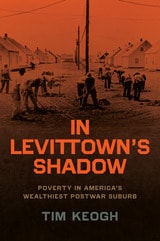
In Levittown’s Shadow
Poverty in America’s Wealthiest Postwar SuburbTim Keogh
University of Chicago Press, 2023
There is a familiar narrative about American suburbs: after 1945, white residents left cities for leafy, affluent subdivisions and the prosperity they seemed to embody. In Levittown’s Shadow tells us there’s more to this story, offering an eye-opening account of diverse, poor residents living and working in those same neighborhoods. Tim Keogh shows how public policies produced both suburban plenty and deprivation—and why ignoring suburban poverty doomed efforts to reduce inequality.
Keogh focuses on the suburbs of Long Island, home to Levittown, often considered the archetypal suburb. Here military contracts subsidized well-paid employment welding airplanes or filing paperwork, while weak labor laws impoverished suburbanites who mowed lawns, built houses, scrubbed kitchen floors, and stocked supermarket shelves. Federal mortgage programs helped some families buy orderly single-family homes and enter the middle class but also underwrote landlord efforts to cram poor families into suburban attics, basements, and sheds. Keogh explores how policymakers ignored suburban inequality, addressing housing segregation between cities and suburbs rather than suburbanites’ demands for decent jobs, housing, and schools.
By turning our attention to the suburban poor, Keogh reveals poverty wasn’t just an urban problem but a suburban one, too. In Levittown’s Shadow deepens our understanding of suburbia’s history—and points us toward more effective ways to combat poverty today.
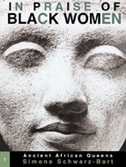
In Praise of Black Women, Volume 1
Ancient African QueensSimone Schwarz-Bart with Andre Schwarz-Bart
University of Wisconsin Press, 2001
Volume 1: Ancient African Queens weaves together oral tradition, folk legends and stories, songs and poems, historical accounts, and travelers’ tales from Egypt to southern Africa, from prehistory to the nineteenth century. These women rulers, warriors, and heroines include Amanirenas, the queen of Kush who battled Roman armies and defeated them at Aswan; Daurama, mother of the seven Hausa kingdoms; Amina Kulibali, founder of the Gabu dynasty in Senegal; Ana de Sousa Nzinga, who resisted the Portuguese conquest of Angola; Beatrice Kimpa Vita, a Kongo prophet burned at the stake by Christian missionaries; Nanda, mother of the famous warrior-king Shaka Zulu; and many others.
These extraordinary women's stories, narrated in the style of African oral tradition, are absorbing, informative, and accessible. The abundant illustrations, many of them rare archival images, depict the diversity among Black women and make this volume a unique treasure for every art lover, every school, and every family.
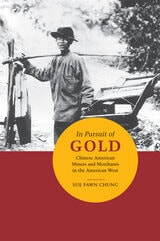
In Pursuit of Gold
Chinese American Miners and Merchants in the American WestSue Fawn Chung
University of Illinois Press, 2011
Both a history of an overlooked community and a well-rounded reassessment of prevailing assumptions about Chinese miners in the American West, In Pursuit of Gold brings to life in rich detail the world of turn-of-the-century mining towns in the Northwest. Sue Fawn Chung meticulously recreates the lives of Chinese immigrants, miners, merchants, and others who populated these towns and interacted amicably with their white and Native American neighbors, defying the common perception of nineteenth-century Chinese communities as insular enclaves subject to increasing prejudice and violence.
While most research has focused on Chinese miners in California, this book is the first extensive study of Chinese experiences in the towns of John Day in Oregon and Tuscarora, Island Mountain, and Gold Creek in Nevada. Chung illustrates the relationships between miners and merchants within the communities and in the larger context of immigration, arguing that the leaders of the Chinese and non-Chinese communities worked together to create economic interdependence and to short-circuit many of the hostilities and tensions that plagued other mining towns.
Peppered with fascinating details about these communities from the intricacies of Chinese gambling games to the techniques of hydraulic mining, In Pursuit of Gold draws on a wealth of historical materials, including immigration records, census manuscripts, legal documents, newspapers, memoirs, and manuscript collections. Chung supplements this historical research with invaluable first-hand observations of artifacts that she experienced in archaeological digs and restoration efforts at several of the sites of the former booming mining towns.
In clear, analytical prose, Chung expertly characterizes the movement of Chinese miners into Oregon and Nevada, the heyday of their mining efforts in the region, and the decline of the communities due to changes in the mining industry. Highlighting the positive experiences and friendships many of the immigrants had in these relatively isolated mining communities, In Pursuit of Gold also suggests comparisons with the Chinese diaspora in other locations such as British Columbia and South Africa.
In Reunion
Transnational Korean Adoptees and the Communication of FamilyDocan-Morgan, Sara
Temple University Press, 2024
The paradoxes of adoption and reunion—shared history without blood relations, and blood relations without shared history—generate questions: What does it mean to be “family”? How do people use communication to constitute family relationships? How are family relationships created, maintained, and negotiated over time? In Reunion details adoptive and cultural identities, highlighting how adoptees often end up shouldering communicative responsibility in their family relationships. Interviews reveal how adoptees navigate birth family relationships across language and culture while also attempting to maintain relationships with their adoptive family members.
Docan-Morgan details the challenges, rewards, and contradictions of reunion. She also offers practical recommendations for transnational adoptees in reunion, adoptees considering reunion, adoptive families, and adoption practitioners.
In tracing the stories of the intercultural dynamics inherent in adoptees’ reunions, Docan-Morgan demonstrates the effort, flexibility, empathy, self-reflection, and time required to navigate long-term relationships with birth families.
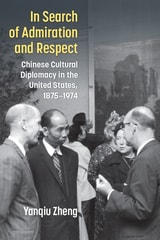
In Search of Admiration and Respect
Chinese Cultural Diplomacy in the United States, 1875–1974Yanqui Zheng
University of Michigan Press, 2024
In Search of Admiration and Respect uses the Chinese case to underscore what Zheng calls “infrastructure of persuasion,” in which American philanthropy, museums, exhibitions, and show business had disproportionate power in setting the agenda of unequal intercultural encounters. This volume also provides historical insights into China’s ongoing quest for international recognition. Drawing upon diverse archival sources, Zheng expands the contours of cultural diplomacy beyond established powers and sheds light on the limited agency of peripheral nations in their self-representation.
In Search of Belonging
Latinas, Media, and CitizenshipJillian M Baez
University of Illinois Press, 2018
Innovative and informed by a wealth of new evidence, In Search of Belonging answers important questions about the ways Latinas perform citizenship in today’s America.
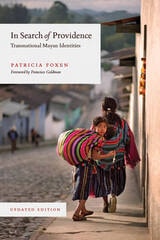
In Search of Providence
Transnational Mayan Identities, Updated EditionPatricia Foxen
Vanderbilt University Press, 2020
In the mid-1990s, Patricia Foxen traveled back and forth between the Guatemalan highlands and Providence, Rhode Island, to understand the migration paths of K'iche' Mayan Indians who had fled the Guatemalan civil war to work in the factories and fisheries of New England. More than two decades later, many Mayans are still migrating to the US. As Foxen argues, the recent surge in Mayan border crossings must be contextualized within both the longer history of violence, marginality, and exclusion that has long led Guatemala's Indigenous populations to be "survivors on the move," as well as contemporary push factors such as climate change and growing inequality that have forced people from their communities.
And yet one of the most significant drivers of continued emigration today, ironically, is the very culture of migration (described in the book) that has accelerated social change within many Indigenous communities, setting in motion a complex series of economic and cultural shifts that have compelled a continuous movement of people and generations to the US. Reading this story in 2020—at a time of massive growth in flows of irregular migrations around the world—can help us better understand the highly complex set of factors that propel long-term migrations and that shape transnational communities on both sides of the border.
In Search of Providence offers a layered, historically grounded perspective that speaks to the local specificity behind the migration experience in order to point to the universal themes and contradictions of contemporary global displacements.
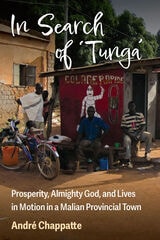
In Search of Tunga
Prosperity, Almighty God, and Lives in Motion in a Malian Provincial TownAndré Chappatte
University of Michigan Press, 2022
In the context of the current global war on terrorism, most studies of Muslim life have focused on the politics of piety of reformist movements, their leaders, and members. By contrast, In Search of “Tunga” takes a perspective from below. It opens piety up to “simply Muslims,” although the religious elites have always claimed authority and legitimacy over piety. Is piety an exclusive field of experiences for those who claim to strive for it? What does piety involve for the majority of Muslims, the non-elite and unaffiliated Muslims? This volume “democratizes” piety by documenting its practice as going beyond sharply defined religious affiliations and Islamic scholarship, and by showing it is both alive and normative, existential and prescriptive. As opposed to studies that build on the classic historical connections between the Maghreb and the Sahel, the southbound migration from the Sahel documented in this book stresses the overlooked historical connections between the southern shores of the Sahara and the lands south of those shores. It demonstrates how the Malian savanna, this former buffer-zone between ancient Mande kingdoms and thereafter remote areas of French Sudan, is increasingly becoming central in today’s Sahel contexts of desiccation and insecurity.
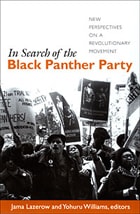
In Search of the Black Panther Party
New Perspectives on a Revolutionary MovementJama Lazerow and Yohuru Williams, eds.
Duke University Press, 2006
One contributor evaluates the legal basis of the Panthers’ revolutionary struggle, explaining how they utilized and critiqued the language of the Constitution. Others explore the roles of individuals, looking at a one-time Panther imprisoned for a murder he did not commit and an FBI agent who monitored the activities of the Panthers’ Oakland branch. Contributors assess the Panthers’ relations with Students for a Democratic Society, the Young Lords, the Brown Berets, and the Peace and Freedom Party. They discuss the Party’s use of revolutionary aesthetics, and they show how the Panthers manipulated and were manipulated by the media. Illuminating some of the complexities involved in placing the Panthers in historical context, this collection demonstrates that the scholarly search for the Black Panthers has only just begun.
Contributors. Bridgette Baldwin, Davarian L. Baldwin, David Barber, Rod Bush, James T. Campbell, Tim Lake, Jama Lazerow, Edward P. Morgan, Jeffrey O. G. Ogbar, Roz Payne, Robert O. Self, Yohuru Williams, Joel Wilson
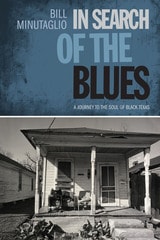
In Search of the Blues
A Journey to the Soul of Black TexasBy Bill Minutaglio
University of Texas Press, 2010
The rich, complex lives of African Americans in Texas were often neglected by the mainstream media, which historically seldom ventured into Houston's Fourth Ward, San Antonio's East Side, South Dallas, or the black neighborhoods in smaller cities. When Bill Minutaglio began writing for Texas newspapers in the 1970s, few large publications had more than a token number of African American journalists, and they barely acknowledged the things of lasting importance to the African American community. Though hardly the most likely reporter—as a white, Italian American transplant from New York City—for the black Texas beat, Minutaglio was drawn to the African American heritage, seeking its soul in churches, on front porches, at juke joints, and anywhere else that people would allow him into their lives. His nationally award-winning writing offered many Americans their first deeper understanding of Texas's singular, complicated African American history.
This eclectic collection gathers the best of Minutaglio's writing about the soul of black Texas. He profiles individuals both unknown and famous, including blues legends Lightnin' Hopkins, Amos Milburn, Robert Shaw, and Dr. Hepcat. He looks at neglected, even intentionally hidden, communities. And he wades into the musical undercurrent that touches on African Americans' joys, longings, and frustrations, and the passing of generations. Minutaglio's stories offer an understanding of the sweeping evolution of music, race, and justice in Texas. Moved forward by the musical heartbeat of the blues and defined by the long shadow of racism, the stories measure how far Texas has come . . . or still has to go.
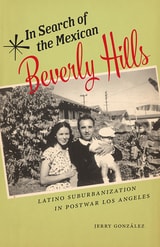
In Search of the Mexican Beverly Hills
Latino Suburbanization in Postwar Los AngelesGonzález, Jerry
Rutgers University Press, 2018
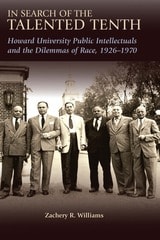
In Search of the Talented Tenth
Howard University Public Intellectuals and the Dilemmas of Race, 1926-1970Zachery R. Williams
University of Missouri Press, 2009
In Search of the Talented Tenth tells how individuals like Rayford Logan, E. Franklin Frazier, John Hope Franklin, Merze Tate, Charles Wesley, and Dorothy Porter left an indelible imprint on academia and black communities alike through their impact on civil rights, anticolonialism, and women’s rights. Zachery Williams explores W. E. B. Du Bois’s Talented Tenth by describing the role of public intellectuals from the Harlem Renaissance to the Black Power movement, in times as trying as the Jim Crow and Cold War eras.
Williams first describes how the years 1890 to 1926 laid the foundation for Howard’s emergence as the “capstone of Negro education” during the administration of university president Mordecai Johnson. He offers a wide-ranging discussion of how the African American community of Washington, D.C., contributed to the dynamism and intellectual life of the university, and he delineates the ties that linked many faculty members to one another in ways that energized their intellectual growth and productivity as scholars. He also discusses the interaction of Howard’s intellectual community with those of the West Indies, Africa, and other places, showing the international impact of Howard’s intellectuals and the ways in which black and brown elites outside the United States stimulated the thought and scholarship of the Howard intellectuals.
In Search of the Talented Tenth marks the first in-depth study of the intellectual activity of this community of scholars and further attests to the historic role of women faculty in shaping the university. It testifies to the impact of this group as a model against which the twenty-first century’s black public intellectuals can be measured.

In Senghor's Shadow
Art, Politics, and the Avant-Garde in Senegal, 1960–1995Elizabeth Harney
Duke University Press, 2004
Heavily illustrated with nearly one hundred images, including some in color, In Senghor’s Shadow surveys the work of a range of Senegalese artists, including painters, muralists, sculptors, and performance-based groups—from those who worked at the height of Senghor’s patronage system to those who graduated from art school in the early 1990s. Harney reveals how, in the 1970s, avant-gardists contested Negritude beliefs by breaking out of established artistic forms. During the 1980s and 1990s, artists such as Moustapha Dimé, Germaine Anta Gaye, and Kan-Si engaged with avant-garde methods and local artistic forms to challenge both Senghor’s legacy and the broader art world’s understandings of cultural syncretism. Ultimately, Harney’s work illuminates the production and reception of modern Senegalese art within the global arena.

In Sullivan's Shadow
The Use and Abuse of Libel Law during the Long Civil Rights StruggleAimee Edmondson
University of Massachusetts Press, 2019
Drawing on archival research and scholarship in journalism, legal history, and African American studies, Edmondson offers a new narrative of brave activists, bold journalists and publishers, and hardheaded southern officials. These little-known courtroom dramas at the intersection of race, libel, and journalism go beyond the activism of the 1960s and span much of the country's history, beginning with lawsuits filed against abolitionist William Lloyd Garrison and concluding with a suit spawned by the 1988 film Mississippi Burning.
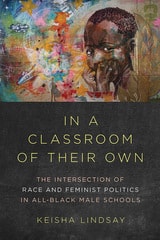
In a Classroom of Their Own
The Intersection of Race and Feminist Politics in All-Black Male SchoolsKeisha Lindsay
University of Illinois Press, 2018
Keisha Lindsay explains the complex politics of ABMSs by situating these schools within broader efforts at neoliberal education reform and within specific conversations about both "endangered” black males and a “boy crisis” in education. Lindsay also demonstrates that intersectionality, long considered feminist, is in fact a politically fluid framework. As such, it represents a potent tool for advancing many political agendas, including those of ABMSs supporters who champion antiracist education for black boys while obscuring black girls’ own race and gender-based oppression in school. Finally, Lindsay theorizes a particular means by which black men and other groups can form antiracist and feminist coalitions even when they make claims about their experiences that threaten bridge building. The way forward, Lindsay shows, allows disadvantaged groups to navigate the racial and gendered politics that divide them in pursuit of productive—and progressive—solutions.
Far-thinking and boldly argued, In a Classroom of Their Own explores the dilemmas faced by professionals and parents in search of equitable schooling for all students—black boys and otherwise.

In a Hundred Graves
A Basque PortraitRobert Laxalt
University of Nevada Press, 2016
The Basques of Europe are legendary for the curtain of privacy they have always drawn around their world, shielding it from visitors from the outside. As a result, accounts of the inner workings of Basque village life are almost nonexistent. In this unique book, author Robert Laxalt has managed to penetrate the deep reserve of Basque village folk. Shepherds, troubadours, merchants, and smugglers, caught up in the panorama of daily life, parade before the reader. They are portrayed against a backdrop of green rugged mountains and stone buildings, typical of the Basque provinces in France and Spain. Laxalt, an American born of Basque parents, unveils the Basque character with warmth, wry humor, and above all, honesty.
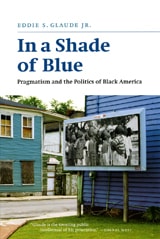
In a Shade of Blue
Pragmatism and the Politics of Black AmericaEddie S. Glaude Jr.
University of Chicago Press, 2007
“Eddie Glaude is poised to become the leading intellectual voice of our generation, raising questions that make us reexamine the assumptions we hold by expanding our inventory of ideas.”—Tavis Smiley

In the Balance of Power
Independent Black Politics and Third-Party Movements in the United StatesOmar H. Ali
Ohio University Press, 2008
Historically, most black voters in the United States have aligned themselves with one of the two major parties: the Republican Party from the time of the Civil War to the New Deal and, since the New Deal—and especially since the height of the modern civil rights movement—the Democratic Party. However, as In the Balance of Power convincingly demonstrates, African Americans have long been part of independent political movements and have used third parties to advance some of the most important changes in the United States, notably the abolition of slavery, the extension of voting rights, and the enforcement of civil rights.
Since the early nineteenth century, there has been an undercurrent of political independence among African Americans. They helped develop the Liberty Party in the 1840s and have continued to work with third parties to challenge the policies of the two major parties. But despite the legal gains of the modern civil rights movement, elements of Jim Crow remain deeply embedded in our electoral process.
In the Balance of Power presents a history and analysis of African American third-party movements that can help us better understand the growing diversity among black voters today.
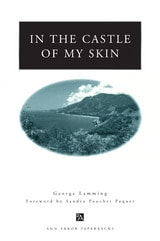
In the Castle of My Skin
George Lamming
University of Michigan Press, 1992
Nearly forty years after its initial publication, George Lamming's In the Castle of My Skin is considered a classic narrative of the Black colonial experience. This poetic autobiographical novel juxtaposes the undeveloped, unencumbered life of a small Caribbean island with the materialism and anxiety of the twentieth century.
Written when Lamming was twenty-three and residing in England, In the Castle of My Skin poignantly chronicles the author's life from his ninth to his nineteenth year. Through the eyes of a young boy the experiences of colonial education, class tensions, and natural disaster are interpreted and reinterpreted, mediated through the presence of the old villagers and friends who leave for the mainland.
One of the leading Black writers of the twentieth century, George Lamming is the author of numerous works exploring the colonial experience.

In the Company of Grace
A Veterinarian's Memoir of Trauma and HealingJody Lulich
University of Minnesota Press, 2023
The son of a Black mother and white father overcomes family trauma to find the courage of compassion in veterinary practice
Rising to accept a prestigious award, Jody Lulich wondered what to say. Explain how he’d been attracted to veterinary medicine? Describe how caring for helpless, voiceless animals in his own shame and pain provided a lifeline, a chance to heal himself as well? Lulich tells his story in In the Company of Grace, a memoir about finding courage in compassion and strength in healing—and power in finally confronting the darkness of his youth.
Lulich’s white father and Black mother met at a civil rights rally, but love was no defense against their personal demons. His mother’s suicide, in his presence when he was nine years old, and his sometimes brutal father’s subsequent withdrawal set Lulich on a course from the South Side of Chicago to the Tuskegee School of Veterinary Medicine in Alabama to an endowed chair at the University of Minnesota, forever searching for the approval and affection that success could not deliver. Though shadowed by troubling secrets, his memoir also features scenes of surprising light and promise—of the neighbors who take him in, a brother’s unlikely effort to save Christmas, his mother’s memories of the family’s charmed early days, bright moments (and many curious details) of veterinary practice. Most consequentially, at Tuskegee Lulich rents a room in the home of a seventy-five-year-old Black woman named Grace, whose wholehearted adoption of him—and her own stories of the Jim Crow era—finally gives him a sense of belonging and possibility.
Completing his book amid the furor over George Floyd’s murder, Lulich reflects on all the ways that race has shaped his life. In the Company of Grace is a moving testament to the power of compassion in the face of seemingly overwhelming circumstances.

In the Forest of Metropoles
Karl-Markus Gauß
Seagull Books, 2024
A Herodotus of Mitteleuropa, cultural historian Karl-Markus Gauß is essential reading for anyone trying to understand the breadth and complexities of cultures and societies in Europe before, during, and after its decades of division in the twentieth century.
In this book, Gauß takes his readers on a thirteen-station journey across Europe. From Brussels to Istanbul and from Naples to Opole, Gauß weaves a Sebaldian web of connection and coincidence into a hybrid cultural history. Significantly, Gauß’s metropoles are not the well-trodden, thoroughly explored, and minutely documented megalopolises and cultural capitals that have been mythologized by writers great and small. There are no visits to Berlin, Paris, Rome, or Madrid, although he does make time for Vienna, where he looks not for imperial remnants, but for traces of genius unrecognized by most. Gauß’s lodestars are small but cosmopolitan towns on the periphery, such as Slaghenaufi, Vacaresti, Fontevraud, Dragatus, Vrzdenec, and Sélestat. In these far-flung towns, Gauß assembles a canon of overlooked humanists, expelled or extinguished by political and historical forces that swept the continent.
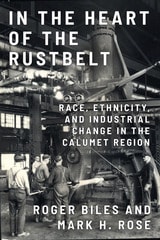
In the Heart of the Rustbelt
Race, Ethnicity, and Industrial Change in the Calumet RegionRoger Biles and Mark H. Rose
Temple University Press, 2027
The Calumet Region around Lake Michigan’s southern rim once housed massive steel mills, workshops, and railroads. Capitalists like Elbert Gary built factories and dominated local governments. During its heyday in the twentieth century, the Calumet Region was also a thriving district for immigrants who worked dangerous jobs.
But even before the area’s decline started in the 1970s, intense racial, ethnic, and political strife determined job and housing prospects. In the Heart of the Rustbelt details how people struggled as factory rules and local politics failed to protect residents from health hazards and sabotaged workers’ rights.
Roger Biles and Mark Rose describe how workers organized (or didn’t), the ethnic neighborhoods where they lived, and the distinct foodstuffs, such as Hungarian goulash, that both bonded and excluded immigrants. The authors also showcase individuals including Gary, IN Mayor Richard G. Hatcher, who fought for equality. Chapters also explore the lives of steelworkers Eddie Sadlowski, who sought to democratize the union, and Mexican American Jesse Villalpando, who experienced union and management’s hostility in hiring and job assignments.
In the Heart of the Rustbelt provides a fascinating history about industrial growth and why race and ethnicity mattered as the Calumet Region rose and fell.
In the Land of Mirrors
Cuban Exile Politics in the United StatesMaria de los Angeles Torres
University of Michigan Press, 2001

In the Mood for Texture
The Revival of Bangkok as a Chinese CityArnika Fuhrmann
Duke University Press, 2026

In the Name of Elijah Muhammad
Louis Farrakhan and The Nation of IslamMattias Gardell
Duke University Press, 1996
Beginning with Master Farad Muhammad, believed to be God in Person, Gardell examines the origins of the Nation. His research on the period of Elijah Muhammad’s long leadership draws on previously unreleased FBI files that reveal a clear picture of the bureau’s attempts to neutralize the Nation of Islam. In addition, they shed new light on the circumstances surrounding the murder of Malcolm X. With the main part of the book focused on the fortunes of the Nation after Elijah Muhammad’s death, Gardell then turns to the figure of Minister Farrakhan. From his emergence as the dominant voice of the radical black Islamic community to his leadership of the Million Man March, Farrakhan has often been portrayed as a demagogue, bigot, racist, and anti-Semite. Gardell balances the media’s view of the Nation and Farrakhan with the Nation’s own views and with the perspectives of the black community in which the organization actively works. His investigation, based on field research, taped lectures, and interviews, leads to the fullest account yet of the Nation of Islam’s ideology and theology, and its complicated relations with mainstream Islam, the black church, the Jewish community, extremist white nationalists, and the urban culture of black American youth, particularly the hip-hop movement and gangs.
In the Name of the Mother
Italian Americans, African Americans, and Modernity from Booker T. Washington to Bruce SpringsteenSamuele F. S. Pardini
Dartmouth College Press, 2017

In the Presence of Gods and Spirits
Hirata Atsutane and His CollaboratorsAnne Walthall
University of Michigan Press, 2025
In the Shadow of Race
Jews, Latinos, and Immigrant Politics in the United StatesVictoria Hattam
University of Chicago Press, 2007
Victoria Hattam locates the origins of ethnicity in the New York Zionist movement of the early 1900s. In a major revision of widely held assumptions, she argues that Jewish activists identified as ethnics not as a means of assimilating and becoming white, but rather as a way of defending immigrant difference as distinct from race—rooted in culture rather than body and blood. Eventually, Hattam shows, the Immigration and Naturalization Service and the Census Bureau institutionalized this distinction by classifying Latinos as an ethnic group and not a race. But immigration and the resulting population shifts of the last half century have created a political opening for reimagining the relationship between immigration and race. How to do so is the question at hand.
In the Shadow of Race concludes by examining the recent New York and Los Angeles elections and the 2006 immigrant rallies across the country to assess the possibilities of forging a more robust alliance between immigrants and African Americans. Such an alliance is needed, Hattam argues, to more effectively redress the persistent inequalities in American life.

In the Shadow of the Giant
The Americanization of Modern MexicoJoseph Contreras
Rutgers University Press, 2009
In this first book to view modern Mexico in the era of NAFTA and globalization, In the Shadow of the Giant offers insight into the land on our southern border.
What we find is a nation that looks more like the United States than even Mexicans themselves could have imagined a decade ago: Rates of obesity are second only to the United States among the world's industrialized countries. Recreational drug use is soaring among young Mexicans, Citigroup owns the largest bank in Mexico Wal-Mart is the country's biggest private employer revealing a vastly different physical and cultural landscape from his days as a young journalist living in Mexico in the mid-1980s. Joseph Contreras tracks the relentless and ongoing Americanization of his ancestral home. Although these changes may seem a natural part of globalization, the country had long prided itself on the social, political, economic, and even spiritual differences that distinguished it from the United States. In addition to embracing our virtues and vices, Contreras argues that our southern neighbor has become a de facto economic colony of the United States.
At a time when immigration looms as a leading hot-button issue in American politics, the time is ripe for examining our influences, for better or worse, on our neighbor to the south.

In the Voice of Others
Chinese Music Bureau PoetryJoseph R. Allen
University of Michigan Press, 1992

In the Wake
On Blackness and BeingChristina Sharpe
Duke University Press, 2016

Incarceration and Race in Michigan
Grounding the National Debate in State PracticeLynn O. Scott
Michigan State University Press, 2019
Incognegro
A Memoir of Exile and ApartheidFrank B. Wilderson III
Duke University Press, 2008
Inconvenient Strangers
Transnational Subjects and the Politics of CitizenshipShui-yin Sharon Yam
The Ohio State University Press, 2019
Inconvenient Strangers: Transnational Subjects and the Politics of Citizenship draws attention to how intersecting networks of power—particularly race and ethnicity, gender, and social class—marginalize transnational subjects who find themselves outside a dominant citizenship that privileges familiarity and socioeconomic and racial superiority. In this study of how neoliberal ideas limit citizenship for marginalized populations in Hong Kong, Shui-yin Sharon Yam examines how three transnational groups—mainland Chinese maternal tourists, Southeast Asian migrant domestic workers, and South Asian permanent residents—engage with the existing citizenry and gain recognition through circulating personal narratives.
Coupling transnational feminist studies with research on emotions, Yam analyzes court cases, interviews, social media discourse, and the personal narratives of Hong Kong’s marginalized groups to develop the concept of deliberative empathy—critical empathy that prompts an audience to consider the structural sources of another’s suffering while deliberating one’s own complicity in it. Yam argues that storytelling and familial narratives can promote deliberative empathy among the audience as both a political and ethical response—carrying the affective power to jolt the dominant citizenry out of their usual xenophobic attitudes and ultimately prompt them to critically consider the human conditions they share with the marginalized and move them toward more ethical coalitions.
Indebted Mobilities
Indian Youth, Migration, and the Internationalizing UniversitySusan Thomas
University of Chicago Press, 2024
As states have reduced funding to public universities, many of those institutions have turned to overseas students as a vital, alternative source of revenue. Students from India have especially been seen as among the most desirable populations, as they’re typically fluent in English and overwhelmingly enroll in professional fields deemed critical to the knowledge economy. The large numbers of these youth migrating for their education tend to be viewed as a shining example of the value of the contemporary global university and how it enables ambitious people to secure opportunities not available to them in their home nation.
However, a deeper examination of these young people’s encounters reveals a more complicated story than glossy brochures and paeans to American higher education would suggest. Indebted Mobilities draws on Susan Thomas’s close shadowing of a group of middle-class Indian migrant men who attended a public university in New York just as the institution sought to “internationalize” its campus in the wake of ongoing withdrawal of state funding. Thomas takes the reader along with the young men as they study, work, and socialize, pursuing the successful futures they believed to be promised when they migrated for an American education. All the while, they must face their marginalization as they become enmeshed in the fraught inclusion politics of contemporary university life in the United States. At the heart of these encounters is these students’ relationship to debt—not just material ones that include student loans, but moral and affective debts as well. This indebtedness, which keeps them tied to both India and the United States, is meaningful to how Indian middle-class men make sense of their experiences as student-migrants. These youth long to be modern “men of the world.” Yet Thomas illuminates how the complex realities that arise for them, informed by the logic of US exceptionalism, force a reckoning with their anxieties about successful masculinities and the precarity of being drawn into the global knowledge economy as indebted migrants.
Indecomposable Continuum
Topology and the Arts in JapanSteven C. Ridgely
University of Minnesota Press, 2027
Locating the diffusion of mathematical concepts into modern literature, experimental music, and critical theory in twentieth-century Japan
In Indecomposable Continuum, Steven C. Ridgely explores where theoretical mathematics meets culture in twentieth-century Japan, tracing how concepts from relativity theory and topology migrated into Japanese art and literature. Through readings of avant-garde fiction, experimental sound practices, and postmodern theory, Ridgely demonstrates how topology became a language for rethinking space and perception.
Ridgely focuses on abstract models such as the Klein bottle, non-Euclidean geometry, and the Lakes of Wada to reveal how Japanese artists and intellectuals like Yuasa Jōji, Inagaki Taruho, and Asada Akira transformed difficult mathematical ideas into powerful aesthetic and social imaginaries in surprising and clever ways. Rather than treating mathematics as separate from cultural studies, Ridgely positions topology itself as a cultural form whose abstractions generated new possibilities for artistic creation and theoretical inquiry in music, novels, and popular media.
Indecomposable Continuum demonstrates how Japanese artists made seemingly impossible abstractions accessible and compelling, revealing the unexpected creativity that emerged when modern mathematics entered the cultural sphere. In doing so, the book offers a fresh perspective on the relationship between scientific thought and artistic modernism in Japan.
Retail e-book files for this title are screen-reader friendly with images accompanied by short alt text and/or extended descriptions.
Indenture Aesthetics
Afro-Indian Femininities and the Queer Limits of South African BlacknessJordache A. Ellapen
Duke University Press, 2025

Indian Accents
Brown Voice and Racial Performance in American Television and FilmShilpa S. Dave
University of Illinois Press, 2013
Indian Given
Racial Geographies across Mexico and the United StatesMaría Josefina Saldaña-Portillo
Duke University Press, 2016

Indianapolis
A City of ImmigrantsM. Teresa Baer
Indiana Historical Society Press, 2012
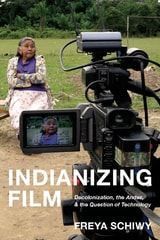
Indianizing Film
Decolonization, the Andes, and the Question of TechnologySchiwy, Freya
Rutgers University Press, 2009
Schiwy argues that instead of solely creating entertainment through their work indigenous media activists are building communication networks that encourage interaction between diverse cultures. As a result, mainstream images are retooled, permitting communities to strengthen their cultures and express their own visions of development and modernization. Indianizing Film encourages readers to consider how indigenous media contributes to a wider understanding of decolonization and anticolonial study against the universal backdrop of the twenty-first century.
Indians and Archaeology of Missouri, Revised Edition
Carl H. Chapman & Eleanor F. Chapman
University of Missouri Press, 1983
This expanded edition of Indians and Archaeology of Missouri gives an excellent introduction to the cultural development of Missouri’s Indians during the past twelve thousand years. Providing a new chapter on the Hunter Foragers of the Dalton period and substantial revision of other chapters to incorporate recent discoveries, the Chapmans present knowledge based upon decades of experience with archaeological excavations in an understandable and fascinating form.
The first edition of Indians and Archaeology of Missouri has been recognized in Missouri and nationally as one of the best books of its kind. The Missouri Historical Review called it “simply indispensable.” The Plains Anthropologist added similar praise: “Clearly written and exceptionally well illustrated…it is the answer to the amateur’s prayers.” Archaeology described it as “a boon to Missouri’s many amateur archaeologists, a useful source of information for professionals and interesting reading for the layman.”
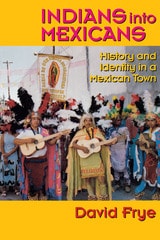
Indians into Mexicans
History and Identity in a Mexican TownBy David Frye
University of Texas Press, 1996
The people of Mexquitic, a town in the state of San Luis Potosí in rural northeastern Mexico, have redefined their sense of identity from "Indian" to "Mexican" over the last two centuries. In this ethnographic and historical study of Mexquitic, David Frye explores why and how this transformation occurred, thereby increasing our understanding of the cultural creation of "Indianness" throughout the Americas.
Frye focuses on the local embodiments of national and regional processes that have transformed rural "Indians" into modern "Mexicans": parish priests, who always arrive with personal agendas in addition to their common ideological baggage; local haciendas; and local and regional representatives of royal and later of national power and control. He looks especially at the people of Mexquitic themselves, letting their own words describe the struggles they have endured while constructing their particular corner of Mexican national identity.
This ethnography, the first for any town in northeastern Mexico, adds substantially to our knowledge of the forces that have rendered "Indians" almost invisible to European-origin peoples from the fifteenth century up to today. It will be important reading for a wide audience not only in anthropology and Latin American studies but also among the growing body of general readers interested in the multicultural heritage of the Americas.
Indians on Indian Lands
Intersections of Race, Caste, and IndigeneityNishant Upadhyay
University of Illinois Press, 2024
Winner of a NWSA/University of Illinois Press First Book Prize
Nishant Upadhyay unravels Indian diasporic complicity in its ongoing colonialist relationship with Indigenous peoples, lands, and nations in Canada. Upadhyay examines the interwoven and simultaneous areas of dominant Indian caste complicity in processes of settler colonialism, antiblackness, capitalism, brahminical supremacy, Hindu nationalism, and heteropatriarchy. Resource extraction in British Columbia in the 1970s–90s and in present-day Alberta offer examples of spaces that illuminate the dispossession of Indigenous peoples and simultaneously reveal racialized, gendered, and casted labor formations. Upadhyay juxtaposes these extraction sites with examples of anticolonial activism and solidarities from Tkaronto. Analyzing silence on settler colonialism and brahminical caste supremacy, Upadhyay upends the idea of dominant caste Indian diasporas as racially victimized and shows that claiming victimhood denies a very real complicity in enforcing other power structures. Exploring stories of quotidian proximity and intimacy between Indigenous and South Asian communities, Upadhyay offers meditations on anticolonial and anti-casteist ways of knowledge production, ethical relationalities, and solidarities.Groundbreaking and ambitious, Indians on Indian Lands presents the case for holding Indian diasporas accountable for acts of violence within a colonial settler nation.

Indifference
On the Praxis of Interspecies BeingNaisargi N. Davé
Duke University Press, 2023

Indigeneity and the Mestizo Question
The Limits of Latin American PhilosophyJorge Sanchez-Perez
Amherst College Press, 2027
In The Limits of Latin American Philosophy: Indigeneity and the Mestizo Question, Jorge Sanchez-Perez argues that the distinction between Latin American philosophy and Indigenous philosophy from Latin America has been neglected. While Latin American philosophers have succeeded in carving out a conceptual space in the landscape of Western philosophy, a space in which issues positions relevant to Latin American concerns are discussed and debated, this space has failed to sufficiently acknowledge the differences with Indigenous philosophy from Latin America. Although both fields can point to some, even if contested, geographical shared space, they emerge from different conceptual backgrounds. While Latin American philosophy emerges as a project in relation, even if as a rejection, to Europe, Indigenous philosophy from Latin America predates the existence of Europe by thousands of years. By defining the countours of Latin American philosophy, The Limits of Latin American Philosophy aims to make room for discussions of Indigenous philosophy from Latin America.
Indigeneity in Real Time
The Digital Making of OaxacaliforniaIngrid Kummels
Rutgers University Press, 2023

Indigenomicon
American Indians, Video Games, and the Structures of DispossessionJodi A. Byrd
Duke University Press, 2025

Indigenous Archives
The Maya Diaspora and Mobile Cultural ProductionFloridalma Boj Lopez
Duke University Press, 2026
Indigenous Genres of the Human
Locating the Intersections of Indigeneity and LatinidadGabriela Raquel Ríos
University of Arizona Press, 2026
Addressing different genres of human and what contemporary indigeneity and reclaiming indigeneity looks like across Latin American contexts, chapters in this work examine digital bruja poetry, Aymara women’s Lucha Libre in Bolivia, Raramuri dance in Mexico, and Indigenous Khipu in the Andes. The author weaves her own story of being from southern Texas and traveling to Mexico throughout the book.
Bridging Sylvia Wynter’s theory of “genres of the human” with critical Latinx indigeneity studies, Chicana/o/x studies, decolonial theory, and rhetorical new materialisms, this book challenges readers to rethink what it means to be human, Indigenous, and Chicanx in the wake of colonial violence. Rather than reinforcing binaries defined by settler colonialism, Ríos proposes a framework that centers community knowledge and grounded practices. Her work opens space for dialogue, listening, and healing, emphasizing that reclaiming indigeneity requires attention to the stories, movements, and rhetorical practices that emerge from within communities themselves.