Results by title
1917 books match the query 'Law' and 75 start with i
International Bankruptcy
The Challenge of Insolvency in a Global EconomyJodie Adams Kirshner
University of Chicago Press, 2018
With International Bankruptcy, Jodie Adams Kirshner explores the issues involved in determining which courts should have jurisdiction and which laws should apply in addressing problems within. Kirshner brings together theory with the discussion of specific cases and legal developments to explore this developing area of law. Looking at the key issues that arise in cross-border proceedings, International Bankruptcy offers a guide to this legal environment. In addition, she explores how globalization has encouraged the creation of new legal practices that bypass national legal systems, such as the European Insolvency Framework and the Model Law on Cross-Border Insolvency of the United Nations Commission on International Trade Law. The traditional comparative law framework misses the nuances of these dynamics. Ultimately, Kirshner draws both positive and negative lessons about regulatory coordination in the hope of finding cleaner and more productive paths to wind down or rehabilitate failing international companies.

International Environmental Policy
From the Twentieth to the Twenty-First CenturyLynton Keith Caldwell
Duke University Press, 1996
International Event-Data Developments
DDIR Phase IIEdited by Richard L. Merritt, Robert G. Muncaster, and Dina A. Zinnes
University of Michigan Press, 1993

International Handbook on Clinical Tax Education
Edited by Amy Lawton
University of London Press, 2023
Tax clinics, a government-funded initiative to help people who may not be able to afford professional advice and representation with their tax affairs, have existed in the United States since the early 1990s. Now they are being established throughout the world, particularly in Australia, the UK, and Ireland. This practical handbook explores the benefits that a clinical tax education can have and equips readers with the tools needed to start a clinical tax project. It investigates the ways in which tax clinics can both educate and remedy tax positions for local communities in supporting those without access to the tax profession to understand their tax liabilities. It also explores the higher education setting, in which community tax projects rely on students for their success, offering them the benefits of an alternative learning environment in tax and experience in the tax profession while studying. Beyond identifying the practical benefits, this handbook uses learning from tax clinics to uncover the burdens and impacts of tax policy on more marginalized taxpayers, and how policymakers can tailor tax systems to overcome them.

International Law, Sustainable Development and Water Management
Antoinette Hildering
Eburon Academic Publishers, 2005

International Trade Law Through the Cases
Volume IJulian Arato, Joseph Weiler, Kathleen Claussen, Sungjoon Cho
Michigan Publishing Services, 2027
International trade law is a manifold. It comprises a wide array of international legal instruments designed to discipline states in their regulation of cross-border trade, including primarily trade in goods and services but also intellectual property, digital trade, and even investment. The study of international trade law requires choices. As the title of this book suggests, the choice of this particular book is to study international trade law through the cases—in particular the robust case law of the WTO. The theory behind our approach is rather that developing a firm foundation in the law and jurisprudence of the WTO will provide a student with the tools to confidently and competently analyze any international trade instrument on their own. The focus here is primarily (though not exclusively) on the law of the WTO, but the goal is to learn the key concepts and disciplines of international trade law writ large.
International Trade Law Through the Cases
Volume IIJulian Arato, Joseph Weiler, Kathleen Claussen, Sungjoon Cho
Michigan Publishing Services, 2027
International trade law is a manifold. It comprises a wide array of international legal instruments designed to discipline states in their regulation of cross-border trade, including primarily trade in goods and services but also intellectual property, digital trade, and even investment. The study of international trade law requires choices. As the title of this book suggests, the choice of this particular book is to study international trade law through the cases—in particular the robust case law of the WTO. The theory behind our approach is rather that developing a firm foundation in the law and jurisprudence of the WTO will provide a student with the tools to confidently and competently analyze any international trade instrument on their own. The focus here is primarily (though not exclusively) on the law of the WTO, but the goal is to learn the key concepts and disciplines of international trade law writ large.
Interpreting State Constitutions
A Jurisprudence of Function in a Federal SystemJames A. Gardner
University of Chicago Press, 2005
With the Supreme Court's retreat from the aggressive protection of individual rights, state courts have begun to interpret state constitutions to provide broader protection of liberties. This development has reversed the polarity of constitutional politics, as liberals advocate unimpeded state power while conservatives lobby for state subordination to a constitutional law controlled centrally by the Supreme Court.
James A. Gardner here lays out the first fully developed theory of subnational constitutional interpretation. He argues that states are integral components of a national system of overlapping and mutually checking authority and that the purpose of this system is to protect liberty and defend against federal domination. The resulting account provides valuable prescriptive advice to state courts, showing them how to fulfill their responsibilities to the federal system in a way that strengthens American constitutional discourse.
Interpreting in Legal Settings
Debra Russell
Gallaudet University Press, 2009
The work of interpreters in legal settings, whether they are spoken or signed language interpreters, is filled with enormous complexity and challenges. This engrossing volume presents six, data-based studies from both signed and spoken language interpreter researchers on a diverse range of topics, theoretical underpinnings, and research methodologies.
In the first chapter, Ruth Morris analyzes the 1987 trial of Ivan (John) Demjanjuk in Jerusalem, and reveals that what might appear to be ethical breaches often were no more than courtroom dynamics, such as noise and overlapping conversation. Waltraud Kolb and Franz Pöchhacker studied 14 asylum appeals in Austria and found that interpreters frequently aligned themselves with the adjudicators. Bente Jacobsen presents a case study of a Danish-English interpreter whose discourse practices expose her attempts to maintain, mitigate, or enhance face among the participants.
In the fourth chapter, Jemina Napier and David Spencer investigate the effectiveness of interpreting in an Australian courtroom to determine if deaf citizens should participate as jurors. Debra Russell analyzed the effectiveness of preparing sign language interpreter teams for trials in Canada and found mixed results. The final chapter presents Zubaidah Ibrahim-Bell’s research on the inadequate legal services in Malaysia due to the fact that only seven sign interpreters are available. Taken together, these studies point to a “coming of age” of the field of legal interpreting as a research discipline, making Interpreting in Legal Settings an invaluable, one-of-a-kind acquisition.
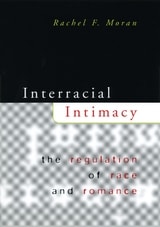
Interracial Intimacy
The Regulation of Race and RomanceRachel F. Moran
University of Chicago Press, 2003
"A good introduction to an issue too often overlooked. . . . The writing is clear and accessible, the evidence is evocative, and the ideas are challenging."—Beth Kiyoko Jamieson, Law and Politics Book Review
"U. S. government bodies have tried to regulate interracial intimacy from the day Pocahontas married John Rolfe up through Loving v. Virginia, which found antimiscegentation laws unconstitutional in 1967. . . . The weirder anecdotes from our racial history enliven this study, which is likely to become a classic in its field."—Publishers Weekly
"Moran examines the history of U. S. regulation of cross-racial romance, considering the impact of that regulation on the autonomy of individuals and families as well as on racial identity and equality. . . . She is attuned to the nuances of race in this polyglot nation, and supplies thoughtful analysis of these nuances."—Booklist
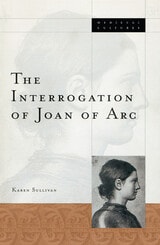
Interrogation Of Joan Of Arc
Karen Sullivan
University of Minnesota Press, 1999
A radical reassessment of the trial of Joan of Arc that gives a new sense of Joan in her time.
The transcripts of Joan of Arc’s trial for heresy at Rouen in 1431 and the minutes of her interrogation have long been recognized as our best source of information about the Maid of Orleans. Historians generally view these legal texts as a precise account of Joan’s words and, by extension, her beliefs. Focusing on the minutes recorded by clerics, however, Karen Sullivan challenges the accuracy of the transcript. In The Interrogation of Joan of Arc, she re-reads the record not as a perfect reflection of a historical personality’s words, but as a literary text resulting from the collaboration between Joan and her interrogators.
Sullivan provides an illuminating and innovative account of Joan’s trial and interrogation, placing them in historical, social, and religious context. In the fifteenth century, interrogation was a method of truth-gathering identified not with people like Joan, who was uneducated, but with clerics, like those who tried her. When these clerics questioned Joan, they did so as scholastics educated at the University of Paris, as judges and assistants to judges, and as pastors trained in hearing confessions.The Interrogation of Joan of Arc traces Joan’s conflicts with her interrogators not to differing political allegiances, but to fundamental differences between clerical and lay cultures. Sullivan demonstrates that the figure depicted in the transcripts as Joan of Arc is a complex, multifaceted persona that results largely from these cultural differences. Discerning and innovative, this study suggests a powerful new interpretive model and redefines our sense of Joan and her time.
Intimate Associations
The Law and Culture of American FamiliesJ. Herbie DiFonzo and Ruth C. Stern
University of Michigan Press, 2013
The rise in divorce, cohabitation, single parenthood, and same-sex partnerships, along with an increase in surrogacy, adoption, and assisted reproductive technologies, has led to many diverse configurations of families, or intimate associations. J. Herbie DiFonzo and Ruth C. Stern chart these trends over the past several decades and investigate their social, legal, and economic implications.
Drawing upon a wealth of social science data, they show that, by a number of measures, children of married parents fare better than children in a household formed by cohabiting adults. This is not to condemn nontraditional families, but to point out that society and the law do not yet adequately provide for their needs. The authors applaud the ways in which courts and legislatures are beginning to replace rigid concepts of marriage and parenthood with the more flexible concept of “functional” family roles. In the conclusion, they call for a legal system that can adapt to the continually changing reality of family life.
Invention, Copyright, and Digital Writing
Martine Courant Rife
Southern Illinois University Press, 2013
This is the first empirical, mixed-methods study of copyright issues that speaks to writing specialists and legal scholars about the complicated intersections of rhetoric, technology, copyright law, and writing for the Internet. Martine Courant Rife opens up new conversations about how invention and copyright work together in the composing process for digital writers and how this relationship is central to contemporary issues in composition pedagogy and curriculum.
In this era of digital writing and publishing, composition and legal scholars have identified various problems with writers’ processes and the law’s construction of textual ownership, such as issues of appropriation, infringement, and fair use within academic and online contexts. Invention, Copyright, and Digital Writing unpacks digital writers’ complex perceptions of copyright, revealing how it influences what they choose to write and how it complicates their work. Rife uses quantitative and qualitative approaches and focuses on writing as a tool and a technology-mediated activity, arguing the copyright problem is about not law but invention and the attendant issues of authorship.
Looking at copyright and writing through a rhetorical lens, Rife leverages the tools and history of rhetoric to offer insights into how some of our most ancient concepts inform our understanding of the problems copyright law creates for writers. In this innovative study that will be of interest to professional and technical writers, scholars and students of writing and rhetoric, and legal professionals, Rife offers possibilities for future research, teaching, curriculum design, and public advocacy in regard to composition and changing copyright laws.
Investment, Profit, and Tenancy
The Jurists and the Roman Agrarian EconomyDennis P. Kehoe
University of Michigan Press, 1997
In Investment, Profit, and Tenancy Dennis P. Kehoe defines the economic mentality of upper-class Romans by analyzing the assumptions that Roman jurists in the Digest of Justinian made about investment and profit in agriculture as they addressed legal issues involving private property. In particular the author analyzes the duties of guardians in managing the property of their wards, and the bequeathing of agricultural property. He bases his analysis on Roman legal sources, which offer a comprehensive picture of the economic interests of upper-class Romans. Farm tenancy was crucial to these interests, and Kehoe carefully examines how Roman landowners contended with the legal, social, and economic institutions surrounding farm tenancy as they pursued security from their agricultural investments.
Kehoe argues that Roman jurists offer a consistent picture of agriculture as a form of investment that was grounded in upper-class conceptions of the Roman economy. In the eyes of the jurists, agriculture represented the only form of investment capable of providing upper-class Romans with economic security, and this situation had important implications for the relationship between landowners and tenants. Landowners who sought economic stability from their agricultural holdings preferred to simplify the task of managing their estates by delegating the work and costs to their tenants. This tended to make landowners depend on the expertise and resources of tenants, which in turn gave the tenants significant bargaining power. This dynamic relationship is traced in the jurists' regulation of farm tenancy, as the jurists adapted Roman law to the economic realities of the Roman empire.
Investment, Profit, and Tenancy will be of interest to classicists as well as to scholars of preindustrial comparative economics.
Dennis P. Kehoe is Professor of Classical Studies, Tulane University.
Invitation to Law and Society, Second Edition
An Introduction to the Study of Real LawKitty Calavita
University of Chicago Press, 2016
With this second edition of Invitation to Law and Society, Calavita brings up to date what is arguably the leading introduction to this exciting, evolving field of inquiry and adds a new chapter on the growing law and cultural studies movement.
Invitation to Law and Society, Second Edition
An Introduction to the Study of Real LawKitty Calavita
University of Chicago Press, 2016
Law and society is a rapidly growing field that turns the conventional view of law as mythical abstraction on its head. Kitty Calavita brilliantly brings to life the ways in which law is found not only in statutes and courtrooms but in our institutions and interactions, while inviting readers into conversations that introduce the field’s dominant themes and most lively disagreements. Deftly interweaving scholarship with familiar examples, Calavita shows how scholars in the discipline are collectively engaged in a subversive exposé of law’s public mythology. While surveying prominent issues and distinctive approaches to both law as it is written and actual legal practices, as well as the law’s potential as a tool for social change, this volume provides a view of law that is more real but just as compelling as its mythic counterpart.
With this second edition of Invitation to Law and Society, Calavita brings up to date what is arguably the leading introduction to this exciting, evolving field of inquiry and adds a new chapter on the growing law and cultural studies movement.
Invitation to Law and Society
An Introduction to the Study of Real LawKitty Calavita
University of Chicago Press, 2010
Law and Society is a rapidly-growing interdisciplinary field that turns on its head the conventional, idealized view of the “Law” as a magisterial abstraction. Kitty Calavita’s Invitation to Law and Society brilliantly brings to life the ways in which law shapes and manifests itself in the institutions and interactions of human society, while inviting the reader into conversations that introduce the field’s dominant themes and most lively disagreements.
Deftly interweaving scholarship with familiar personal examples, Calavita shows how scholars in the discipline are collectively engaged in a subversive exposé of law’s public mythology. While surveying prominent issues and distinctive approaches to the use of the law in everyday life, as well as its potential as a tool for social change, this volume provides a view of law that is more real but just as compelling as its mythic counterpart. In a field of inquiry that has long lacked a sophisticated yet accessible introduction to its ways of thinking, Invitation to Law and Society will serve as an engaging and indispensible guide.
Is Administrative Law Unlawful?
Philip Hamburger
University of Chicago Press, 2014
With Is Administrative Law Unlawful?, Philip Hamburger answers this question in the affirmative, offering a revisionist account of administrative law. Rather than accepting it as a novel power necessitated by modern society, he locates its origins in the medieval and early modern English tradition of royal prerogative. Then he traces resistance to administrative law from the Middle Ages to the present. Medieval parliaments periodically tried to confine the Crown to governing through regular law, but the most effective response was the seventeenth-century development of English constitutional law, which concluded that the government could rule only through the law of the land and the courts, not through administrative edicts. Although the US Constitution pursued this conclusion even more vigorously, administrative power reemerged in the Progressive and New Deal Eras. Since then, Hamburger argues, administrative law has returned American government and society to precisely the sort of consolidated or absolute power that the US Constitution—and constitutions in general—were designed to prevent.
With a clear yet many-layered argument that draws on history, law, and legal thought, Is Administrative Law Unlawful? reveals administrative law to be not a benign, natural outgrowth of contemporary government but a pernicious—and profoundly unlawful—return to dangerous pre-constitutional absolutism.
Is It Time to Reform Social Security?
Edward M. Gramlich
University of Michigan Press, 2000
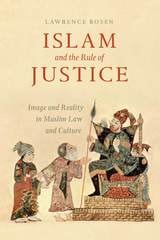
Islam and the Rule of Justice
Image and Reality in Muslim Law and CultureLawrence Rosen
University of Chicago Press, 2018
With Islam and the Rule of Justice, Lawrence Rosen analyzes a number of these misperceptions. Drawing on specific cases, he explores the application of Islamic law to the treatment of women (who win most of their cases), the relations between Muslims and Jews (which frequently involve close personal and financial ties), and the structure of widespread corruption (which played a key role in prompting the Arab Spring). From these case studie the role of informal mechanisms in the resolution of local disputes. The author also provides a close reading of the trial of Zacarias Moussaoui, who was charged in an American court with helping to carry out the 9/11 attacks, using insights into how Islamic justice works to explain the defendant’s actions during the trial. The book closes with an examination of how Islamic cultural concepts may come to bear on the constitutional structure and legal reforms many Muslim countries have been undertaking.
Islands of Privacy
Christena E. Nippert-Eng
University of Chicago Press, 2010
Everyone worries about privacy these days. As corporations and governments devise increasingly sophisticated data gathering tools and joining Facebook verges on obligatory, concerns over the use and abuse of personal information are undeniable. But the way privacy functions on the virtual frontier of the Internet is only a subset of the fascinating ways we work to achieve it throughout our everyday lives. In Islands of Privacy, Christena Nippert-Eng pries open the blinds, giving us an intimate view into the full range of ordinary people’s sometimes extraordinary efforts to preserve the border between themselves and the rest of the world.
Packed with stories that are funny and sad, familiar and strange, Islands of Privacy tours the myriad arenas where privacy battles are fought, lost, and won. Nippert-Eng explores how we manage our secrets, our phone calls and e-mail, the perimeters of our homes, and our interactions with neighbors. She discovers that everybody practices the art of selectively concealing and disclosing information on a daily basis. This important balancing act governs a wide range of behaviors, from deciding whether to give our bosses our cell phone numbers to choosing what we carry in our wallets or purses. Violations of privacy and anxiety about how we grant it to each other also come under Nippert-Eng’s microscope as she crafts a compelling argument that successfully managing privacy is critical for successfully maintaining our relationships with each other and our selves.
Roaming from the beach to the bank and from the bathroom to the bus, Nippert-Eng’s keenly observed and vividly told book gives us the skinny on how we defend our shrinking islands of privacy in the vast ocean of accessibility that surrounds us.
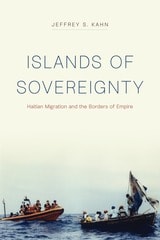
Islands of Sovereignty
Haitian Migration and the Borders of EmpireJeffrey S. Kahn
University of Chicago Press, 2018
Issues and Options for U.S.-Japan Trade Policies
Robert M. Stern, Editor
University of Michigan Press, 2002
The chapters represent a spectrum of approaches, including theoretical analysis, quantitative measurement, and evaluations of policies and institutions from economic and legal perspectives. The multi-lateral issues cover the analysis of the economic effects of a new WTO negotiating round and the range of issues that are to be addressed there, including reform of Japan's agricultural policies, services liberalization, antidumping, intellectual property rights, and trade and the environment. The regional issues include theoretical and simulation analysis of the benefits of preferential trading arrangements and the policy of open regionalism that is being sought by APEC members. U.S.-Japan bilateral relations are studied by analyzing the major actions and positions taken by the two nations in the context of their national trade laws and policies, how trade policies are implemented, the effects of bilateral trade agreements on the United States and Japan, and the interplay of legal decisions reached in WTO actions with bilateral and unilateral measures undertaken by the two nations.
The book is designed for a broad audience consisting of academic economists, lawyers, policymakers, and students interested in U.S.-Japan international economic relations.
Robert M. Stern is Professor Emeritus of Economics and Public Policy, University of Michigan.
Issues in Law and Economics
Harold Winter
University of Chicago Press, 2017
It's All in the Game
A Nonfoundationalist Account of Law and AdjudicationAllan C. Hutchinson
Duke University Press, 2000
Taking on leading contemporary theories to explore the claim that “law is politics,” Hutchinson delineates a route toward professional, relevant, and responsible—if radical—judicial practices. After discussing the difference between foundationalist, antifoundationalist, and nonfoundationalist legal critiques, he offers a focused, unequivocal, and positive account of the advantages of operating within a nonfoundationalist framework. Although such an approach centralizes the role of rhetoric in law, Hutchinson claims that this does not necessitate a turn away from politics or, more particularly, from a progressive politics. Driving home the political and jurisprudential impact of his critique and of his account of nonfoundationalist alternatives, he urges judges and jurists to engage in law’s language game of politics.
This engaging book will interest linguistic philosophers, legal theorists, law students, attorneys, judges, and jurists of all stripes.