Results by title
4917 books match the query 'Philosophy' and 177 start with i
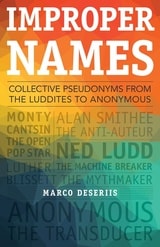
Improper Names
Collective Pseudonyms from the Luddites to AnonymousMarco Deseriis
University of Minnesota Press, 2015
Improper Names offers a genealogy and theory of the “improper name,” which author Marco Deseriis defines as the adoption of the same pseudonym by organized collectives, affinity groups, and individual authors. Although such names are often invented to pursue a specific social or political agenda, they are soon appropriated for different and sometimes diverging purposes. This book examines the tension arising from struggles for control of a pseudonym’s symbolic power.
Deseriis provides five fascinating and widely varying case studies. Ned Ludd was the legendary and eponymous leader of the English Luddites, textile workers who threatened the destruction of industrial machinery and then advanced a variety of economic and political demands. Alan Smithee—an alias coined by Hollywood film directors in 1969 in order to disown films that were recut by producers—became a contested signature and was therefore no longer effective to signal prevarication to Hollywood insiders. Monty Cantsin was an “open pop star” created by U.S. and Canadian artists in the late 1970s to critique bourgeois notions of authorship, but its communal character was compromised by excessive identification with individual users of the name. The Italian media activists calling themselves Luther Blissett, aware of the Cantsin experience, implemented measures to prevent individuals from assuming the alias, which was used to author media pranks, sell apocryphal manuscripts to publishers, fabricate artists and artworks, and author best-selling novels. The longest chapter here is devoted to the contemporary “hacktivist” group known as Anonymous, which protests censorship and restricted access to information and information technologies.
After delving into a rich philosophical debate on community among those who have nothing in common, the book concludes with a reflection on how the politics of improper names affects present-day anticapitalist social movements such as Occupy and 15-M.
Improvisation for the Theater
A Handbook of Teaching and Directing TechniquesViola Spolin
Northwestern University Press, 1983
In Force, Drive, Desire, Rudolf Bernet develops a philosophical foundation of psychoanalysis focusing on human drives. Rather than simply drawing up a list of Freud’s borrowings from Schopenhauer and Nietzsche, or Lacan’s from Hegel and Sartre, Bernet orchestrates a dialogue between philosophy and psychoanalysis that goes far beyond what these eminent psychoanalysts knew about philosophy. By relating the writings of Freud, Lacan, and other psychoanalysts to those of Aristotle, Leibniz, Schopenhauer, Nietzsche, Husserl, Heidegger, and, more tacitly, Bergson and Deleuze, Bernet brings to light how psychoanalysis both prolongs and breaks with the history of Western metaphysics and philosophy of nature.
Rereading the long history of metaphysics (or at least a few of its key moments) in light of psychoanalytic inquiries into the nature and function of drive and desire also allows for a rewriting of the history of philosophy. Specifically, it allows Bernet to bring to light a different history of metaphysics, one centered less on Aristotelian substance (ousia) and more on the concept of dunamis—a power or potentiality for a realization toward which it strives with all its might. Relating human drives to metaphysical forces also bears fruit for a renewed philosophy of life and subjectivity.
Improvising Improvisation
From Out of Philosophy, Music, Dance, and LiteratureGary Peters
University of Chicago Press, 2017
Guided by Kant, Hegel, Heidegger, and especially Deleuze—and exploring a range of artists from Hendrix to Borges—Peters illuminates new fundamentals about what, as an experience, improvisation truly is. As he shows, improvisation isn’t so much a genre, idiom, style, or technique—it’s a predicament we are thrown into, one we find ourselves in. The predicament, he shows, is a complex entwinement of choice and decision. The performativity of choice during improvisation may happen “in the moment,” but it is already determined by an a priori mode of decision. In this way, improvisation happens both within and around the actual moment, negotiating a simultaneous past, present, and future. Examining these and other often ignored dimensions of spontaneous creativity, Peters proposes a consistently challenging and rigorously argued new perspective on improvisation across an extraordinary range of disciplines.
Imre Lakatos and the Guises of Reason
John Kadvany
Duke University Press, 2001
Lakatos escaped Hungary following the failed 1956 Revolution. Before then, he had been an influential Communist intellectual and was imprisoned for years by the Stalinist regime. He also wrote a lost doctoral thesis in the philosophy of science and participated in what was criminal behavior in all but a legal sense. Kadvany argues that this intellectual and political past animates Lakatos’s English-language philosophy, and that, whether intended or not, Lakatos integrated a penetrating vision of Hegelian ideas with rigorous analysis of mathematical proofs and controversial histories of science.
Including new applications of Lakatos’s ideas to the histories of mathematical logic and economics and providing lucid exegesis of many of Hegel’s basic ideas, Imre Lakatos and the Guises of Reason is an exciting reconstruction of ideas and episodes from the history of philosophy, science, mathematics, and modern political history.

In Defense of Politics in Public Administration
A Value Pluralist PerspectiveMichael W. Spicer
University of Alabama Press, 2009
Where values collide, politics guides the way.
Scholars of public administration have historically too often been disdainful towards politics in the field, viewing political activities and interests as opportunities for corruption, mismanagement, and skewed priorities. Supporters of this anti-political stance have become even more strident in recent years, many of them advancing scientific models for the study and practice of public administration and governance.
Michael Spicer argues that politics deserves to be defended as a vital facet of public administration on the grounds that it can promote moral conduct in government and in public administration, principally by bringing to the foreground the role of values in administrative practice. Politics can facilitate the resolution of conflicts that naturally arise from competing values, or conceptions of the good, while minimizing the use of force or violence. Drawing on the writings of Isaiah Berlin, Bernard Crick, and Stuart Hampshire, In Defense of Politics in Public Administration argues that value conflict is an integral part of our moral experience, both in making our own moral choices and in dealing with those whose values conflict with our own. This book is a spirited declaration of principles and a timely contribution to a dialogue that is redefining public administration, both in theory and in practice.

In Place/Out of Place
Geography, Ideology, and TransgressionTim Cresswell
University of Minnesota Press, 1996
In Place/Out of Place was first published in 1996. Minnesota Archive Editions uses digital technology to make long-unavailable books once again accessible, and are published unaltered from the original University of Minnesota Press editions.
What is the relationship between place and behavior? In this fascinating volume, Tim Cresswell examines this question via "transgressive acts" that are judged as inappropriate not only because they are committed by marginalized groups but also because of where they occur.
In Place/Out of Place seeks to illustrate the ways in which the idea of geographical deviance is used as an ideological tool to maintain an established order. Cresswell looks at graffiti in New York City, the attempts by various "hippie" groups to hold a free festival at Stonehenge during the summer solstices of 1984–86, and the Greenham Common Women's Peace Camp in Berkshire, England. In each of the cases described, the groups involved were designated as out of place both by the media and by politicians, whose descriptions included an array of images such as dirt, disease, madness, and foreignness.
Cresswell argues that space and place are key factors in the definition of deviance and, conversely, that space and place are used to construct notions of order and propriety. In addition, whereas ideological concepts being expressed about what is good, just, and appropriate often are delineated geographically, the transgression of these delineations reveals the normally hidden relationships between place and ideology-in other words, the "out-of-place" serves to highlight and define the "in-place." By looking at the transgressions of the marginalized, Cresswell argues, we can gain a novel perspective on the "normal" and "taken-for-granted" expectations of everyday life. The book concludes with a consideration of the possibility of a "politics of transgression," arguing for a link between the challenging of spatial boundaries and the possibility of social transformation.
Tim Cresswell is currently lecturer in geography at the University of Wales.
In Praise of Philosophy and Other Essays
Maurice Merleau-Ponty
Northwestern University Press, 1988

In Quest of History
On Czech Statehood and IdentityJirí Pribán and Karel Hvíždala
Karolinum Press, 2019
In Quest of the Ordinary
Lines of Skepticism and RomanticismStanley Cavell
University of Chicago Press, 1988
In Reasonable Hope
Philosophical Reflections on Ultimate MeaningPatrick Masterson
Catholic University of America Press, 2021
In Search of Authenticity
The Formation of Folklore StudiesRegina Bendix
University of Wisconsin Press, 1997
Searches for authenticity, Bendix contends, have been a constant companion to the feelings of loss inherent in modernization, forever upholding a belief in a pristine yet endangered cultural essence and fueling cultural nationalism worldwide. Beginning with precursors of Herder and Emerson and the “discovery” of the authentic in expressive culture and literature, she traces the different, albeit intertwined, histories of German Volkskunde and American folklore studies. A Swiss native educated in American folklore programs, Bendix moves effortlessly between the two traditions, demonstrating how the notion of authenticity was used not only to foster national causes, but also to lay the foundations for categories of documentation and analysis within the nascent field of folklore studies.
Bendix shows that, in an increasingly transcultural world, where Zulu singers back up Paul Simon and where indigenous artists seek copyright for their traditional crafts, the politics of authenticity mingles with the forces of the market. Arguing against the dichotomies implied in the very idea of authenticity, she underscores the emptiness of efforts to distinguish between folklore and fakelore, between echt and ersatz.

In Search of Divine Reality
Science as a Source of InspirationLothar Schäfer
University of Arkansas Press, 1997

In Search of Goodness
Edited by Ruth W. Grant
University of Chicago Press, 2011
The recent spate of books and articles reflecting on the question of evil might make one forget that the question of just what constitutes goodness is no less urgent or perplexing. Everyone wants to think of him- or herself as good. But what does a good life look like? And how do people become good? Are there multiple, competing possibilities for what counts as a good life, all equally worthy? Or, is there a unified and transcendent conception of the good that should guide our judgment of the possibilities? What does a good life look like when it is guided by God? How is a good life involved with the lives of others? And, finally, how good is good enough?
These questions are the focus of In Search of Goodness, the product of a year-long conversation about goodness. The eight essays in this volume challenge the dichotomies that usually govern how goodness has been discussed in the past: altruism versus egoism; reason versus emotion; or moral choice versus moral character. Instead, the contributors seek to expand the terms of the discussion by coming at goodness from a variety of perspectives: psychological, philosophic, literary, religious, and political. In each case, they emphasize the lived realities and particulars of moral phenomena, taking up examples and illustrations from life, literature, and film. From Achilles and Billy Budd, to Oskar Schindler and Shel Silverstein’s The Giving Tree, to Iris Murdoch and the citizens of Flagstaff, Arizona, readers will find a wealth of thought-provoking insights to help them better understand this most basic, but complex, element of human life and happiness.
In Search of Mechanisms
Discoveries across the Life SciencesCarl F. Craver and Lindley Darden
University of Chicago Press, 2013

In Search of Schopenhauer's Cat
Arthur Schopenhauer's Quantum-Mystical Theory of JusticeRaymond B. Marcin
Catholic University of America Press, 2006
In Search of a New Image of Thought
Gilles Deleuze and Philosophical ExpressionismGregg Lambert
University of Minnesota Press, 2012
Gregg Lambert demonstrates that since the publication of Proust and Signs in 1964 Gilles Deleuze’s search for a new means of philosophical expression became a central theme of all of his oeuvre, including those written with psychoanalyst Félix Guattari. Lambert, like Deleuze, calls this “the image of thought.”
Lambert’s exploration begins with Deleuze’s earliest exposition of the Proustian image of thought and then follows the “tangled history” of the image that runs through subsequent works, such as Kafka: Toward a Minor Literature, The Rhizome (which serves as an introduction to Deleuze’s A Thousand Plateaus), and several later writings from the 1980s collected in Essays Critical and Clinical. Lambert shows how this topic underlies Deleuze’s studies of modern cinema, where the image of thought is predominant in the analysis of the cinematic image—particularly in The Time-Image. Lambert finds it to be the fundamental concern of the brain proposed by Deleuze in the conclusion of What Is Philosophy?
By connecting the various appearances of the image of thought that permeate Deleuze’s entire corpus, Lambert reveals how thinking first assumes an image, how the images of thought become identified with the problem of expression early in the works, and how this issue turns into a primary motive for the more experimental works of philosophy written with Guattari. The study traces a distinctly modern relationship between philosophy and non-philosophy (literature and cinema especially) that has developed into a hallmark of the term “Deleuzian.” However, Lambert argues, this aspect of the philosopher’s vision has not been fully appreciated in terms of its significance for philosophy: “not only ‘for today’ but, to quote Nietzsche, meaning also ‘for tomorrow, and for the day after tomorrow.’”

In Space We Read Time
On the History of Civilization and GeopoliticsKarl Schlögel
Bard Graduate Center, 2016
Here is both a model for thinking about history within physical space and a stimulating history of thought about space, as Schlögel reads historical periods and events within the context of their geographical location. Discussions range from the history of geography in France to what a town directory from 1930s Berlin can say about professional trades that have since disappeared. He takes a special interest in maps, which can serve many purposes—one poignant example being the German Jewish community’s 1938 atlas of emigration, which showed the few remaining possibilities for escape. Other topics include Thomas Jefferson’s map of the United States; the British survey of India; and the multiple cartographers with Woodrow Wilson at the Paris Peace Conference, where the aim was to redraw Europe’s boundaries on the basis of ethnicity. Moving deftly from the Austro-Hungarian Empire to 9/11 and from Vermeer’s paintings to the fall of the Berlin Wall, this intriguing book presents history from a completely new perspective.
In The Metro
Marc Auge
University of Minnesota Press, 2002
In The Nature Of Things
Language, Politics, and the EnvironmentJane Bennett
University of Minnesota Press, 1993
Informed by recent developments in literary criticism and social theory, In the Nature of Things addresses the presumption that nature exists independent of culture and, in particular, of language. The theoretical approaches of the contributors represent both modernist and postmodernist positions, including feminist theory, critical theory, Marxism, science fiction, theology, and botany. They demonstrate how the concept of nature is invoked and constituted in a wide range of cultural projects—from the Bible to science fiction movies, from hunting to green consumerism. Ultimately, it weeks to link the work of theorists concerned with nature and the environment to nontheorists who share similar concerns.
Contributors include R. McGreggor Cawley, Romand Coles, William E. Connolly, Jan E. Dizard, Valerie Hartouni, Cheri Lucas Jennings, Bruce H. Jennings, Timothy W. Luke, Shane Phelan, John Rodman, Michael J. Shapiro, and Wade Sikorski.
In The Scheme Of Things
Alternative Thinking on the Practice of ArchitectureThomas R. Fisher Fisher
University of Minnesota Press, 2006
In each of the twelve essays that comprise this timely volume, Fisher addresses issues of vital concern to architects and students, offering hard-hitting criticism and proposing innovative and practical ideas for reform at the level of both the individual practitioner and the profession as a whole. Through his thoughtful and nuanced consideration of architecture’s ideological foundations and its relationship to ecology, politics, and technology, as well as his subtle understanding of the architect’s interior life, Fisher challenges the demoralized design community to recapture its historical role as steward and visionary of the public realm.
Thomas R. Fisher is dean of the College of Architecture and Landscape Architecture at the University of Minnesota and coeditor of Architectural Research Quarterly. His essays have appeared in Design Quarterly, Architectural Record, and other leading journals.
In Tune With The World
Josef Pieper
St. Augustine's Press, 1999
In this stimulating and still-timely study, Josef Pieper takes up a theme of paramount importance to his thinking – that festivals belong by rights among the great topics of philosophical discussion. As he develops his theory of festivity, the modern age comes under close and painful scrutiny. It is obvious that we no longer know what festivity is, namely, the celebration of existence under various symbols
Pieper exposes the pseudo-festivals, in their harmless and their sinister forms: traditional feasts contaminated by commercialism; artificial holidays created in the interest of merchandisers; holidays by coercion, decreed by dictators the world over; festivals as military demonstrations; holidays empty of significance. And lastly we are given the apocalyptic vision of a nihilistic world which would seek its release not in festivities but in destruction.
Formulated with Pieper's customary clarity and elegance, enhanced by brilliantly chosen quotations, this is an illuminating contribution to the understanding of traditional and contemporary experience.
In a Field of Static
Missed Encounters with Black Feminist TheorizingJames Bliss
Duke University Press, 2026
In a Shade of Blue
Pragmatism and the Politics of Black AmericaEddie S. Glaude Jr.
University of Chicago Press, 2007
“Eddie Glaude is poised to become the leading intellectual voice of our generation, raising questions that make us reexamine the assumptions we hold by expanding our inventory of ideas.”—Tavis Smiley
In the Company of Scholars
The Struggle for the Soul of Higher EducationBy Julius G. Getman
University of Texas Press, 1992
"I began this book to articulate my sense of disappointment and alienation from the status I had fought so hard to achieve." A remarkable admission from an alumnus of Harvard Law School who has held tenured professorships in the law schools of Yale and Stanford and has taught in the law schools of Harvard and Chicago.
In this personal reflection on the status of higher education, Julius Getman probes the tensions between status and meaning, elitism and egalitarianism, that challenge the academy and academics today. He shows how higher education creates a shared intellectual community among people of varied races and classes—while simultaneously dividing people on the basis of education and status.
In the course of his explorations, Getman touches on many of the most current issues in higher education today, including the conflict between teaching and research, challenges to academic freedom, the struggle over multiculturalism, and the impact of minority and feminist activism. Getman presents these issues through relevant, often humorous anecdotes, using his own and others' experiences in coping with the constantly changing academic landscape.
Written from a liberal perspective, the book offers another side of the story told in such works as Allan Bloom's The Closing of the American Mind and Roger Kimball's Tenured Radicals.
In the Eyes of God
A Study on the Culture of SufferingBy Fernando Escalante Gonzalbo
University of Texas Press, 2006
"Every culture needs to appropriate the universal truth of human suffering," says Fernando Escalante, ". . . to give its own meaning to this suffering, so that human existence is bearable." Originally published in Spanish as La mirada de Dios: Estudios sobre la cultura del sufrimiento, this book is a remarkable study of the evolution of the culture of suffering and the different elements that constitute it, beginning with a reading of Rousseau and ending with the appearance of the Shoah in the Western consciousness—"The memory endures, and this constitutes a fundamental transition for the Western conscience: we have witnessed."
Drawing on writings from the Greeks to Cervantes, Voltaire to Nietzsche, and Freud to William James, Escalante combines his considerable knowledge of politics and political theory with a vast array of literary examples to arrive at an intellectual understanding of the history and meaning of suffering. His investigation encompasses the rise of popular politics, the role of messianism in modern nationalism, and the contemporary implications of the Shoah.
This book will appeal to a wide audience: students of political theory, humanism, and philosophy, as well as the general reader interested in a glimpse into the mind of a highly original Latin American thinker.
In the Memory of the Map
A Cartographic MemoirChristopher Norment
University of Iowa Press, 2012
Maps may have been the stuff of his dreams, but they sometimes drew him away from places where he should have remained firmly rooted. In the Memory of the Map explores the complex relationship among maps, memory, and experience—what might be called a “cartographical psychology” or “cartographical history.” Interweaving a personal narrative structured around a variety of maps, with stories about maps as told by scholars, poets, and fiction writers, this book provides a dazzlingly rich personal and intellectual account of what many of us take for granted.
A dialog between desire and the maps of his life, an exploration of the pleasures, utilitarian purposes, benefits, and character of maps, this rich and powerful personal narrative is the matrix in which Norment embeds an exploration of how maps function in all our lives. Page by page, readers will confront the aesthetics, mystery, function, power, and shortcomings of maps, causing them to reconsider the role that maps play in their lives.

In the Name of History
Joan Wallach Scott
Central European University Press, 2020
In this book Joan Wallach Scott discusses the role history has played as an arbiter of right and wrong and of those who claim to act in its name—"in the name of history." Scott investigates three different instances in which repudiation of the past was conceived as a way to a better future: the International Military Tribunal at Nuremberg in 1946, the South African Truth and Reconciliation Commission in 1996, and the ongoing movement for reparations for slavery in the United States.
Scott shows how in these cases history was not only used to explain the past but to produce a particular future. Yet both past and future were subject to the political realities of their time and defined in terms of moral absolutes, often leading to deep contradictions. These three instances demonstrate that history is not an impartial truth, rather its very meaning is constructed by those who act in its name.
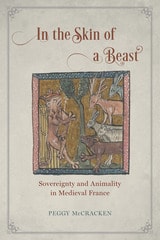
In the Skin of a Beast
Sovereignty and Animality in Medieval FrancePeggy McCracken
University of Chicago Press, 2017
Peggy McCracken discusses a range of literary texts and images from medieval France, including romances in which animal skins appear in symbolic displays of power, fictional explorations of the wolf’s desire for human domestication, and tales of women and snakes converging in a representation of territorial claims and noble status. These works reveal that the qualities traditionally used to define sovereignty—lineage and gender among them—are in fact mobile and contingent. In medieval literary texts, as McCracken demonstrates, human dominion over animals is a disputed model for sovereign relations among people: it justifies exploitation even as it mandates protection and care, and it depends on reiterations of human-animal difference that paradoxically expose the tenuous nature of human exceptionalism.
In the Wake of Chaos
Unpredictable Order in Dynamical SystemsStephen H. Kellert
University of Chicago Press, 1993
Inadvertent Images
A History of Photographic ApparitionsPeter Geimer
University of Chicago Press, 2018
Incapacity
Wittgenstein, Anxiety, and Performance BehaviorSpencer Golub
Northwestern University Press, 2014
In this highly original study of the nature of performance, Spencer Golub uses the insights of Ludwig Wittgenstein into the way language works to analyze the relationship between the linguistic and the visual in the work of a broad range of dramatists, novelists, and filmmakers, among them Richard Foreman, Mac Wellman, Peter Handke, David Mamet, and Alfred Hitchcock. Like Wittgenstein, these artists are concerned with the limits of language’s representational capacity. For Golub, it is these limits that give Wittgenstein’s thought a further, very personal significance—its therapeutic quality with respect to the Obsessive Compulsive Disorder from which he suffers.
Underlying what Golub calls “performance behavior” is Wittgenstein’s notion of “pain behavior”—that which gives public expression to private experience. Golub charts new directions for exploring the relationship between theater and philosophy, and even for scholarly criticism itself.
Incarnation, Pain, Theology
A Phenomenology of the BodyEspen Dahl
Northwestern University Press, 2024
While the phenomenological tradition has carefully treated both the objective and the lived body, Espen Dahl explores a dimension of the body that does not fall neatly into either category, suggesting that philosophers should take account of the inner density of our organic, material body. By integrating the dimension of “flesh-and-blood” into the phenomenological notion of the body, Dahl argues that it is possible to reach a more adequate notion of human incarnation. The author explores the body in its subjectivity and its resistance, in activity founded on passivity, and in the ambiguous limits of its skin. The phenomenon of pain is given particular attention in this investigation, since pain is, as Dahl argues, what makes the body inescapably manifest in its otherwise hidden dimensions, including its ambiguity and vulnerability. Related to this focus, Dahl also engages with the Christian theological concerns of incarnation, pain, and hope. Phenomenologists have long drawn on this religious inheritance, particularly in what has been dubbed the French “theological turn.” In a similar manner, Incarnation, Pain, Theology: A Phenomenology of the Body draws on these theological sources while firmly holding to its philosophical commitments in methodological approach and analytic aims.
Incarnation
A Philosophy of FleshMichel Henry; Translated from the French by Karl Hefty
Northwestern University Press, 2015
After having placed the difficult problem of the incarnation in an historical perspective going back to the thought of the Fathers of the Church, he makes in this book a critical review of the phenomenological tradition that leads to the reversal of phenomenology. He then proposes to elaborate a phenomenology of the flesh which leads to the notion of a not constituted original flesh given in the "Arch-revelation" of Life, as well as a phenomenology of Incarnation.
Although the flesh is traditionally understood as the place of sin, it is also in Christianity the place of salvation, which consists in the deification of man, that’s to say in the fact of becoming Son of God, to come back to the eternal and absolute Life we had forgotten getting lost in the world, caring only about things and ourselves. In the fault, we make the tragic experience of our powerlessness to do the good we would like to do and of our inability to avoid the evil. In this way in front of the magic body of the other, that’s the anguished desire to meet the life in it that leads to the fault. In the night of the lovers, the sexual act couples two impulsive movements, but the erotic desire fails to reach the pleasure of the other where it is experienced, in a total loving fusion. The erotic relation is however doubled by a pure affective relation, foreign to the carnal coupling, a relation made of mutual gratitude or of love. That’s this affective dimension that is denied in this way of violence that is pornography, which extracts the erotic relation from the pathos of life to abandon it to the world, and which consists in a real profanation of life.
Incinarration
What Do We Carry?Hélène Cixous
Seagull Books, 2026
Hélène Cixous’s powerful new book, masterfully translated by Peggy Kamuf, is a vivid journey through fire. From the ashes of wars, wildfires, and upheaval, Cixous traces a dramatic path across time—from the Second World War and the Nazi occupation of Oran to the European wildfires of 2022—weaving a rich, intimate narrative that merges history, autobiography, and myth. With her piercing, lyrical voice, Cixous confronts the human cost of destruction and upheaval, and asks a universal question: What do we carry with us when everything we know is falling to ashes?
In Incinarration, Cixous finds hope in the power of words, memory, and imagination to illuminate our darkest moments and redeem the future. As forests burn and regimes collapse, Cixous shows us how stories become a form of resistance—a way to remember, to bear testimony, and to find renewal in the face of oblivion.
Indians and Anthropologists
Vine Deloria, Jr., and the Critique of AnthropologyThomas Biolsi
University of Arizona Press, 1997
CONTENTS
Introduction: What's Changed, What Hasn't, Thomas Biolsi & Larry J. Zimmerman
Part One--Deloria Writes Back
Vine Deloria, Jr., in American Historiography, Herbert T. Hoover
Growing Up on Deloria: The Impact of His Work on a New Generation of Anthropologists, Elizabeth S. Grobsmith
Educating an Anthro: The Influence of Vine Deloria, Jr., Murray L. Wax
Part Two--Archaeology and American Indians
Why Have Archaeologists Thought That the Real Indians Were Dead and What Can We Do about It?, Randall H. McGuire
Anthropology and Responses to the Reburial Issue, Larry J. Zimmerman
Part Three-Ethnography and Colonialism
Here Come the Anthros, Cecil King
Beyond Ethics: Science, Friendship and Privacy, Marilyn Bentz
The Anthropological Construction of Indians: Haviland Scudder Mekeel and the Search for the Primitive in Lakota Country, Thomas Biolsi
Informant as Critic: Conducting Research on a Dispute between Iroquoianist Scholars and Traditional Iroquois, Gail Landsman
The End of Anthropology (at Hopi)?, Peter Whiteley
Conclusion: Anthros, Indians and Planetary Reality, Vine Deloria, Jr.

Indigeneity and the Mestizo Question
The Limits of Latin American PhilosophyJorge Sanchez-Perez
Amherst College Press, 2027
In The Limits of Latin American Philosophy: Indigeneity and the Mestizo Question, Jorge Sanchez-Perez argues that the distinction between Latin American philosophy and Indigenous philosophy from Latin America has been neglected. While Latin American philosophers have succeeded in carving out a conceptual space in the landscape of Western philosophy, a space in which issues positions relevant to Latin American concerns are discussed and debated, this space has failed to sufficiently acknowledge the differences with Indigenous philosophy from Latin America. Although both fields can point to some, even if contested, geographical shared space, they emerge from different conceptual backgrounds. While Latin American philosophy emerges as a project in relation, even if as a rejection, to Europe, Indigenous philosophy from Latin America predates the existence of Europe by thousands of years. By defining the countours of Latin American philosophy, The Limits of Latin American Philosophy aims to make room for discussions of Indigenous philosophy from Latin America.
Indigenizing Philosophy through the Land
A Trickster Methodology for Decolonizing Environmental Ethics and Indigenous FuturesBrian Burkhart
Michigan State University Press, 2019
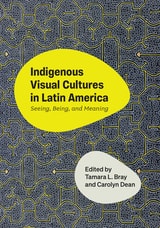
Indigenous Visual Cultures in Latin America
Seeing, Being, and MeaningEdited by Tamara L. Bray and Carolyn Dean
University of Texas Press, 2026
Reframing the study of Indigenous visual cultures, this volume explores how images and objects generate affect and relation in non-Western contexts, foregrounding alternative modes of material engagement and meaning-making.
While traditional approaches to Indigenous visual cultures have often centered on iconography and representation, this volume turns toward other ways that images and objects act in the world. Indigenous Visual Cultures in Latin America explores how material productions function not merely as signs that point elsewhere but as agents that help shape relationships, environments, and affective experience.
Spanning Mesoamerica, the Andes, and Amazonia from 1500 BCE to the present, the chapters examine how meaning may reside in materials themselves; how making is a form of exchange between maker and matter; and how visual forms participate in configuring relations among humans, ancestors, deities, and place. These works are not passive containers of meaning, but charged presences—generative forces within ongoing worlds. Attuned to Indigenous ways of knowing and being, the volume invites readers to think beyond the frame, beyond the image, and beyond representation itself.

Indigenous and Popular Thinking in América
Rodolfo Kusch
Duke University Press, 2010
Indigenous and Popular Thinking in América is a record of Kusch's attempt to immerse himself in the indigenous ways of knowing and being. At first glance, his methodology resembles ethnography. He speaks with and observes indigenous people and mestizos in Peru, Bolivia, and Argentina. He questions them about their agricultural practices and economic decisions; he observes rituals; he asks women in the market the meaning of indigenous talismans; he interviews shamans; he describes the spatial arrangement and the contents of shrines, altars, and temples; and he reproduces diagrams of archaeological sites, which he then interprets at length. Yet he does not present a "them" to a putative "us." Instead, he offers an inroad to a way of thinking and being that does not follow the logic or fit into the categories of Western social science and philosophy. In his introduction, Walter D. Mignolo discusses Kusch's work and its relation to that of other twentieth-century intellectuals, Argentine history, and contemporary scholarship on the subaltern and decoloniality.
Individualism and Holism
Studies in Confucian and Taoist ValuesDonald J. Munro, Editor
University of Michigan Press, 1985
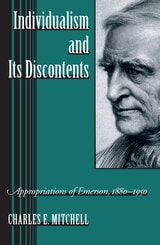
Individualism and Its Discontents
Appropriations of Emerson, 1880-1950Charles E. Mitchell
University of Massachusetts Press, 1997
The work of Ralph Waldo Emerson has long been synonymous with the American ideals of self-reliance and individualism. Like those ideals, it has come to mean different things, at different times, to different people. Emerson has been identified as the source of both the best and worst in the American intellectual tradition, his authority invoked by back-to-the-landers and industrial capitalists, the philosopher Nietzsche, as well as the promoters of Nike footwear.
This book explores the intertwined history of Emerson and individualism. Charles E. Mitchell begins by examining those who regarded Emersonian individualism with ambivalence or hostility, focusing on the comments of such diverse figures as Henry James, Sr., Oliver Wendell Holmes, Van Wyck Brooks, and H.L. Mencken. He then offers an alternative view as reflected in the work of William James, John Dewey, W.E.B. Du Bois, and William Carlos Williams. Each of these figures embraced Emerson’s claim for the sanctity of the individual and wove it into a social vision that sought to reconcile the paradox at the heart of American life: a simultaneous devotion to the community and the individual, tradition and innovation, order and freedom.
While indirectly answering Emerson’s more fervent critics, James, Dewey, Du Bois, and Williams also constructed a vibrant tradition of their own, one that offers guidance as Americans continue to struggle with these competing claims.
Induction
Socrates to PopperJohn P. McCaskey
University of Chicago Press, 2026
Charts the historical development of induction and challenges contemporary understandings of the concept and its foundations.
The problem of induction continues to vex and beguile. How can we reliably draw universal conclusions from limited observations? In Induction, John P. McCaskey steps back and rethinks long-held assumptions, tracing the ideas of Socrates and Aristotle in ancient Greece to those of Karl Popper in the twentieth century.
This comprehensive account does not look at how people of the past answered the questions we ask today. Instead, it asks: How did they understand the very meaning of the words epagōgē in Greek, inductio in Latin, istiqrāʾ in Arabic, Induktion in German, and induction in English? McCaskey’s careful treatment of texts in their context dispels many long-standing myths, and importantly, he introduces us to a now-unfamiliar way to think about what induction is—a way in which there simply is no “problem of induction.” McCaskey reveals that the problem was one of our own making and that an accurate history may help us recover old ways—and thereby introduce new ways—to think about the whole idea. A must-read for philosophers, historians of ideas, and anyone interested in the scientific method.
Inference and Representation
A Study in Modeling ScienceMauricio Suárez
University of Chicago Press, 2024
Mauricio Suárez develops a conception of representation that delivers a compelling account of modeling practice. He begins by discussing the history and methodology of model building, charting the emergence of what he calls the modeling attitude, a nineteenth-century and fin de siècle development. Prominent cases of models, both historical and contemporary, are used as benchmarks for the accounts of representation considered throughout the book. After arguing against reductive naturalist theories of scientific representation, Suárez sets out his own account: a case for pluralism regarding the means of representation and minimalism regarding its constituents. He shows that scientists employ a variety of modeling relations in their representational practice—which helps them to assess the accuracy of their representations—while demonstrating that there is nothing metaphysically deep about the constituent relation that encompasses all these diverse means.
The book also probes the broad implications of Suárez’s inferential conception outside scientific modeling itself, covering analogies with debates about artistic representation and philosophical thought over the past several decades.
Infinite Nature
R. Bruce Hull
University of Chicago Press, 2006
In this impassioned and judicious work, R. Bruce Hull argues that environmentalism will never achieve its goals unless it sheds its fundamentalist logic. The movement is too bound up in polarizing ideologies that pit humans against nature, conservation against development, and government regulation against economic growth. Only when we acknowledge the infinite perspectives on how people should relate to nature will we forge solutions that are respectful to both humanity and the environment.
Infinite Nature explores some of these myriad perspectives, from the scientific understandings proffered by anthropology, evolution, and ecology, to the promise of environmental responsibility offered by technology and economics, to the designs of nature envisioned in philosophy, law, and religion. Along the way, Hull maintains that the idea of nature is social: in order to reach the common ground where sustainable and thriving communities are possible, we must accept that many natures can and do exist.
Incisive, heartfelt, and brimming with practical solutions, Infinite Nature brings a much-needed and refreshing voice to the table of environmental reform.
Infinite Phenomenology
The Lessons of Hegel's Science of ExperienceJohn Russon
Northwestern University Press, 2016
Infinite Phenomenology builds on John Russon’s earlier book, Reading Hegel’s Phenomenology, to offer a second reading of Hegel’s Phenomenology of Spirit. Here again, Russon writes in a lucid, engaging style and, through careful attention to the text and a subtle attunement to the existential questions that haunt human life, he demonstrates how powerfully Hegel’s philosophy can speak to the basic questions of philosophy. In addition to original studies of all the major sections of the Phenomenology, Russon discusses complementary texts by Hegel, namely, the Philosophy of Spirit, the Philosophy of Right, and the Science of Logic. He concludes with an appendix that discusses the reception and appropriation of Hegel’s Phenomenology in twentieth-century French philosophy. As with Russon’s earlier work, Infinite Phenomenology will remain essential reading for those looking to engage Hegel’s essential, yet difficult, text.
Influx and Efflux
Writing Up with Walt WhitmanJane Bennett
Duke University Press, 2020

Information and Experimental Knowledge
James Mattingly
University of Chicago Press, 2021
What is experimental knowledge, and how do we get it? While there is general agreement that experiment is a crucial source of scientific knowledge, how experiment generates that knowledge is far more contentious. In this book, philosopher of science James Mattingly explains how experiments function. Specifically, he discusses what it is about experimental practice that transforms observations of what may be very localized, particular, isolated systems into what may be global, general, integrated empirical knowledge. Mattingly argues that the purpose of experimentation is the same as the purpose of any other knowledge-generating enterprise—to change the state of information of the knower. This trivial-seeming point has a non-trivial consequence: to understand a knowledge-generating enterprise, we should follow the flow of information. Therefore, the account of experimental knowledge Mattingly provides is based on understanding how information flows in experiments: what facilitates that flow, what hinders it, and what characteristics allow it to flow from system to system, into the heads of researchers, and finally into our store of scientific knowledge.
Information and Mind
The Philosophy of Fred DretskeEdited by Paul G. Skokowski
CSLI, 2020

Inorganic Life
On Post-VitalismEckardt Lindner
Diaphanes, 2024
Contemporary theory has pushed the boundaries of the concept of the living, urging us to consider a vitality that manifests beyond the human, animal, or even the organic altogether. Recognizing the vast variety of modes of existence and vibrancy entails—such is the claim—a new ethics and politics. In Inorganic Life, the philosopher Eckardt Lindner intervenes in this discussion. He claims that we have not yet properly understood how and to what effect we can break the organo-centrism of philosophy and have neglected to consider the inner contradictions of such novel amalgams of vitalism and materialism.
As an unlikely ally in his critical project, he investigates the inner tension in Deleuze’s works between an overtly vitalist stance and critiques of classical forms of vitalism, bordering on a novel anti-vitalism. Against active forms of vitalism, interested in more immersion in the world, interconnectedness, and ever more efficacious praxis, one can find in Deleuze a passive vitalism. This subterranean thought in the philosophy of immanence highlights the capacity of life to disorient itself, to be out of line with itself, to detach itself from purposeful action and its own inner goals.
Lindner explores this passive vitalism by drawing together thinkers such as Deleuze, Cioran, Laruelle, Kant, and Derrida. Suspicious of the moralistic and enthusiastic tendency of new materialisms, this vitalism would be inherently critical—even of its own commitments to liveliness—and thus gestures to a new politics and ethics of life.
Inquiry into the Picturesque
Sidney K. Robinson
University of Chicago Press, 1991