Results by title
4743 books match the query 'Religion' and 175 start with i
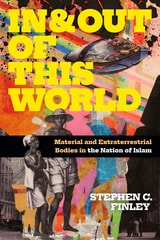
In and Out of This World
Material and Extraterrestrial Bodies in the Nation of IslamStephen C. Finley
Duke University Press, 2022

In quibus visitabit nobis, oriens ex alto
Studies Offered in Honor of Father Robert J. Kaslyn, SJ (1956-2019)Kurt Martens
Catholic University of America Press, 2025
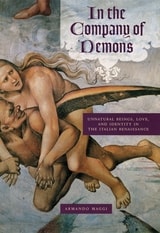
In the Company of Demons
Unnatural Beings, Love, and Identity in the Italian RenaissanceArmando Maggi
University of Chicago Press, 2006
Maggi leads us straight to the heart of what Italian Renaissance culture thought familiar spirits were. Through close readings of Giovan Francesco Pico della Mirandola, Strozzi Cigogna, Pompeo della Barba, Ludovico Sinistrari, and others, we find that these spirits or demons speak through their sudden and striking appearances—their very bodies seen as metaphors to be interpreted. The form of the body, Maggi explains, relies on the spirits’ knowledge of their human interlocutors’ pasts. But their core trait is compassion, and sometimes their odd, eerie arrivals are seen as harbingers or warnings to protect us. It comes as no surprise then that when spiritual beings distort the natural world to communicate, it is vital that we begin to listen.
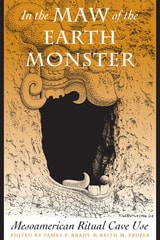
In the Maw of the Earth Monster
Mesoamerican Ritual Cave UseEdited by James E. Brady and Keith M. Prufer
University of Texas Press, 2005
As portals to the supernatural realm that creates and animates the universe, caves have always been held sacred by the peoples of Mesoamerica. From ancient times to the present, Mesoamericans have made pilgrimages to caves for ceremonies ranging from rituals of passage to petitions for rain and a plentiful harvest. So important were caves to the pre-Hispanic peoples that they are mentioned in Maya hieroglyphic writing and portrayed in the Central Mexican and Oaxacan pictorial codices. Many ancient settlements were located in proximity to caves.
This volume gathers papers from twenty prominent Mesoamerican archaeologists, linguists, and ethnographers to present a state-of-the-art survey of ritual cave use in Mesoamerica from Pre-Columbian times to the present. Organized geographically, the book examines cave use in Central Mexico, Oaxaca, and the Maya region. Some reports present detailed site studies, while others offer new theoretical understandings of cave rituals. As a whole, the collection validates cave study as the cutting edge of scientific investigation of indigenous ritual and belief. It confirms that the indigenous religious system of Mesoamerica was and still is much more terrestrially focused that has been generally appreciated.
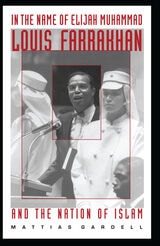
In the Name of Elijah Muhammad
Louis Farrakhan and The Nation of IslamMattias Gardell
Duke University Press, 1996
Beginning with Master Farad Muhammad, believed to be God in Person, Gardell examines the origins of the Nation. His research on the period of Elijah Muhammad’s long leadership draws on previously unreleased FBI files that reveal a clear picture of the bureau’s attempts to neutralize the Nation of Islam. In addition, they shed new light on the circumstances surrounding the murder of Malcolm X. With the main part of the book focused on the fortunes of the Nation after Elijah Muhammad’s death, Gardell then turns to the figure of Minister Farrakhan. From his emergence as the dominant voice of the radical black Islamic community to his leadership of the Million Man March, Farrakhan has often been portrayed as a demagogue, bigot, racist, and anti-Semite. Gardell balances the media’s view of the Nation and Farrakhan with the Nation’s own views and with the perspectives of the black community in which the organization actively works. His investigation, based on field research, taped lectures, and interviews, leads to the fullest account yet of the Nation of Islam’s ideology and theology, and its complicated relations with mainstream Islam, the black church, the Jewish community, extremist white nationalists, and the urban culture of black American youth, particularly the hip-hop movement and gangs.

In the Name of the Father
The Rhetoric of the New Southern Baptist ConventionCarl L. Kell and L. Raymond Camp. Foreword by Kenneth Chafin
Southern Illinois University Press, 1999
In the Name of the Father: The Rhetoric of the New Southern Baptist Conventionbegins with an analysis of the 1979 Southern Baptist Convention, the watershed convention where moderate forces fell before the powerful oratory of the ultraconservative faction, which has remained in power ever since. Communication professors Carl L. Kell and L. Raymond Camp investigate the rhetorical shift from moderate to ultraconservative in the Southern Baptist Convention, the largest denomination in the South and the largest Protestant denomination in the United States.
Drawing on sermons delivered at national conventions from 1979 to the present, Kell and Camp outline the discourses of fundamentalism, inerrancy, and exclusion. These discourses, the authors assert, point to the SBC leaders’ call for a return to times before feminism and tolerance of varying sexual orientations allegedly brought chaos to society and shook believers from their theological foundations.
In the Presence of Gods and Spirits
Hirata Atsutane and His CollaboratorsAnne Walthall
University of Michigan Press, 2025
In the School of the Word
Biblical Interpretation from the New to the Old TestamentCarlos Granados
Saint Paul Seminary Press, 2021
In the Shadow of Empire
Israel and Judah in the Long Sixth Century BCEPamela Barmash
SBL Press, 2021
Empires Come and Go, Homelands Never
Readers of the Hebrew Bible know the basic story line: during the early sixth century BCE the Babylonian ruler Nebuchadnezzar sacked Jerusalem, deported a portion of the population to Mesopotamia, and triggered a crisis of faith in the minds of prophets, priests, and liturgists that still echoes through the centuries. Though many Judahites chose to make their way home under Persian imperial control, the straightforward biblical story of exile and return masks many complex issues of evidence and fact. Unlike previous studies that focused narrowly on the Babylonian exile of the Judahite elites, this volume widens the geographical and temporal scope to include the Assyrian, Babylonian, and Persian Empires. Improved access to and understanding of relevant texts, iconography, and material culture provide an opportunity for scholars to reappraise methods of imperial control and the responses of those in exile and under occupation. Contributors Pamela Barmash, Ryan P. Bonfiglio, Caralie Cooke, Lisbeth S. Fried, Martien A. Halvorson-Taylor, Mark W. Hamilton, Matt Waters, and Ian D. Wilson lay a firm foundation for future work on the long sixth century.

In the Shadow of Salem
The Andover Witch Hunt of 1692Richard Hite
Westholme Publishing, 2024
By July 1692, the witch hunt surrounding the town of Salem and Salem Village had been raging for four months. The Massachusetts Bay colony’s new governor, William Phips, had established a special court to try the suspected witches and the trials were well under way. No new arrests had taken place for nearly six weeks and residents had every reason to believe the crisis soon would be over. However, a middle-aged woman in nearby Andover lay gravely ill. Her husband suspected witchcraft as the cause and invited some of the afflicted girls from Salem Village to the town, thinking they could determine whether his suspicions were valid. Not surprisingly, they confirmed his supposition. The first person these girls accused in Andover—a frail and elderly widow bereaved by a series of family tragedies over the previous three years—not only confessed, but stated that there were more than three hundred witches in the region, five times more than the number of suspects already in jail. This touched off a new wave of accusations, confessions, and formal charges. Before the witchcraft crisis ended, forty-five residents of Andover found themselves jailed on suspicion of witchcraft—more than the combined total of suspects from Salem Village and the town of Salem. Of these, three were hanged and one died while awaiting execution.
Based on extensive primary source research, In the Shadow of Salem: The Andover Witch Hunt of 1692, by historian and archivist Richard Hite, tells for the first time the fascinating story of this long overlooked phase of the largest witch hunt in American history. Untangling a net of rivalries and ties between families and neighbors, the author explains the actions of the accusers, the reactions of the accused, and their ultimate fates. In the process, he shows how the Andover arrests prompted a large segment of the town’s population to openly oppose the entire witch hunt and how their actions played a crucial role in finally bringing the 1692 witchcraft crisis to a close.
In the Trenches with Jesus and Marx
Harry F. Ward and the Struggle for Social JusticeDavid Duke
University of Alabama Press, 2006
The story of a Social Gospel leader who brought faith, activism, and social justice into the heart of modern American politics.
Radical religious and political leader Harry F. Ward started life quietly enough in a family of Methodist shopkeepers and butchers in London. But his relentless pursuit of social justice would lead him to the United States and a long career of religious activism. Ward served as professor of Christian ethics at the Union Theological Seminary and chairman of the board of the American Civil Liberties Union for two decades. He also became a leader in labor groups, Protestant activist organizations, and New York intellectual circles.
David Duke builds his comprehensive story of this fiery leader from extensive archival sources, including FBI files and private correspondence, sermons, class notes, and other unpublished material. Duke skillfully charts Ward's rise from an idealistic Methodist minister in a Chicago stockyard parish to a prominent national religious leader and influential political figure. Ultimately, Ward's lifelong attempt to synthesize the beliefs of Jesus and Marx and his role as an admirer of the Soviet Union put him on a collision course with McCarthyism in Cold War America. Viewed by some as a prophet and by others as a heretic, traitor, and communist, Ward became increasingly marginalized as he stubbornly maintained his radical positions. Even in his own circle, he went from being a figure of unquestioned integrity who eloquently spoke his convictions to a tragically short-sighted idealogue whose unwavering pro-Soviet agenda blinded him to the horrors of Stalinist oppression.
Harry Ward's long, colorful career intersected nearly every intellectual current in American culture for more than a half century. This biography will be important for scholars of American religious history, students of liberalism and politics, social Christians, and general readers who enjoy a compelling tour into the private and public lives of notable figures of history.
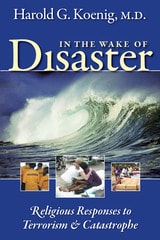
In the Wake of Disaster
Religious Responses to Terrorism and CatastropheHarold G Koenig
Templeton Press, 2006
In a timely book with a powerful and persuasive message, Dr. Harold G. Koenig addresses federal, state, and local government policy leaders, urging them to more fully integrate religious organizations into the formal disaster response system, and he then provides recommendations on how this can effectively be done. Koenig also advocates faith communities and organizations to learn more about the role they can play in responding to disasters and terrorism.
In the Work of Their Hands Is Their Prayer
Cultural Narrative and Redemption on the American Frontiers, 1830-1930Joel Daehnke
Ohio University Press, 2003
Westward expansion on the North American continent by European settlers generated a flurry of writings on the frontier experience over the course of a hundred years. Asserting that the dominant ideology of America’s Manifest Destiny embodied a tense, often contradictory union of Christian and secular republican views of social progress, In the Work of Their Hands Is Their Prayer investigates the ambivalence of the frontier as it was inscribed with redemptive, historical significance by a host of frontier writers.
Enlisting canonical and noncanonical sources, Joel Daehnke examines the manner in which the imagery of the human figure at work and play in the frontier landscape participated in the nationalist, “civilizing” project of westward expansion. While he acknowledges the growing secularization of American life, Professor Daehnke surveys the continuing claims of the Christian redemptive scheme as a powerful symbolic domain for these writers’ meditations on social progress and the potential for human perfectibility in the landscapes of the West.
Whether discussing the Edenic imagery of women’s gardens, the advocacy of an ethics of land use, or the affairs of fortune in the mining districts of Nevada, In the Work of Their Hands Is Their Prayer presents an enlightening reexamination of an American ideology of progress and its enduring fascination with mission, Manifest Destiny, and the ends of history.
In the Work of Their Hands Is Their Prayer is a welcome addition to the extended library of critical attention to the ideology, history, and literary traditions of the American frontier.
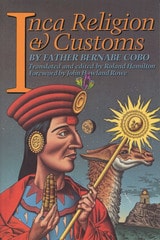
Inca Religion and Customs
By Bernabe Cobo
University of Texas Press, 1990
Incarnate Meaning
Lonergan on NewmanRichard M. Liddy
Catholic University of America Press, 2027
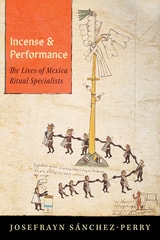
Incense and Performance
The Lives of Mexica Ritual SpecialistsSánchez-Perry, Josefrayn
University of Arizona Press, 2026
At the time of the conquest of Mexico, the anonymous authors of the Anales de Tlatelolco (1560s) recorded the deaths of two Mexica ritual specialists. During the tumultuous events of the times, Quauhnochtli (a telpochcalli specialist) and Quauhcoatl (a calmecac specialist) died protecting the temple of Huitzilopochtli and his bundled embodiement in the neighborhood of Huitznahuac.
Scholar Josefrayn Sánchez-Perry reconstructs the lives and labors of the two specialists, articulated through Nahuatl-language texts, material culture from neighborhood and temple spaces, and the academic study of religion. The book expands on known theories on Mexica ritual specialists by providing new insights about telpochcalli and calmecac duties, their interrelated educational models, and the collective practices that brought people, animals, flora, specialists, and teteo (more-than-human forces) together. The book demonstrates that telpochcalli and calmecac specialists shared the ritual responsibilities of collective and elective practices.
Giving care to teteo, giving life, and giving offerings were balanced with giving war, giving council, and giving music and dance. As Quauhnochtli and Quauhcoatl ensured the safety of the bundled Huitzilopochtli, they characterized how a Mexica ritual specialist lived and what they did.

India in the Eyes of Europeans
Conceptualization of Religion in Theology and Oriental StudiesMartin Fárek
Karolinum Press, 2022
In India in the Eyes of Europeans, Martin Fárek argues that when Western scholars interpret Indian traditions, they actually present distorted reflections of their own European culture, despite their attempts at unbiased objectivity. This distortion is clearest in the way India is viewed primarily through a religious lens—a lens fashioned from an implicitly Christian design. While discussing the current international dialogue on the topic and the work of such scholars as S. N. Balagangadhara, Fárek’s study presents the results of original research on several key topics: the problems in assigning religious significance to the Indian traditions that gave rise to Hinduism and Buddhism; Europeans’ questioning of Indians’ historical consciousness; the current debate surrounding the arrival of the Aryans in India; and controversial interpretations of the work of the reformer Rammohan Raj. The result is a provocative study that should prove fascinating to Indologists, theologians, anthropologists, and anyone interested in the history of thought.
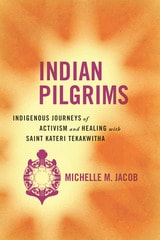
Indian Pilgrims
Indigenous Journeys of Activism and Healing with Saint Kateri TekakwithaMichelle M. Jacob
University of Arizona Press, 2016
Author Michelle M. Jacob examines Saint Kateri’s influence on and relation to three important themes—caring for the environment, building community, and reclaiming the Native feminine as sacred—and brings a Native feminist perspective to the story of Saint Kateri. The book demonstrates the power and potential of Indigenous decolonizing activism, as Saint Kateri’s devotees claim the space of the Catholic Church to revitalize traditional cultural practices, teach and learn Indigenous languages, and address critical issues such as protecting Indigenous homelands from environmental degradation. The book is based on ethnographic research at multiple sites, including Saint Kateri’s 2012 canonization festivities in Vatican City and Italy, the Akwesasne Mohawk Reservation (New York and Canada), the Yakama Reservation (Washington), and the National Tekakwitha Conferences in Texas, North Dakota, and Louisiana. Through narratives from these events, Jacob addresses issues of gender justice—such as respecting the autonomy of women while encouraging collectivist thinking and strategizing—and seeks collective remedies that challenge colonial and capitalist filters.
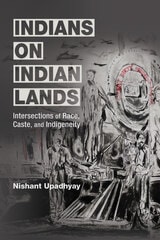
Indians on Indian Lands
Intersections of Race, Caste, and IndigeneityNishant Upadhyay
University of Illinois Press, 2024
Winner of a NWSA/University of Illinois Press First Book Prize
Nishant Upadhyay unravels Indian diasporic complicity in its ongoing colonialist relationship with Indigenous peoples, lands, and nations in Canada. Upadhyay examines the interwoven and simultaneous areas of dominant Indian caste complicity in processes of settler colonialism, antiblackness, capitalism, brahminical supremacy, Hindu nationalism, and heteropatriarchy. Resource extraction in British Columbia in the 1970s–90s and in present-day Alberta offer examples of spaces that illuminate the dispossession of Indigenous peoples and simultaneously reveal racialized, gendered, and casted labor formations. Upadhyay juxtaposes these extraction sites with examples of anticolonial activism and solidarities from Tkaronto. Analyzing silence on settler colonialism and brahminical caste supremacy, Upadhyay upends the idea of dominant caste Indian diasporas as racially victimized and shows that claiming victimhood denies a very real complicity in enforcing other power structures. Exploring stories of quotidian proximity and intimacy between Indigenous and South Asian communities, Upadhyay offers meditations on anticolonial and anti-casteist ways of knowledge production, ethical relationalities, and solidarities.Groundbreaking and ambitious, Indians on Indian Lands presents the case for holding Indian diasporas accountable for acts of violence within a colonial settler nation.
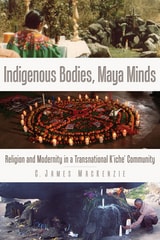
Indigenous Bodies, Maya Minds
Religion and Modernity in a Transnational K'iche' CommunityC. James MacKenzie
University Press of Colorado, 2016
Indigenous Bodies, Maya Minds examines tension and conflict over ethnic and religious identity in the K’iche’ Maya community of San Andrés Xecul in the Guatemalan Highlands and considers how religious and ethnic attachments are sustained and transformed through the transnational experiences of locals who have migrated to the United States.
Author C. James MacKenzie explores the relationship among four coexisting religious communities within Highland Maya villages in contemporary Guatemala—costumbre, traditionalist religion with a shamanic substrate; “Enthusiastic Christianity,” versions of Charismaticism and Pentecostalism; an “inculturated” and Mayanized version of Catholicism; and a purified and antisyncretic Maya Spirituality—with attention to the modern and nonmodern worldviews that sustain them. He introduces a sophisticated set of theories to interpret both traditional religion and its relationship to other contemporary religious options, analyzing the relation among these various worldviews in terms of the indigenization of modernity and the various ways modernity can be apprehended as an intellectual project or an embodied experience.
Indigenous Bodies, Maya Minds investigates the way an increasingly plural religious landscape intersects with ethnic and other identities. It will be of interest to Mesoamerican and Mayan ethnographers, as well as students and scholars of cultural anthropology, indigenous cultures, globalization, and religion.
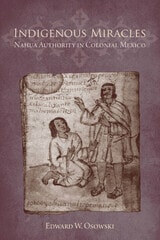
Indigenous Miracles
Nahua Authority in Colonial MexicoEdward W. Osowski
University of Arizona Press, 2010
Indigenous Miracles is about how the Nahua elite of central Mexico secured political legitimacy through the administration of public rituals centered on miraculous images of Christ the King. Osowski argues that these images were adopted as community symbols and furthermore allowed Nahua leaders to “represent their own kingship,” protecting their claims to legitimacy. This legitimacy allowed them to act collectively to prevent the loss of many aspects of their culture. Osowski demonstrates how a shared religion admitted the possibility of indigenous agency and new ethnic identities.
Consulting both Nahuatl and Spanish sources, Osowski strives to fill a gap in the history of the Nahuas from 1760 to 1810, a momentous time when previously sanctioned religious practices were condemned by the viceroys and archbishops of the Bourbon royal dynasty. His approach synthesizes ethnohistory and institutional history to create a fascinating account of how and why the Nahuas protected the practices and symbols they had appropriated under Hapsburg rule. Ultimately, Osowski’s account contributes to our understanding of the ways in which indigenous agency was negotiated in colonial Mexico.
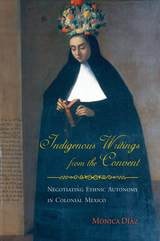
Indigenous Writings from the Convent
Negotiating Ethnic Autonomy in Colonial MexicoMónica Díaz
University of Arizona Press, 2010
While colonial sources that refer to indigenous women are not scant, documents in which women emerge as agents who actively participate in shaping their own identity are rare. Looking at this minority agency—or subaltern voice—in various religious discourses exposes some central themes. It shows that an indigenous identity recast in Catholic terms was able to be effectively recorded and that the religious participation of these women at a time when indigenous parishes were increasingly secularized lent cohesion to that identity.
Indigenous Writings from the Convent examines ways in which indigenous women participated in one of the most prominent institutions in colonial times—the Catholic Church—and what they made of their experience with convent life. This book will appeal to scholars of literary criticism, women’s studies, and colonial history, and to anyone interested in the ways that class, race, and gender intersected in the colonial world.
Indigenous and Popular Thinking in América
Rodolfo Kusch
Duke University Press, 2010
Indigenous and Popular Thinking in América is a record of Kusch's attempt to immerse himself in the indigenous ways of knowing and being. At first glance, his methodology resembles ethnography. He speaks with and observes indigenous people and mestizos in Peru, Bolivia, and Argentina. He questions them about their agricultural practices and economic decisions; he observes rituals; he asks women in the market the meaning of indigenous talismans; he interviews shamans; he describes the spatial arrangement and the contents of shrines, altars, and temples; and he reproduces diagrams of archaeological sites, which he then interprets at length. Yet he does not present a "them" to a putative "us." Instead, he offers an inroad to a way of thinking and being that does not follow the logic or fit into the categories of Western social science and philosophy. In his introduction, Walter D. Mignolo discusses Kusch's work and its relation to that of other twentieth-century intellectuals, Argentine history, and contemporary scholarship on the subaltern and decoloniality.
Indiscretion
Finitude and the Naming of GodThomas A. Carlson
University of Chicago Press, 1998
Combining both historical research in theology (from Pseudo-Dionysius to Aquinas to Eckhart) and contemporary philosophical analysis (from Hegel and Nietzsche to Heidegger, Derrida, and Marion), Indiscretion will interest philosophers, theologians, and other scholars concerned with the possibilities and limits of language surrounding both God and human subjectivity.
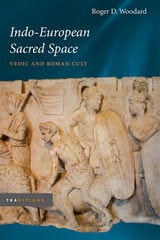
Indo-European Sacred Space
Vedic and Roman CultRoger D. Woodard
University of Illinois Press, 2006
Looking closely at the organization of Roman religious activity, especially as regards sacrifices, festivals, and the hierarchy of priests, Woodard sheds new light on issues including the presence of the god Terminus in Jupiter's Capitoline temple, the nature of the Roman suovetaurilia, the Ambarvalia and its relationship to the rites of the Fratres Arvales, and the identification of the "Sabine" god Semo Sancus. Perhaps most significantly, this work also presents a novel and persuasive resolution to the long standing problem of "agrarian Mars."
Ingrid Jonker
Poet under ApartheidLouise Viljoen
Ohio University Press, 2012
Nelson Mandela brought the poetry of Ingrid Jonker to the attention of South Africa and the wider world when he read her poem “Die kind” (The Child) at the opening of South Africa’s first democratic parliament on May 24, 1994. Though Jonker was already a significant figure in South African literary circles, Mandela’s reference contributed to a revival of interest in Jonker and her work that continues to this day.
Viljoen’s biography illuminates the brief and dramatic life of Jonker, who created a literary oeuvre—as searing in its intensity as it is brief—before taking her own life at the age of thirty-one. Jonker wrote against a background of escalating apartheid laws, violent repression of black political activists, and the banning of the African National Congress and the Pan Africanist Congress. Viljoen tells the story of Ingrid Jonker in the political and cultural context of her time, provides sensitive insights into her poetry, and considers the reasons for the enduring fascination with her life and death.
Her writings, her association with bohemian literary circles, and her identification with the oppressed brought her into conflict with her father, a politician in the white ruling party, and with other authority figures from her Afrikaner background. Her life and work demonstrate the difficulty and importance of artistic endeavor in a place of terrible conflict.
Inka Bodies and the Body of Christ
Corpus Christi in Colonial Cuzco, PeruCarolyn Dean
Duke University Press, 1999
As Dean clearly illustrates, the central rite of the festival—the taking of the Eucharist—symbolized both the acceptance of Christ and the power of the colonizers over the colonized. The most remarkable of Andean celebrants were those who appeared costumed as the vanquished Inka kings of Peru’s pagan past. Despite the subjugation of the indigenous population, Dean shows how these and other Andean nobles used the occasion of Corpus Christi as an opportunity to construct new identities through tinkuy, a native term used to describe the conjoining of opposites. By mediating the chasms between the Andean region and Europe, pagans and Christians, and the past and the present, these Andean elites negotiated a new sense of themselves. Dean moves beyond the colonial period to examine how these hybrid forms of Inka identity are still evident in the festive life of modern Cuzco.
Inka Bodies and the Body of Christ offers the first in-depth analysis of the culture and paintings of colonial Cuzco. This volume will be welcomed by historians of Peruvian culture, art, and politics. It will also interest those engaged in performance studies, religion, and postcolonial and Latin American studies.
Inquiry about the Monks in Egypt
Catholic University of America Press, 2020
Inscribed
Encounters with the Ten CommandmentsRabbi Oren J. Hayon
Central Conference of American Rabbis, 2020
This anthology gives voice to the many diverse and contemporary perspectives about each of the Ten Commandments. Written by an impressive collection of rabbis and scholars, the volume allots multiple chapters for each of the commandments in order to engage with the ways in which these timeless utterances have inspired contemporary laws, ethics, and moral guidelines.

Inside Al-Qaeda and the Taliban
Beyond Bin Laden and 9/11Syed Saleem Shahzad
Pluto Press, 2011
President Obama may have delivered on his campaign promise to kill Osama bin Laden, but as an Al-Qaeda strategist bin Laden has been dead for years. This book introduces and examines the new generation of Al-Qaeda leaders who have been behind the most recent attacks.
Investigative journalist Syed Saleem Shahzad dedicated his life to revealing the strategies and inner workings of Al-Qaeda and the Taliban. He had access to top-level commanders in both movements, as well as within the ISI, Pakistan's intelligence service. Shahzad's work was praised by US Secretary of State Hillary Clinton for 'bringing to light the troubles extremism poses to Pakistan's stability.' Inside Al-Qaeda and the Taliban explains the wider aims of both organisations and provides an essential analysis of major terrorist incidents, including the 2008 Mumbai attacks.
In May 2011, Shahzad was abducted and killed in Pakistan, days after writing an article suggesting that insiders in the Pakistani navy had colluded with Al-Qaeda in an attack on a naval air station. This book is a testament to his fearless reporting and analytical rigour. It will provide readers worldwide with an invaluable introduction to a new phase of the ongoing struggle against terrorism which threatens lives in so many countries.
Inspiration and Interpretation
A Theological Introduction to Sacred ScriptureDenis Farkasfalvy
Catholic University of America Press, 2010
Instrument of Memory
Encounters with the Wandering JewLisa Lampert-Weissig
University of Michigan Press, 2024
Intellectual Appetite
A Theological GrammarPaul J. Griffiths
Catholic University of America Press, 2009
Intellectual Sacrifice and Other Mimetic Paradoxes
Paolo Diego Bubbio
Michigan State University Press, 2018
Intelligent Souls?
Feminist Orientalism in Eighteenth-Century English LiteratureSamara Anne Cahill
Bucknell University Press, 2019
Published by Bucknell University Press. Distributed worldwide by Rutgers University Press.
Intelligibility of Nature
A William A. Wallace ReaderWilliam A. Wallace
Catholic University of America Press, 2022
Interested Readers
Essays on the Hebrew Bible in Honor of David J.A. ClinesJames K. Aitken
SBL Press, 2013
Interfaith Encounters in America
McCarthy, Kate
Rutgers University Press, 2007
From its most cosmopolitan urban centers to the rural Midwest, the United States is experiencing a rising tide of religious interest. While terrorist attacks keep Americans fixed on an abhorrent vision of militant Islam, popular films such as The Passion of the Christ and The Da Vinci Code make blockbuster material of the origins of Christianity. The 2004 presidential election, we are told, was decided on the basis of religiously driven moral values. A majority of Americans are reported to believe that religious differences are the biggest obstacle to world peace.
Beneath the superficial banter of the media and popular culture, however, are quieter conversations about what it means to be religious in America today—conversations among recent immigrants about how to adapt their practices to life in new land, conversations among young people who are finding new meaning in religions rejected by their parents, conversations among the religiously unaffiliated about eclectic new spiritualities encountered in magazines, book groups, or online. Interfaith Encounters in America takes a compelling look at these seldom acknowledged exchanges, showing how, despite their incompatibilities, Buddhist, Muslim, Christian, Jewish, and Hindu Americans, among others, are using their beliefs to commit to the values of a pluralistic society rather than to widen existing divisions.
Chapters survey the intellectual exchanges among scholars of philosophy, religion, and theology about how to make sense of conflicting claims, as well as the relevance and applicability of these ideas “on the ground” where real people with different religious identities intentionally unite for shared purposes that range from national public policy initiatives to small town community interfaith groups, from couples negotiating interfaith marriages to those exploring religious issues with strangers in online interfaith discussion groups.
Written in engaging and accessible prose, this book provides an important reassessment of the problems, values, and goals of contemporary religion in the United States. It is essential reading for scholars of religion, sociology, and American studies, as well as anyone who is concerned with the purported impossibility of religious pluralism.
Interfigural Readings of the Gospel of John
Ingrid Rosa Kitzberger
SBL Press, 2019
New and challenging readings of biblical characters
This volume of collected essays introduces the concept of interfigurality, the interrelations and interdependence between characters in the Gospel of John and in the Synoptic Gospels and the Hebrew Bible.The essays are informed by a narrative-critical reader-response, (post)feminist hermeneutics and an autobiographical approach to biblical texts. This volume encourages transformative encounters between present-day readers and the ancient biblical texts.
Features:
- Previously unpublished conference papers and published essays
- A new perspective on the relation between New Testament and Hebrew Bible
- Foreword by Fernando F. Segovia
Ingrid Rosa Kitzberger is an independent scholar and the author of Transformative Encounters: Jesus and Women Re-viewed (1999) and the editor of The Personal Voice in Biblical Interpretation (1998) and Autobiographical Biblical Criticism: Between Text and Self (2002).
Intermediate Biblical Hebrew Grammar
A Student's Guide to Phonology and MorphologyEric D. Reymond
SBL Press, 2018
A unique grammar for intermediate or advanced students of Hebrew
This grammar is intended for students of Hebrew who wish to learn more about the history of the Hebrew language, specifically its phonology and morphology. Reymond focuses on aspects of Hebrew that will encourage a student to better remember the words and their inflection as well as those that will reinforce general principles of the language. Specific examples for memorization are outlined at the end of each chapter. The book also serves as a resource for students wishing to remind themselves of the relative frequency of certain phenomena. The book provides students with a full picture of the language's morphology.
Features:
- Tables of nouns and adjectives illustrating the absolute and construct, singular and plural forms, as well as all the forms with suffixes
- Tables include forms not found in the Masoretic Text
- Additional tables that set similar verbal inflections side by side
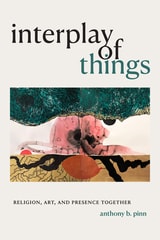
Interplay of Things
Religion, Art, and Presence TogetherAnthony B. Pinn
Duke University Press, 2021
Interpreting 2 Peter through African American Women’s Moral Writings
Shively T. J. Smith
SBL Press, 2023
Interpreting Maimonides
Studies in Methodology, Metaphysics, and Moral PhilosophyMarvin Fox
University of Chicago Press, 1990
Interpreting the Gospel of John in Antioch and Alexandria
Miriam DeCock
SBL Press, 2020
A nuanced study of early Christian exegesis
Miriam DeCock analyzes four important early Christian treatments of the Gospel of John, including commentaries by Origen and Cyril from the Alexandrian tradition and the homilies of John Chrysostom and the commentary of Theodore of Mopsuestia, which represent Antiochian traditions. DeCock maintains that the traditional distinction between nonliteral and literal interpretations in these two early Christian centers remains helpful despite recent challenges to the paradigm. She argues that a major and abiding distinction between the two schools lies in the manner in which Alexandrian and Antiochian authors apply the gospel text to their respective communities. DeCock demonstrates that the Antiochenes find primarily literal moral examples and doctrinal teachings in John's Gospel, whereas the Alexandrians find both these and nonliteral teachings concerning the immediate situation of the church and of its individual members.
Features
- An examination of each author's interpretations of a selection of texts
- Focused explorations of John 2; 4; and 9-11 in early Christian exegesis
- A study of early literal non-literal interpretations of John's Gospel
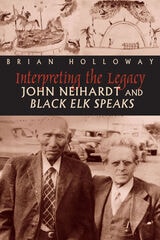
Interpreting the Legacy
John Neihardt and Black Elk SpeaksBrian Holloway
University Press of Colorado, 2020
Using Neihardt's original handwritten notes and early manuscript drafts, Holloway demonstrates the poet's careful and deliberate re-creation of Black Elk's spiritual world in order to induce a transcendent experience in the reader. Through exhaustive research into Neihardt's biographical materials, published philosophical and metaphysical writings, and volumes of taped lectures, Holloway examines the sources of the book's production as well as the reactions to and the implications of his literary portrayal of the spiritual world of the Oglala.
Restoring Neihardt's reputation as a faithful witness to Black Elk's sacred landscape, Interpreting the Legacy: John Neihardt and Black Elk Speaks will be of interest to Neihardt scholars and students of literature, religious studies, and Native American studies.
Intersecting Journeys
The Anthropology of Pilgrimage and TourismEdited by Ellen Badone and Sharon R. Roseman
University of Illinois Press, 2004
Intersexual Persons and Theology of the Body
A Limit Case for John Paul II's Theological AnthropologyBeth Zagrobelny Lofgren
Catholic University of America Press, 2026
Intimacy Across Borders
Race, Religion, and Migration in the U.S. MidwestJane Juffer
Temple University Press, 2013
Examining how encounters produced by migration lead to intimacies-ranging from sexual, spiritual, and neighborly to hateful and violent, Jane Juffer considers the significant changes that have occurred in small towns following an influx of Latinos to the Midwest.
Intimacy across Borders situates the story of the Dutch Reformed Church in Iowa and South Africa within a larger analysis of race, religion, and globalization. Drawing on personal narrative, ethnography, and sociopolitical critique, Juffer shows how migration to rural areas can disrupt even the most thoroughly entrenched religious beliefs and transform the schools, churches, and businesses that form the heart of small-town America. Conversely, such face-to-face encounters can also generate hatred, as illustrated in the increasing number of hate crimes against Latinos and the passage of numerous anti-immigrant ordinances.
Juffer demonstrates how Latino migration to new areas of the U.S. threatens certain groups because it creates the potential for new kinds of families—mixed race, mixed legal status, and transnational—that challenge the conservative definition of community based on the racially homogeneous, coupled, citizen family.
Intimate Connections
Love and Marriage in Pakistan’s High MountainsAnna-Maria Walter
Rutgers University Press, 2022
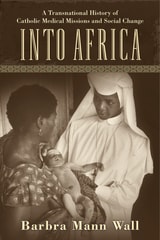
Into Africa
A Transnational History of Catholic Medical Missions and Social ChangeWall, Barbra Mann
Rutgers University Press, 2015
Awarded first place in the 2016 American Journal of Nursing Book of the Year Award in the History and Public Policy category
The most dramatic growth of Christianity in the late twentieth century has occurred in Africa, where Catholic missions have played major roles. But these missions did more than simply convert Africans. Catholic sisters became heavily involved in the Church’s health services and eventually in relief and social justice efforts. In Into Africa, Barbra Mann Wall offers a transnational history that reveals how Catholic medical and nursing sisters established relationships between local and international groups, sparking an exchange of ideas that crossed national, religious, gender, and political boundaries.
Both a nurse and a historian, Wall explores this intersection of religion, medicine, gender, race, and politics in sub-Saharan Africa, focusing on the years following World War II, a period when European colonial rule was ending and Africans were building new governments, health care institutions, and education systems. She focuses specifically on hospitals, clinics, and schools of nursing in Ghana and Uganda run by the Medical Mission Sisters of Philadelphia; in Nigeria and Uganda by the Irish Medical Missionaries of Mary; in Tanzania by the Maryknoll Sisters of New York; and in Nigeria by a local Nigerian congregation. Wall shows how, although initially somewhat ethnocentric, the sisters gradually developed a deeper understanding of the diverse populations they served. In the process, their medical and nursing work intersected with critical social, political, and cultural debates that continue in Africa today: debates about the role of women in their local societies, the relationship of women to the nursing and medical professions and to the Catholic Church, the obligations countries have to provide care for their citizens, and the role of women in human rights.
A groundbreaking contribution to the study of globalization and medicine, Into Africa highlights the importance of transnational partnerships, using the stories of these nuns to enhance the understanding of medical mission work and global change.