Results by title
22279 books match the query 'Social Science' and 851 start with i

Identities
Edited by Kwame Anthony Appiah and Henry Louis Gates Jr.
University of Chicago Press, 1995
Leading scholars in literary criticism, anthropology, sociology, and philosophy explore such topics as "Gypsies" in the Western imagination, the mobilization of the West in Chinese television, the lesbian identity and the woman's gaze in fashion photography, and the regulation of black women's bodies in early 20th-century urban areas. This collection of twenty articles brings together the special issue of Critical Inquiry entitled "Identities" (Summer 1992), two other previously published essays, and five previously published critical responses and rejoinders, all of which is interrogated in two new essays by Michael Gorra and Judith Butler.
Contributors include Elizabeth Abel, Kwame Anthony Appiah, Akeel Bilgrami, Daniel Boyarin, Jonathan Boyarin, Judith Butler, Hazel V. Carby, Xiaomei Chen, Diana Fuss, Henry Louis Gates, Jr., Avery Gordon, Michael Gorra, Cheryl Herr, Saree S. Makdisi, Walter Benn Michaels, Christopher Newfield, Gananath Obeyesekere, Molly Anne Rothenberg, Gayatri Chakravorty Spivak, Sara Suleri, Katie Trumpener, and Joseph Valente.
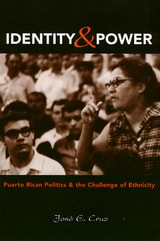
Identity And Power
Puerto Rican Politics and the Challenge of EthnicityJosé E. Cruz
Temple University Press, 1998
The activities of the Puerto Rican Political Action Committee from 1983 to 1991 illustrate the power of ethnic mobilization and strategy in an urban setting. Cruz examines their insistence on their right to be included in the political process in the context of both a typical mid-sized American city and the unique attributes of Hartford's predominantly white-collar population. At the same time, this study acknowledges the limitations of the exercise of such power in the political process.
Through extensive interviews Cruz brings to light the variety of ways in which politicians and political activists themselves view their own activities and achievements. This group of Puerto Rican activists attempted to penetrate the power structure of Hartford. Though their success was limited, their work constitutes a springboard for further change.

Identity Complex
Making the Case for MultiplicityMichael Hames-García
University of Minnesota Press, 2011
In seemingly exhaustive arguments about identity as a category of analysis, we have made a critical error—one that Michael Hames-García sets out to correct in this revisionary look at the making and meaning of social identities. We have asked how separate identities—of race, class, ethnicity, gender, and sexuality—come to intersect. Instead, Hames-García proposes, we should begin by understanding such social identities as mutually constituting one another.
Grounded in both theoretical and political practices—in the lived realities of people’s experience—Identity Complex reinvigorates identity as a key concept and as a tool for the pursuit of social justice. Hames-García draws on a wide range of examples to show that social identities are central to how exploitation works, such as debates about the desirability of sexual minority identities in postcolonial contexts, questions about the reality of race, and the nature of the U.S. prison crisis.
Unless we understand precisely how identities take shape in relation to each other and within contexts of oppression, he contends, we will never be able to eradicate discrimination and social inequality. By analyzing the social interdependence of identities, Hames-García seeks to enable the creation of deep connections of solidarity across differences.
Identity Crises
A Social Critique Of PostmodernityRobert G. Dunn
University of Minnesota Press, 1998
A readable analysis of postmodernity that provides a cultural context for its rise.
Though the term “postmodern” looms large on our cultural landscape, rarely do we find a systematic and impartial discussion of the circumstances of its ascendance. Identity Crises offers just such an accounting. In this book, Robert G. Dunn situates the intellectual currency of “the postmodern” within the larger context of social and cultural change shaping the movement over the past several decades. Along the way, he offers a necessary corrective to both the sociological and historical shortcomings of cultural criticism and the cultural myopia of social science in considering the postmodern world.
Dunn explains contemporary culture and contemporary cultural criticism as part of a distinct historical moment, one that entails new social relations as a consequence of new means of production. In place of prevailing cultural and political constructions, Dunn proposes a “social relational” approach that explicitly recognizes the structural and situational contexts of identity formation. He conceptualizes issues of identity and difference in terms of social, cultural, and political transformations in the transition from modern to postmodern society. This provides a socio-historical perspective through which to consider the impact of consumption, mass media, globalization, and new social movements on identity-forming processes. Unique to this undertaking and crucial to Dunn’s critique of poststructuralist and postmodern theories is his application of the theory of George Herbert Mead as a more effective means of theorizing identity and difference. Dunn’s focus on postmodernity as opposed to postmodernism serves to ground the analysis of identity and difference materially and socially. Learned, evenhanded, and enlightening, Identity Crises is an essential demonstration of the connections between cultural theory and criticism, contemporary culture, and sociological analysis. ISBN 0-8166-3072-0 Cloth $49.95xxISBN 0-8166-3073-9 Paper $19.95x304 pages 5 7/8 x 9 MarchTranslation inquiries: University of Minnesota Press
Identity Designs
The Sights and Sounds of a NationKaren A Cerulo
Rutgers University Press, 1995
National symbols, modern totems with ancient roots, remain entities for which men and women continue to march, debate, fight, and die. Modern political leaders still drape their campaigns in such symbols; modern revolutionaries still defile them. Identity Designs explores the source of this long-standing power––the way national symbols are selected, the manner in which their meaning is conveyed, their potential effects, and the sustenance of their power.
In particular, the book charts the role of design in the selection of symbolic images, thus demonstrating that symbols are chosen not just for what they convey, but how they convey their message. Karen Cerulo shows that the symbolic designs of a nation's identity are not simply the products of indigenous characteristics, as conventional wisdom might suggest. Rather, the banners and songs by which nations represent themselves are generated by broad social forces that transcend the peculiarities of any one nation. Cerulo's analysis acquaints readers with a set of social structural factors that delimit rules of symbolic expression. Further, the book suggests the benefits of adhering to these rules and explores the costs of violating them.

Identity Destabilised
Living in an Overheated WorldEdited by Thomas Hylland Eriksen and Elisabeth Schober
Pluto Press, 2016
Identity Politics of Difference
The Mixed-Race American Indian ExperienceMichelle Montgomery
University Press of Colorado, 2021
In Identity Politics of Difference, author Michelle R. Montgomery uses a multidisciplinary approach to examine questions of identity construction and multiracialism through the experiences of mixed-race Native American students at a tribal school in New Mexico. She explores the multiple ways in which these students navigate, experience, and understand their racial status and how this status affects their educational success and social interactions.
Montgomery contextualizes students’ representations of their racial identity choices through the compounded race politics of blood quantum and stereotypes of physical features, showing how varying degrees of "Indianness" are determined by peer groups. Based on in-depth interviews with nine students who identify as mixed-race (Native American–White, Native American–Black, and Native American–Hispanic), Montgomery challenges us to scrutinize how the category of “mixed-race” bears different meanings for those who fall under it based on their outward perceptions, including their ability to "pass" as one race or another.
Identity Politics of Difference includes an arsenal of policy implications for advancing equity and social justice in tribal colleges and beyond and actively engages readers to reflect on how they have experienced the identity politics of race throughout their own lives. The book will be a valuable resource to scholars, policy makers, teachers, and school administrators, as well as to students and their families.
Identity Politics
Lesbian Feminism and the Limits of CommunityShane Phelan
Temple University Press, 1991
"Lesbian feminism began and has fueled itself with the rejection of liberalism.... In this rejection, lesbian feminists were not alone. They were joined by the New Left, by many blacks in the civil rights movement, by male academic theorists.... What all these groups shared was an intense awareness of the ways in which liberalism fails to account for the social reality of the world, through a reliance upon law and legal structure to define membership, through individualism, through its basis in a particular conception of rationality."
In tracing how lesbian feminism came to be defined in uneasy relationships with the Women’s Movement and gay rights groups, Shane Phelan explores the tension between liberal ideals of individual rights and tolerance and communitarian ideals of solidarity. The debate over lesbian sado-masochism—an expression of individual choice or pornographic, anti-feminist behavior?—is considered as a test case.
Phelan addresses the problems faced by "the woman-identified woman" in a liberal society that presumes heterosexuality as the biological, psychological, and moral standard. Often silenced by laws defining their sexual behavior as criminal and censured by a medical establishment that persists in defining homosexuality as perversion, lesbians, like blacks and other groups, have fought to have the same rights as others in their communities and even in their own homes. Lesbian feminists have also sought to define themselves as a community that would be distinctly different, a community that would disavow the traditional American obsession with individual advancement in the world as it is.
In this controversial study of political philosophy and the women’s movement, Phelan argues that "the failure to date to produce a satisfying theory and program for lesbian action is reflective of the failure of modern political thinking to produce a compelling, nonsuspect alternative to liberalism."
In the series Women in the Political Economy, edited by Ronnie J. Steinberg.
Identity Technologies
Constructing the Self OnlineEdited by Anna Poletti and Julie Rak
University of Wisconsin Press, 2013
Identity Work in Social Movements
Jo Reger
University of Minnesota Press, 2008
This volume offers new scholarship that explores issues of diversity and uniformity among social movement participants. Featuring case studies that range widely—from Jewish resistance fighters in Nazi-occupied Poland to antigay Christian movements in the United States to online white supremacy groups—the essays show how participants set aside issues of personal identity in order to merge together and how these processes affect mobilization and the attainment of goals.
Contributors: Mary Bernstein, Kimberly B. Dugan, Elizabeth Kaminski, Susan Munkres, Kevin Neuhouser, Benita Roth, Silke Roth, Todd Schroer, Verta Taylor, Jane Ward.
Identity and the Case for Gay Rights
Race, Gender, Religion as AnalogiesDavid A. J. Richards
University of Chicago Press, 1999
Richards argues that racial and gender struggles are informative but partial models. As in these movements, achieving gay rights requires eliminating unjust stereotypes and allowing one's identity to develop free from intolerant views. Richards stresses, however, that gay identity is an ethical choice based on gender equality. Thus the right to religious freedom offers the most compelling analogy for a gay rights movement because gay identity should be protected legally as an ethical decision of conscience.
A thoughtful and highly original voice in the struggle for gay rights, David Richards is the first to argue that discrimination is like religious intolerance-denial of full humanity to individuals because of their identity and moral commitments to gender equality.
Identity and the Failure of America
From Thomas Jefferson to the War on TerrorJohn Michael
University of Minnesota Press, 2008
From Thomas Jefferson to John Rawls, justice has been at the center of America’s self-image and national creed. At the same time, for many of its peoples-from African slaves and European immigrants to women and the poor-the American experience has been defined by injustice: oppression, disenfranchisement, violence, and prejudice.
In Identity and the Failure of America, John Michael explores the contradictions between a mythic national identity promising justice to all and the realities of a divided, hierarchical, and frequently iniquitous history and social order. Through a series of insightful readings, Michael analyzes such cultural moments as the epic dramatization of the tension between individual ambition and communal complicity in Moby-Dick, attempts to effect social change through sympathy in the novels of Lydia Marie Child and Harriet Beecher Stowe, Ralph Waldo Emerson’s antislavery activism and Frederick Douglass’s long fight for racial equity, and the divisive figures of John Brown and Nat Turner in American letters and memory.
Focusing on exemplary instances when the nature of the United States as an essentially conflicted nation turned to force, Michael ultimately posits the development of a more cosmopolitan American identity, one that is more fully and justly imagined in response to the nation’s ethical failings at home and abroad.
John Michael is professor of English and of visual and cultural studies at the University of Rochester. He is the author of Anxious Intellects: Academic Professionals, Public Intellectuals, and Enlightenment Values and Emerson and Skepticism: The Cipher of the World.
Identity and the Second Generation
How Children of Immigrants Find Their SpaceFaith G. Nibbs
Vanderbilt University Press, 2015
This book explores the social worlds of the children of immigrants. Based on rich ethnographic research, the contributors illustrate how these young people, the so-called second generation, construct and negotiate their lives. Ultimately, the driving question is profoundly important on a universal level: How do these young people construct an identity and a sense of belonging for themselves, and how do they deal with processes of inclusion and exclusion?
Identity, Culture, And Politics In The Basque Diaspora
Gloria Pilar Totoricagüena
University of Nevada Press, 2015
Totoricagüena offers a superb quantitative study of an aspect of Basque culture that has been largely ignored by scholars—the diaspora. In doing so, she enlarges the understanding of cultural identity in general—how it is defined and preserved, how it evolves over time, and how both the politics of distant places and the most intimate family habits can shape an individual’s sense of self. Identity, Culture, and Politics in the Basque Diaspora is a major contribution to the knowledge of Basques and their persistent political and cultural traditions.
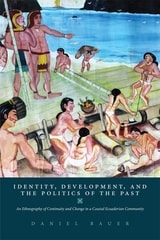
Identity, Development, and the Politics of the Past
An Ethnography of Continuity and Change in a Coastal Ecuadorian CommunityBauer
University Press of Colorado, 2018
Residents in the coastal community of Salango pushed for formal recognition of Indigenous identity while highlighting their pre-Hispanic roots in order to make claims about cultural continuity and ancestrality. Bauer considers the extent to which the politics of identity is embedded in the process of community-based development, paying close attention to how local conceptions of identity and residents’ ideas about their own identity and the identities of others fit within the broader context of Ecuadorian and Latin American notions of mestizaje. He emphasizes ethnogenesis and the fluid nature of identity as residents reference prehistory and the archaeological record as anchor points for claims to an Indigenous ethnic identity.
Identity, Development, and the Politics of the Past moves beyond existing studies that center on questions of authenticity and instead focuses on the ways people make claims to identity. This book makes a significant contribution to the growing body of literature on the Ecuadorian coast and directs scholars who focus on Ecuador to expand their focus beyond the highland and Amazonian regions. It will be of interest to students and scholars of Latin American studies, anthropology, ethnology, economic development, and ethnic identity.

Identity, Feasting, and the Archaeology of the Greater Southwest
Barbara J. Mills
University Press of Colorado, 2004
Unlike many previous studies, the authors of this volume place emphasis on how differences within and between societies came about rather than why dissimilar structures arose, elevating the place of both agency and history in understanding the past. Identity, Feasting, and the Archaeology of the Greater Southwest will be of interest to all doing archaeological research in the Southwestern United States and those conducting research on social identity, cultural affiliation, and commensal politics. Contributors include Karen R. Adams, Jeffrey J. Clark, Patricia L. Crown, T. J. Ferguson, Catherine S. Fowler, Robert J. Hard, Jane H. Hill, Jane H. Kelley, Frances Levine, Micah Loma'omvaya, K. Tsianina Lomawaima, A. C. MacWilliams, Paul E. Minnis, Scott G. Ortman, David Phillips Jr., James M. Potter, John R. Roney, Lynne Sebastian, Katherine A. Spielmann, Joe D. Stewart, Scott Van Keuren, Laurie D. Webster, Michael E. Whalen, and W. H. Wills
Identity, Mediation, and the Cunning of Capital
Ani Maitra
Northwestern University Press, 2020
Maitra’s archive is transnational and multimodal. Moving from anticolonial polemics to psychoanalysis to diasporic experimental literature to postcolonial feminist and queer media, he lays bare the cunning by which capitalism produces and fragments identity through an intermedial “aesthetic dissonance” with the commodity form. Maitra’s novel contribution to theories of identity and to the concept of mediation will interest a wide range of scholars in media studies, critical race and postcolonial studies, and critical aesthetics.
Ideologies in Archaeology
Edited by Reinhard Bernbeck and Randall McGuire
University of Arizona Press, 2011
Contributors to this volume focus on elements of life in past societies that “went without saying” and that concealed different forms of power as obvious and unquestionable. From the use of burial rites as political theater in Iron Age Germany to the intersection of economics and elite power in Mississippian mound building, the contributors uncover complex manipulations of power that have often gone unrecognized. They show that Occam’s razor—the tendency to favor simpler explanations—is sometimes just an excuse to avoid dealing with the historical world in its full complexity.
Jean-Paul Demoule’s concluding chapter echoes this sentiment and moreover brings a continental European perspective to the preceding case studies. In addition to situating this volume in a wider history of archaeological currents, Demoule identifies the institutional and cultural factors that may account for the current direction in North American archaeology. He also offers a defense of archaeology in an era of scientific relativism, which leads him to reflect on the responsibilities of archaeologists.
Includes contributions by: Susan M. Alt, Bettina Arnold, Uzi Baram, Reinhard Bernbeck, Matthew David Cochran, Jean-Paul Demoule, Kurt A. Jordan, Susan Kus, Vicente Lull, Christopher N. Matthews, Randall H. McGuire, Rafael Micó, Cristina Rihuete Herrada, Paul Mullins, Sue Novinger, Susan Pollock, Victor Raharijaona, Roberto Risch, Kathleen Sterling, Ruth M. Van Dyke, and LouAnn Wurst
Ideology
David Mclellan
University of Minnesota Press, 1995

Idiocracy
The Culture of the New IdiotZoran Terzic
Diaphanes, 2021
Zoran Terzić’s wide-ranging essay takes up the figure of the idiot and follows its numerous appearances throughout intellectual history in an examination of the “art of the idiotic” that both reflects and transcends the freneticism of the present.
Idiotism
Capitalism and the Privatisation of LifeNeal Curtis
Pluto Press, 2012
Constructing a new vocabulary with which to understand contemporary society, Curtis examines 'idiotism' across the spheres of economics, politics and culture, drawing on the philosophy and political theories of Martin Heidegger, Louis Althusser, Franco Berardi, Jacques Rancière and Cornelius Castoriadis.
Idiotism recasts our conception of the new neoliberal 'common sense', presenting it as not simply a case of false consciousness, but an ontological problem related to our being-in-the-world.
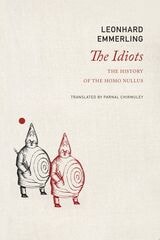
Idiots
The History of the Homo NullusLeonhard Emmerling
Seagull Books, 2026
Dostoevsky and Nietzsche wrote about him; Dadaists and punks idolized him; artists like Warhol and Beuys made him their icon. From holy fool to punk rebel, the idiot—a figure that traces its roots back to the Greek idiotes, a person who was alienated from public life—has always challenged society’s norms from the margins. Far from a simple madman, the idiot is a powerful subversive, a person who disregards norms and finds profound insight in a state of unmediated inspiration. Using a cross-disciplinary approach bridging literature, religion, art, and philosophy, this volume traces a rich journey up to the present, where the idiot reemerges in a dramatic twist: a public figure who inverts social norms, confounds the boundary between private and public, and declares a new, paradoxical view of the world.
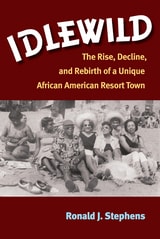
Idlewild
The Rise, Decline, and Rebirth of a Unique African American Resort TownRonald J. Stephens
University of Michigan Press, 2013
In 1912, white land developers founded Idlewild, an African American resort community in western Michigan. Over the following decades, the town became one of the country’s foremost vacation destinations for the black middle class, during its peak drawing tens of thousands of visitors annually and hosting the era’s premier entertainers, such as The Four Tops, Della Reese, Brook Benton, and George Kirby. With the civil rights movement and the resulting expansion of recreation options available to African Americans, Idlewild suffered a sharp social and economic decline, and by the early 1980s the town had become a struggling retirement community in the midst of financial and political crises.
Meticulously researched and unearthing never-before-seen historical material, Ronald J. Stephens’s book examines the rapid rise and decline of this pivotal landmark in African American and leisure history, in the process exploring intersections among race, class, tourism, entertainment, and historic preservation in the United States. Featuring a wealth of fieldwork on contemporary Idlewild, the book also takes a candid look at recent revitalization efforts and analyzes the possibilities for a future resurgence of this national treasure.
Idolatry and the Construction of the Spanish Empire
Mina García Soormally
University Press of Colorado, 2018
Contrasting readings of evangelization plays and chronicles from the Indies and legislation and literature produced in Spain, author Mina García Soormally places theoretical analysis of state formation in Colonial Latin America within the historical context. The conquest of America was presented, in its first instances, as a virtual extension of the Reconquista, which had taken place in Spain since 711, during which Spaniards fought to build an empire based in part on religious discrimination. The fight against the “heathens” (Moors and Jews) provided the experience and mindset to practice the repression of the other, making Spain a cultural laboratory that was transported across the Atlantic Ocean.
Idolatry and the Construction of the Spanish Empire is a wide-ranging explication of religious orthodoxy and unorthodoxy during Spain’s medieval and early modern period as they relate to idolatry, with analysis of events that occurred on both sides of the Atlantic. The book contributes to the growing field of transatlantic studies and explores the redefinition that took place in Europe and in the colonies.
If Beale Street Could Talk
Music, Community, CultureRobert Cantwell
University of Illinois Press, 2008
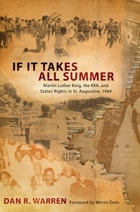
If It Takes All Summer
Martin Luther King, the KKK, and States' Rights in St. Augustine, 1964Dan R. Warren, with foreword by Morris Dees
University of Alabama Press, 2008
An insider’s record of the St. Augustine Civil Rights drama.
This memoir recounts the struggle against segregation in St. Augustine, Florida, in the early and mid-1960s. In the summer of 1964 the nation’s oldest city became the center of the civil rights movement as Martin Luther King Jr., encouraged by President Johnson, a southerner, who made the civil rights bill the center piece of his domestic policy, chose this tourism-driven community as an ideal location to demonstrate the injustice of discrimination and the complicity of southern leaders in its enforcement.
St. Augustine was planning an elaborate celebration of its founding, and expected generous federal and state support. But when the kick-off dinner was announced only whites were invited, and local black leaders protested. The affair alerted the national civil rights leadership to the St. Augustine situation as well as fueling local black resentment.
Ferment in the city grew, convincing King to bring his influence to the leadership of the local struggle. As King and his allies fought for the right to demonstrate, a locally powerful Ku Klux Klan counter-demonstrated. Conflict ensued between civil rights activists, local and from out-of-town, and segregationists, also home-grown and imported. The escalating violence of the Klan led Florida’s Governor to appoint State Attorney Dan Warren as his personal representative in St. Augustine. Warren’s crack down on the Klan and his innovative use of the Grand Jury to appoint a bi-racial committee against the intransigence of the Mayor and other officials, is a fascinating story of moral courage. This is an insider view of a sympathetic middleman in the difficult position of attempting to bring reason and dialog into a volatile situation.
If Memory Serves
Gay Men, AIDS, and the Promise of the Queer PastChristopher Castiglia
University of Minnesota Press, 2011
The AIDS epidemic soured the memory of the sexual revolution and gay liberation of the 1970s, and prominent politicians, commentators, and academics instructed gay men to forget the sexual cultures of the 1970s in order to ensure a healthy future. But without memory there can be no future, argue Christopher Castiglia and Christopher Reed in this exploration of the struggle over gay memory that marked the decades following the onset of AIDS.
Challenging many of the assumptions behind first-wave queer theory, If Memory Serves offers a new perspective on the emergence of contemporary queer culture from the suppression and repression of gay memory. Drawing on a rich archive of videos, films, television shows, novels, monuments, paintings, and sculptures created in the wake of the epidemic, the authors reveal a resistance among critics to valuing—even recognizing—the inscription of gay memory in art, literature, popular culture, and the built environment. Castiglia and Reed explore such topics as the unacknowledged ways in which the popular sitcom Will and Grace circulated gay subcultural references to awaken a desire for belonging among young viewers; the post-traumatic (un)rememberings of queer theory; and the generation of “ideality politics” in the art of Félix González-Torres, the film Chuck & Buck, and the independent video Video Remains.
Inspired by Alasdair MacIntyre’s insight that “the possession of a historical identity and the possession of a social identity coincide,” Castiglia and Reed demonstrate that memory is crafted in response to inadequacies in the present—and therefore a constructive relation to the past is essential to the imagining of a new future.
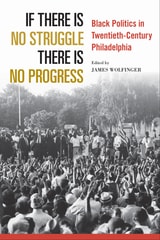
If There Is No Struggle There Is No Progress
Black Politics in Twentieth-Century PhiladelphiaEdited by James Wolfinger
Temple University Press, 2022
Philadelphia has long been a crucial site for the development of Black politics across the nation. If There Is No Struggle There Is No Progress provides an in-depth historical analysis—from the days of the Great Migration to the present—of the people and movements that made the city a center of political activism. The editor and contributors show how Black activists have long protested against police abuse, pushed for education reform, challenged job and housing discrimination, and put presidents in the White House.
If There Is No Struggle There Is No Progress emphasizes the strength of political strategies such as the “Don’t Buy Where You Can’t Work” movement and the Double V campaign. It demonstrates how Black activism helped shift Philadelphia from the Republican machine to Democratic leaders in the 1950s and highlights the election of politicians like Robert N. C. Nix, Sr., the first African American representative from Philadelphia. In addition, it focuses on grassroots movements and the intersection of race, gender, class, and politics in the 1960s, and shows how African Americans from the 1970s to the present challenged Mayor Frank Rizzo and helped elect Mayors Wilson Goode, John Street, and Michael Nutter.
If There Is No Struggle There Is No Progress cogently makes the case that Black activism has long been a powerful force in Philadelphia politics.

If They Don't Bring Their Women Here
Chinese Female Immigration before ExclusionGeorge Anthony Peffer
University of Illinois Press, 1999
Seven years before the Chinese Exclusion Act of 1882, the Page Law sought to stem the tide of Chinese prostitutes entering the United States. Yet during these seven years, it was not just prostitutes but all Chinese females who encountered at best hostility and at worst expulsion when they reached the "Golden Door."
George Anthony Peffer looks at enforcement of immigration laws to provide the first detailed account of Chinese American women's lives in the pre-exclusion era. Peffer documents the habeas corpus trials in which the wives and daughters of Chinese laborers were required to prove their status as legal immigrants or return to China. He also surveys the virulently anti-Chinese coverage of these trials and the issue of Chinese immigration received in California newspapers, confirming that Chinatown's prostitution industry so dominated the popular imagination as to render other classes of female immigrants all but invisible.
Insightful and groundbreaking, If They Don't Bring Their Women Here amplifies the voices of Chinese immigrant women and establishes a place for them within the historiographic framework of Chinese American studies.

If Truth Be Told
The Politics of Public EthnographyDidier Fassin, editor
Duke University Press, 2017
Contributors. Jonathan Benthall, Lucas Bessire, João Biehl, Gabriella Coleman, Manuela Ivone Cunha, Vincent Dubois, Nadia Abu El-Haj, Didier Fassin, Kelly Gillespie, Ghassan Hage, Sherine Hamdy, Federico Neiburg, Unni Wikan

If You Don't Laugh You'll Cry
The Occupational Humor of White Wisconsin Prison WorkersClaire Schmidt
University of Wisconsin Press, 2017
In a state that locks up a disproportionate number of men and women of color, white prison workers occupy a complicated social position as representatives of institutional authority and bearers of social stigma. The job, by turns dangerous, dull, or dehumanizing, is aided by a quick wit, comedic timing, and verbal agility. The men and women who do this work rely on storytelling, practical jokes, and sarcasm to bond with each other, build flexible relationships with inmates, and create personal identities that work in and out of prison. Schmidt shows how this humorous occupational culture both upholds and undermines prisons as social institutions.
Issues of power and race, as well as sex and gender, infuse Schmidt's groundbreaking analysis, and she also engages with current scholarship about identity, occupational folklore, and family narrative. This eye-opening, provocative book reveals the invisible culture, beliefs, and aesthetics embedded in workplace humor.
If You've Seen One, You've Seen the Mall
EUROPEANS AND AMERICAN MASS CULTURERob Kroes
University of Illinois Press, 1996
continually fragmenting, disassembling, and reassembling itself--and in
the process creating something new. In a series of topical essays that
show why he is one of Europe's leading authorities on American culture,
Kroes probes trends in American advertising, the image of the Vietnam
war in American films, the implications of American vernacular culture as represented in rap music, and other topics.
Ifá Priestcraft
Ifáyemí Elébuìbon and Yorùbá Ancestral Knowledge SystemsToyin Falola
University of Wisconsin Press, 2026
Born in 1947, Ifáyẹmí Ọ̀ṣúndàgbonù Ẹlẹ́buìbọn descends from a long line of Yorùbá healers, philosophers, and priests. A fervent disciple of Ifá from age four, Ẹlẹ́buìbọn grew to become both a living moral exemplar and an internationally recognized face of his religion. The first scholarly work to connect the biography of a devout Ifá practitioner to broader intellectual conversations around pluriversalism and Indigenous knowledge systems, Ifá Priestcraft analyzes the complexities of Yorùbá philosophy and religion and their lasting cultural impact in Nigeria and throughout the diaspora. Toyin Falola, a world-renowned scholar of African studies, employs a phenomenological approach that recognizes and solidifies the voice of the “guru” as an organic and authentic source of knowledge. The result is a wholly original and uniquely interdisciplinary study of Yorùbá spirituality and an extraordinary contribution to the field of ancestral studies.

Ilegal
Reflexiones de un inmigrante indocumentadoJosé Ángel N.
University of Illinois Press, 2019
José Ángel N. es escritor y traductor. Sus ensayos se han publicado en revistas culturales en México y Estados Unidos. Verónica Murguía es escritora y traductora y radica en México.
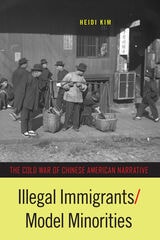
Illegal Immigrants/Model Minorities
The Cold War of Chinese American NarrativeHeidi Kim
Temple University Press, 2021
In the Cold War era, Chinese Americans were caught in a double-bind. The widespread stigma of illegal immigration, as it was often called, was most easily countered with the model minority, assimilating and forming nuclear families, but that in turn led to further stereotypes. In Illegal Immigrants/Model Minorities, Heidi Kim investigates how Chinese American writers navigated a strategy to normalize and justify the Chinese presence during a time when fears of Communism ran high.
Kim explores how writers like Maxine Hong Kingston, Jade Snow Wong, and C. Y. Lee, among others, addressed issues of history, family, blood purity, and law through then-groundbreaking novels and memoirs. Illegal Immigrants/Model Minorities also uses legal cases, immigration documents, and law as well as mass media coverage to illustrate how writers constructed stories in relation to the political structures that allowed or disallowed their presence, their citizenship, and their blended identity.
Kim illuminates the rapidly shifting political and social pressures on Chinese American authors who selectively concealed, revealed, and reconstructed issues of citizenship, belonging, and inclusion in their writing.

Illegal Migrations and the Huckleberry Finn Problem
John S W Park
Temple University Press, 2013

Illegalized
Undocumented Youth Movements in the United StatesRafael A. Martínez
University of Arizona Press, 2024
Rafael A. Martínez, an undocu-scholar, intricately weaves his lived experience into this deeply insightful exploration. Martínez’s interdisciplinary approach will engage scholars and readers alike, resonating with disciplines such as history, American studies, Chicana and Chicano studies, and borderlands studies.
Illegalized shows that undocumented youth and their activism represent a disruption to the social imaginary of the U.S. nation-state and its figurative and physical borders. It invites readers to explore how undocumented youth activists changed the way immigrant rights are discussed in the United States today.
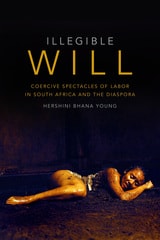
Illegible Will
Coercive Spectacles of Labor in South Africa and the DiasporaHershini Bhana Young
Duke University Press, 2017

Illiberal Politics and Religion in Europe and Beyond
Concepts, Actors, and Identity NarrativesEdited by Anja Hennig and Mirjam Weiberg-Salzmann
Campus Verlag, 2020

Illiberal Vanguard
Populist Elitism in the United States and RussiaAlexandar Mihailovic
University of Wisconsin Press, 2023
Mihailovic investigates notable right-wing actors like Steve Bannon and Alexander Dugin and targets of right-wing ire such as globalization, LGBTQ+ activism, and mobilizations to remove controversial statues (that honor Confederate generals and Soviet leaders, for instance), but the argument extends beyond the specifics. How and why are radical right-wing movements developing along such similar trajectories in two nominally oppositional countries? How do religious sectarianism, the construction of whiteness, and institutionalized homophobia support each other in this transnational, informal, but powerful allegiance? Despite their appeals to populism and flamboyant theatrics, Mihailovic argues, much of the answer can be found in the mutual desire to justify and organize an illiberal vanguard of elite intellectuals, one that supports and advocates for a new authoritarianism.

Illness Politics and Hashtag Activism
Lisa Diedrich
University of Minnesota Press, 2024
How illness on social media reveals the struggle for care and access against ableism and stigma
Illness Politics and Hashtag Activism explores illness and disability in action on social media, analyzing several popular hashtags as examples of how illness figures in recent U.S. politics. Lisa Diedrich shows how illness- and disability-oriented hashtags serve as portals into how and why illness and disability are sites of political struggle and how illness politics is informed by, intersects with, and sometimes stands in for sexual, racial, and class politics. She argues that illness politics is central—and profoundly important—to both mainstream and radical politics, and she investigates the dynamic intersection of media and health and health-activist practices to show the ways their confluence affects our perception and understanding of illness.

Illness or Deviance?
Drug Courts, Drug Treatment, and the Ambiguity of AddictionJennifer Murphy
Temple University Press, 2015
Illness or Deviance? highlights the confusion and contradictions about labeling addiction. Murphy’s fieldwork in a drug court and an outpatient drug treatment facility yields fascinating insights, such as how courts and treatment centers both enforce the “disease” label of addiction, yet their management tactics overlap treatment with “therapeutic punishment.” The “addict" label is a result not just of using drugs, but also of being a part of the drug lifestyle, by selling drugs. In addition, Murphy observes that drug courts and treatment facilities benefit economically from their cooperation, creating a very powerful institutional arrangement.
Murphy contextualizes her findings within theories of medical sociology as well as criminology to identify the policy implications of a medicalized view of addiction.
Illuminating Letters
Typography and Literary InterpretationPaul C. Gutjahr
University of Massachusetts Press, 2001
What do we read when we read a text? The author's words, of course, but is that all? The prevailing publishing ethic has insisted that typography—the selection and arrangement of type and other visual elements on a page—should be an invisible, silent, and deferential servant to the text it conveys.
This book contests that conventional point of view. Looking at texts ranging from the King James Bible to contemporary comic strips, the contributors to Illuminating Letters examine the seldom considered but richly revealing relationships between a text's typography and its literary interpretation. The essays assume no previous typographic knowledge or expertise; instead they invite readers primarily concerned with literary and cultural meanings to turn a more curious eye to the visual and physical forms of a specific text or genre. As the contributors show, closer inspection of those forms can yield fresh insights into the significance of a text's material presentation, leading readers to appreciate better how presentation shapes understandings of the text's meanings and values.
The case studies included in the volume amplify its two overarching themes: one set explores the roles of printers and publishers in manipulating, willingly or not, the meaning and reception of texts through typographic choices; the other group examines the efforts of authors to circumvent or subvert such mediation by directly controlling the typographic presentation of their texts. Together these essays demonstrate that choices about type selection and arrangement do indeed help to orchestrate textual meaning.
In addition to the editors, contributors include Sarah A. Kelen, Beth McCoy, Steven R. Price, Leon Jackson, and Gene Kannenberg Jr.
Illuminating the Particular
Photographs of Milwaukee's Polish South SideChristel T. Maass
Wisconsin Historical Society Press, 2003
While Kwasniewski's camera captured the sights and sounds of Milwaukee at the turn of the century from the perspective of a single ethnic group in a single neighborhood, his photographs resonate far beyond Milwaukee's Polish South Side. They illuminate the particulars of American life during the early decades of the twentieth century. "What we see, reflected in the distant mirror," says John Gurda, "is ourselves."

Illusions of a Future
Psychoanalysis and the Biopolitics of DesireKate Schechter
Duke University Press, 2014
In the process, Schechter shows how deeply imbricated the analyst-patient relationship is in this effort. Since the mid-twentieth century, the "real" relationship between analyst and patient is no longer the unremarked background of analysis but its very site. Psychoanalysts seek to validate the centrality of this relationship with theory and, through codified "standards," to claim it as a privileged technique. It has become the means by which psychoanalysts, in seeking to protect their disciplinary autonomy, have unwittingly bound themselves to a neoliberal discourse of regulation.
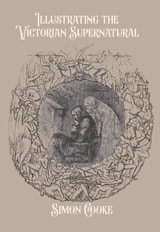
Illustrating the Victorian Supernatural
Simon Cooke
Ohio University Press, 0
A detailed study of Victorian supernaturalism in book and magazine illustrations and cartoons
Illustrating the Victorian Supernatural explores written and visual texts through which the original Victorian readership encountered and navigated their experience of supernaturalism. Looking across the nineteenth century, Simon Cooke investigates illustrative responses to well-known texts by writers such as Charles Dickens and Henry James while also examining responses to less familiar ghost stories by female authors such as M. E. Braddon and Amelia Edwards. The mix of familiar and unfamiliar carries forward into the selection of artists, both those in the mainstream—John Leech, George Cruikshank, Dante Gabriel Rossetti, John Everett Millais—and others whose names are lost to modern readers and whose work deserves to be better known.
The study addresses two main questions: how illustration responded to key literary texts and how graphic designs related to contemporary contexts of race, gender, and class and to the workings of the supernatural itself. The first chapter focuses on satirical writings about ghosts and ghostliness and the various ways illustrators depicted that mockery. Chapter 2 traces artistic responses to Dickens’s writing of the supernatural as a mode of psychological investigation. Chapter 3 looks at class and gender and the problematic practice of male artists illustrating female-authored ghost stories. The fourth chapter examines satirical cartoons’ deployment of supernatural imagery to anatomize issues of imperialism and race. Finally, chapter 5 examines how neo-Victorian artists have revisited the classic texts and taken up the themes established by their forebears.

Imacoqwa’s Arrow
On the Biunity of the Sun and Moon in a Papuan LifeworldJadran Mimica
HAU, 2025
In Imacoqwa’s Arrow, Jadran Mimica draws on decades of field research to bring us a rich ethnographic account of myth and meaning in the lifeworlds of the Yagwoia of Papua New Guinea. He focuses especially on the relations of the sun and the moon in Yagwoia understandings of the universe and their own place within it. This is classic terrain in Melanesian ethnography, but Mimica does much more than add to the archive of anthropological accounts of the significance of the sun and the moon for peoples of this part of the world. With extraordinary rigor and reflexivity, he grounds his understanding of Yagwoia concepts in psychoanalytic and phenomenological methods that afford a radically new and revealing translation of these seminal themes in Melanesian mythology and its poetics. This is a major contribution to the hermeneutics of ethnographic translation and theorization.

Image Ethics In The Digital Age
Larry Gross
University of Minnesota Press, 2003
Over the past quarter century, dramatic technological advances in the production, manipulation, and dissemination of images have transformed the practices of journalism, entertainment, and advertising as well as the visual environment itself. From digital retouching to wholesale deception, the media world is now beset by an unprecedented range of moral, ethical, legal, and professional challenges. Image Ethics in the Digital Age brings together leading experts in the fields of journalism, media studies, and law to address these challenges and assess their implications for personal and societal values and behavior.
Among the issues raised are the threat to journalistic integrity posed by visual editing software; the monopolization of image archives by a handful of corporations and its impact on copyright and fair use laws; the instantaneous electronic distribution of images of dubious provenance around the world; the erosion of privacy and civility under the onslaught of sensationalistic twenty-four-hour television news coverage and entertainment programming; and the increasingly widespread use of surveillance cameras in public spaces. This volume of original essays is vital reading for anyone concerned with the influence of the mass media in the digital age.
Contributors: Howard S. Becker; Derek Bousé, Eastern Mediterranean U, Cyprus; Hart Cohen, U of Western Sydney; Jessica M. Fishman; Paul Frosh, Hebrew U of Jerusalem; Faye Ginsburg, New York U; Laura Grindstaff, U of California, Davis; Dianne Hagaman; Sheldon W. Halpern, Ohio State U; Darrell Y. Hamamoto, U of California, Davis; Marguerite Moritz, U of Colorado, Boulder; David D. Perlmutter, Louisiana State U; Dona Schwartz, U of Minnesota; Matthew Soar, Concordia University; Stephen E. Weil, Smithsonian Institution’s Center for Education and Museum Studies.
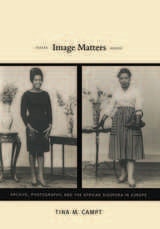
Image Matters
Archive, Photography, and the African Diaspora in EuropeTina M. Campt
Duke University Press, 2012

Images and Identity
Educating Citizenship through Visual ArtsEdited by Rachel Mason and Carl-Peter Buschkuehle
Intellect Books, 2013