Results by title
3785 books match the query 'Poetry' and 144 start with i
Innovative Women Poets
An Anthology of Contemporary Poetry and InterviewsElisabeth A. Frost
University of Iowa Press, 2007
Inside the Storm I Want to Touch the Tremble
Carolyn Oliver
University of Utah Press, 2022
Oliver’s polyphonic gathering of speakers includes lovers and saints, painters and dead poets, a hawk and a mother. In varied forms (ghazals and prose poems, dialogues and erasures, bref double and Golden Shovel, among others) these poems bear witness to and seek reprieve from disasters at once commonplace and terrifying. “I can’t surface for every scalpel slice, / I need a dreamy estuary present,” she writes.
Stumbling toward joy across time and space, these poems hum with fear and desire, bewildering loss, and love’s lush possibilities.
Inside the Storm I Want to Touch the Tremble
Carolyn Oliver
University of Utah Press, 2022
Oliver’s polyphonic gathering of speakers includes lovers and saints, painters and dead poets, a hawk and a mother. In varied forms (ghazals and prose poems, dialogues and erasures, bref double and Golden Shovel, among others) these poems bear witness to and seek reprieve from disasters at once commonplace and terrifying. “I can’t surface for every scalpel slice, / I need a dreamy estuary present,” she writes.
Stumbling toward joy across time and space, these poems hum with fear and desire, bewildering loss, and love’s lush possibilities.
Instead of Dying
Lauren Haldeman
University Press of Colorado, 2017
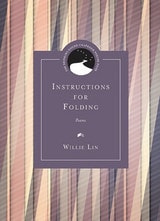
Instructions for Folding
PoemsWillie Lin
Northwestern University Press, 2015
In one of the poems in Instructions for Folding, Willie Lin writes, “it seemed you were away but not beyond language.” And accordingly, the voice in these poems is sometimes fervid, sometimes wry, moved to speech by the specific desire to speak to someone. The poems often progress associatively, following a kind of lyric logic of involution, disruption, and juxtaposition. They rehearse the work of learning the heft and shape of memories. They revel in failures and take pleasure in mourning. They bristle with narrative suggestiveness, weaving an austere music against a scrim of love, loneliness, secrets, and elation.
.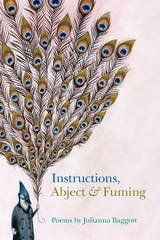
Instructions, Abject & Fuming
Julianna Baggott
Southern Illinois University Press, 2017
Alongside her cultural commentary, the speaker frankly confronts love and sex, as well as the beauty and brutality of having children. Still other poems reflect questions and considerations of faith: the speaker ponders St. Thomas in a pet store and imagines Jesus explaining to God how it feels to have a body.
Baggott’s use of obsolete Old English words subverts common language and creates new ways of interrogating the world around us. There is heartache on these pages, but Baggott also offers humor, such as a complaint about a lover’s eating habits or an extended discourse on a baby’s rattle. Baggott’s latest proves to be a rollicking book sui generis.
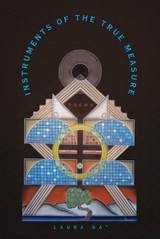
Instruments of the True Measure
PoemsLaura Da'
University of Arizona Press, 2018
Surveying and geography underpin the collection, but even as Da’ investigates these signifiers of measurement, she pushes the reader to interrogate their function within the stark atrocities of American history. Da’ laments this harsh dichotomy, observing that America’s mathematical point of beginning is located in the heart of her tribe’s homeland: “I do not have the Shawnee words to describe this place; the notation that is available to me is 40°38´32.61´´ N 80°31´9.76´´ W.”
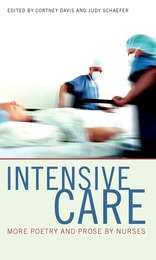
Intensive Care
More Poetry and Prose by NursesCortney & Judy Davis & Schaefer
University of Iowa Press, 2003
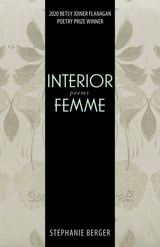
Interior Femme
PoemsStephanie Berger
University of Nevada Press, 2022
The poems offer layered perspectives fused with multiple versions of female representation, as if to underscore the burden of responsibility, inherited shame, and awesome power that comes with the position women have occupied throughout history. Berger reveals a woman critically wounded—representing the totality of the Western feminine imaginary. Lyrically complex, sometimes surreal, and often ekphrastic in style and content, Interior Femme simultaneously offers heartbreak, laughter, comfort, and empowerment.
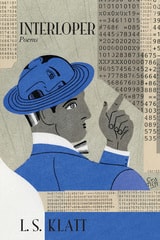
Interloper
PoemsL. S. Klatt
University of Massachusetts Press, 2009
The poems in Interloper unsettle frontiers between disparate worlds so that the imagination is given room to roam: pears become guitars, racks of ribs are presented as steamboats, and helicopters transmute into diesel seraphs. The poetry aspires acrobatically in the manner of prayers and pilots, but adventure throughout the book is viewed as precarious and the will to conquest leads to apocalypse and ruin. The interloper wanders through crime scenes and crash sites as he glosses the landscape—at home and not at home with the America of yesterday and tomorrow. In symbols that scat and ricochet, the interloper scores a new song, one that composes—and decomposes—on the page.
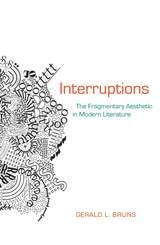
Interruptions
The Fragmentary Aesthetic in Modern LiteratureGerald L. Bruns
University of Alabama Press, 2018
A history of fragmentary—or interrupted—writing in avant-garde poetry and prose by a renowned literary critic.
In Interruptions: The Fragmentary Aesthetic in Modern Literature, Gerald L. Bruns explores the effects of parataxis, or fragmentary writing as a device in modern literature. Bruns focuses on texts that refuse to follow the traditional logic of sequential narrative. He explores numerous examples of self-interrupting composition, starting with Friedrich Schlegel's inaugural theory and practice of the fragment as an assertion of the autonomy of words, and their freedom from rule-governed hierarchies.
Bruns opens the book with a short history of the fragment as a distinctive feature of literary modernism in works from Gertrude Stein to Paul Celan to present-day authors. The study progresses to the later work of Maurice Blanchot and Samuel Beckett, and argues, controversially, that Blanchot's writings on the fragment during the 1950s and early 1960s helped to inspire Beckett’s turn toward paratactic prose.
The study also extends to works of poetry, examining the radically paratactic arrangements of two contemporary British poets, J. H. Prynne and John Wilkinson, focusing chiefly on their most recent, and arguably most abstruse, works. Bruns also offers a close study of the poetry and poetics of Charles Bernstein.
Interruptions concludes with two chapters about James Joyce. First, Bruns tackles the language of Finnegans Wake, namely the break-up of words themselves, its reassembly into puns, neologisms, nonsense, and even random strings of letters. Second, Bruns highlights the experience of mirrors in Joyce’s fiction, particularly in Dubliners, Portrait of the Artist as a Young Man, and Ulysses, where mirrored reflections invariably serve as interruptions, discontinuities, or metaphorical displacements and proliferations of self-identity.
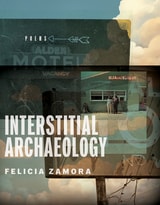
Interstitial Archaeology
Felicia Zamora
University of Wisconsin Press, 2025
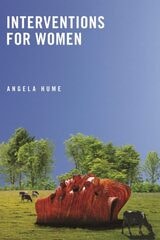
Interventions for Women
Angela Hume
Omnidawn, 2021
Poems that address cultural pressures placed on women and girls.
This is a book for those who were raised to be girls and expected to become women, for those who were told they were too girly and not girly enough, and for those who were ogled, talked over, touched, fed, imagined, and indoctrinated in ways they didn’t want. Angela Hume considers the persistent instructions to smile, be quiet, and act happy, all administered with the promise that this forced behavior would make everything better. The poems address rigid social norms and, ultimately, walk through the uncomfortable realizations about the bigger systems at play and call on us to examine our own complicity in them.
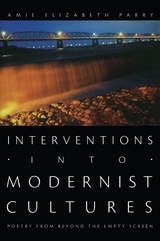
Interventions into Modernist Cultures
Poetry from Beyond the Empty ScreenAmie Elizabeth Parry
Duke University Press, 2007
Reading various works by US expatriates Ezra Pound and Gertrude Stein, Parry compares the cultural politics of U.S. canonical modernism with alternative representations of temporality, hybridity, erasure, and sexuality in the work of the Taiwanese writers Yü Kwang-chung and Hsia Yü and the Asian American immigrant author Theresa Hak Kyung Cha. Juxtaposing poems by Pound and Yü Kwang-chung, Parry shows how Yü’s fragmented, ambivalent modernist form reveals the effects of neocolonialism while Pound denies and obscures U.S. imperialism in Asia, asserting a form of nondevelopmental universalism through both form and theme. Stein appropriates discourses of American modernity and identity to represent nonnormative desire and sexuality, and Parry contrasts this tendency with representations of sexuality in the contemporary experimental poetry of Hsia Yü. Finally, Parry highlights the different uses of modernist forms by Pound in his Cantos—which incorporate a multiplicity of decontextualized and ahistorical voices—and by Cha in her 1982 novel Dictee, a historicized, multilingual work. Parry’s sophisticated readings provide a useful critical framework for apprehending how “minor modernisms” illuminate the histories erased by certain canonical modernist texts.
Intimacy
Catherine Imbriglio
University Press of Colorado, 2013
Intimacy is a series of experimental poems that play with, resist, and acknowledge complicity with received concepts of intimacy that circulate in this media-centric age. Undertaking an expansive understanding of the word “intimacy”, each poem contains a word or set of words that modifies the noun, uncovering the attending, associative and often contradictory obligations that arise in our relations with one another.
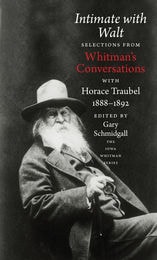
Intimate With Walt
Whitmans Conversataions With Horace TraubelGary Schmidgall
University of Iowa Press, 2001
In Intimate with Walt Gary Schmidgall has condensed Traubel's nearly 5,000 pages into one manageable volume featuring the many self-revealing, humorous, nostalgic, and often curmudgeonly words of the Good Gray Poet. The book is divided into five sections, each consisting of several chapters: the first, presenting Walt on himself, his family, and his daily life and visitors at the only home he ever owned; the second, on his artistic credos, the literary life, and a large array of comments on the writing, publication of, and critical reaction to Leaves of Grass; the third, focusing on his friends, admirers, idols, and lovers; the fourth and longest, presenting his no-holds-barred views on a variety of topics, including the American scene, race, religion, music, and even alcohol; and finally, a gathering of passages revealing Whitman's struggles with his infirmities, his poignant final days, and Traubel's observations on Whitman's deathbed scene and burial rites.

Intimate
An American Family Photo AlbumPaisley Rekdal
Tupelo Press, 2012
Into Daylight
Jeffrey Harrison
Tupelo Press, 2014
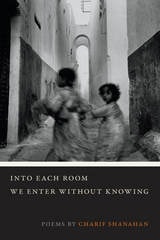
Into Each Room We Enter without Knowing
Charif Shanahan
Southern Illinois University Press, 2017
Finalist, Publishing Triangle's Thom Gunn Award
In this affecting poetry debut, Charif Shanahan explores what it means to be fully human in our wounded and divided world. In poised yet unrelenting lyric poems, Shanahan—queer and mixed-race—confronts the challenges of a complex cultural inheritance, informed by colonialism and his mother’s immigration to the United States from Morocco, navigating racial constructs, sexuality, family, and the globe in search of “who we are to each other . . . who we are to ourselves.”
With poems that weave from Marrakesh to Zürich to London, through history to the present day, this book is, on its surface, an uncompromising exploration of identity in personal and collective terms. Yet the collection is, most deeply, about intimacy and love, the inevitability of human separation and the challenge of human connection. Urging us to reexamine our own place in the broader human tapestry, Into Each Room We Enter without Knowing announces the arrival of a powerful and necessary new voice.
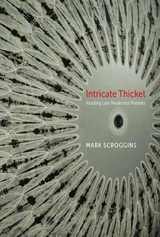
Intricate Thicket
Reading Late Modernist PoetriesMark Scroggins
University of Alabama Press, 2015
In these essays, Scroggins reviews the legacy of Louis Zukofsky, delineates the exceptional influence of the Black Mountain poets, and provides close readings of a wealth of examples of poetic works from poets who have carried the modernist legacy into contemporary poetry. He traces with an insider’s keen observation the careers of many of the most dynamic, innovative, and celebrated poets of the past half-century, among them Ian Hamilton Finlay, Ronald Johnson, Rae Armantrout, Harryette Mullen, and Anne Carson.
In a concluding pair of essays, Scroggins situates his own practice within the broad currents he has described. He reflects on his own aesthetics as a contemporary poet and, drawing on his extensive study and writing about Louis Zukofsky, examines the practical and theoretical challenges of literary biography.
While the core of these essays is the interpretation of poetry, Scroggins also offers clear aesthetic evaluations of the successes and failures of the poetries he examines. Scroggins engages with complex and challenging works, and yet his highly accessible descriptions and criticisms avoid theoretical entanglements and specialized jargon. Intricate Thicket yields subtle and multifaceted insights to experts and newcomers alike.
Introduction To Poetics
Tzvetan Todorov
University of Minnesota Press, 1981
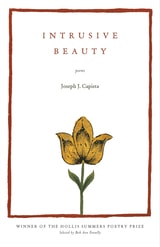
Intrusive Beauty
PoemsJoseph J. Capista
Ohio University Press, 2019
Winner of the 2018 Hollis Summers Poetry Prize
Joseph J. Capista’s Intrusive Beauty reckons with reluctant ecstasy and the improbable forms that beauty assumes. In this powerful debut, Capista traverses earth and ether to yield poems that elucidate the space between one’s life and one’s livelihood. While its landscapes range from back-alley Baltimore to the Bitterroot Valley, this book remains close to unbidden beauty and its capacity to sway one’s vision of the world. Whether a young father who won’t lower the volume on the radio or a Victorian farm boy tasked with scaring birds from seed-sown furrows, the inhabitants of Intrusive Beauty are witness to the startling ease with which one’s assorted lives come in time to comprise a singular life. Mortality, love, duty, desire, an acute longing for transcendence: here, old themes resound anew as they’re uttered in a multiplicity of forms and means, holding fast always to the heart.
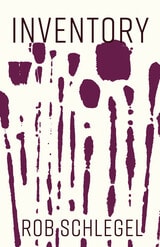
Inventory
Rob Schlegel
University of Chicago Press, 0
A book-length poem serving as a son’s elegy for his late father, an artist and forest steward.
Rob Schlegel’s long poem Inventory emerges from three discrete inventories the poet must catalog in the aftermath of a sudden loss: a selection of his father’s art to be organized for a posthumous exhibition, two hundred acres of trees in a forest stewarded by his father in western Oregon, and his own emotional landscape in the aftermath of his father’s death. As Schlegel moves through these collections of objects and emotions, he learns how to navigate grief. His father’s paintings act as an inventory of the poet’s own life, with each landscape recalling a moment in time, each sketch holding a story. Celebrating a close relationship while mourning its loss, Schlegel reflects on the ties between art and grief, parents and children, people and trees.
At the time of his father’s death, an extreme heatwave was moving across the region, broadening the scope of grief from the personal and familial to encompass tragedies on a larger scale. Social disintegration and climate disaster weave through the lives of a family in mourning as they navigate the complexity of how to sit with loss, change, love, and art. Through quiet, measured verse and arresting simplicity, Inventory extends the ekphrastic tradition into a contemporary elegy rich in both profound sadness and optimism for the future.
Inventory of Doubts
Landon Godfrey
Tupelo Press, 2021
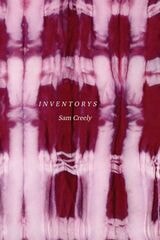
Inventorys
Sam Creely
Omnidawn, 2025
In this work of hybrid historiography, Sam Creely modulates the English sentence to map the ways anglophone imperial self-fashioning moves in and out of social coherence, investigating how syntactic requirements reflect colonial history and how the rules of language structure thought. Through scenes including intimate encounters with dye, fabric, and garments, Creely reveals the sexual and racial grammars of empire.
Inventorys takes as its point of departure the voyage, shipwreck, and eventual excavation of the Spanish trade vessel El Nuevo Constante. Animated by the image of sixty thousand pounds of dye bleeding into the Gulf of Mexico, this six-part poetic documentation follows the wreckage of the Constante linguistically, moving among early modern lexicography, and ultimately toward enmeshed histories of catalog, fabrication, and revision.
Inventorys is the winner of the 2022 Omnidawn Poetry Open Book Contest, selected by Shane McCrae.
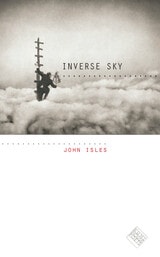
Inverse Sky
John Isles
University of Iowa Press, 2008
Part Baudelairian flâneur, an Arcadian shepherd, the speaker in John Isles’s brave new Inverse Sky encounters a fragmented history. It is nineteenth-century California, and the missions are still burning after the Americans establish the Bear Flag Republic; it is the twenty-first century, and the miners of '49 are relegated to a mural in an arcade. Both a loner and a lover, Isles’s pilgrim-poet takes us on a journey where Native Americans are “missing persons” outside a diorama of their ancestors, then sets us adrift in settings ranging from film noir to the clear-cut hills of modern-day California landscapes, under siege but not defeated.
Inverse Sky evokes the paradigm of a shocked and disbelieving child dealing with a broken promise, yet the poems carry within themselves the knowledge that promises will be kept. The only response to broken promises is “to come undone / to come and go in a single breath.” But this is a beginning as well as an end. Each poem becomes a new world—for if there is anything on earth worth loving, it is something made with the world as it has been handed down to us. Inverse Sky is an insistent effort to "love the things not loving back.”
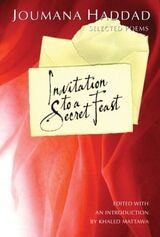
Invitation to a Secret Feast
Selected PoemsJoumana Haddad
Tupelo Press, 2007
In these gorgeous translations, her voice sings, celebrating sexuality, femininity and womanhood.
Involuntary Lyrics
Aaron Shurin
Omnidawn, 2005
Iron Wheel
Greg Miller
University of Chicago Press, 1998
Is There Room for Another Horse on Your Horse Ranch?
Cyrus Cassells
Four Way Books, 2024
Isaac Murphy
I Dedicate This RideFrank X Walker
Ohio University Press, 2010

Isolato
Larissa Szporluk
University of Iowa Press, 2000
The short lyric poems in Larissa Szporluk's new collection, Isolato, search for meaning and beauty—for poetry—in an unpredictable and incomprehensible world. Their voices break from the contemporary preoccupation with autobiography, held together by language rather than a sustained narrative or plot. Yet the narrative fragments clearly evoke certain themes and moods: interaction of and struggle between the human and natural world; violence, particularly against women and children; alienation and betrayal; the mysteries of the universe, God, and death; and, of course, poetry itself.
Variously called a religious, a metaphysical, or a visionary poet, Szporluk has been compared to Emily Dickinson and George Herbert as well as to twentieth-century poets like Sylvia Plath, Mark Strand, and Louise Glück. Her work is concise, experimental, and challenging. Language and syntax are often elusive, the logic that of dreams or music, the imagery mysterious. The poems, once read, are not easily dismissed. Like the poet's “Deer Crossing the Sea,”readers find “the promise of nectar / haunts them forever, the shore pecked out / of their eyes, and there, in its stead, / something greater to catch, / a scent that would paralyze God.”
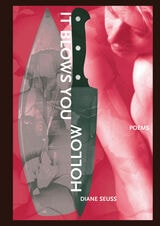
It Blows You Hollow
Diane Seuss
New Issues Poetry and Prose, 1998
Nothing is solved by the end of this book, but much is gained as the quest itself has become a victory of perfectly pitched and furious language. God’s still hidden away, but by now the natural world has evolved to replace the absence Seuss feels. In the book’s erotically charged universe, one paradoxically begins to feel a calm settle over the burned-up panorama of the soul. It Blows You Hollow is a book, rare these days, that feels as if it had to be written. Diane Seuss goes for broke.
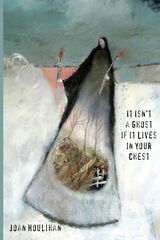
It Isn’t a Ghost if It Lives in Your Chest
Joan Houlihan
Four Way Books, 2021
Houlihan’s sixth collection of lyric poems reflects upon the persistence of what is lost and the accidental ruptures of trauma that allow re-entry into our world. These poems are at once despairing and hopeful.
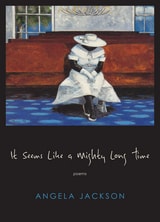
It Seems Like a Mighty Long Time
PoemsAngela Jackson
Northwestern University Press, 2015
2015 PEN Open Book Award Finalist
Angela Jackson’s latest collection of poetry borrows its title from a lyric in Barbara Lewis’s 1963 hit single “Hello Stranger,” recorded at Chess Records in Chicago. Like the song, Jackson’s poems are a melodic ode to the African American experience, informed by both individual lives and community history, from the arrival of the first African slave in Virginia in 1619 to post-Obama America.
It Seems Like a Mighty Long Time reflects the maturity of Jackson’s poetic vision. The Great Migration, the American South, and Chicago all serve as signposts, but it is the complexity of individual lives—both her own and those who have gone before, walk beside, and come after—that invigorate this collection. Upon surveying so vast a landscape, Jackson finds that sorrow meets delight, and joy lifts up anger and despair. And for all this time, love is the agent, the wise and just rule and guide.
It Was Fever That Made The World
Jim Powell
University of Chicago Press, 1989
"I find it difficult to overpraise the ease of this writing, which in one act combines succinct physical presentation and explanation of it. . . . It is perhaps here that Jim Powell, not yet forty, most shows his superiority to many of his contemporaries and seniors. He not only understands the way in which opposites are necessary to one another, he achieves his knowledge in the poem, and so we grasp it as we read. . . . he has tapped a subject matter that is endless and important, and by the thoroughgoingness and the subtlety of his exploration shows he has the power to do almost anything."—Thom Gunn, Shelf Life
"His title burns away everywhere in the volume, in the fevers of eros, divination, memory, destruction, and grief. . . . Page for page, there is more sheer fine, clear, yet syntactically subtle and metaphorically gorgeous writing in Powell than I have seen in some time."—Mary Kinzie, Poetry
"Jim Powell's poems, like those of Thomas Hardy, are haunted forms, full of ghosts and mocking gods, shadows and foreshadowings. But Powell is a Hardy whose poems we've never read, a Hardy with his hand in the blaze, not stirring the ash in a cold and wind-torn grate."—Jennifer Clarvoe, The Threepenny Review
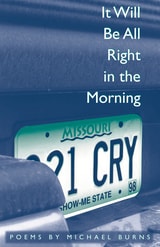
It Will Be All Right in the Morning
PoemsMichael Burns
University of Arkansas Press, 1998
In his plain-spoken lyrics and dramatic monologues, Michael Burns digs at the marrow. His poems—in formal and free verse—are quick, incisive, and always capable of revealing the dark whimsies of fate and the pain of our own actions and inactions.
These poems travel to Casqui mounds in the Arkansas Delta, traffic-clogged urban streets, a wasteland in Oklahoma, and Faulkner’s Rowan Oak. They assume the voices of others so convincingly that we find ourselves face to face with hunters, philanderers, husbands, a Union general, a Snopes, and even a version of God.
Gathering the images of each place, crafting lines in clear, unpretentious language, Burns comes across new knowledge, confronting the ever-present mysteries and the ways the mind loves to lie to itself.
It Will Return
PoemsJulia Hartwig
Northwestern University Press, 2010
In It Will Return, her most recent volume of poems, Julia Hartwig is in dialogue with other great artists—Keats, Rimbaud, Milosz, Beethoven, Ravel, Van Gogh—considering the implications of greatness. Alongside this expansive perspective, we find attention to the smallest details, composing quotidian moments that open out into unexpected meaning. For Hartwig, close attention to the material world is a kind of spiritual undertaking. Like her Nobel Prize–winning contemporary Wislawa Szymborska, she writes poems that appear simple but are somehow all the more capable of yielding profound insights.
It Will Return reflects Hartwig’s firsthand involvement in Polish history and culture, and its poems are sensitive to the calamities of Poland’s tumultuous twentieth century. But It Will Return is a human collection before it is a national one, and these political motifs form the backdrop for more universal dramas.
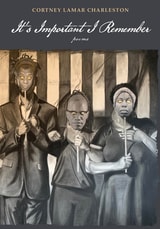
It's Important I Remember
PoemsCortney Lamar Charleston
Northwestern University Press, 2026
An incantation of strength and solace for persisting in twenty-first-century America
“History doesn’t repeat, it rhymes.” In his sweeping third collection, Charleston brings a poet’s ear for echo and rhythm to bear on American history and life after 2016. For Charleston, these rhymes cut two ways: the long tradition of American racism and fascism, and the steady pulse of Black persistence. The collection’s titular invocation frames each poem, at times an oratory to rally a crowd, in other moments a private prayer whispered as the speaker gathers himself to face another day. Charleston insists that should we cede memory of our national biography—whether to repression or indifference—we will witness the country’s dissolution into something unrecognizable to many, yet all too familiar to its most marginalized people. But with each reiteration and riff, he also invokes a tenuous hope—that if we summon an American history of Black resistance, we might still make a more perfect union.
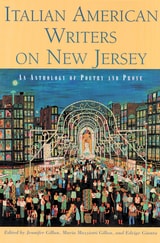
Italian American Writers on New Jersey
An Anthology of Poetry and ProseEdited by Jennifer Gillan, Maria Mazziotti Gillan, and Edvige Giunta
Rutgers University Press, 2003
This anthology gathers fiction, poetry, memoirs, oral histories, and journalistic pieces by some of the best writers to chronicle the Italian American experience in the Garden State. These works focus on ethnic identity and the distinctive culture of New Jersey, which has long been home to a large and vital Italian American community.
Filled with passion, humor, and grace, these writings depict a variety of experiences, including poignant but failed attempts at conformity and the alienation often felt by ethnic Americans. The authors also speak of the strength gained through the preservation of their communities and the realization that it is often the appreciation of their heritage that helps them to succeed. Although presented from the vantage point of only one ethnic group, this book addresses in microcosm the complexities of American identity, depicting situations and conveying emotions that will resonate with people of all immigrant ancestries.
Among the many writers featured are Gay Talese, Bill Ervolino, Tom Perrotta, Louise DeSalvo, Carole Mazo, Diane di Prima, and Maria Laurino. Each of the contributors provides a fresh perspective on the diversity, complexity, and richness of the Italian American experience.
Publication of this book is made possible in part by a grant from the Institute of Italian and Italian American Heritage Studies, State of New Jersey.

Itch Like Crazy
Wendy Rose
University of Arizona Press, 2002
In her latest work, Rose returns to these major motifs while exploring a new dimension: using poetry as a tool to delve into the buried secrets of family history—and all of American history as well. Confronting questions of personal history that itch like crazy—the irritations that drive human existence—she acknowledges and pays tribute to her Indian and European ancestors without hiding her anger with American society.
Rose's poems are strong political and social statements that have a distinctly narrative flavor. Here are Europeans who first set foot on America's shores while Taino Indians greeted them as if they were visiting neighbors; Hopi and Miwok "Clan Mothers, grand-daughters, all those the missionaries erased"; and European forebears who as settlers pushed their way relentlessly west. Through her vivid imagery, she speaks to and for these ancestors with a sense of loss and an itching caused by the biases provoked by ethnic chauvinism.
Itch Like Crazy is a finely crafted literary work that is also a manifesto addressing contacts and conflicts in the history of Indian-white relations. By presenting another view of U.S. history and its impact on the Native Americans who are her ancestors, it offers a new appreciation of the issue of "tribal identity" that too often faces Native peoples of the Americas—and is too often misunderstood by Euro-American society.
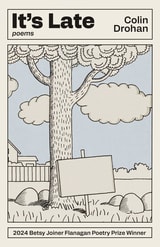
It’s Late
PoemsColin Drohan
University of Nevada Press, 2026
It’s Late approaches the world with openness and affection, prioritizing wonder about plants, animals, and other people, as well as individual and communal pasts, presents, and futures as a guiding force. The voices behind these poems dwell in a state of perpetual curiosity. Colin Drohan’s writing is full of awe but he also asks difficult questions about the world we inhabit and its present ecological crises, often discovering humor as a mechanism for real hope. It's Late imagines readers as close friends and confidants, written with a conversational quality that welcomes the absurdity of our daily lives.
in field latin
Lutz Seiler
Seagull Books, 2016
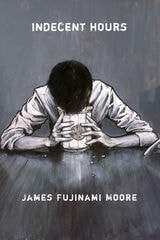
indecent hours
James Fujinami Moore
Four Way Books, 2022
For award-winning poet James Fujinami Moore, the past is never past. In this brutal debut, sensual, political, and imagined worlds collide, tracing a history of diaspora and trauma that asks: what do we do in the aftermath of violence, and why do we long to inflict it? From Vegas boxing rings and the restless sands of Manzanar to the scrolling horrors of a Facebook feed, Moore’s poems trace over intimate details with surprising humor, fierce eroticism, and a restless eye.