Results by title
28164 books match the query 'History' and 997 start with i

Imagination and the Arts in C.S. Lewis
Journeying to Narnia and Other WorldsPeter J. Schakel
University of Missouri Press, 2002
Imagination has long been regarded as central to C. S. Lewis's life and to his creative and critical works, but this is the first study to provide a thorough analysis of his theory of imagination, including the different ways he used the word and how those uses relate to each other. Peter Schakel begins by concentrating on the way reading or engaging with the other arts is an imaginative activity. He focuses on three books in which imagination is the central theme—Surprised by Joy, An Experiment in Criticism, and The Discarded Image—and shows the important role of imagination in Lewis's theory of education.
He then examines imagination and reading in Lewis's fiction, concentrating specifically on the Chronicles of Narnia, the most imaginative of his works. He looks at how the imaginative experience of reading the Chronicles is affected by the physical texture of the books, the illustrations, revisions of the texts, the order in which the books are read, and their narrative "voice," the "storyteller" who becomes almost a character in the stories.
Imagination and the Arts in C. S. Lewis also explores Lewis's ideas about imagination in the nonliterary arts. Although Lewis regarded engagement with the arts as essential to a well- rounded and satisfying life, critics of his work and even biographers have given little attention to this aspect of his life. Schakel reviews the place of music, dance, art, and architecture in Lewis's life, the ways in which he uses them as content in his poems and stories, and how he develops some of the deepest, most significant themes of his stories through them.
Schakel concludes by analyzing the uses and abuses of imagination. He looks first at "moral imagination." Although Lewis did not use this term, Schakel shows how Lewis developed the concept in That Hideous Strength and The Abolition of Man long before it became popularized in the 1980s and 1990s. While readers often concentrate on the Christian dimension of Lewis's works, equally or more important to him was their moral dimension.
Imagination and the Arts in C. S. Lewis will appeal to students and teachers of both children's literature and twentieth-century British writers. It will also be of value to readers who wish to compare Lewis's creations with more recent imaginative works such as the Harry Potter series.

Imagination, Meditation, and Cognition in the Middle Ages
Michelle Karnes
University of Chicago Press, 2011
Imagine Lagos
Mapping History, Place, and Politics in a Nineteenth-Century African CityAdemide Adelusi-Adeluyi
Ohio University Press, 2024
Imagined Empires
Tracing Imperial Nationalism in Eastern and Southeastern EuropeDimitris Stamatopoulos
Central European University Press, 2021
The Balkans offer classic examples of how empires imagine they can transform themselves into national states (Ottomanism) and how nation-states project themselves into future empires (as with the Greek “Great Idea” and the Serbian “Načertaniye”). By examining the interaction between these two aspirations this volume sheds light on the ideological prerequisites for the emergence of Balkan nationalisms.
With a balance between historical and literary contributions, the focus is on the ideological hybridity of the new national identities and on the effects of “imperial nationalisms” on the emerging Balkan nationalisms. The authors of the twelve essays reveal the relation between empire and nation-state, proceeding from the observation that many of the new nation-states acquired some imperial features and behaved as empires. This original and stimulating approach reveals the imperialistic nature of so-called ethnic or cultural nationalism.

Imagined Homes
Soviet German Immigrants in Two CitiesHans Werner
University of Manitoba Press, 2007

Imagined Museums
Art and Modernity in Postcolonial MoroccoKatarzyna Pieprzak
University of Minnesota Press, 2010
Imagined Olympians
Body Culture And Colonial Representation In RwandaJohn Bale
University of Minnesota Press, 2002
Imagined Orphans
Poor Families, Child Welfare, and Contested Citizenship in LondonMurdoch, Lydia
Rutgers University Press, 2006
With his dirty, tattered clothes and hollowed-out face, Oliver Twist is the enduring symbol of the young indigent spilling out of orphanages and haunting the streets of late-nineteenth-century London. Although poor children were often portrayed as real-life Oliver Twists—either orphaned or abandoned by unworthy parents—they in fact frequently maintained contact and were eventually reunited with their families.
In Imagined Orphans, Lydia Murdoch focuses on this discrepancy between the representation and the reality of children’s experiences within welfare institutions—a discrepancy that she argues stems from conflicts over middle- and working-class notions of citizenship that arose in the 1870s and persisted until the First World War. Reformers’ efforts to depict poor children as either orphaned or endangered by abusive or “no-good” parents fed upon the poor’s increasing exclusion from the Victorian social body. Reformers used the public’s growing distrust and pitiless attitude toward poor adults to increase charity and state aid to the children.
With a critical eye to social issues of the period, Murdoch urges readers to reconsider the complex situations of families living in poverty. While reformers’ motivations seem well intentioned, she shows how their methods solidified the public’s antipoor sentiment and justified a minimalist welfare state that engendered a cycle of poverty. As they worked to fashion model citizens, reformers’ efforts to protect and care for children took on an increasingly imperial cast that would continue into the twentieth century.
Imagined Spiritual Communities in Britain's Age of Print
Joshua King
The Ohio State University Press, 2015
Focusing primarily on the work of Anglicans between the 1820s and 1890s, this study begins by freshly interpreting reading and educational programs promoted by Samuel Taylor Coleridge, Frederick Denison Maurice, and Matthew Arnold. King then traces the emergence of John Keble’s Christian Year as a catalyst for competing visions of a Christian nation united by private reading. He argues that this phenomenon illuminates the structure and reception of best-selling poetic cycles as diverse as Alfred Tennyson’s In Memoriam and Christina Rossetti’s late Verses. Ultimately, Imagined Spiritual Communities reveals how dreams of print-mediated spiritual communion generated new poetic genres and rhetorical strategies, theories and theologies of media and reading, and ambitious schemes of education and church reform.
Imaging Animal Industry
American Meatpacking in Photography and Visual CultureEmily Kathryn Morgan
University of Iowa Press, 2024
Drawing on archival collections across the American Midwest, this book relates a history of the meatpacking industry’s use of images in the early to mid-twentieth century. In the process, it reveals the key role that images, particularly photographs, have played in assisting with the rise of industrial meat production.
Imaging Hoover Dam
The Making of a Cultural IconAnthony F. Arrigo
University of Nevada Press, 2014
Anthony F. Arrigo has researched a wide array of primary sources and archival materials to trace the project from its earliest representations in illustrations to the documentary photography of its construction and later depictions of the structure in commercial promotions, fine art photography, and paintings. Analyzing Hoover Dam through the trajectory of imagery across several decades, rather than the narrative of its construction, illuminates the underlying cultural and ecological imperatives in the drive to build it, including the influence of religious doctrine and the American agrarian movement. Arrigo also discusses various portrayals of laborers, women, minority groups, nature, and technology in this imagery. In time, the visual icon of power and domination was commercialized to sell cars, vacations, and more.
Imaging Hoover Dam is an important work in both visual rhetoric and cultural studies. It will also intrigue readers interested in such varied topics as the history of the American Southwest, the Great Depression and the New Deal, social and environmental issues, and American popular culture.
Imagining A Medieval English Nation
Kathy Lavezzo
University of Minnesota Press, 2003
The first comprehensive analysis of English national identity in the late Middle Ages
During the late Middle Ages, the increasing expansion of administrative, legal, and military systems by a central government, together with the greater involvement of the commons in national life, brought England closer than ever to political nationhood. Examining a diverse array of texts—ranging from Latin and vernacular historiography to Lollard tracts, Ricardian poetry, and chivalric treatises—this volume reveals the variety of forms “England” assumed when it was imagined in the medieval West.
These essays disrupt conventional thinking about the relationship between premodernity and modernity, challenge traditional preconceptions regarding the origins of the nation, and complicate theories about the workings of nationalism. Imagining a Medieval English Nation is not only a collection of new readings of major canonical works by leading medievalists, it is among the first book-length analyses on the subject and of critical interest. Contributors: Kathleen Davis, Bucknell U; L. O. Aranye Fradenburg, U of California, Santa Barbara; Andrew Galloway, Cornell U; Jill C. Havens, Baylor U; Peggy A. Knapp, Carnegie Mellon U; Larry Scanlon, Rutgers U; D. Vance Smith, Princeton U; Claire Sponsler, U of Iowa; Lynn Staley, Colgate U; Thorlac Turville-Petre, U of Nottingham.
Imagining Asia in the Americas
Zelideth María Rivas and Debbie Lee-DiStefano
Rutgers University Press, 2016
Imagining Central America
Short HistoriesSerena Cosgrove and Isabeau J. Belisle Dempsey
University of Minnesota Press, 2022
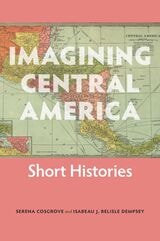
Given the strategic location of Central America, its importance to US foreign policy, and the migration from the region to other parts of the world, this succinct summary of the countries of Central America is an essential resource for those working in, studying, writing about, or traveling to the region. Promoting increased understanding of the region’s governance, economics, and structures of power, Imagining Central America highlights the many ways that Central American countries are connected to the United States through resettling, economic investment, culture flows, and foreign policy.
Each of the seven chapters focuses on a different country within Central America—Belize, Costa Rica, El Salvador, Guatemala, Honduras, Nicaragua, and Panama—and includes a map, regional introduction, timeline, and history of each country from the pre-Columbian era to the present day. Each chapter also provides a substantial recommended reading list of novels and academic sources for readers who want to learn more about the key events and themes within individual countries. A QR code within each chapter links to online resources that walk readers through each country in full color.
Imagining Deliberative Democracy in the Early American Republic
Sandra M. Gustafson
University of Chicago Press, 2011
Deliberation, in recent years, has emerged as a form of civic engagement worth reclaiming. In this persuasive book, Sandra M. Gustafson combines historical literary analysis and political theory in order to demonstrate that current democratic practices of deliberation are rooted in the civic rhetoric that flourished in the early American republic.
Though the U.S. Constitution made deliberation central to republican self-governance, the ethical emphasis on group deliberation often conflicted with the rhetorical focus on persuasive speech. From Alexis de Tocqueville’s ideas about the deliberative basis of American democracy through the works of Walt Whitman, John Dewey, John F. Kennedy, and Martin Luther King Jr., Gustafson shows how writers and speakers have made the aesthetic and political possibilities of deliberation central to their autobiographies, manifestos, novels, and orations. Examining seven key writers from the early American republic—including James Fenimore Cooper, David Crockett, and Daniel Webster—whose works of deliberative imagination explored the intersections of style and democratic substance, Gustafson offers a mode of historical and textual analysis that displays the wide range of resources imaginative language can contribute to political life.

Imagining Ethiopia
Struggles for History and Identity in the Horn of AfricaJohn Sorenson
Rutgers University Press, 1993

Imagining Health
Medicine, Social Protest, and Modern American LiteratureIra Halpern
University of Massachusetts Press, 2026
In the United States, a deep suspicion of professional medical expertise is becoming increasingly prominent. Meanwhile, many arguments for health justice take a highly critical view of medical authority, even rejecting it entirely. In the early to mid-twentieth century, alternatively, as medicine rapidly professionalized, Americans came to hold the medical establishment in a particularly high regard, while many saw how it could play a crucial role in progressive politics. In this period, technologies developed, specializations grew, and medical education became standardized. With this process came inequities, as marginalized populations struggled to access the highest levels of care. Literary writers confronting social ills through their work included critiques of this new system in their writing, Ira Halpern argues. Without abandoning professional medicine, they called for alternative systems of care that could better serve diverse populations.
Halpern examines the work of several writers—including Robert Herrick, Wallace Thurman, Frank Slaughter, Charles Chesnutt, Walter White, Ralph Ellison, Charlotte Perkins Gilman, Upton Sinclair, Stephen Crane, and Edith Wharton—to demonstrate how American writing from this period embedded a critical look at healthcare within other elements of progressive politics, from racial protest and women’s rights to disability justice and counter-capitalist viewpoints. Placing this writing into historical context, in terms of medical and scientific developments as well as traditions of social protest, Halpern reveals the efforts of these writers to envision better alternative trajectories for a quickly evolving medical establishment that left too many Americans without reliable care.
Imagining Identity in New Spain
Race, Lineage, and the Colonial Body in Portraiture and Casta PaintingsBy Magali M. Carrera
University of Texas Press, 2003
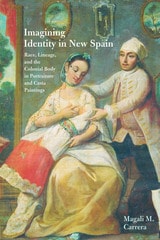
Using an interdisciplinary approach that also considers legal, literary, and religious documents of the period, Magali Carrera focuses on eighteenth-century portraiture and casta paintings to understand how the people and spaces of New Spain were conceptualized and visualized.
Winner, Book Award, Association of Latin American Art, 2004
Reacting to the rising numbers of mixed-blood (Spanish-Indian-Black African) people in its New Spain colony, the eighteenth-century Bourbon government of Spain attempted to categorize and control its colonial subjects through increasing social regulation of their bodies and the spaces they inhabited. The discourse of calidad (status) and raza (lineage) on which the regulations were based also found expression in the visual culture of New Spain, particularly in the unique genre of casta paintings, which purported to portray discrete categories of mixed-blood plebeians.
Using an interdisciplinary approach that also considers legal, literary, and religious documents of the period, Magali Carrera focuses on eighteenth-century portraiture and casta paintings to understand how the people and spaces of New Spain were conceptualized and visualized. She explains how these visual practices emphasized a seeming realism that constructed colonial bodies—elite and non-elite—as knowable and visible. At the same time, however, she argues that the chaotic specificity of the lives and lived conditions in eighteenth-century New Spain belied the illusion of social orderliness and totality narrated in its visual art. Ultimately, she concludes, the inherent ambiguity of the colonial body and its spaces brought chaos to all dreams of order.
Imagining Illness
Public Health and Visual CultureDavid Serlin
University of Minnesota Press, 2010
Contributors to this volume examine historical and contemporary visual practices-Chinese health fairs, documentary films produced by the World Health Organization, illness maps, fashions for nurses, and live surgery on the Internet-in order to delve into the political and epidemiological contexts underlying their creation and dissemination.

Imagining Indonesia
Cultural Politics and Political CultureJim Schiller
Ohio University Press, 1997
The contributions presented here represent a wide range of disciplines, points of view, and ideological orientations. Taken together they convey the notion that much might be gained if the idea were abandoned that a single understanding of what constitutes Indonesian culture is possible or desirable.
Imagining Judeo-Christian America
Religion, Secularism, and the Redefinition of DemocracyK. Healan Gaston
University of Chicago Press, 2019
Imagining Los Angeles
A City In FictionDavid Fine
University of Nevada Press, 2004

Imagining Mary Tudor, Queen of France
JoAnn DellaNeva
University of Delaware Press, 2027
This book examines early modern texts that portray Mary Tudor’s girlhood and betrothal to a foreign prince, her brief marriage to the aging king of France, and her untimely widowhood, as well as retrospective accounts that depict her life in France, her relationships with her husband and his heir apparent, and her surreptitious romance and clandestine marriage to an English duke. Here, texts from England are put into conversation with a significant body of work that was written in French, Spanish, Italian, and Latin, culminating in an examination of a novel from North America that passed itself off as a genuine sixteenth-century memoir. Author JoAnn DellaNeva also examines a spectrum of extra-literary texts—such as dialogues, popular songs, letters, speeches, portraiture, tapestries, fashion, jewelry, and book illuminations—for the ways they too helped shape Mary’s image. In so doing, she analyzes the intersection of history and literature, demonstrating how porous the borders between these disciplines can be. Through a series of close readings that are informed by an examination of the cultural context behind these texts, Imagining Mary Tudor, Queen of France seeks to explain how Mary’s fictional biography proved to be so slippery, vacillating between portrayals of her as a virtuous, generally powerless woman and as a wily and wicked minx.
Imagining Monsters
Miscreations of the Self in Eighteenth-Century EnglandDennis Todd
University of Chicago Press, 1995
Mary Toft's outrageous claim was accepted because of a common belief that the imagination of a pregnant woman could deform her fetus, creating a monster within her. Drawing on largely unexamined material from medicine, embryology, philosophy, and popular "monster" exhibitions, Todd shows that such ideas about monstrous births expressed a fear central to scientific, literary, and philosophical thinking: that the imagination could transgress the barrier between mind and body.
In his analysis of the Toft case, Todd exposes deep anxieties about the threat this transgressive imagination posed to the idea of the self as stable, coherent, and autonomous. Major works of Pope and Swift reveal that they, too, were concerned with these issues, and Imagining Monsters provides detailed discussions of Gulliver's Travels and The Dunciad illustrating how these writers used images of monstrosity to explore the problematic nature of human identity. It also includes a provocative analysis of Pope's later work that takes into account his physical deformity and his need to defend himself in a society that linked a deformed body with a deformed character.
Imagining Niagara
The Meaning and Making of Niagara FallsPatrick McGreevy
University of Massachusetts Press, 2009
Patrick McGreevy begins with the question, What can these visions of Niagara tell us about the place itself? The landscape surrounding the falls contains not only parks and religious shrines but also circuses, horror museums, and factories. People travel to Niagara not only to experience nature but also to celebrate marriages or commit suicide.
One way to make sense of these bizarre "human accumulations," as H. G. Wells called them, is to take seriously the Niagaras people have imagined. This book focuses on four interlocking themes that recur time and again in descriptions of the falls: Niagara as a thing imagined from afar, as a metaphor for death, as an embodiment of nature, and as a focus of future events. Using the skills of a cultural geographer, McGreevy discovers some surprising connections between the Niagara people have imagined and the one they made, between its natural grandeur and its industrial exploitation, between Frederick Law Olmsted's Reservation and the Love Canal.
Imagining Our Americas
Toward a Transnational FrameSandhya Shukla and Heidi Tinsman, eds.
Duke University Press, 2007
Scholars of literature, ethnic studies, and regional studies as well as of anthropology and history, the contributors focus on the Americas as a broadly conceived geographic, political, and cultural formation. Among the essays are explorations of the varied histories of African Americans’ presence in Mexican and Chicano communities, the different racial and class meanings that the Colombian musical genre cumbia assumes as it is absorbed across national borders, and the contrasting visions of anticolonial struggle embodied in the writings of two literary giants and national heroes: José Martí of Cuba and José Rizal of the Philippines. One contributor shows how a pidgin-language mixture of Japanese, Hawaiian, and English allowed second-generation Japanese immigrants to critique Hawaii’s plantation labor system as well as Japanese hierarchies of gender, generation, and race. Another examines the troubled history of U.S. gay and lesbian solidarity with the Cuban Revolution. Building on and moving beyond previous scholarship, this collection illuminates the productive intellectual and political lines of inquiry opened by a focus on the Americas.
Contributors. Rachel Adams, Victor Bascara, John D. Blanco, Alyosha Goldstein, Héctor Fernández L’Hoeste, Ian Lekus, Caroline F. Levander, Susan Y. Najita, Rebecca Schreiber, Sandhya Shukla, Harilaos Stecopoulos, Michelle Stephens, Heidi Tinsman, Nick Turse, Rob Wilson
Imagining Progress
Science, Faith, and Child Mortality in AmericaKristin Johnson
University of Alabama Press, 2024
Explores the intellectual history of how Americans imagined science, faith, and human improvement through the most wrenching of experiences—the deaths of children.
Offering fascinating examples from the works of diverse writers and thinkers such as Benjamin Franklin, Frederick Douglass, Mark Twain, W. E. B. Du Bois, Elizabeth Cady Stanton, and Harriet Shelton Dover, Kristin Johnson traces the history of Americans’ complicated faith in science and the various triumphs and tragedies that faith has inspired. Imagining Progress reveals many of the complex factors involved in the polarized state of contemporary American attitudes toward science, scientists, public health, medicine, and science policy.
Humankind has always wrestled with the existence of suffering, how to respond to suffering, whom to care for, and in what ways. For two centuries, many American ministers, physicians, and scientists believed that an omnipotent and omniscient God created the world such that people might relieve suffering through ingenuity and learning. Others responded to the new worldview introduced by the scientific revolution as a threat to the divine order. In Imagining Progress, Johnson traces the history of Americans’ evolving relationship with science and religion at “one of its most dramatic places”—the bedsides of dying children. It’s here, in the crucible of parental despair, that she illuminates diverging assumptions about God, nature, and history.
From Cotton Mather’s campaign for smallpox inoculation to battles over teaching evolution in the 1920s, Johnson adroitly weaves an interdisciplinary history of medicine, science, theology, and activism. She follows a wide cast of characters from across theological, scientific, and political spectrums. What emerges is a kaleidoscopic portrait of diverse, often contradictory hopes and anxieties inspired by new theories of nature and human existence. Johnson also discerns a problematic pattern of invoking science both to ameliorate the suffering of some children while ignoring the suffering of others.
Imagining Religion
From Babylon to JonestownJonathan Z. Smith
University of Chicago Press, 1982
Making use of examples as apparently diverse and exotic as the Maori cults in nineteenth-century New Zealand and the events of Jonestown, Smith shows that religion must be construed as conventional, anthropological, historical, and as an exercise of imagination. In his analyses, religion emerges as the product of historically and geographically situated human ingenuity, cognition, and curiosity—simply put, as the result of human labor, one of the decisive but wholly ordinary ways human beings create the worlds in which they live and make sense of them.
"These seven essays . . . display the critical intelligence, creativity, and sheer common sense that make Smith one of the most methodologically sophisticated and suggestive historians of religion writing today. . . . Smith scrutinizes the fundamental problems of taxonomy and comparison in religious studies, suggestively redescribes such basic categories as canon and ritual, and shows how frequently studied myths may more likely reflect situational incongruities than vaunted mimetic congruities. His final essay, on Jonestown, demonstrates the interpretive power of the historian of religion to render intelligible that in our own day which seems most bizarre."—Richard S. Sarason, Religious Studies Review
Imagining Serengeti
A History of Landscape Memory in Tanzania from Earliest Times to the PresentJan Bender Shetler
Ohio University Press, 2007
Many students come to African history with a host of stereotypes that are not always easy to dislodge. One of the most common is that of Africa as safari grounds—as the land of expansive, unpopulated game reserves untouched by civilization and preserved in their original pristine state by the tireless efforts of contemporary conservationists. With prose that is elegant in its simplicity and analysis that is forceful and compelling, Jan Bender Shetler brings the landscape memory of the Serengeti to life. She demonstrates how the social identities of western Serengeti peoples are embedded in specific spaces and in their collective memories of those spaces. Using a new methodology to analyze precolonial oral traditions, Shetler identifies core spatial images and reevaluates them in their historical context through the use of archaeological, linguistic, ethnographic, ecological, and archival evidence. Imagining Serengeti is a lively environmental history that will ensure that we never look at images of the African landscape in quite the same way.
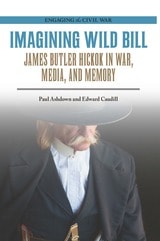
Imagining Wild Bill
James Butler Hickok in War, Media, and MemoryPaul Ashdown and Edward Caudill
Southern Illinois University Press, 2020
When it came to the Wild West, the nineteenth-century press rarely let truth get in the way of a good story. James Butler “Wild Bill” Hickok’s story was no exception. Mythologized and sensationalized, Hickok was turned into the deadliest gunfighter of all, a so-called moral killer, a national phenomenon even while he was alive.
Rather than attempt to tease truth from fiction, coauthors Paul Ashdown and Edward Caudill investigate the ways in which Hickok embodied the culture of glamorized violence Americans embraced after the Civil War and examine the process of how his story emerged, evolved, and turned into a viral multimedia sensation full of the excitement, danger, and romance of the West.
Journalists, the coauthors demonstrate, invented “Wild Bill” Hickok, glorifying him as a civilizer. They inflated his body count and constructed his legend in the midst of an emerging celebrity culture that grew up around penny newspapers. His death by treachery, at a relatively young age, made the story tragic, and dime-store novelists took over where the press left off. Reimagined as entertainment, Hickok’s legend continued to enthrall Americans in literature, on radio, on television, and in the movies, and it still draws tourists to notorious Deadwood, South Dakota.
American culture often embraces myths that later become accepted as popular history. By investigating the allure and power of Hickok’s myth, Ashdown and Caudill explain how American journalism and popular culture have shaped the way Civil War–era figures are remembered and reveal how Americans have embraced violence as entertainment.
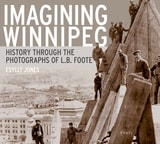
Imagining Winnipeg
History Through the Photographs of L.B. FooteEsyllt W. Jones
University of Manitoba Press, 2012
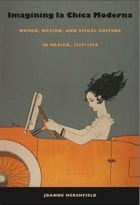
Imagining la Chica Moderna
Women, Nation, and Visual Culture in Mexico, 1917–1936Joanne Hershfield
Duke University Press, 2008
Through her detailed interpretations of visual representations of la chica moderna, Hershfield demonstrates how the images embodied popular ideas and anxieties about sexuality, work, motherhood, and feminine beauty, as well as class and ethnicity. Her analysis takes into account the influence of mexicanidad, the vision of Mexican national identity promoted by successive postrevolutionary administrations, and the fashions that arrived in Mexico from abroad, particularly from Paris, New York, and Hollywood. She considers how ideals of the modern housewife were promoted to Mexican women through visual culture; how working women were represented in illustrated periodicals and in the Mexican cinema; and how images of traditional “types” of Mexican women, such as la china poblana (the rural woman), came to define a “domestic exotic” form of modern femininity. Scrutinizing photographs of Mexican women that accompanied articles in the Mexican press during the 1920s and 1930s, Hershfield reflects on the ways that the real and the imagined came together in the production of la chica moderna.

Imagining the Forest
Narratives of Michigan and the Upper MidwestJohn Knott
University of Michigan Press, 2011
Forests have always been more than just their trees. The forests in Michigan (and similar forests in other Great Lakes states such as Wisconsin and Minnesota) played a role in the American cultural imagination from the beginnings of European settlement in the early nineteenth century to the present. Our relationships with those forests have been shaped by the cultural attitudes of the times, and people have invested in them both moral and spiritual meanings.
Author John Knott draws upon such works as Simon Schama's Landscape and Memory and Robert Pogue Harrison's Forests: The Shadow of Civilization in exploring ways in which our
relationships with forests have been shaped, using Michigan---its history of settlement, popular literature, and forest management controversies---as an exemplary case. Knott looks at such well-known figures as William Bradford, James Fenimore Cooper, John Muir, John Burroughs, and Teddy Roosevelt; Ojibwa conceptions of the forest and natural world (including how Longfellow mythologized them); early explorer accounts; and contemporary literature set in the Upper Peninsula, including Jim Harrison's True North and Philip Caputo's Indian Country.
Two competing metaphors evolved over time, Knott shows: the forest as howling wilderness, impeding the progress of civilization and in need of subjugation, and the forest as temple or cathedral, worthy of reverence and protection. Imagining the Forestshows the origin and development of both.
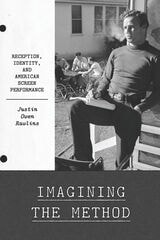
Imagining the Method
Reception, Identity, and American Screen PerformanceJustin Owen Rawlins
University of Texas Press, 2024
A revisionist history of Method acting that connects the popular reception of “methodness” to entrenched understandings of screen performance still dominating American film discourse today.
Only one performance style has dominated the lexicon of the casual moviegoer: “Method acting.” The first reception-based analysis of film acting, Imagining the Method investigates how popular understandings of the so-called Method—what its author Justin Rawlins calls "methodness"—created an exclusive brand for white, male actors while associating such actors with rebellion and marginalization. Drawing on extensive archival research, the book maps the forces giving shape to methodness and policing its boundaries.
Imagining the Method traces the primordial conditions under which the Method was conceived. It explores John Garfield's tenuous relationship with methodness due to his identity. It considers the links between John Wayne's reliance on "anti-Method" stardom and Marlon Brando and James Dean's ascribed embodiment of Method features. It dissects contemporary emphases on transformation and considers the implications of methodness in the encoding of AI performers. Altogether, Justin Rawlins offers a revisionist history of the Method that shines a light on the cultural politics of methodness and the still-dominant assumptions about race, gender, and screen actors and acting that inform how we talk about performance and performers.
Imagining the Penitentiary
Fiction and the Architecture of Mind in Eighteenth-Century EnglandJohn Bender
University of Chicago Press, 1987
Imagining the Tropics
Women, Romance, and the Making of Modern TourismElizabeth S. Manley
Rutgers University Press, 2025
Imagining the Turkish House
Collective Visions of HomeBy Carel Bertram
University of Texas Press, 2008
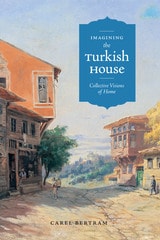
"Houses can become poetic expressions of longing for a lost past, voices of a lived present, and dreams of an ideal future." Carel Bertram discovered this truth when she went to Turkey in the 1990s and began asking people about their memories of "the Turkish house." The fondness and nostalgia with which people recalled the distinctive wooden houses that were once ubiquitous throughout the Ottoman Empire made her realize that "the Turkish house" carries rich symbolic meaning. In this delightfully readable book, Bertram considers representations of the Turkish house in literature, art, and architecture to understand why the idea of the house has become such a potent signifier of Turkish identity.
Bertram's exploration of the Turkish house shows how this feature of Ottoman culture took on symbolic meaning in the Turkish imagination as Turkey became more Westernized and secular in the early decades of the twentieth century. She shows how artists, writers, and architects all drew on the memory of the Turkish house as a space where changing notions of spirituality, modernity, and identity—as well as the social roles of women and the family—could be approached, contested, revised, or embraced during this period of tumultuous change.
Imitation Artist
Gertrude Hoffmann’s Life in Vaudeville and DanceSunny Stalter-Pace
Northwestern University Press, 2020
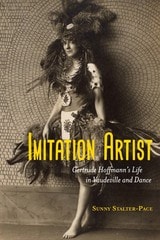
Gertrude Hoffmann made her name in the early twentieth century as an imitator, copying highbrow performances staged in Europe and popularizing them for a broader American audience. Born in San Francisco, Hoffmann started working as a ballet girl in pantomime spectacles during the Gay Nineties. She performed through the heyday of vaudeville and later taught dancers and choreographed nightclub revues. After her career ended, she reflected on how vaudeville’s history was represented in film and television.
Drawn from extensive archival research, Imitation Artist shows how Hoffmann’s life intersected with those of central figures in twentieth-century popular culture and dance, including Florenz Ziegfeld, George M. Cohan, Isadora Duncan, and Ruth St. Denis. Sunny Stalter-Pace discusses the ways in which Hoffmann navigated the complexities of performing gender, race, and national identity at the dawn of contemporary celebrity culture. This book is essential reading for those interested in the history of theater and dance, modernism, women’s history, and copyright.
Imitations of Life
Fannie Hurst’s Gaslight SonatasAbe C. Ravitz
Southern Illinois University Press, 2009
In the early 1920s, Fannie Hurst’s enormous popularity made her the highest-paid writer in America. She conquered the literary scene at the same time the silent movie industry began to emerge as a tremendously profitable and popular form of entertainment. Abe C. Ravitz parallels Hurst’s growing acclaim with the evolution of silent films, from which she borrowed ideas and techniques that furthered her career. Ravitz notes that Hurst was amazingly adept at anticipating what the public wanted. Sensing that the national interest was shifting from rural to urban subjects, Hurst set her immigrant tales and her "woiking goil" tales in urban America. In her early stories, she tried to bridge the gap between Old World and New World citizens, each somewhat fearful and suspicious of the other. She wrote of love and ethnicity—bringing the Jewish Mother to prominence—of race relations and prejudice, of the woman alone in her quest for selfhood. Ravitz argues, in fact, that her socially oriented tales and her portraits of women in the city clearly identify her as a forerunner of contemporary feminism.
Ravitz brings to life the popular culture from 1910 through the 1920s, tracing the meteoric rise of Hurst and depicting the colorful cast of characters surrounding her. He reproduces for the first time the Hurst correspondence with Theodore Dreiser, Charles and Kathleen Norris, and Gertrude Atherton. Fellow writers Rex Beach and Vachel Lindsay also play important roles in Ravitz’s portrait of Hurst, as does Zora Neale Hurston, who awakened Hurst’s interest in the Harlem Renaissance and in race relations, as shown in Hurst’s novel Imitation of Life.
Imitations of Life
Two Centuries of Melodrama in RussiaLouise McReynolds and Joan Neuberger, eds.
Duke University Press, 2002
Drawing on a wide variety of sources, including plays, lachrymose novels, popular movies, and even highly publicized funerals and political trials, the essays in Imitations of Life argue that melodrama has consistently offered models of behavior for times of transition, and that contemporary televised versions of melodrama continue to help Russians cope with national events that they understand implicitly but are not yet able to articulate. In contrast to previous studies, this collection argues for a reading that takes into account the subtle but pointed challenges to national politics and to gender and class hierarchies made in melodramatic works from both the nineteenth and twentieth centuries. Collectively, the contributors shift and cross borders, illustrating how the cultural dismissal of melodrama as fundamentally escapist and targeted primarily at the politically disenfranchised has subverted the drama’s own intrinsically subversive virtues.
Imitations of Life will interest students and scholars of contemporary Russia, and Russian history, literature, and theater.
Contributors. Otto Boele, Julie Buckler, Julie Cassiday, Susan Costanzo, Helena Goscilo, Beth Holmgren, Lars Lih, Louise McReynolds, Joan Neuberger, Alexander Prokhorov, Richard Stites
Immanuel Wallerstein and the Problem of the World
System, Scale, CultureDavid Palumbo-Liu, Bruce Robbins, and Nirvana Tanoukhi, eds.
Duke University Press, 2011
Contributors. Gopal Balakrishnan, Tani E. Barlow, Neil Brenner, Richard E. Lee, Franco Moretti, David Palumbo-Liu, Bruce Robbins, Helen Stacy, Nirvana Tanoukhi, Immanuel Wallerstein, Kären Wigen
Immeasurable Weather
Meteorological Data and Settler Colonialism from 1820 to Hurricane SandySara J. Grossman
Duke University Press, 2023
Immersive Life Practices
Edited by Daniel Tucker
School of the Art Institute of Chicago, 2014
Immersive Life Practices talks to Chicago-based artists and authors about life as an art practice and art as a life practice. The contributors explore a range of concerns, from how to be holistic, ethical, or practical; to how to balance life and work; to formal questions of how to represent a never-ending project. Some speak fondly of long-term collaborative relationships that sustain their work, while others place emphasis on the physical space in and outside the city as necessary to keep them grounded. Engaging and honest, the essays and interviews in this collection will resonate with anyone working to create a life—and an art—worth living.
Immersive Life Practices is part of the new Chicago Social Practice History series, edited by Mary Jane Jacob and Kate Zeller in the Department of Exhibitions and Exhibition Studies at the School of the Art Institute of Chicago (SAIC).

Immigrant Acts
On Asian American Cultural PoliticsLisa Lowe
Duke University Press, 1996
Lowe argues that a national memory haunts the conception of Asian American, persisting beyond the repeal of individual laws and sustained by U.S. wars in Asia, in which the Asian is seen as the perpetual immigrant, as the “foreigner-within.” In Immigrant Acts, she argues that rather than attesting to the absorption of cultural difference into the universality of the national political sphere, the Asian immigrant—at odds with the cultural, racial, and linguistic forms of the nation—displaces the temporality of assimilation. Distance from the American national culture constitutes Asian American culture as an alternative site that produces cultural forms materially and aesthetically in contradiction with the institutions of citizenship and national identity. Rather than a sign of a “failed” integration of Asians into the American cultural sphere, this critique preserves and opens up different possibilities for political practice and coalition across racial and national borders.
In this uniquely interdisciplinary study, Lowe examines the historical, political, cultural, and aesthetic meanings of immigration in relation to Asian Americans. Extending the range of Asian American critique, Immigrant Acts will interest readers concerned with race and ethnicity in the United States, American cultures, immigration, and transnationalism.
Immigrant Identity and the Politics of Citizenship
A Collection of Articles from the Journal of American Ethnic HistoryJohn J Bukowczyk
University of Illinois Press, 2016

Immigrant Minds, American Identities
Making the United States Home, 1870-1930Orm Overland
University of Illinois Press, 2000
Devised by middle-class ethnic leaders and spread through ethnic media, banquets, and rallies, homemaking myths uncovered a role for immigrants in the nation's founding, a place of honor in the nation's wars, and traces of American democratic political ideology in the immigrants' ethnic past. These stories proclaim that immigrants, in the person of their ancestors, disembarked from Christopher Columbus's ships, fought for victory over the Axis, and brought American values of freedom and democracy from their native lands. By virtue of their ethnic group's contributions, these myths maintain, non-Anglo European immigrants came to America not as foreigners but as ready-made ideal citizens of the Republic.
Øverland shows that the plots and themes of homemaking myths share so many characteristics that they must be considered an American phenomenon rather than one peculiar to an individual ethnic group. As a symbol of the immigrant's insider status, these stories have played a crucial role in forming American ethnic identities and in carving out a place for immigrants in an Anglo-dominated society.

Immigrant Voices
New Lives in America, 1773-2000Edited by Thomas Dublin
University of Illinois Press, 2014
A classroom staple, Immigrant Voices: New Lives in America, 1773-2000 has been updated with writings that reflect trends in immigration to the United States through the turn of the twenty-first century. New chapters include a selection of letters from Irish immigrants fleeing the famine of the 1840s, writings from an immigrant who escaped the civil war in Liberia during the 1980s, and letters that crossed the U.S.-Mexico border during the late 1980s and early '90s. With each addition editor Thomas Dublin has kept to his original goals, which was to show the commonalities of the U.S. immigrant experience across lines of gender, nation of origin, race, and even time.
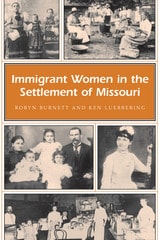
Immigrant Women in the Settlement of Missouri
Robyn Burnett & Ken Luebbering
University of Missouri Press, 2005
Because it examines the lives of women from many social classes and ethnic backgrounds, Immigrant Women in the Settlement of Missouri does much to explain the rich cultural diversity Missouri enjoys today. The photographs and narratives relating to Czech, French, German, Hungarian, Irish, Italian, and Polish life will remind descendants of immigrants that many customs and traditions they grew up practicing have roots in their home countries and will also promote understanding of the customs of other cultures. In addition to the ethnic and class differences that affected these women’s lives, the book also notes the impact of the various eras in which they lived, their education, the circumstances of their migrations, and their destinations across Missouri.
With their engaging and straightforward narrative, Burnett and Luebbering take the reader chronologically through the history of the state from the colonial period to the Civil War and industrialization. Like all Missouri Heritage Readers, this one is presented in an accessible format with abundant illustrations, and it is sure to please both general readers and those engaged in immigrant and women’s studies.

Immigrants Raising Citizens
Undocumented Parents and Their ChildrenHirokazu Yoshikawa
Russell Sage Foundation, 2011
Immigrants against the State
Yiddish and Italian Anarchism in AmericaKenyon Zimmer
University of Illinois Press, 2015
Zimmer focuses on Italians and Eastern European Jews in San Francisco, New York City, and Paterson, New Jersey. Tracing the movement's changing fortunes from the pre–World War I era through the Spanish Civil War, Zimmer argues that anarchists, opposed to both American and Old World nationalism, severed all attachments to their nations of origin but also resisted assimilation into their host society. Their radical cosmopolitan outlook and identity instead embraced diversity and extended solidarity across national, ethnic, and racial divides. Though ultimately unable to withstand the onslaught of Americanism and other nationalisms, the anarchist movement nonetheless provided a shining example of a transnational collective identity delinked from the nation-state and racial hierarchies.