Results by title
297 books match the query 'Alabama' and 5 start with j

Jeffrey's Latest Thirteen
More Alabama Ghosts, Commemorative EditionKathryn Tucker Windham
University of Alabama Press, 2016
A deluxe, commemorative edition of a beloved collection of ghostly stories from famed southern author and folklorist Kathryn Tucker Windham’s home state of Alabama.
Accompanied by her faithful companion, Jeffrey, a friendly spirit who resided in her home in Selma, Alabama, Kathryn Tucker Windham traveled the South, visiting the sites of spectral legends in Mississippi, Georgia, and Tennessee, among other places. In Jeffrey’s Latest Thirteen: More Alabama Ghosts, a sequel to her landmark Thirteen Alabama Ghosts and Jeffrey, Windham introduces readers to thirteen more of Jeffrey's ghostly acquaintances, each with the charm and universal appeal that has created hundreds of thousands of Jeffrey fans.
Among the other hair-raising tales in this collection, Windham spotlights the apparitions of academia. From the three Yankee soldiers who haunt the University of Alabama’s Civil War–era Little Round House to the Confederate soldier who resides in the University Chapel at Auburn University, Alabama’s institutions of higher learning seem to have more than a few paranormal pupils.
Photographs of the sites about which Windham writes are one of the best-loved features of her series of “Jeffrey the Ghost” books. Jeffrey’s Latest Thirteen features the image of a beautiful child who, though not photographed in life, reappeared long enough to be photographed with his bereaved father's borrowed camera. Bewitched readers will find the startling photograph of the child in the next-to-last chapter, just pages before he book’s photograph of Windham’s own spectral muse, Jeffrey.
This commemorative edition returns Windham’s thrilling classic to its original 1982 keepsake quality and includes a new afterword by the author’s children.

John Horry Dent
South Carolina Aristocrat On Alabama FrontierRay Mathis
University of Alabama Press, 1979
Jonah Horry Dent was born on 5 August 1815 in Newport, Rhode Island, the son of John Herbert Dent and Elizabeth Anne Horry Dent. Dent grew up in Charleston, South Carolina, and spent summers with his family on a plantation in Colleton County, South Carolina. When he was still a young child, his name was changed from “Jonah” to “John” when an older brother, named John, died, leaving little Jonah as the oldest living son. He was known as John Horry Dent the rest of his life.
Dent married Mary Elizabeth Morrison in 1835 and moved to Barbour County, Alabama, in 1836. He purchased 360 acres of land on Cowikee Creek, paying $15 an acre, and named the new plantation “Good Hope.” Dent amassed a good fortune but lost most of it after the Civil War when slavery was abolished and his slaves became freemen. In 1866 he sold his properties in Barbour County and moved to Cave Springs, Floyd County, Georgia.
Dent kept detailed records about his crops and properties until very late in life. He died in Cave Springs on 17 May 1892.
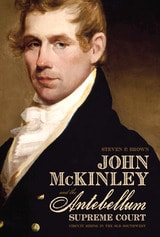
John McKinley and the Antebellum Supreme Court
Circuit Riding in the Old SouthwestSteven P. Brown
University of Alabama Press, 2012
A Southern voice on a national bench—McKinley’s legacy in antebellum law.
John McKinley and the Antebellum Supreme Court offers the first comprehensive biography of Justice John McKinley (1780–1852), a largely forgotten figure in American legal history who played a pivotal role during a formative period of the U.S. Supreme Court. Steven P. Brown rescues McKinley from historical obscurity, presenting a compelling portrait of a man deeply embedded in the political, legal, and financial life of the early 19th-century South.
Born in Kentucky and later settling in northern Alabama, McKinley served in both the U.S. Senate and House of Representatives before being appointed to the Supreme Court by President Martin Van Buren in 1837. His tenure on the bench coincided with the creation of the Ninth Circuit, a vast and challenging judicial territory encompassing Alabama, Arkansas, Louisiana, and Mississippi. Brown details McKinley’s arduous circuit-riding duties, which required extensive travel and exposed him to the legal complexities of a rapidly expanding frontier.
More than a biography, the book provides a penetrating analysis of antebellum legal culture, Alabama state politics, and the internal workings of the Supreme Court during a time of national transformation. Brown challenges the prevailing view of McKinley as a mediocre jurist, arguing instead that his contributions—particularly his dissents defending states’ rights—deserve renewed scholarly attention. With rich historical context and meticulous research, John McKinley and the Antebellum Supreme Court sheds light on the burdens of justice in a divided nation and the legacy of a justice whose career mirrored the tensions of his time.
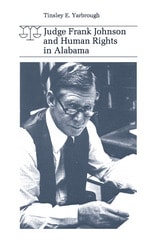
Judge Frank Johnson and Human Rights in Alabama
Tinsley E. Yarbrough
University of Alabama Press, 1981
Where courage meets the gavel: One judge’s relentless fight for justice and human rights in Alabama.
Judge Frank M. Johnson, Jr., Chief Judge of the United States District Court for the Middle District of Alabama until his elevation to the Court of Appeals for the Fifth Circuit in 1979, was perhaps President Dwight D. Eisenhower’s most significant appointment to a lower court. His selection to the bench in 1955 followed by only a few months the Supreme Court’s historic decision in Brown vs. Board of Education.
During Judge Johnson’s tenure, his court invalidated segregation and other forms of racial discrimination in Alabama’s transportation facilities, voter registration processes, school and colleges, administrative agencies, system of jury selection, prisons, mental institutions, political parties, and government grant programs. In fact, most of the state’s major racial crises were resolved in his courtroom. However, his impact on human rights policy in Alabama was not confined to a racial context. Among other significant developments, the Middle District Court ordered reapportionment of the state’s governing bodies and invalidated its grossly inequitable property tax systems.
Judge Johnson’s decisions made him one of the most widely respected and controversial trial judges in the country. Until recently, however, his name was anathema to many white Alabamians, and he and his family were subject to ostracism, threats, violence, and verbal abuse.
Yarbrough examines Judge Johnson’s life through the end of the Wallace era and the Judge’s appointment to the Fifth Circuit Court. More broadly, the book is a history of modern human rights reform in Alabama, cast in the biographical idiom. For, in a real sense, the history of the reform and of Judge Johnson’s judicial career have been synonymous.
Jule
George Wylie Henderson
University of Alabama Press, 1989
From the fields of Alabama to the streets of Harlem, a young man's journey mirrors a generation's search for opportunity and identity.
Jule by George Wylie Henderson is a powerful coming-of-age novel that traces the journey of a young African American man from the rural communities of Alabama to the bustling streets of Harlem during a transformative period in American history. Raised by his devoted mother, Ollie Miss, who encourages him to strive for a better future, Jule grows up amid the traditions, hardships, and close-knit relationships of Depression-era Southern life. As he matures, friendships, first love, and the realities of racial inequality shape his understanding of himself and the world around him.
When circumstances compel him to leave Alabama, Jule embarks on a journey to Harlem, the cultural capital of Black America and a center of artistic, intellectual, and economic opportunity. There he encounters a vibrant urban society that challenges and expands his ambitions while exposing him to new possibilities and struggles. Drawing on autobiographical elements from Henderson's own experiences, the novel offers a rare and insightful portrayal of the connections between the rural South and the Harlem Renaissance.
Jule is both a compelling personal story and an important work of African American literary history. The novel provides valuable insight into migration, identity, family, and aspiration, illuminating the experiences of a generation seeking opportunity while carrying the enduring influence of its Southern roots.