496 books match the query 'Christian Theology' and 14 start with j
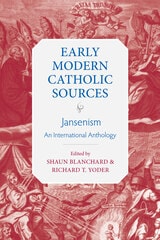
cover of Jansenism: An International Anthology

Jansenism

An International Anthology

Shaun Blanchard

Catholic University of America Press, 2024
Jansenism: An International Anthology is the first comprehensive anthology of Jansenist texts in English translation. Covering the full sweep of the Jansenist movement from the 1630s until the early nineteenth century, this anthology is a major asset to historians of early modernity, theologians, advanced and beginner students, and interested non-specialists. Readers of English can now directly hear the voices of the women and men, nuns and priests, and politicians and pamphleteers embroiled in some of the most dynamic controversies of early modern Christianity. While giving due attention to France, the anthology showcases the geographic breadth of Jansenism, from Portugal to Lebanon. Consequently, a team of translators have provided texts translated not just from French and Latin; selections from German, Spanish, Portuguese, Italian, and Arabic also appear here. Blanchard and Yoder present a diverse range of texts, including letters, tracts, periodical excerpts, books, treatises, and synodal documents. These readings cover the controversies over divine grace and penance for which Jansenism is infamous, but they also show the widening scope of Jansenists’ reformist concerns as the movement developed and changed. They address issues such as liturgical reform, devotion to Mary and the saints, politics, religious toleration, prayer, gender and the role of women in the Church, polemics, and ecclesiastical reform. The whole volume is introduced by an essay introducing Jansenism, exposing the important themes, summarizing the relevant scholarship, and contextualizing the content that will follow. Jansenism: An International Anthology provides the first port-of-call for the study of Jansenism in English. The anthology presents a diverse and rich selection of primary source texts and draws on the best recent research into the fascinating and controversial transnational phenomena called “Jansenism.”
[more]
cover of Jesus Becoming Jesus, Volume 2: A Theological Interpretation of the Gospel of John: Prologue and the Book of Signs

Jesus Becoming Jesus, Volume 2

A Theological Interpretation of the Gospel of John: Prologue and the Book of Signs

Thomas G. Weinandy

Catholic University of America Press, 2021
Jesus Becoming Jesus, Volume 2: A Theological Interpretation of the Gospel of John: Prologue and the Book of Signs follows upon the first volume of this series entitled Jesus Becoming Jesus. The first volume was a theological interpretation of the Gospels of Matthew, Mark and Luke. Unlike many conventional biblical commentaries, Weinandy concentrates on the theological content contained within John’s Gospel. He does this in the light of the Church’s doctrinal and theological tradition, particularly in keeping with the Second Vatican Council’s Dogmatic Constitution, Dei Verbum. This is accomplished through a close reading of John’s Gospel, theologically interpreting each chapter of the Gospel sequentially. In so doing he also takes into account the Johannine corpus as a whole. He also relates John’s Gospel to relevant material found within the Synoptic Gospels, the Pauline Corpus and other New Testament writings. This original theological interpretation focuses primarily on the intertwining theological themes contained within John’s Gospel, specifically within the Prologue and the Book of Signs – light and darkness, the seven miracle-signs, the sacraments of baptism and the Eucharist, the seven “I Am” sayings, the contentious dialogues with the Jews, Jesus’ relationship to his Father as the Father’s incarnate Word and Son, etc. Within all of these interlocking themes one finds the importance of Jesus’ saving actions – the salvific works of his Father. The overarching theme of this book, as the title suggests, is that Jesus, being named Jesus, throughout his public ministry is enacting his name and so becoming who he is – YHWH-Saves. Weinandy offers a singular, vibrant, and luminous reading of John’s Gospel; one that reveals the Evangelist’s theological depth and doctrinal sophistication. In so doing, Weinandy makes manifest the particular beauty of the Gospel According to John.
[more]
cover of Jesus Becoming Jesus, Volume 3: A Theological Interpretation of the Gospel of John: The Book of Glory and the Passion and Resurrection

Jesus Becoming Jesus, Volume 3

A Theological Interpretation of the Gospel of John: The Book of Glory and the Passion and Resurrection

Thomas G. Weinandy

Catholic University of America Press, 2022
Jesus Becoming Jesus, Volume 3 follows upon the previous two volumes of this series entitled Jesus Becoming Jesus. Volume 1 was a theological interpretation of the Gospels of Matthew, Mark and Luke, and volume 2 was a theological interpretation of the Prologue and Book of Signs of John’s Gospel (chapters 1-12). Unlike many conventional biblical commentaries, Weinandy concentrates on the theological content contained within John’s Gospel. This is accomplished through a close reading of John’s Gospel, theologically interpreting each chapter of the Gospel sequentially. In so doing he also takes into account the Johannine corpus as a whole. He also relates John’s Gospel to relevant material found within the Synoptic Gospels, the Pauline Corpus and other New Testament writings. In this present volume, Weinandy’s original theological interpretation focuses first on the Evangelist’s narrative of the Last Supper, which includes Jesus’ washing of his disciples’ feet, followed upon his lengthy farewell address and his ensuing High Priestly Prayer (chapter 13-17). Although Jesus speaks of his leaving his disciples, yet their hearts should not be troubled, for he is going to prepare a place for them in his Father’s house, and he will also send them another Counselor, the Holy Spirit. The Holy Spirit will not only convict the world sin, but he will also empower the disciples to profess their faith in Jesus as the Father’s Son, even in the midst of persecution. All that Jesus tells his disciple in his final discourse, he then prays that his Father will accomplish through his forthcoming death and resurrection – above all that his disciples will share in the same oneness of love that he and his Father possess. Weinandy masterfully treats John’s Passion and Resurrection Narratives. He not only theologically interprets the uniqueness of the Evangelist’s narratives, but also how his narratives insect with the Synoptic accounts. Moreover, Weinandy’s theological reading of Jesus’ crucifixion and resurrection weaves together John’s soteriology, ecclesiology, and sacramentality – all of which are founded upon the Incarnation, that Jesus is the Father’s Spirit-filled incarnate Son. As the title suggests, Jesus, being named Jesus, in his death and resurrection, definitively enacts his name and so becoming who he is – YHWH-Saves.
[more]
cover of Jesus Being Jesus: A Theological Interpretation of the Acts of the Apostles, Volume 2: Chapters 15-28

Jesus Being Jesus

A Theological Interpretation of the Acts of the Apostles, Volume 2: Chapters 15-28

Thomas G. Weinandy

Catholic University of America Press, 2026
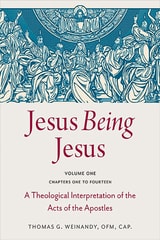
Luke was a Gentile and physician. Though not one of Jesus’ initial Jewish disciples, Luke was a traveling companion of Paul. As with the Old Testament and the Gospels, Luke provides the theological and ecclesial significance of the historical events he is narrating. In so doing, he accentuates what the risen and ascended Jesus is doing through the Holy Spirit by means of the nascent church, primarily through Peter and Paul. Although the book is entitled the Acts of the Apostles, the Holy Spirit is the primary actor throughout its entirety. Luke is traditionally believed to be the author of both the third Gospel as well as the Acts of the Apostles. As Luke, in his Gospel, first wrote “an orderly account for you, most excellent Theophilus, concerning the truth of the gospel,” so he now writes what has taken place after Jesus’ departure. Thus, the Acts of the Apostles is a continuation of a historical narrative. The Gospel contains what Jesus historically said and did until his Ascension into Heaven. Acts is the historical narrative of what followed upon Jesus’ ascension and the pouring out of the Holy Spirit at Pentecost that gave birth of the Church, and the first preaching of the Good News. If in Luke’s gospel account one finds Jesus becoming Jesus through his saving actions which culminate in his death and resurrection, in the Acts of the Apostles, one finds the risen Jesus being Jesus through the preaching and actions of the apostolic church. Jesus continues to enact his name, YHWH-Saves. In this second volume on Acts, such saving words and actions are particularly found within Paul’s preaching of the gospel in course of his missionary journeys.
[more]
cover of Jesus Being Jesus: A Theological Interpretation of the Acts of the Apostles: Volume 1: Chapters 1-14

Jesus Being Jesus

A Theological Interpretation of the Acts of the Apostles: Volume 1: Chapters 1-14

Thomas G. Weinandy

Catholic University of America Press, 2026
Luke was a Gentile and physician. Though not one of Jesus’ initial Jewish dis­ciples, Luke was a traveling companion of Paul. As with the Old Testament and the Gospels, Luke provides the theological and ecclesial significance of the historical events he is narrating. In so doing, he accentuates what the risen and ascended Jesus is doing through the Holy Spirit by means of the na­scent church, primarily through Peter and Paul. Although the book is entitled the Acts of the Apostles, the Holy Spirit is the primary actor throughout its entirety. Luke is traditionally believed to be the author of both the third Gospel as well as the Acts of the Apostles. As Luke, in his Gospel, first wrote “an or­derly account for you, most excellent Theophilus, concerning the truth of the gospel,” so he now writes what has taken place after Jesus’ departure. Thus, the Acts of the Apostles is a continuation of a historical narrative. The Gospel contains what Jesus historically said and did until his Ascension into Heaven. Acts is the historical narrative of what followed upon Jesus’ ascen­sion and the pouring out of the Holy Spirit at Pentecost that gave birth to the Church, and the first preaching of the Good News. If in Luke’s gospel account one finds Jesus becoming Jesus through his sav­ing actions which culminate in his death and resurrection, in the Acts of the Apostles, one finds the risen Jesus being Jesus through the preaching and actions of the apostolic church. Jesus continues to enact his name, YH­WH-Saves. Such saving words and actions are particularly within the evan­gelistic ministry of Peter and Paul.
[more]
cover of Jesus-Shock

Jesus-Shock

Peter Kreeft

St. Augustine's Press, 2008

Jesus Shock is the second in a series of short works on seminal concerns of the impact that Jesus Christ made in the world. The first work, The Philosophy of Jesus (St. Augustine’s Press, 2007), explored philosophy in light of Jesus, rather than the other way around. The present work investigates the reception Jesus received both in His lifetime and continuously to the present time, not only from His enemies, but from His friends, a reception of shock, astonishment, even disgust.
  Perhaps a few remarks from the book best explains it:

The point of the book:
 The point of the title: Imagine a storm has downed a telephone wire so that everyone who touches it is shocked in every cell of his body. Well, the storm of God’s crazy love has “downed” (incarnated) Jesus, and everyone who touches this “live wire” is shocked in every cell of his soul.
 The question of the book: Why is “Jesus” the most non-neutral, the most controversial, the most embarrassing name in the world? Why is talking about Jesus like talking about sex?
 This whole book is really about a single movie line, the greatest line in the greatest movie in history. Bet you know what it is.
 Jesus-Shock is about the Real Presence of Christ in the Gospels and in the Eucharist. It
is not about the theology of the Real Presence, but about the experience of Him there, and about the experience of everyone in the Gospels who met Him.

 What was the bitterest controversy of the Protestant Reformation, both between Protestants and Catholics and between different Protestant denominations, the one that had both sides calling the other not just heretics but devils?   
 Answer: It was not Justification by Faith, the hallmark of the Reformation, even though that question is about nothing less momentous than how to be saved, how to get to Heaven. It was not the relation between religion and politics, even though that was a matter of life or death (literally, on battlefields and at guillotines and hangings) and not just a matter of truth or falsity, or of good or evil. It was not about the sufficiency of the Bible, or the corruption in the Church, or the relation between the Bible and the Church. It was not about the Pope, and the governance of the Church. It was not about Mary or saints or angels or Purgatory. It was not about the Incarnation or the Trinity or the Atonement.
 It was about the Real Presence of Christ in the Eucharist.

 Jesus-Shock, in addressing this controversy forcefully and faithfully, shows the reasons why to this day the name of “Jesus” stirs up controversy, even revulsion, in polite society. In the true spirit of ecumenism, it also points the way toward a true rapprochement among His modern-day disciples.
[more]
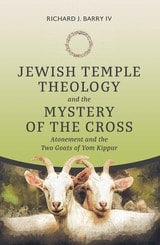
cover of Jewish Temple Theology and the Mystery of the Cross: Atonement and the Two Goats of Yom Kippur

Jewish Temple Theology and the Mystery of the Cross

Atonement and the Two Goats of Yom Kippur

Richard J. Barry IV

Catholic University of America Press, 2023
On the Day of Atonement, two goats were brought before the high priest at the temple. One was chosen as the goat for the Lord, a spotless sacrifice, and the other was set aside for Azazel, doomed to bear sins into the wilderness. Jewish Temple Theology and the Mystery of the Cross shows how a theological appreciation for the two movements of Yom Kippur makes it possible to identify the paradox at the heart of Christian soteriology: in his single atoning act, Jesus Christ fulfills the work of both goats, without confusion, without division. Appreciation for this paradox helps illuminate many of the doctrinal debates in the history of Christian soteriology and offers a compelling way forward. Jewish Temple Theology and the Mystery of the Cross begins with a survey of biblical geography: first, a rich theological pilgrimage to Mount Zion, the home of beauty, goodness, and truth, and then to the surrounding desert, the wilderness of sin and sorrow. To appreciate the Yom Kippur liturgy, and to understand the priestly word “atonement,” one must be oriented by this cosmic stage. Drawing on the best modern historical-critical scholarship, this volume reveals the wonders hidden in Leviticus and shows how a sophisticated theological interpretation of this book leads to breakthroughs in our understanding of Christ’s saving work. Seeing the mystery of the cross from the perspective of the ancient Jewish scriptures has surprising results. For example, Richard Barry shows how Hans Urs von Balthasar’s controversial theology of Holy Saturday is a compelling development of Azazel-goat soteriology; it is not only biblically licit but is in some ways mandated by the logic of Yom Kippur. At the same time, David Bentley Hart is celebrated for the way he powerfully advances modern YHWH-goat soteriology, yet obedience to the logic of Yom Kippur also necessitates a nuanced biblical critique of his muscular universalism. How can Christ fulfill the seemingly contradictory movements of both goats in a single saving work? Grappling with that question, Jewish Temple Theology and the Mystery of the Cross seeks to draw nearer to the heart of the mystery of salvation.
[more]
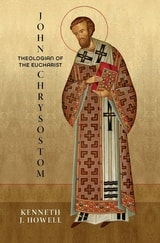
cover of John Chrysostom, Theologian of the Eucharist

John Chrysostom, Theologian of the Eucharist

Kenneth J. Howell

Catholic University of America Press, 2024
Despite the fact that John Chrysostom wrote more on the Eucharist than any other Greek Church Father, there has never been a full treatment of his doctrine in English. In this book, Kenneth Howell brings together a wide array of sources from which he develops a many-sided portrait of Chrysostom’s eucharistic thought. While the Antiochene preacher assumed the real presence and the sacrificial nature of the Eucharist, he focused more on the moral and spiritual implications of communion. At the root of his theology lies the conviction that the Eucharist with its home in the liturgy is the extension of Christ’s incarnate life through space and time. All that Christ accomplished in his life, death, and resurrection is present and available to the communing Christian who stands in union with the angelic hosts in the liturgy of the church. John’s preaching at times reaches encomiastic proportions as he never tires of praising the benefits and power of the Eucharist and he deftly applies the sacrament to the struggle of virtue and vice as he explores both the invitation and the obstacles to communion. Among the moral implications of the Eucharist, John seems to distinguish well between sins arising from human weakness versus malicious dispositions freely chosen. He is especially keen to exhort his hearers to lay aside the remembrance of evil (mnesikakia) done to them in their past lives. Humility and forbearance are two essential virtues in arriving at forgiveness of past injuries. And lack of forgiveness is like greed in that both constitute a turn in on oneself. The Eucharist demands love of neighbor and active ministry to the less fortunate of the world. For John, God is interested in golden souls more than golden chalices.
[more]
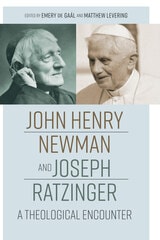
cover of John Henry Newman and Joseph Ratzinger: A Theological Encounter

John Henry Newman and Joseph Ratzinger

A Theological Encounter

Emery de Gaal

Catholic University of America Press, 2024
This book brings the thought of John Henry Newman into conversation with that of Joseph Ratzinger/Benedict XVI on a number of crucial theological themes. The book begins with a programmatic essay by Tracey Rowland connecting Newman’s approach with that of Ratzinger’s doktorvater Gottlieb Söhngen, along seven instructive paths. The book then delves into central themes of both Newman’s and Ratzinger’s thought, with essays that treat dogmatic development, the relationship of faith and reason, biblical inspiration, mystery, conscience, attentiveness to the “signs of the times,” interculturality and revelation, the Church as the Mystical Body, ecclesial authority, the relationship of faith and natural science, and deification. The essays in the volume come from many of the world’s leading Newman and Ratzinger scholars, with Ratzinger being represented by such experts as Rowland, Emery de Gaál, Aaron Pidel, SJ, Jacob Phillips, Matthew Ramage, and Jeremy Pilch; and Newman by such experts as Frederick D. Aquino, Andrew Meszaros, Marial Corona, Ryan Marr, and Elizabeth A. Huddleston. The Introduction briefly sets the scene for the encounter by describing the German reception of Newman during Ratzinger’s youth in comparison with the much less robust situation in German Newman scholarship today. It is the hope of the editors that this theological encounter will serve to promote and advance both Newman studies and Ratzinger studies in English- and German-speaking lands today.
[more]
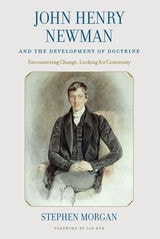
cover of John Henry Newman and the Development of Doctrine: Encountering Change, Looking for Continuity

John Henry Newman and the Development of Doctrine

Encountering Change, Looking for Continuity

Stephen Morgan

Catholic University of America Press, 2022
John Henry Newman and the Development of Doctrine provides an analysis of the attempts by John Henry Newman to account for the historical reality of doctrinal change within Christianity in the light of his lasting conviction that the idea of Christianity is fixed by reference to the dogmatic content of the deposit of faith. It argues that Newman proposed a series of hypotheses to account for the apparent contradiction between change and continuity, that this series begins much earlier than is generally recognized and that the final hypothesis he was to propose, contained in An Essay on the Development of Christian Doctrine, provides a methodology of lasting theological value and contemporary relevance. Stephen Morgan establishes the centrality of the problem of change and continuity in theology, to Newman's theological work as an Anglican, its part in his conversion to Catholicism and its contemporary relevance to Catholic theology. It also surveys the major secondary literature relating to the question, with particular reference to those works published within the last fifty years. Additionally, Morgan considers the legacy of the Essay as a tool in Newman’s theology and in the work of later theologians, finally suggesting that it may offer a useful methodological contribution to the contemporary Catholic debate about hermeneutical approaches to the Second Vatican Council and post-conciliar developments in doctrine.
[more]
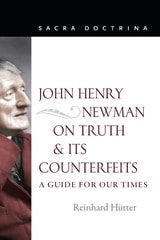
cover of John Henry Newman on Truth and its Counterfeits: A Guide for Our Times

John Henry Newman on Truth and its Counterfeits

A Guide for Our Times

Reinhard Hutter

Catholic University of America Press, 2020
Reinhard Hütter’s main thesis in this third volume of the Sacra Doctrina series is that John Henry Newman, in his own context of the nineteenth century, a century far from being a foreign one to our own, faced the same challenges as we do today; the problems then and now differ in degree, not in kind. Hence, Newman's engagement with these problems offers us a prescient and indeed prophetic diagnosis of what these problems or errors, if not corrected, will lead to—consequences which have more or less come to pass—and, furthermore, an alternative way which is at once thoroughly Catholic and holds contemporary relevance. The introduction offers a survey of Newman’s life and works and each of the subsequent four chapters addresses one significant aspect of Christianity that is not only contested or rejected by secular unbelief, but also has a counterfeit for which not only Christians, but even Catholics have fallen. The counterfeit of conscience is the “conscience” of the sovereign subject (Ch. 1); the counterfeit of faith is the “faith” of one who does not submit to the living authority through which God communicates but rather adheres to the principle of private judgment in matters of revealed religion(Ch.2); the counterfeit of doctrinal development is twofold: (i) paying lip service to development while only selectively accepting its consequences on the grounds of a specious antiquarianism and (ii) invoking development theory to justify all sorts of contemporary changes according to the present Zeitgeist (Ch. 3). Finally, the counterfeit of the university are all those “universities” whose end is not to educate and thereby to perfect the intellect, but rather to feed more efficiently the empire of desire that is informed by the techno-consumerism of today (Ch. 4). The book concludes with an epilogue on Hütter’s journey to Catholicism.
[more]
cover of José Martí’s Liberative Political Theology

José Martí’s Liberative Political Theology

Miguel A. De La Torre

Vanderbilt University Press, 2021

José Martí's Liberative Political Theology argues that Martí's religious views, which at first glance might appear outdated and irrelevant, are actually critical to understanding his social vision. During a time in which the predominant philosophical view was materialistic (e.g., Darwin, Marx), Martí sought to reconcile social and political trends with the metaphysical, believing that ignoring the spiritual would create a soulless approach toward achieving a liberative society. As such, Martí used religious concepts and ideas as tools that could bring forth a more just social order. In short, this book argues Martí could be considered a precursor to what would come to be called liberation theology.

Miguel De La Torre has authored the most comprehensive text written thus far concerning Martí's religious views and how they affected his political thought. The few similar texts that exist are written in Spanish, and most of them romanticize Martí's spirituality in an attempt to portray him as a “Christian believer.” Only a handful provide an academic investigation of Martí's theological thought based solely on his writings, and those concentrate on just one aspect of Martí's religious influences. José Martí's Liberative Political Theology allows for mutual influence between Martí's political and religious views, rather than assuming one had precedence over the other.
[more]
cover of Journeys in Church History Volume 2: Essays from the <i>Catholic Historical Review</i>

Journeys in Church History Volume 2

Essays from the <i>Catholic Historical Review</i>

Nelson H. Minnich

Catholic University of America Press, 2025
Journeys in Church History, Volume 2 offers further reflections from leading contemporary church historians, who describe in their own words how they have come to practice their craft. They trace their family and educational backgrounds, the themes that attracted their attention, the challenges they encountered in researching them, the new methodologies they adopted to answer questions, and the reception given to their findings. They also tell of their experiences in the classroom, both as students and teachers, the difficulties they encountered in their careers due to prejudices based on gender or religion, and how the discipline of church history has changed over their lifetimes. Their often entertaining accounts will serve to inform and inspire fellow historians, both young and old. Featured in this collection are essays from scholars who study the church across the centuries. Dame Avril Cameron focused her work on religion in the Byzantine Empire. John Van Engen has been interested in lay religion in the Middle Ages and has studied the rise of the Modern Devotion with its Imitation of Christ and experiments in communal religious life. Robert Bireley, SJ, specialized on Jesuit confessors to Catholic rulers during the Thirty Years War and laid out how both the Catholic and Protestant churches tried to adjust to a changing world in the early modern period. Asuncion Lavrin has studied the role of women in the religious life of colonial Latin America. Hugh Mc Leod used sociological data to map how various Christian denominations fared in the industrialized world of modern Europe. And Leslie Tentler has traced the changes in American Catholicism, especially those related to the Second Vatican Council and the Church’s teaching on women and sex. Each scholar shares the difficulties he or she encountered in doing their research and how their findings were initially received. This collection of essays is taken from the pages of The Catholic Historical Review, the official organ of the American Catholic Historical Association and the only scholarly journal under Catholic auspices in the English-speaking world devoted to the history of the Universal Church.
[more]
cover of Justice After War: <i>Jus Post Bellum</i> in the 21st Century

Justice After War

<i>Jus Post Bellum</i> in the 21st Century

David Chiwon Kwon

Catholic University of America Press, 2023

Justice After War is aimed especially to both undergraduate and graduate students, as well as the general audience who want to understand the significance of a recent development within the just war tradition, namely, the increasing attention given to the category of jus post bellum (postwar justice and peace). While examining the interrelated challenges of moral and social norms in both political and legal domains, as well as church practices, this work proposes an innovative methodology for linking theology, ethics, and social science so that the ideal and the real can inform each other in the ethics of war and peacebuilding. The main task of this project, then, is to identify what the author views as three key themes of jus post bellum, and three practices that are essential to implementing jus post bellum immediately after a war: just policing, just punishment, and just political participation. David Kwon endeavors to challenge the view of those who suggest that reconciliation, mainly political reconciliation, is the foremost ambition of jus post bellum. Instead, he attempts to justify the proposition that achieving just policing, just punishment, and just political participation are essential to building a just peace, a peace in which the fundamental characteristic must be human security. It thus demonstrates that human security is an oft-neglected theme in the recent discourse of moral theologians and that a more balanced understanding of jus post bellum will direct attention to the elements composing human security in a postwar context.
[more]