Results by title
3785 books match the query 'Poetry' and 30 start with j
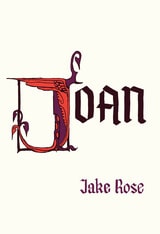
JOAN
Jake Rose
University of Chicago Press, 2026
Longlisted for the 2026 National Book Award for Poetry. A narrative sequence of lyric poems reimagining Joan of Arc as a framework for queer identity, transformation, and poetic voice.
Collapsing biography and autobiography, the poetry of Jake Rose’s debut explores queer identity, grief, and desire through the historical framework of Joan of Arc’s life. Moving through rural landscapes of the speaker’s youth, contradictions of faith, consequences of desire, and fragmentations of trauma, JOAN is structured as an excavation of the speaker’s most intimate moments, combining poetry with historical quotations, visual collage, and a sequence of film stills. Through vivid lyric moments, the poems construct a speaker and world both intimate and charged—“I have to touch my farthest feeling,” “the sapphire dusk draping its lace arias”—with clarity and vibrant intensity. Refusing resolution, these poems dwell in rupture, reinvention, and fluid forms of gender that come to life outside of inherited boundaries. This collection speaks from the margins, searching for a body the self might inhabit and asking what it means to transform through language, gender, and desire.
JOAN is the winner of the Phoenix Emerging Poet Book Prize.
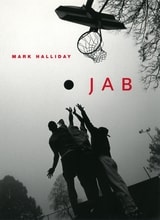
Jab
Mark Halliday
University of Chicago Press, 2002
Halliday has whacked Death and Mutabilitie before, but this time . . . this time he whacks them again. After this Jab, the world will never be the same. Or at least, a few hundred conversations, here and there, will be somewhat affected. Roll over Death, and tell Mutabilitie the news.
Jagged with Love
Susanna Childress
University of Wisconsin Press, 2005
Jalousie
Allyson Paty
Tupelo Press, 2025
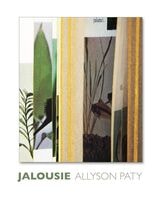
The “I-centered,” first person, yet experimental poems in Jalousie explore the ways in which expression of the deeply personal experience is both dictated to and altered by rigid societal expectations. The speaker of these highly personal poems can’t help but view language as a historical artifact, the DNA of past worlds, as these poems delve into the complexities of sorting out one’s individual identity amid broader cultural contexts. Paty’s poems attempt to connect the personal, private, intimate persona with elements that are always external—external not only to this poet but to every person.
These poems seek to capture fleeting moments of personal connection despite the impossibility of language, the societal dictates of gender roles, the pressures of making a living, the inexorable march of time, and the bewildering strangeness of architectural spaces. At the heart of this collection is “Premise,” an extensive poem that weaves in detours through the history of New York City, themes of discard, references to Bruegel's “Wedding Dance,” and discussions on representation and memory. The book also contains three full-color illustrations which augment the poet’s themes and concerns.
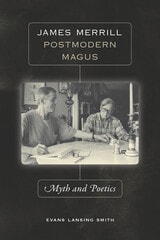
James Merrill, Postmodern Magus
Myth and PoeticsEvans Lansing Smith
University of Iowa Press, 2008
In this meticulously researched, carefully argued work, Evans Lansing Smith argues that the nekyia, the circular Homeric narrative describing the descent into the underworld and reemergence in the same or similar place, confers shape and significance upon the entirety of James Merrill’s poetry. Smith illustrates how pervasive this myth is in Merrill’s work – not just in The Changing Light at Sandover, where it naturally serves as the central premise of the entire trilogy, but in all of the poet’s books, before and after that central text.
By focusing on the details of versification and prosody, Smith demonstrates the ingenious fusion of form and content that distinguishes Merrill as a poet. Moving beyond purely literary interpretations of the poetry, Smith illuminates the numerous allusions to music, art, theology, philosophy, religion, and mythology found throughout Merrill’s work.

James Wright
The Poetry of a Grown Man; Constancy and Transition in the Work of James WrightKevin Stein
Ohio University Press, 1988
Stein locates Wright in the Emersonian tradition which sees struggle with language as a struggle with the self -- a locating and defining of the self within a world of natural facts. Language, then, becomes a means of self-definition, and to be frivolous or irresponsible with language becomes a negation of the self and the world it inhabits. For Wright, “the poetry of a grown man” issues from this understanding. Because Wright joins the act of language with the act of selfhood, it is not surprising that the mode and tenor of his work would alter as the self redefines its values and goals, its very identity. In fact, Stein divides Wright’s career into three interrelated stages of development: “containment,” in which he relies on traditional religious and rhetorical measures to distance himself from a world of experience; “vulnerability,” in which he enters the experiential world where the self is rewarded and equally threatened; and “integration,” in which he accepts and balances the necessary combination of beauty and horror inherent in being human within a natural world.
Stein shows that throughout his career Wright’s presiding concern is to discover a way of writing and a way of life that might overcome the effects of an individual’s separation from the human community, the natural world, and the spiritual presence in the universe. In Wright’s world, to do less is to betray one’s language -- and one’s self.
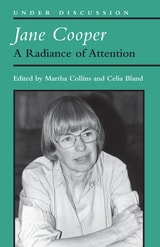
Jane Cooper
A Radiance of AttentionMartha Collins and Celia Bland, editors
University of Michigan Press, 2019
Martha Collins and Celia Bland bring together several decades’ worth of essential writing on Cooper’s poetry. While some pieces offer close examination of Cooper’s process or thoughtful consideration of the craft of a single poem, the volume also features reviews of her collections, including a previously unpublished piece on her first book, The Weather of Six Mornings (1969), by James Wright, a lifelong champion of her work. Marie Howe, Jan Heller Levi, and Thomas Lux, among others, share personal remembrances of Cooper as a teacher, colleague, and inspiration. L. R. Berger’s moving tribute to Cooper’s final days closes the volume. This book has much to offer for both readers who already love Cooper’s work and new readers, especially among younger poets, just discovering her enduring poems.
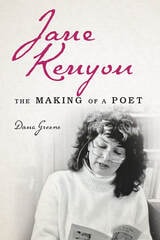
Jane Kenyon
The Making of a PoetDana Greene
University of Illinois Press, 2023
Pleasure-loving, sarcastic, stubborn, determined, erotic, deeply sad--Jane Kenyon’s complexity and contradictions found expression in luminous poems that continue to attract a passionate following. Dana Greene draws on a wealth of personal correspondence and other newly available materials to delve into the origins, achievement, and legacy of Kenyon’s poetry and separate the artist’s life story from that of her husband, the award-winning poet Donald Hall.
Impacted by relatives’ depression during her isolated childhood, Kenyon found poetry at college, where writers like Robert Bly encouraged her development. Her graduate school marriage to the middle-aged Hall and subsequent move to New Hampshire had an enormous impact on her life, moods, and creativity. Immersed in poetry, Kenyon wrote about women’s lives, nature, death, mystical experiences, and melancholy--becoming, in her own words, an “advocate of the inner life.” Her breakthrough in the 1980s brought acclaim as “a born poet” and appearances in the New Yorker and elsewhere. Yet her ongoing success and artistic growth exacerbated strains in her marriage and failed to stave off depressive episodes that sometimes left her non-functional. Refusing to live out the stereotype of the mad woman poet, Kenyon sought treatment and confronted her illness in her work and in public while redoubling her personal dedication to finding pleasure in every fleeting moment. Prestigious fellowships, high-profile events, residencies, and media interviews had propelled her career to new heights when leukemia cut her life short and left her husband the loving but flawed curator of her memory and legacy.
Revelatory and insightful, Jane Kenyon offers the first full-length biography of the elusive poet and the unquiet life that shaped her art.
Janet's Cottage
PoemsD.H. Tracy
St. Augustine's Press, 2012
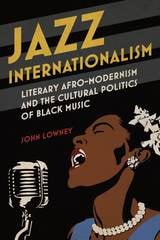
Jazz Internationalism
Literary Afro-Modernism and the Cultural Politics of Black MusicJohn Lowney
University of Illinois Press, 2017
Jazz Internationalism offers a bold reconsideration of jazz's influence in Afro-modernist literature. Ranging from the New Negro Renaissance through the social movements of the 1960s, John Lowney articulates nothing less than a new history of Afro-modernist jazz writing. Jazz added immeasurably to the vocabulary for discussing radical internationalism and black modernism in leftist African American literature. Lowney examines how Claude McKay, Ann Petry, Langston Hughes, and many other writers employed jazz as both a critical social discourse and mode of artistic expression to explore the possibilities—and challenges—of black internationalism. The result is an expansive understanding of jazz writing sure to spur new debates.
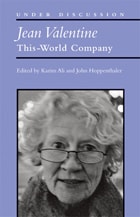
Jean Valentine
This-World CompanyKazim Ali and John Hoppenthaler, editors
University of Michigan Press, 2012
Over the course of more than four decades, contemporary American poet Jean Valentine has written eleven books of stunning, spirit-inflected poetry. This collection of essays, assembled over several years by Kazim Ali and John Hoppenthaler, brings together twenty-six pieces on all stages of Valentine's career by a range of poets, scholars, and admirers.
Valentine's poetry has long been valued for its dreamlike qualities, its touches of the personal and the political, and its mesmerizing phrasing. Valentine is a National Book Award winner and was named the State Poet of New York in 2008. She has taught a number of popular workshops and has been awarded a Bunting Institute Fellowship, a Guggenheim Foundation Fellowship, and the Shelley Memorial Prize.
Jewish Poet and Intellectual in Seventeenth-Century Venice
The Works of Sarra Copia Sulam in Verse and Prose Along with Writings of Her Contemporaries in Her Praise, Condemnation, or DefenseSarra Copia Sulam
University of Chicago Press, 2009
The first Jewish woman to leave her mark as a writer and intellectual, Sarra Copia Sulam (1600?–41) was doubly tainted in the eyes of early modern society by her religion and her gender. This remarkable woman, who until now has been relatively neglected by modern scholarship, was a unique figure in Italian cultural life, opening her home, in the Venetian ghetto, to Jews and Christians alike as a literary salon.
For this bilingual edition, Don Harrán has collected all of Sulam’s previously scattered writings—letters, sonnets, a Manifesto—into a single volume. Harrán has also assembled all extant correspondence and poetry that was addressed to Sulam, as well as all known contemporary references to her, making them available to Anglophone readers for the first time. Featuring rich biographical and historical notes that place Sulam in her cultural context, this volume will provide readers with insight into the thought and creativity of a woman who dared to express herself in the male-dominated, overwhelmingly Catholic Venice of her time.
John Ciardi
Measure of the ManVince Clemente
University of Arkansas Press, 1989
Some men make so indelible a mark on the lives of others that a place in time is reserved for them. In this memorial volume, some whose lives have been touched by such a man share their thoughts and memories of the poet, translator, editor , teacher, student, father, son, and husband they knew as John Ciardi.
X.J. Kennedy and Lewis Turco discuss Lives of X, a neglected American classic, which chronicles the years Ciardi spent growing up in Medford, Massachusetts, studying at Tufts, and serving as a gunner in World War II.
Richard Eberhart remembers Ciardi’s unforgettable presence, while John Holmes and Roy W. Cowden remember him as a brilliant student and poet at Tufts and at Michigan, where he won the Avery Hopwood Award. Others remember him as a teacher at Harvard and Rutgers. Dan Jaffe writes, “If John Ciardi held to any cause, it was the notion of precision, to an uncompromising excellence, to the notion that to strive was in itself not enough that one needed to judge honestly, to assess courageously, and to respond without flinching.”
William Heyden and Norbert Krapf tell how the books I Marry You and How Does a Poem Mean? influenced them as young men. In “john Ciardi: the Many Lives of Poetry,” John Nims claims Ciardi as our Chaucer. John Williams, Maxine Kumin, Diane Wakoski, and John Stone write about the Ciardi they knew at the Bread Loaf Writers’ Conference.
Gay Wilson Allen describes the list of contributors to Measure of the Man as a “Who’s Who” in American literature. Certainly it is an impressive gathering of poets, critics, and friends who have been touched by John Ciardi. “We are all in his debt,” Norman Cousins writes in his essay “Ciardi at The Saturday Review,” “and it is important that we say so.”
John Donne's Christian Vocation
Robert S. Jackson
Northwestern University Press, 1970
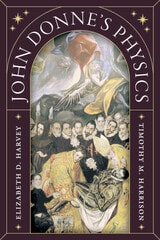
John Donne's Physics
Elizabeth D. Harvey and Timothy M. Harrison
University of Chicago Press, 2024
In 1624, poet and preacher John Donne published Devotions upon Emergent Occasions, a book that recorded his near-death experience during a deadly epidemic in London. Four hundred years later, in the aftermath of our own pandemic, Harvey and Harrison show how Devotions crystalizes the power, beauty, and enduring strangeness of Donne’s thinking. Arguing that Donne saw human life in light of emergent ideas in the study of nature (physics) and the study of the body (physick), John Donne’s Physics reveals Devotions as a culminating achievement, a radically new literary form that uses poetic techniques to depict Donne’s encounter with death in a world transformed by new discoveries and knowledge systems.
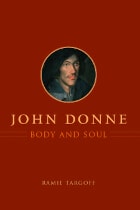
John Donne, Body and Soul
Ramie Targoff
University of Chicago Press, 2008
For centuries readers have struggled to fuse the seemingly scattered pieces of Donne’s works into a complete image of the poet and priest. In John Donne, Body and Soul, Ramie Targoff offers a way to read Donne as a writer who returned again and again to a single great subject, one that connected to his deepest intellectual and emotional concerns.
Reappraising Donne’s oeuvre in pursuit of the struggles and commitments that connect his most disparate works, Targoff convincingly shows that Donne believed throughout his life in the mutual necessity of body and soul. In chapters that range from his earliest letters to his final sermon, Targoff reveals that Donne’s obsessive imagining of both the natural union and the inevitable division between body and soul is the most continuous and abiding subject of his writing.
“Ramie Targoff achieves the rare feat of taking early modern theology seriously, and of explaining why it matters. Her book transforms how we think about Donne.”—Helen Cooper, University of Cambridge
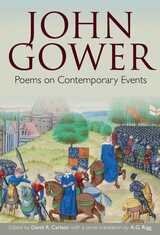
John Gower
Poems on Contemporary EventsDavid R. Carlson
Bodleian Library Publishing, 2011

John Greenleaf Whittier’s Poetry
An Appraisal and a SelectionRobert Penn Warren
University of Minnesota Press, 1971
John Greenleaf Whittier's Poetry was first published in 1971. Minnesota Archive Editions uses digital technology to make long-unavailable books once again accessible, and are published unaltered from the original University of Minnesota Press editions.
In this volume Robert Warren Penn, the noted critic, poet, and novelist, provides a major new appraisal of the once enormously popular New England port, John Greenleaf Whittier, along with his selection of 36 of Whittier's poems. Through Warren's perceptive and illuminating discussion, the significance of Whittier as a writer for our time becomes clear. In his introduction Warren shows that Whittier's deep commitment to his fellowman, especially his devotion to the cause of abolition, profoundly influenced his writing. In his estimate of Whittier's place in literature, Warren invokes the questions What does the past mean to an American? and in this context he compares Whittier with Cooper, Hawthorne, Melville, and Faulkner. He finds that Whittier's "star belongs in their constellation. If it is less commanding than any of theirs it yet shines with a clear and authentic light."
John Keats
Woof, Robert
Rutgers University Press, 1999
Jorie Graham
Essays on the PoetryEdited by Thomas Gardner
University of Wisconsin Press, 2005
These essays identify three broad concerns that run through each of her strikingly different volumes of poems: the movement of the mind in action, the role of the body in experiencing the world, and the pressures of material conditions on mind and body alike. Gardner both shows how Graham is being read at the moment and charts new areas of investigation likely to dominate thinking about her over the next decade. This collection is sure to become the crucial first step for all future work on Graham and on American poetry of the last two decades.
Joseph
An EpicZachary McLeod Hutchins
University of Illinois Press, 2025
Journal of a Homecoming / Cahier d'un retour au pays natal
Aimé Césaire
Duke University Press, 2017
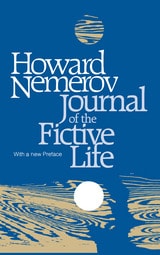
Journal of the Fictive Life
Howard Nemerov
University of Chicago Press, 1981
"He often shows bravery and shrewdness; the book is full of fine criticism and psychological insight. As always, his prose has that ease and transparency that make one forget one is reading; one seems simply to hear a voice speaking. Nemerov's improvised self-analysis has weaknesses, but few that he himself doesn't eventually recognize."—New York Times Book Review
"In an age of explicitness, Nemerov's Journal of the Fictive Life is explicitly without vulgarity; in an age of revelation, it reveals only what counts. More then a book about creativity, it is a beautiful creation."—Richard G. Stern
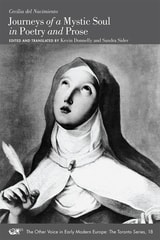
Journeys of a Mystic Soul in Poetry and Prose
Cecilia del Nacimiento
Iter Press, 2012
—Stacey Schlau
Professor, Department of Languages and Culture and the Women’s Studies Program
West Chester University, Pennsylvania
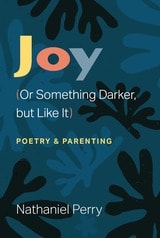
Joy (Or Something Darker, but Like It)
poetry & parentingNathaniel Perry
University of Michigan Press, 2024
Each of the twelve essays considers a different poet—Edward Thomas, Henry W. Longfellow, George Scarbrough, Elizabeth Bishop, Geoffrey Hill, Primus St. John, Robert Hayden, Elizabeth Coatsworth, Gwendolyn Brooks, Robert Frost, E.A. Robinson, and Belle Randall—and, alongside them, different concerns of parenting and living. Organized in chronological order, they track the growth of Nathaniel Perry’s own children who pop up from time to time in a believable way. Essays consider the idea of devotion and belief, the idea of imperfection, the small details we can focus on as parents, and the conceptions of the world we pass along to our children. Together these essays not only represent the author's personal canon of poets who have been important to him in his life and work, but also present a diverse slice of American poetry, in voice, form, identity, origin, and time period.
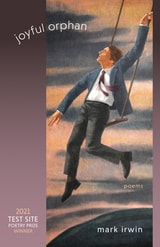
Joyful Orphan
PoemsMark Irwin
University of Nevada Press, 2023
Through poems of witness, species and habitat extinction, war, pandemic, technology, history, and race, Mark Irwin’s elegant collection of poetry explores the collision between metropolis and wilderness, and engages with forms of spirit that cannot be bound. With the incursion of electronic communication, our connections with one another have been radically distorted. Irwin’s poems confront what it means to be human, and how conflict, along with the interface between technology and humanity, can cause us to become orphaned in many different ways. But it is our decision to be joyful.
Excerpt from “Letter”
Times when we touch hope like the hem of a cloud
just as when we touch a body or door, or think
of the dead come back, romancing
us through the warp of memory, lighting a way
by luring . . .
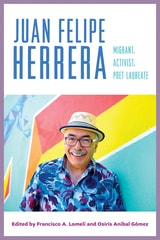
Juan Felipe Herrera
Migrant, Activist, Poet LaureateEdited by Francisco A. Lomelí and Osiris Aníbal Gómez
University of Arizona Press, 2023
For the first time, this book presents the distinguished, prolific, and highly experimental writer Juan Felipe Herrera. This wide-ranging collection of essays by leading experts offers critical approaches on Herrera, who transcends ethnic and mainstream poetics. It expertly demonstrates Herrera’s versatility, resourcefulness, innovations, and infinite creativity.
As a poet Herrera has had an enormous impact within and beyond Chicano poetics. He embodies much of the advancements and innovations found in American and Latin American poetry from the early l970s to the present. His writings have no limits or boundaries, indulging in the quotidian as well as the overarching topics of his era at different periods of his life. Both Herrera and his work are far from being unidimensional. His poetics are eclectic, incessantly diverse, transnational, unorthodox, and distinctive.
Reading Herrera is an act of having to rearrange your perceptions about things, events, historical or intra-historical happenings, and people. The essays in this work delve deeply into Juan Felipe Herrera’s oeuvre and provide critical perspectives on his body of work. They include discussion of Chicanx indigeneity, social justice, environmental imaginaries, Herrera’s knack for challenging theory and poetics, transborder experiences, transgeneric constructions, and children’s and young adult literature.
This book includes an extensive interview with the poet and a voluminous bibliography on everything by, about, and on the author. The chapters in this book offer a deep dive into the life and work of an internationally beloved poet who, along with serving as the poet laureate of California and the U.S. poet laureate, creates work that fosters a deep understanding of and appreciation for people’s humanity.
Contributors
Trevor Boffone
Marina Bernardo-Flórez
Manuel de Jesús Hernández-G.
Whitney DeVos
Michael Dowdy
Osiris Aníbal Gómez
Carmen González Ramos
Cristina Herrera
María Herrera-Sobek
Francisco A. Lomelí
Tom Lutz
Manuel M. Martín-Rodríguez
Marzia Milazzo
Maria Antònia Oliver-Rotger
Rafael Pérez-Torres
Renato Rosaldo
Donaldo W. Urioste
Luis Alberto Urrea
Santiago Vaquera-Vásquez
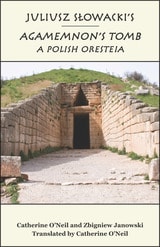
Juliusz Slowacki's Agamemnon's Tomb
A Polish OresteiaCatherine O'Neil
St. Augustine's Press, 2019
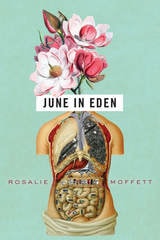
June in Eden
Rosalie Moffett
The Ohio State University Press, 2017
A sharp, darkly funny, and tender debut that exposes the fractures in our language, our technologies, and our attempts to call the world by its right name.
In June in Eden, Rosalie Ruth Moffett leads us through terrains that shift between the mythic and the modern. Sometimes the garden is wild and blooming; other times, the coveted tree is only hiding a cell tower, lungs become ATMs, and prayers travel by text message. This is a book for an age when “new kinds of war…keep / changing the maps,” and when even small slips—preying or praying—reveal the instability of the words we rely on.
At the heart of the collection lies an obsession with language: its power, its failures, and what remains when it falters. “Ruth,” our speaker notes, is “a kind of compassion / nobody wants anymore—the surviving half / of the pair of words is ruthless.” Throughout these poems, dark humor coexists with deep tenderness, reminding us of the human urge to “love the world / we made and all its shadows.
Moffett offers a speaker bewildered and awestruck by the world’s contradictions—its technological miracles, its medical uncertainties, its imaginative leaps. These poems, equal parts grief and wonder, give us a landscape that from some angles resembles paradise, and from others, something far stranger.
Just Between Us
David McElroy
University of Alaska Press, 2018