Results by title
28164 books match the query 'History' and 406 start with j
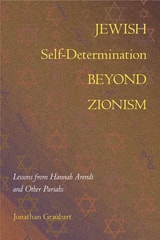
Jewish Self-Determination beyond Zionism
Lessons from Hannah Arendt and Other PariahsJonathan Graubart
Temple University Press, 2023
Jewish Self-Determination beyond Zionism also engages a Humanist Zionist vision to confront the Zionist movement’s foundational sins and demands a full reckoning with the Palestinians. Graubart focuses on two of Humanist Zionism’s most insightful thinkers, Martin Buber and Hannah Arendt, putting them “in conversation” with each other, and synthesizing their collective insights and critical Jewish perspectives alongside the ideas of Noam Chomsky, Judith Butler, Ella Shohat, Edward Said, and other philosophers and academics. Jewish Self-Determination beyond Zionism concludes that an updated, binational program is the best path forward.
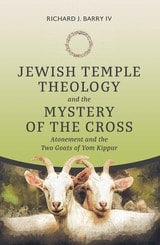
Jewish Temple Theology and the Mystery of the Cross
Atonement and the Two Goats of Yom KippurRichard J. Barry IV
Catholic University of America Press, 2023

Jewish Women in Fin de Siècle Vienna
By Alison Rose
University of Texas Press, 2008
Despite much study of Viennese culture and Judaism between 1890 and 1914, little research has been done to examine the role of Jewish women in this milieu. Rescuing a lost legacy, Jewish Women in Fin de Siècle Vienna explores the myriad ways in which Jewish women contributed to the development of Viennese culture and participated widely in politics and cultural spheres.
Areas of exploration include the education and family lives of Viennese Jewish girls and varying degrees of involvement of Jewish women in philanthropy and prayer, university life, Zionism, psychoanalysis and medicine, literature, and culture. Incorporating general studies of Austrian women during this period, Alison Rose also presents significant findings regarding stereotypes of Jewish gender and sexuality and the politics of anti-Semitism, as well as the impact of German culture, feminist dialogues, and bourgeois self-images.
As members of two minority groups, Viennese Jewish women nonetheless used their involvement in various movements to come to terms with their dual identity during this period of profound social turmoil. Breaking new ground in the study of perceptions and realities within a pivotal segment of the Viennese population, Jewish Women in Fin de Siècle Vienna applies the lens of gender in important new ways.
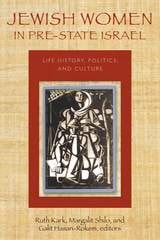
Jewish Women in Pre-State Israel
Life History, Politics, and CultureEdited by Ruth Kark, Margalit Shilo, and Galit Hasan-Rokem
Brandeis University Press, 2009
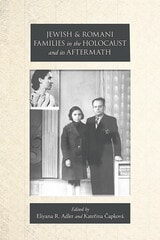
Jewish and Romani Families in the Holocaust and its Aftermath
Eliyana R. Adler
Rutgers University Press, 2021
In this work, scholars from the United States, Israel, and across Europe bring a variety of backgrounds and disciplines to their study of the Holocaust and its aftermath from the family perspective. Drawing on research from Belarus to Great Britain, and examining both Jewish and Romani families, they demonstrate the importance of recognizing how people continued to function within family units—broadly defined—throughout the war and afterward.
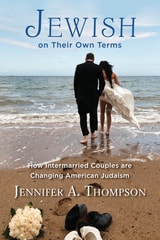
Jewish on Their Own Terms
How Intermarried Couples are Changing American JudaismThompson, Jennifer A
Rutgers University Press, 0
Over half of all American Jewish children are being raised by intermarried parents. This demographic group will have a tremendous impact on American Judaism as it is lived and practiced in the coming decades. To date, however, in both academic studies about Judaism and in the popular imagination, such children and their parents remain marginal.
Jennifer A. Thompson takes a different approach. In Jewish on Their Own Terms, she tells the stories of intermarried couples, the rabbis and other Jewish educators who work with them, and the conflicting public conversations about intermarriage among American Jews. Thompson notes that in the dominant Jewish cultural narrative, intermarriage symbolizes individualism and assimilation. Talking about intermarriage allows American Jews to discuss their anxieties about remaining distinctively Jewish despite their success in assimilating into American culture.
In contrast, Thompson uses ethnography to describe the compelling concerns of all of these parties and places their anxieties firmly within the context of American religious culture and morality. She explains how American and traditional Jewish gender roles converge to put non-Jewish women in charge of raising Jewish children. Interfaith couples are like other Americans in often harboring contradictory notions of individual autonomy, universal religious truths, and obligations to family and history.
Focusing on the lived experiences of these families, Jewish on Their OwnTerms provides a complex and insightful portrait of intermarried couples and the new forms of American Judaism that they are constructing.
Jews Against Zionism
The American Council for Judaism, 1942-1948Thomas A. Kolsky
Temple University Press, 1992
This is the first full-scale history of the only organized American Jewish opposition to Zionism during the 1940s. Despite extensive literature on the Zionist movement, the Jewish opposition to Zionism has received only marginal and usually negative attention. In this impartial study, Thomas A. Kolsky examines the neglected phenomenon of Jewish anti-Zionism, its roots, and its results.
In 1942, a number of dissident Reform rabbis founded the American Council for Judaism, the first and only Jewish organization created to fight against Zionism and the establishment of a Jewish state. Emphasizing the purely religious nature of Judaism and unequivocally rejecting Jewish nationalism, the Council supported free Jewish immigration and equal rights for Jews throughout the world. For Palestine, specifically, it advocated establishment of a democratic state wherein all citizens, regardless of their religion, would enjoy equal political rights.
Summarizing both the history of Zionism and the history of American Jews, Kolsky traces the effects of the Holocaust on the Zionist movement and the personalities that shaped the leadership of the Council. Its position toward Zionism has particular contemporary relevance in understanding the historical relationship between Israel and the Palestinians.
Jews Welcome Coffee
Tradition and Innovation in Early Modern GermanyRobert Liberles
Brandeis University Press, 2012
Jews and Christians in Medieval Castile
Maya Soifer Irish
Catholic University of America Press, 2016
Jews and Diaspora Nationalism
Writings on Jewish Peoplehood in Europe and the United StatesEdited by Simon Rabinovitch
Brandeis University Press, 2012
Jews and Gentiles in Early America
1654-1800William Pencak
University of Michigan Press, 2005
Jews and Other Germans
Civil Society, Religious Diversity, and Urban Politics in Breslau, 1860–1925Till van Rahden
University of Wisconsin Press, 2008
Closely analyzing the political, social, and cultural life in a major German city, van Rahden shows that Jews were a part of a broad urban community that encompassed diversity within unity, at once offering them a large measure of equality while permitting them to remain meaningfully Jewish. Jews and Other Germans also substantially revises the chronology of anti-Semitism in Germany, showing that Jews only began to experience exclusion from Breslau’s social world during World War I.
Yet van Rahden not only illuminates Breslau’s multicultural fabric; he also tells the story of this remarkable city as one of cultural and religious conflict and coexistence. Recounting the experiences of Jews, Protestants, and Catholics within a single narrative, he offers a critical intervention into scholarship on liberalism and civil society in nineteenth- and early twentieth-century Europe.
Jews and Race
Writings on Identity and Difference, 1880–1940Edited by Mitchell B. Hart
Brandeis University Press, 2011
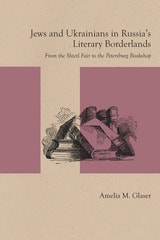
Jews and Ukrainians in Russia's Literary Borderlands
From the Shtetl Fair to the Petersburg BookshopAmelia M. Glaser
Northwestern University Press, 2011
Studies of Eastern European literature have largely confined themselves to a single language, culture, or nationality. In this highly original book, Glaser shows how writers working in Russian, Ukrainian, and Yiddish during much of the nineteenth century and the early part of the twentieth century were in intense conversation with one another. The marketplace was both the literal locale at which members of these different societies and cultures interacted with one another and a rich subject for representation in their art. It is commonplace to note the influence of Gogol on Russian literature, but Glaser shows him to have been a profound influence on Ukrainian and Yiddish literature as well. And she shows how Gogol must be understood not only within the context of his adopted city of St. Petersburg but also that of his native Ukraine. As Ukrainian and Yiddish literatures developed over this period, they were shaped by their geographical and cultural position on the margins of the Russian Empire. As distinctive as these writers may seem from one another, they are further illuminated by an appreciation of their common relationship to Russia. Glaser’s book paints a far more complicated portrait than scholars have traditionally allowed of Jewish (particularly Yiddish) literature in the context of Eastern European and Russian culture.
Jews and the Italian Left
Socialism, Zionism, and Antisemitism from 1892 to 1992Alessandra Tarquini, Translated by Max Matukhin
University of Wisconsin Press, 2026
Tarquini’s research fills an important lacuna by analyzing the antisemitism of twentieth-century socialist movements. Crucially, however, Tarquini makes important distinctions between antisemitism on the Italian left and right, and identifies the relationship between leftism and antisemitism as a distinct formation.
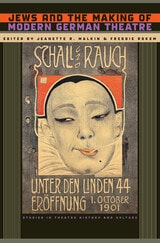
Jews and the Making of Modern German Theatre
Jeanette R. Malkin
University of Iowa Press, 2010
While it is common knowledge that Jews were prominent in literature, music, cinema, and science in pre-1933 Germany, the fascinating story of Jewish co-creation of modern German theatre is less often discussed. Yet for a brief time, during the Second Reich and the Weimar Republic, Jewish artists and intellectuals moved away from a segregated Jewish theatre to work within canonic German theatre and performance venues, claiming the right to be part of the very fabric of German culture. Their involvement, especially in the theatre capital of Berlin, was of a major magnitude both numerically and in terms of power and influence. The essays in this stimulating collection etch onto the conventional view of modern German theatre the history and conflicts of its Jewish participants in the last third of the nineteenth and first third of the twentieth centuries and illuminate the influence of Jewish ethnicity in the creation of the modernist German theatre.
The nontraditional forms and themes known as modernism date roughly from German unification in 1871 to the end of the Weimar Republic in 1933. This is also the period when Jews acquired full legal and trade equality, which enabled their ownership and directorship of theatre and performance venues. The extraordinary artistic innovations that Germans and Jews co-created during the relatively short period of this era of creativity reached across the old assumptions, traditions, and prejudices that had separated people as the modern arts sought to reformulate human relations from the foundations to the pinnacles of society.
The essayists, writing from a variety of perspectives, carve out historical overviews of the role of theatre in the constitution of Jewish identity in Germany, the position of Jewish theatre artists in the cultural vortex of imperial Berlin, the role played by theatre in German Jewish cultural education, and the impact of Yiddish theatre on German and Austrian Jews and on German theatre. They view German Jewish theatre activity through Jewish philosophical and critical perspectives and examine two important genres within which Jewish artists were particularly prominent: the Cabaret and Expressionist theatre. Finally, they provide close-ups of the Jewish artists Alexander Granach, Shimon Finkel, Max Reinhardt, and Leopold Jessner. By probing the interplay between “Jewish” and “German” cultural and cognitive identities based in the field of theatre and performance and querying the effect of theatre on Jewish self-understanding, they add to the richness of intercultural understanding as well as to the complex history of theatre and performance in Germany.
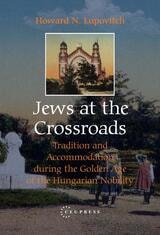
Jews at the Crossroads
Tradition and Accomodation during the Golden Age of the Hungarian NobilityHoward N. Lupovitch
Central European University Press, 2007
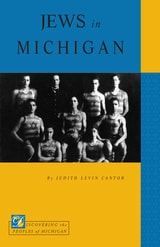
Jews in Michigan
Judith Levin Cantor
Michigan State University Press, 2001
Since the earliest days of the British fur trade, Jewish pioneers have made Michigan their home. Judith Levin Cantor's Jews in Michigan captures the struggles and triumphs of Michigan's Jews as they worked to establish farms, businesses and synagogues, sparking commercial and residential development throughout the state, and even into the far reaches of the Upper Peninsula. Cantor celebrates both urban and rural immigrants, who supplied essential goods and services to those in lumbering, mining, and automobile manufacturing. She also deals honestly with questions of anti-Semitism and prejudice. Cantor's book shows how, in the quest to build strong communities, Jewish residents also helped create the foundations of the Michigan we know today.
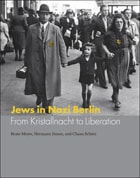
Jews in Nazi Berlin
From Kristallnacht to LiberationEdited by Beate Meyer, Hermann Simon, and Chana Schütz
University of Chicago Press, 2009
Though many of the details of Jewish life under Hitler are familiar, historical accounts rarely afford us a real sense of what it was like for Jews and their families to live in the shadow of Nazi Germany’s oppressive racial laws and growing violence. With Jews in Nazi Berlin, those individual lives—and the constant struggle they required—come fully into focus, and the result is an unprecedented and deeply moving portrait of a people.
Drawing on a remarkably rich archive that includes photographs, objects, official documents, and personal papers, the editors of Jews in Nazi Berlin have assembled a multifaceted picture of Jewish daily life in the Nazi capital during the height of the regime’s power. The book’s essays and images are divided into thematic sections, each representing a different aspect of the experience of Jews in Berlin, covering such topics as emigration, the yellow star, Zionism, deportation, betrayal, survival, and more. To supplement—and, importantly, to humanize—the comprehensive documentary evidence, the editors draw on an extensive series of interviews with survivors of the Nazi persecution, who present gripping first-person accounts of the innovation, subterfuge, resilience, and luck required to negotiate the increasing brutality of the regime.
A stunning reconstruction of a storied community as it faced destruction, Jews in Nazi Berlin renders that loss with a startling immediacy that will make it an essential part of our continuing attempts to understand World War II and the Holocaust.
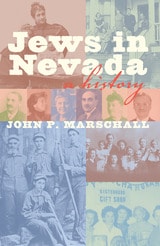
Jews in Nevada
A HistoryJohn P. Marschall
University of Nevada Press, 2011
Jews have always been one of Nevada’s most active and influential ethnic minorities. They were among the state’s earliest Euro-American settlers, and from the beginning they have been involved in every area of the state’s life as businessmen, agrarians, scholars, educators, artists, politicians, and civic, professional, and religious leaders. Jews in Nevada is an engaging, multilayered chronicle of their lives and contributions to the state. Here are absorbing accounts of individuals and families who helped to settle and develop the state, as well as thoughtful analyses of larger issues, such as the reasons Jews came to Nevada in the first place, how they created homes and interacted with non-Jews, and how they preserved their religious and cultural traditions as a small minority in a sparsely populated region.
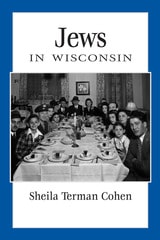
Jews in Wisconsin
Sheila Terman Cohen
Wisconsin Historical Society Press, 2016
Unlike the other cultural groups covered in the People of Wisconsin series, the Jews who have made their home in Wisconsin are united not by a single country of origin, but by a shared history and set of religious beliefs. This diverse group found their way to America’s heartland over several centuries from Germany, Russia, and beyond, some fleeing violence and persecution, others searching for new opportunities, but all making important contributions to the fabric of this state’s history. Through detailed historical information and personal accounts, Sheila Terman Cohen brings to life the stories of their various trials and triumphs. Jews in Wisconsin details their battles against anti-Semitism, their efforts to participate in the communities they joined, and their successes at holding onto their own cultural identities.
In addition to excerpts of Cohen’s many interviews with Wisconsin Jews, Jews in Wisconsin also features the compelling journals of German immigrant Louis Heller, a tradesman who established himself in Milwaukee, and Russian immigrant Azriel Kanter, who details the perilous journey his family embarked on to escape anti-Semitism in his home country and make a new life in Wisconsin.
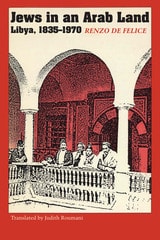
Jews in an Arab Land
Libya, 1835–1970By Renzo De Felice; translated by Judith Roumani; foreword by Rafello Fellah
University of Texas Press, 1985
Internationally renowned scholar Renzo De Felice’s pioneering study of the Jews of Libya is, in many ways, a microcosm of the major sources of conflict in the modern Middle East. This is the first English translation of Ebrei in un paese arabo, originally published by Il Mulino, Bologna, in 1978.
The author’s broad-ranging and meticulous research has enabled him to reconstruct the contemporary history of the Jews in Libya with an incredible richness of detail, bringing into vivid relief the social, religious, cultural, and political lives of a people caught between centuries of tradition and a series of governments bent on plunging them headfirst into the modern world. This story—fraught with the passion, drama, tragicomedy, and conflict of a society in transition—will be an invaluable resource for scholars in Middle Eastern studies, Jewish studies, and contemporary European history. The wealth of documentation, much of it previously unknown or unpublished, makes this a particularly useful book.
Jews, Christian Society, and Royal Power in Medieval Barcelona
Elka Klein
University of Michigan Press, 2006
Jews, Christian Society, and Royal Power in Medieval Barcelona traces the development of the Jewish community of Barcelona from 1050 to 1300. Elka Klein challenges the common perception that medieval Jews lived in relative isolation from the surrounding society, argues for the existence of significant cultural common ground between Jews and Christians, and proposes a new model for understanding Jewish communal autonomy and the relationship between Jews and their rulers.
Klein traces the development of the Jewish community of Barcelona in two contexts: the parallel development of the city of Barcelona and the changing relationship of the king to urban communities, Jewish and Christian. Until the later twelfth century, the Jewish community, like the Christian city of Barcelona, was left mostly to its own devices by the counts of Barcelona, who had neither the interest nor the power to interfere in internal affairs. Klein draws on both Hebrew and Latin sources to offer a picture of a communal elite whose power, mostly informal, derived from their influence within the community. This system changed in the later twelfth century as a result of the expansion of comitial-royal administration. Four Jewish families used their positions as bailiffs, accountants, and secretaries to consolidate power within their community. The rule of this courtier elite was short lived; two episodes of communal conflict in the early thirteenth century and increased royal activism led to the institution of a new regime of elected officials in 1241. The book concludes with an examination of the new elite and the implications of increased royal interference in internal affairs.
A central argument of Jews, Christian Society, and Royal Power in Medieval Barcelona is that it is necessary to distinguish between autonomy by default, resulting from the indifference of the ruler, who leaves a community to govern itself; and autonomy by design, guaranteed by selective royal interference. Against the view that royal interference undercut Jewish autonomy, Klein argues that autonomy by default left the community with insufficient power to enforce its decisions; because Catalan kings generally interfered in support of existing structures, autonomy by design in fact strengthened the community.
This book contributes to ongoing debates about the relationship between the cultures of the three religions in the Iberian peninsula. It joins a body of recent scholarship arguing that medieval European Jews and Christians shared considerable cultural common ground.
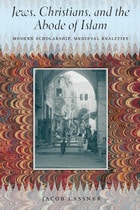
Jews, Christians, and the Abode of Islam
Modern Scholarship, Medieval RealitiesJacob Lassner
University of Chicago Press, 2012
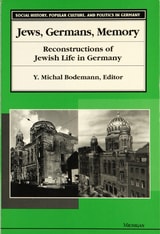
Jews, Germans, Memory
Reconstructions of Jewish Life in GermanyY. Michal Bodemann, Editor
University of Michigan Press, 1996

Jews, Sports, and the Rites of Citizenship
Edited by Jack Kugelmass
University of Illinois Press, 2006
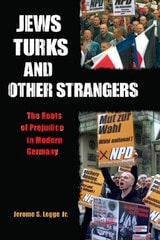
Jews, Turks, and Other Strangers
Roots of Prejudice in Modern GermanyJerome S. Legge, Jr.
University of Wisconsin Press, 2003
Scholarly, objective, insightful, and analytical, Jews, Turks, and Other Strangers studies the causes of prejudice against Jews, foreign workers, refugees, and emigrant Germans in contemporary Germany. Using survey material and quantitative analyses, Legge convincingly challenges the notion that German xenophobia is rooted in economic causes. Instead, he sees a more complex foundation for German prejudice, particularly in a reunified Germany where perceptions of the "other" sometimes vary widely between east and west, a product of a traditional racism rooted in the German past. By clarifying the foundations of xenophobia in a new German state, Legge offers a clear and disturbing picture of a conflicted country and a prejudice that not only affects Jews but also fuels a larger, anti-foreign sentiment.
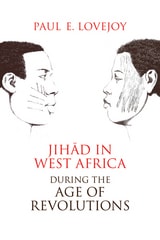
Jihad in West Africa during the Age of Revolutions
Paul E. Lovejoy
Ohio University Press, 2016
In Jihād in West Africa during the Age of Revolutions, a preeminent historian of Africa argues that scholars of the Americas and the Atlantic world have not given Africa its due consideration as part of either the Atlantic world or the age of revolutions. The book examines the jihād movement in the context of the age of revolutions—commonly associated with the American and French revolutions and the erosion of European imperialist powers—and shows how West Africa, too, experienced a period of profound political change in the late eighteenth through the mid-nineteenth centuries. Paul E. Lovejoy argues that West Africa was a vital actor in the Atlantic world and has wrongly been excluded from analyses of the period.
Among its chief contributions, the book reconceptualizes slavery. Lovejoy shows that during the decades in question, slavery expanded extensively not only in the southern United States, Cuba, and Brazil but also in the jihād states of West Africa. In particular, this expansion occurred in the Muslim states of the Sokoto Caliphate, Fuuta Jalon, and Fuuta Toro. At the same time, he offers new information on the role antislavery activity in West Africa played in the Atlantic slave trade and the African diaspora.
Finally, Jihād in West Africa during the Age of Revolutions provides unprecedented context for the political and cultural role of Islam in Africa—and of the concept of jihād in particular—from the eighteenth century into the present. Understanding that there is a long tradition of jihād in West Africa, Lovejoy argues, helps correct the current distortion in understanding the contemporary jihād movement in the Middle East, Afghanistan, Pakistan, and Africa.
Jihadism, Sectarianism and Politics in a Changing Middle East
Adib Abdulmajid
Eburon Academic Publishers, 2021
The emergence and growth of sectarian Islamist militant organizations, whether Sunni or Shia, is deemed to be the fruit of the emerging radical interpretations of the concept of jihad, and the evolution of Islamism in general. The main objective of this book is to help the reader understand the complex religio-political scene in today’s Middle East and the ideological principles and agendas of influential movements, whose beliefs and actions constitute a serious threat to cultural diversity in the region. It addresses the doctrinal tenets associated with the emergence of influential Islamist organizations and the challenges encountered by the culturally diverse populations that surround them. This book also delves into the historical events that have shaped the Middle East as we know it today. It further examines the key factors behind the rise of the most influential sectarian-guided, jihadi-based extremist groups in the recent years
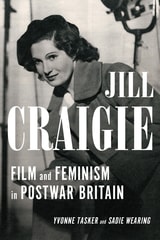
Jill Craigie
Film and Feminism in Postwar BritainYvonne Tasker and Sadie Wearing
University of Illinois Press, 2026
Tasker and Wearing reconsider Craigie’s place and reputation in the history of British Cinema. Craigie created work that showed a strong critical voice and at the same time challenged contemporary modes of filmmaking with both documentary and drama. Tasker and Wearing examine her feminist and working-class influences and also emphasize the democratic impulse that drove Craigie to include her subjects’ participation, and her commitment to representing them on screen. Throughout, Tasker and Wearing analyze Craigie’s work against the backdrop of postwar concerns and preoccupations.
Distinctive and nuanced, Jill Craigie reconsiders the career of a groundbreaking woman director.
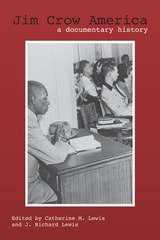
Jim Crow America
A Documentary HistoryCatherine M. Lewis
University of Arkansas Press, 2009
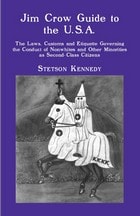
Jim Crow Guide to the U.S.A.
The Laws, Customs and Etiquette Governing the Conduct of Nonwhites and Other Minorities as Second-Class CitizensStetson Kennedy
University of Alabama Press, 2011
“A history of the United States that is almost incredible.” —Jean-Paul Sartre, Les Temps Modernes
Jim Crow Guide to the U.S.A. by Stetson Kennedy is a bold exposé of America’s institutionalized racism, originally published in 1959 and hailed as a landmark in civil rights literature. With unflinching clarity, Kennedy documents the laws, customs, and social codes that relegated nonwhite citizens to second-class status under the Jim Crow system. From the mistreatment of Native Americans to the exclusionary immigration policies targeting Asians and Africans, the book maps the presence of race-based politics across every facet of American life—housing, education, employment, and even burial.
What makes this work especially influential is its international resonance. The famed French existentialist Jean-Paul Sartre championed the book’s publication in Europe, recognizing its power to illuminate the contradictions between American democratic ideals and racial realities. Sartre’s endorsement helped position the book as a global indictment of racial injustice, aligning it with anti-colonial and human rights movements worldwide. Provocative, meticulously researched, and deeply human, Jim Crow Guide to the U.S.A. remains a vital historical document and a call to conscience. It is not merely a guide—it is a mirror held up to a nation, reflecting truths that later generations were called on to address.
Jim Crow Networks
African American Periodical CulturesEurie Dahn
University of Massachusetts Press, 2021
As Eurie Dahn demonstrates, authors like James Weldon Johnson, Nella Larsen, William Faulkner, and Jean Toomer wrote in the context of interracial and black periodical networks, which shaped the literature they produced and their concerns about racial violence. This original study also explores the overlooked intersections between the black press and modernist and Harlem Renaissance texts, and highlights key sites where readers and writers worked toward bottom-up sociopolitical changes during a period of legalized segregation.
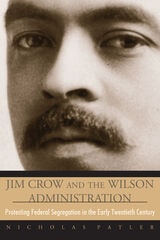
Jim Crow and the Wilson Administration
Protesting Federal Segregation in the Early Twentieth CenturyNicholas Patler
University Press of Colorado, 2007
This protest campaign, carried out on a level not seen since the abolitionist movement, galvanized a vast community of men and women. Blacks and whites, professionals and laymen, signed petitions, wrote protest letters, participated in organized mass meetings, lobbied public officials, directly confronted Wilson, made known their plight through publicity campaigns, and, in at least one case, marched to express their opposition. Patler provides a thorough examination of the two national organizations that led these protests efforts - the National Association for the Advancement of Colored People and William Monroe Trotter's National Equal Rights League - and deftly contextualizes the movement, while emphasizing the tragic, enduring consequences of the Wilson administration's actions.
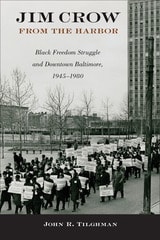
Jim Crow from the Harbor
Black Freedom Struggle and Downtown Baltimore, 1945–1980John R. Tilghman
Temple University Press, 2026
How do poor Black communities co-exist with downtown revitalization? How do Black social movements respond to urban renewal to ensure access to better housing and city spaces? John Tilghman investigates these interlocking questions in Jim Crow from the Harbor. Looking at Baltimore, Maryland’s redevelopment in the post-war era of deindustrialization and population decline through white flight, Tilghman tells the story of how Black activists clashed with urban regimes.
Tilghman follows the money—redevelopment profits—which created tensions that prompted anti-freeway campaigns and affirmative action efforts. Through grassroots activism, protests, and community building, participants in the Black Freedom Struggle undermined downtown interests’ efforts to reinforce racial segregation as well as other civil, political, and economic inequalities.
While their efforts met with both success and limitations, Tilghman emphasizes the strengths of this minority majority population as they strove for urban equality. Jim Crow from the Harbor provides a new perspective that helps explain what has provoked today’s struggles in Baltimore for Black Americans.

Jin Ping Mei – A Wild Horse in Chinese Literature
Essays on Texts, Illustrations and Translations of a Late Sixteenth-Century MasterpieceEdited by Vibeke Børdahl and Lintao Qi
National University of Singapore Press, 2022
Joan of Arc
Jules Michelet
University of Michigan Press, 1967
The holy mission of the Maid of Orleans is recreated in this, one of the greatest of the books on Joan. Jules Michelet captures the hardships of battle, the glory of victory, the disillusion of imprisonment. Her betrayal and martyrdom at the stake have an enduring mood of beauty and brutality. Albert Guérard's sensitive translation offers the first complete English rendition of this classic nineteenth-century work.
Jules Michelet, 1798-1874, noted French historian, is perhaps best known for his Histoire de la révolution française (1847-53) and his Histoire de France (1833-67).
The late Albert Guérard was professor of comparative literature and lecturer in French civilization at Stanford University. His many books include Europe Free and United, Napoleon III, Education of a Humanist, and France: A Modern History.
Joanna Hogg
Shonni Enelow
University of Illinois Press, 2024
Films like The Eternal Daughter and the diptych The Souvenir and The Souvenir Part II have cemented Joanna Hogg’s reputation as an original voice in contemporary cinema. Her rigorous and quiet style draws on the histories of film and art to tell stories that weave autobiography with studies in human opacity.
Shonni Enelow analyzes Hogg’s six feature films around the concepts of turning away, the reality effect, and the impossible encounter. Throughout, Enelow explores the tension between absorption, in which characters are immersed in a diegetic fiction, and self-reflexivity, as the filmmaker comments on her techniques of representation. An in-depth interview with Hogg delves into the director’s process, approach to creating character, and use of artistic and literary references.
Sophisticated and innovative, Joanna Hogg illuminates the work of one of today’s most original filmmakers.

Joaquim Nabuco, British Abolitionists, and the End of Slavery in Brazil
Correspondence 1880-1905Edited by Leslie Bethell and Murilo De Carvalho
University of London Press, 2009
Job and the god of Babylon
Theo-politics, the Covenant and the Fall of MardukJacob Kaaks
Eburon Academic Publishers, 2011
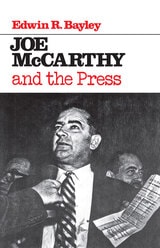
Joe McCarthy and the Press
Edwin R. Bayley
University of Wisconsin Press, 2003
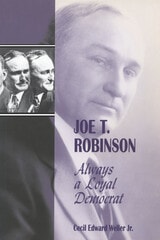
Joe T. Robinson
Always a Loyal DemocratCecil Weller
University of Arkansas Press, 1998
Senate majority leader Joseph Taylor Robinson was undoubtedly one of the most powerful U.S. senators of the early twentieth century. An important political figure in Arkansas from the time he was elected to the state legislature in 1895, Joe T., as he was popularly called became nationally prominent when he ascended to the Democratic leadership of the U.S. Senate in 1923.
Robinson’s career spanned momentous legislative debates in the chambers of the Senate, such as the League of Nations charter, the Teapot Dome Scandal, and FDR’s plan to “pack” the Supreme Court. His run for the vice-presidency in 1928, the first Southerner on a major ticket after the Civil War, and his three terms as chairman of the Democratic National Convention, in 1920, 1928, and 1936, are all covered in this perceptive study.
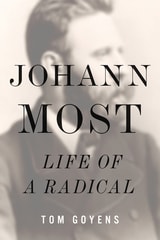
Johann Most
Life of a RadicalTom Goyens
University of Illinois Press, 2025

Johann Scheibe
Organ Builder in Leipzig at the Time of BachLynn Edwards Butler
University of Illinois Press, 2022
Drawing on extensive research and previously untapped archival materials, Lynn Edwards Butler explores Scheibe's professional relationships and the full range of his projects. These assignments included the three-manual organ for St. Paul’s Church, renovations of the organs in the important churches of St. Thomas and St. Nicholas, and the lone surviving example of Scheibe's craft, a small organ in the nearby village of Zschortau. Viewing Scheibe within the context of the era, Butler illuminates the music scene of Bach's time as she follows the life of a gifted craftsman and his essential work on an instrument that anchored religious musical practice and community.
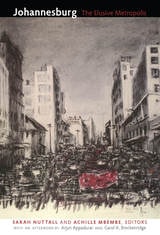
Johannesburg
The Elusive MetropolisSarah Nuttall and Achille Mbembe, eds.
Duke University Press, 2008
The volume’s essays include an investigation of representation and self-stylization in the city, an ethnographic examination of friction zones and practices of social reproduction in inner-city Johannesburg, and a discussion of the economic and literary relationship between Johannesburg and Maputo, Mozambique’s capital. One contributor considers how Johannesburg’s cosmopolitan sociability enabled the anticolonial projects of Mohandas Ghandi and Nelson Mandela. Journalists, artists, architects, writers, and scholars bring contemporary Johannesburg to life in ten short pieces, including reflections on music and megamalls, nightlife, built spaces, and life for foreigners in the city.
Contributors: Arjun Appadurai, Carol A. Breckenridge, Lindsay Bremner, David Bunn, Fred de Vries, Nsizwa Dlamini, Mark Gevisser, Stefan Helgesson, Julia Hornberger, Jonathan Hyslop, Grace Khunou, Frédéric Le Marcis, Xavier Livermon, John Matshikiza, Achille Mbembe, Robert Muponde, Sarah Nuttall, Tom Odhiambo, Achal Prabhala, AbdouMaliq Simone
Johannesburg
The Elusive Metropolis, Volume 16Sarah Nuttall and Achille Mbembe, eds.
Duke University Press, 0
Contributors to this issue—a mix of scholars, urban planners, and artists, many of whom hail from South Africa—reveal Johannesburg to be a polycentric and international city that has developed its own cosmopolitan culture. In a detailed study of three streets in the modern precinct of Melrose Arch, one essay shows how the thoroughly commodified and marketed Johannesburg cityscape has shaped the cultural sensitivities, aesthetics, and urban subjectivities of its inhabitants, at times even overriding the historical memory of apartheid. Another essay, focusing on the emergence of a new urban culture, examines how the city itself becomes a crucial site for the remixing and reassembling of racial identities. By tracking the movement of people with AIDS to various locations in the city to seek relief and treatment, another essay reveals an urban geography very different from what is seen from the highways. Finally, through interviews and commentaries, journalists, artists, and architects of Johannesburg offer reflections on the geography and shifting culture of the city and its townships, on the complicated relationship between Johannesburg and other African cities, and on the search for an architectural style that adequately expresses the complexity of this cosmopolitan city.
Contributors. Lindsay Bremner, Nsizwa Dlamini, Mark Gevisser, Grace Khunou, Frédéric Le Marcis, John Matshikiza, Achille Mbembe, Sarah Nuttall, Rodney Place, AbdouMaliq Simone, Michael Watts
John A. Logan
Stalwart Republican from IllinoisJames Pickett Jones
Southern Illinois University Press, 2001
Not available.
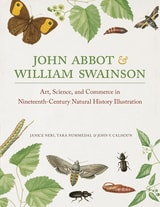
John Abbot and William Swainson
Art, Science, and Commerce in Nineteenth-Century Natural History IllustrationJanice Neri, Tara Nummedal, and John V. Calhoun
University of Alabama Press, 2019
During his lifetime (1751–ca. 1840), English-born naturalist and artist John Abbot rendered more than 4,000 natural history illustrations and profoundly influenced North American entomology, as he documented many species in the New World long before they were scientifically described. For sixty-five years, Abbot worked in Georgia to advance knowledge of the flora and fauna of the American South by sending superbly mounted specimens and exquisitely detailed illustrations of insects, birds, butterflies, and moths, on commission, to collectors and scientists all over the world.
Between 1816 and 1818, Abbot completed 104 drawings of insects on their native plants for English naturalist and patron William Swainson (1789–1855). Both Abbot and Swainson were artists, naturalists, and collectors during a time when natural history and the sciences flourished. Separated by nearly forty years in age, Abbot and Swainson were members of the same international communities and correspondence networks upon which the study of nature was based during this period.
The relationship between these two men—who never met in person—is explored in John Abbot and William Swainson: Art, Science, and Commerce in Nineteenth-Century Natural History Illustration. This volume also showcases, for the first time, the complete set of original, full-color illustrations discovered in 1977 in the Alexander Turnbull Library in Wellington, New Zealand. Originally intended as a companion to an earlier survey of insects from Georgia, the newly rediscovered Turnbull manuscript presents beetles, grasshoppers, butterflies, moths, and a wasp. Most of the insects are pictured with the flowering plants upon which Abbot thought them to feed. Abbot’s journal annotations about the habits and biology of each species are also included, as are nomenclature updates for the insect taxa.
Today, the Turnbull drawings illuminate the complex array of personal and professional concerns that informed the field of natural history in the eighteenth and nineteenth centuries. These illustrations are also treasured artifacts from times past, their far-flung travels revealing a world being reshaped by the forces of global commerce and information exchange even then. The shared project of John Abbot and William Swainson is now brought to completion, signaling the beginning of a new phase of its significance for modern readers and scholars.
John Adams vs Thomas Paine
Rival Plans for the Early RepublicJett B. Conner
Westholme Publishing, 2018
Initially admiring Thomas Paine’s efforts for independence, John Adams nevertheless was rattled by the political philosophy of Common Sense and responded to it by publishing his Thoughts on Government to counteract Paine’s proposals, which Adams said were far too “democratical.” Although John Adams is given credit for his substantive contributions to American constitutionalism, especially his notions of separation of powers, checks and balances, and representation, in John Adams vs Thomas Paine: Rival Plans for the Early Republic, historian Jett B. Conner makes the case that Thomas Paine was more than just a revolutionary figure who spurred Americans toward declaring independence. Common Sense made important contributions to American constitutional thought, too, particularly its call for more equal representation, popular sovereignty, a constitutional convention, and a federal system of governance with a strong central government. The book explores how the two rivals helped shape America’s first constitutions—the Articles of Confederation and those of several states— and how they continued contributing to American political thought as it developed during the so-called “critical period” between the adoption of the Articles of Confederation and the start of the Constitutional Convention of 1787. It also focuses on the creation of our democratic republic and compares Paine’s and Adams’s approaches to structuring constitutions to ensure free government while guarding against abuses of power and the excesses of democratic majorities. An abridged version of Common Sense and the short but complete Thoughts on Government are included in an appendix for easy reader reference.
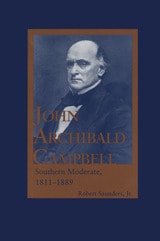
John Archibald Campbell
Southern Moderate, 1811–1889Robert Saunders Jr.
University of Alabama Press, 1997
The first full biography of the southern U.S. Supreme Court justice who championed both the U.S. Constitution and states’ rights.
The life of John Archibald Campbell reflects nearly every major development of 19th-century American history. He participated either directly or indirectly in events ranging from the Indian removal process of the 1830s, to sectionalism and the Civil War, to Reconstruction and redemption. Although not a defender of slavery, he feared that abrupt abolition would produce severe economic and social dislocation. He urged southerners to reform their labor system and to prepare for the eventual abolition of slavery. In the early 1850s he proposed a series of reforms to strengthen slave families and to educate the slaves to prepare them for assimilation into society as productive citizens. These views distinguished him from many southerners who steadfastly maintained the sanctity of the peculiar institution.
Born and schooled in Georgia, Campbell moved to Montgomery, Alabama, in the early 1830s, where he joined a successful law practice. He served in the Alabama legislature for a brief period and then moved with his family to Mobile to establish a law practice. In 1853 Campbell was appointed an associate justice of the U.S. Supreme Court. His concurring opinion in the Dred Scott case in 1857 derived not from the standpoint of protecting slavery but from an attempt to return political power to the states. As the sectional crisis gathered heat, Campbell counseled moderation. He became widely detested in the North because of his defense of states’ rights, and he was distrusted in the South because of his moderate views on slavery and secession. In May 1861 Campbell resigned from the Court and later became the Confederacy's assistant secretary of war. After the war, Campbell moved his law practice to New Orleans. Upon his death in 1889, memorial speakers in Washington, D.C., and New Orleans recognized him as one of the nation's most gifted lawyers and praised his vast learning and mastery of both the common law and the civil law.
In this first full biography of Campbell, Robert Saunders, Jr., reveals the prevalence of anti-secession views prior to the Civil War and covers both the judicial aspects and the political history of this crucial period in southern history.