Results by title
8812 books match the query 'Political Science' and 176 start with j
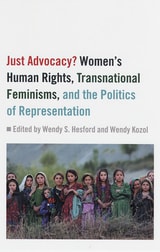
Just Advocacy?
Women's Human Rights, Transnational Feminism, and the Politics of RepresentationHesford, Wendy S
Rutgers University Press, 2005
In humanitarian and political debates about the topic, women and children are frequently considered first. Since the 1990s, human rights have become the most legitimate and legitimizing juridical and cultural claim made on a woman's behalf. But what are the consequences of equating women's rights with human rights? As the eleven essays in this volume show, the impact is often contradictory.
Bringing together some of the most respected scholars in the field, including Inderpal Grewal, Leela Fernandes, Leigh Gilmore, Susan Koshy, Patrice McDermott, and Sidonie Smith, Just Advocacy? sheds light on the often overlooked ways that women and children are further subjugated when political or humanitarian groups represent them solely as victims and portray the individuals that are helping them as paternal saviors.
Drawn from a variety of disciplinary perspectives in the humanities, arts, and social sciences, Just Advocacy? promises to advance a more nuanced and politically responsible understanding of human rights for both scholars and activists.
Just Around The Corner
The Paradox Of The Jobless RecoveryStanley Aronowitz
Temple University Press, 2005

Just Assassins
The Culture of Terrorism in RussiaEdited and with an introduction by Anthony Anemone
Northwestern University Press, 2010
Just Assassins examines terrorism as it’s manifested in Russian culture past and present, with essays devoted to Russian literature, film, and theater; historical narrative; and even amateur memoir, songs, and poetry posted on the Internet. Along with editor Anthony Anemone’s introduction, these essays chart the evolution of modern political terrorism in Russia, from the Decembrist uprising to the horrific school siege in Beslan in 2004, showing how Russia’s cultural engagement with its legacy of terrorism speaks to the wider world.
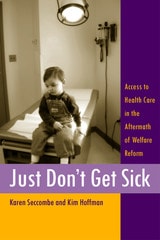
Just Don't Get Sick
Access to Health Care in the Aftermath of Welfare ReformSeccombe, Karen
Rutgers University Press, 2007
Drawing upon statistical data and in-depth interviews with over five hundred families in Oregon, Karen Seccombe and Kim Hoffman assess the ways in which welfare reform affects the well-being of adults and children who leave the program for work. We hear of asthmatic children whose uninsured but working mothers cannot obtain the preventive medicines to keep them well, and stories of pregnant women receiving little or no prenatal care who end up in emergency rooms with life-threatening conditions.
Representative of poor communities nationwide, the vivid stories recounted here illuminate the critical relationship between health insurance coverage and the ability to transition from welfare to work.
Just Elections
Creating a Fair Electoral Process in the United StatesDennis F. Thompson
University of Chicago Press, 2002
Thompson argues that three central democratic principles—equal respect, free choice, and popular sovereignty—underlie our electoral institutions, and should inform any assessment of the justice of elections. Although we may all endorse these principles in theory, Thompson shows that in practice we disagree about their meaning and application. He shows how they create conflicts among basic values across a broad spectrum of electoral controversies, from disagreements about term limits and primaries to disputes about recounts and presidential electors.
To create a fair electoral system, Thompson argues, we must deliberate together about these principles and take greater control of the procedures that govern our elections. He demonstrates how applying the principles of justice to electoral practices can help us answer questions that our electoral system poses: Should race count in redistricting? Should the media call elections before the polls close? How should we limit the power of money in elections?
Accessible and wide ranging, Just Elections masterfully weaves together the philosophical, legal, and political aspects of the electoral process. Anyone who wants to understand the deeper issues at stake in American elections and the consequences that follow them will need to read it.
In answering these and other questions, Thompson examines the arguments that citizens and their representatives actually use in political forums, congressional debates and hearings, state legislative proceedings, and meetings of commissions and local councils. In addition, the book draws on a broad range of literature: democratic theory, including writings by Madison, Hamilton, and Tocqueville, and contemporary philosophers, as well as recent studies in political science, and work in election law.

Just Language
Walter Benjamin, German-Jewish Exile, and the Critique of Linguistic ViolenceDennis Johannßen
University of Michigan Press, 2026
Just Language revisits the Weimar period and its representation in the postwar years to explore narratives of linguistic resistance in the works of Walter Benjamin, Theodor W. Adorno, Hannah Arendt, and Paul Celan. How did this generation of exile writers grapple with their experiences of oppression and persecution? How did they create a language of resistance during the decades that prepared the Third Reich and the Shoah?
Facing the devastations of World War I, the book explores how Walter Benjamin analyzed language’s ability to radically break the cyclical violence of war and examines his opposition to expansionism and imperialism in Weimar education and culture. Based on Benjamin’s analysis, Johannßen traces the postwar responses of Hannah Arendt and Paul Celan. While Arendt proposed strategies of metaphorical thinking to counteract the formation of totalitarianism, Celan mobilized silence as a poetic counterforce against oppression and erasure. Just Language argues that every linguistic act and practice, no matter how small or marginalized, entails the ethical task of opposing the normalization and institutionalization of political violence. By tracing how Benjamin and his interlocutors struggled against German fascism, Johannßen presents a memory-based critique of linguistic violence, opening a dialogue between German-Jewish writers and today’s debates on nondiscrimination, propaganda, and social justice.
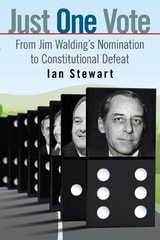
Just One Vote
From Jim Walding's Nomination to Constitutional DefeatIan Stewart
University of Manitoba Press, 2009

Just Three Minutes, Please
Thinking Out Loud on Public RadioMichael Blumenthal
West Virginia University Press, 2014
What’s wrong with the contemporary American medical system? What does it mean when a state’s democratic presidential primary casts 40% of its votes for a felon incarcerated in another state? What’s so bad about teaching by PowerPoint? What is truly the dirtiest word in America?
These are just a few of the engaging and controversial issues that Michael Blumenthal, poet, novelist, essayist, and law professor, tackles in this collection of poignant essays commissioned by West Virginia Public Radio.
In these brief essays, Blumenthal provides unconventional insights into our contemporary political, educational, and social systems, challenging us to look beyond the headlines to the psychological and sociological realities that underlie our conventional thinking.
As a widely published poet and novelist, Blumenthal brings along a lawyer’s analytical ability with his literary sensibility, effortlessly facilitating a distinction between the clichés of today’s pallid political discourse and the deeper realities that lie beneath. This collection will captivate and provoke those with an interest in literature, politics, law, and the unwritten rules of our social and political engagements.

Just Transitions
Social Justice in the Shift Towards a Low-Carbon WorldEdouard Morena
Pluto Press, 2019
Just Transition emerged as a framework developed within the trade union movement to encompass a range of social interventions needed to secure workers' and frontline communities' jobs and livelihoods as economies shift to sustainable production. Just Transitions draws on a range of perspectives from the global North and South to interrogate the overlaps, synergies and tensions between various understandings of the Just Transition approach. As the concept is entering the mainstream, has it lost its radical edge, and if so, can it be recovered?
Written by academics and activists from around the globe, this unique edited collection is the first book entirely devoted to Just Transition.

Just Transitions
Social Justice in the Shift Towards a Low-Carbon WorldEdouard Morena
Pluto Press, 2022
Just Transition emerged as a framework developed within the trade union movement to encompass a range of social interventions needed to secure workers' and frontline communities' jobs and livelihoods as economies shift to sustainable production. Just Transitions draws on a range of perspectives from the global North and South to interrogate the overlaps, synergies and tensions between various understandings of the Just Transition approach. As the concept is entering the mainstream, has it lost its radical edge, and if so, can it be recovered?
Written by academics and activists from around the globe, this unique edited collection is the first book entirely devoted to Just Transition.
Just Work?
Migrant Workers' Struggle TodayEdited by Aziz Choudry and Mondli Hlatshwayo
Pluto Press, 2015

Justice After War
<i>Jus Post Bellum</i> in the 21st CenturyDavid Chiwon Kwon
Catholic University of America Press, 2023

Justice And School Systems
The Role of the Courts in Education Litigationedited by Barbara Flicker
Temple University Press, 1990
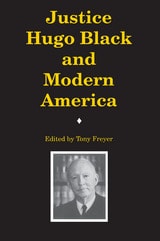
Justice Hugo Black and Modern America
Tony Freyer
University of Alabama Press, 1990
Reexamining the Justice Who Helped Shape Modern Constitutional America.
The struggle to accommodate both individual freedom and community welfare shaped modern America. American have disagreed about whether federal protection of national welfare could be reconciled with defense of individual rights; however, no public figure worked longer or more consistently to meet this challenge than Alabama’s Hugo L. Black
This collection of essays, reprints of the spring 1985 and winter 1987 issues of the Alabama Law Review with a new introduction and minor revisions, suggests that Black’s constitutional principles and personal values provided a means to achieve a balance between majority will and individual freedom. Black’s life and career are reexamined here by leading scholars and jurors in the first major study in twenty years, tracing his relationship to the South, to the development of American liberalism, and to the constitutional revolution in individual rights.
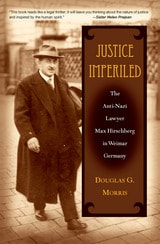
Justice Imperiled
The Anti-Nazi Lawyer Max Hirschberg in Weimar GermanyDouglas G. Morris
University of Michigan Press, 2005
-Sister Helen Prejean
Justice Imperiled is the story of the brilliant lawyer Max Hirschberg, one of Germany's most courageous defenders of justice in the face of Hitler's rise to power.
Hirschberg lived an extraordinary life at a defining moment in German and European history. By the time he fled Nazi Germany in 1934, he had argued a series of cases in Munich's courtrooms that shed light on the history of political justice in pre-Nazi Germany and, by extension, the miscarriage of justice in all Western democracies.
Hirschberg was a rare figure: he fought for cases that reflected the new democracy rather than the old monarchy, that valued equality rather than hierarchy, and that showed respect for workers as well as aristocrats.
Throughout the Weimar period Hirschberg squared off in court against Munich's conservatives, reactionaries, and Nazis-twice facing Hitler himself. As he litigated politically charged disputes, he also began fighting to reverse the criminal convictions of innocent defendants and to study what mistaken verdicts teach us about the criminal justice system as a whole.
In a unique blend of biography and courtroom drama, Justice Imperiled captures the excitement of Hirschberg's actual cases and presents legal battles that still rage, in different circumstances, to this day.
Justice Is an Option
A Democratic Theory of Finance for the Twenty-First CenturyRobert Meister
University of Chicago Press, 2021
Justice Is an Option uses those problems—and the framework of finance that created them—to reimagine historical justice. Robert Meister returns to the spirit of Marx to diagnose our current age of finance. Instead of closing our eyes to the political and economic realities of our era, we need to grapple with them head-on. Meister does just that, asking whether the very tools of finance that have created our vastly unequal world could instead be made to serve justice and equality. Meister here formulates nothing less than a democratic financial theory for the twenty-first century—one that is equally conversant in political philosophy, Marxism, and contemporary politics. Justice Is an Option is a radical, invigorating first page of a new—and sorely needed—leftist playbook.
Justice and Injustice in Law and Legal Theory
Austin Sarat and Thomas R. Kearns, Editors
University of Michigan Press, 1998
Justice and Peace
Interdisciplinary Perspectives on a Contested RelationshipEdited by Gunther Hellmann
Campus Verlag, 2013

Justice and the American Metropolis
Clarissa Rile Hayward
University of Minnesota Press, 2011
Today’s American cities and suburbs are the sites of “thick injustice”—unjust power relations that are deeply and densely concentrated as well as opaque and seemingly intractable. Thick injustice is hard to see, to assign responsibility for, and to change.
Identifying these often invisible and intransigent problems, this volume addresses foundational questions about what justice requires in the contemporary metropolis. Essays focus on inequality within and among cities and suburbs; articulate principles for planning, redevelopment, and urban political leadership; and analyze the connection between metropolitan justice and institutional design. In a world that is progressively more urbanized, and yet no clearer on issues of fairness and equality, this book points the way to a metropolis in which social justice figures prominently in any definition of success.
Contributors: Susan S. Fainstein, Harvard U; Richard Thompson Ford, Stanford U; Gerald Frug, Harvard U; Loren King, Wilfrid Laurier U; Margaret Kohn, U of Toronto; Stephen Macedo, Princeton U; Douglas W. Rae, Yale U; Clarence N. Stone, George Washington U; Margaret Weir, U of California, Berkeley; Thad Williamson, U of Richmond.
Justice as Translation
An Essay in Cultural and Legal CriticismJames Boyd White
University of Chicago Press, 1990
"White has given us not just a novel answer to the traditional jurisprudential questions, but also a new way of reading and evaluating judicial opinions, and thus a new appreciation of the liberty which they continue to protect."—Robin West, Times Literary Supplement
"James Boyd White should be nominated for a seat on the Supreme Court, solely on the strength of this book. . . . Justice as Translation is an important work of philosophy, yet it is written in a lucid, friendly style that requires no background in philosophy. It will transform the way you think about law."—Henry Cohen, Federal Bar News & Journal
"White calls us to rise above the often deadening and dreary language in which we are taught to write professionally. . . . It is hard to imagine equaling the clarity of eloquence of White's challenge. The apparently effortless grace of his prose conveys complex thoughts with deceptive simplicity."—Elizabeth Mertz, Yale Journal of Law and the Humanities
"Justice as Translation, like White's earlier work, provides a refreshing reminder that the humanities, despite the pummelling they have recently endured, can be humane."—Kenneth L. Karst, Michigan Law Review
Justice at Work
The Rise of Economic and Racial Justice Coalitions in CitiesMarc Doussard
University of Minnesota Press, 2022
A pathbreaking look at how progressive policy change for economic justice has swept U.S. cities
In the 2010s cities and counties across the United States witnessed long-overdue change as they engaged more than ever before with questions of social, economic, and racial justice. After decades of urban economic restructuring that intensified class divides and institutional and systemic racism, dozens of local governments countered the conventional wisdom that cities couldn’t address inequality—enacting progressive labor market policies, from $15 minimum wages to paid sick leave.
Justice at Work examines the mutually reinforcing roles of economic and racial justice organizing and policy entrepreneurship in building power and support for policy changes. Bridging urban social movement and urban politics studies, it demonstrates how economic and racial justice coalitions are collectively the critical institution underpinning progressive change. It also shows that urban policy change is driven by “urban policy entrepreneurs” who use public space and the intangible resources of the city to open “agenda windows” for progressive policy proposals incubated through national networks.
Through case studies of organizing and policy change efforts in cities including Chicago, Seattle, and New Orleans around minimum wages, targeted hiring, paid time off, fair scheduling, and anti-austerity, Marc Doussard and Greg Schrock show that the contemporary wave of successful progressive organizing efforts is likely to endure. Yet they caution that success is dependent on skillful organizing that builds and sustains power at the grassroots—and skillful policy work inside City Hall. By promoting justice at—and increasingly beyond—work, these movements hold the potential to unlock a new model for inclusive economic development in cities.
Justice by Means of Democracy
Danielle Allen
University of Chicago Press, 2023
“A sweeping vision.”—Ezra Klein, The New York Times • “An important book.”—Peter Coy, The New York Times • “Liberals and non-liberals alike should applaud its arrival.”—Max Foley-Keene, Commonweal • “A major work of political philosophy.”—Gregory Laski, Public Books • “Compelling. . . . Superb.”—Josiah Ober • “Without doubt one of the most important books ever written on democracy.”—Margeret Levi
From leading thinker Danielle Allen, a bold and urgent articulation of a new political philosophy: power-sharing liberalism.
At a time of great social and political turmoil, when many residents of the leading democracies question the ability of their governments to deal fairly and competently with serious public issues, and when power seems more and more to rest with the wealthy few, this book reconsiders the very foundations of democracy and justice. Scholar and writer Danielle Allen argues that the surest path to a just society in which all are given the support necessary to flourish is the protection of political equality; that justice is best achieved by means of democracy; and that the social ideals and organizational design principles that flow from recognizing political equality and democracy as fundamental to human well-being provide an alternative framework not only for justice but also for political economy. Allen identifies this paradigm-changing new framework as “power-sharing liberalism.”
Liberalism more broadly is the philosophical commitment to a government grounded in rights that both protect people in their private lives and empower them to help govern public life. Power-sharing liberalism offers an innovative reconstruction of liberalism based on the principle of full inclusion and non-domination—in which no group has a monopoly on power—in politics, economy, and society. By showing how we all might fully share power and responsibility across all three sectors, Allen advances a culture of civic engagement and empowerment, revealing the universal benefits of an effective government in which all participate on equal terms.

Justice for All
Selected Writings of Lloyd A. BarbeeLloyd A Barbee
Wisconsin Historical Society Press, 2017
Civil rights leader and legislator Lloyd A. Barbee frequently signed his correspondence with "Justice for All," a phrase that embodied his life’s work of fighting for equality and fairness. An attorney most remembered for the landmark case that desegregated Milwaukee Public Schools in 1972, Barbee stood up for justice throughout his career, from defending University of Wisconsin students who were expelled after pushing the school to offer black history courses, to representing a famous comedian who was arrested after stepping out of a line at a protest march. As the only African American in the Wisconsin legislature from 1965 to 1977, Barbee advocated for fair housing, criminal justice reform, equal employment opportunities, women’s rights, and access to quality education for all, as well as being an early advocate for gay rights and abortion access.
This collection features Barbee’s writings from the front lines of the civil rights movement, along with his reflections from later in life on the challenges of legislating as a minority, the logistics of coalition building, and the value of moving the needle on issues that would outlast him. Edited by his daughter, civil rights lawyer Daphne E. Barbee-Wooten, these documents are both a record of a significant period of conflict and progress, as well as a resource on issues that continue to be relevant to activists, lawmakers, and educators.

Justice in Public Life
Claire Foster-Gilbert, Jane Sinclair, and James Hawkey
Haus Publishing, 2021
The three essays in Justice in Public Life, written by Claire Foster-Gilbert, Jane Sinclair, and James Hawkey, examine the meaning of justice in the twenty-first century, asking how justice can be expressed by our public service institutions and in society more widely. They consider whether justice is tied to truth and whether our idea of justice is skewed when we conflate it with fairness. They also explore how justice as a virtue can help us navigate the complexities of life in economics, in wider society, and in righting wrongs. In addition, their essays consider the threats to a just society, including human nature itself, the inheritance of unjust structures, the wide range of views about what constitutes justice, and the difficulty of establishing it globally and between nation-states. Justice in Public Life brings an often abstract concept to life, calling on public servants to nurture justice as a virtue pursued both individually and communally.
Justice, Gender, and Affirmative Action
Susan D. Clayton and Faye J. Crosby
University of Michigan Press, 1992
Justices of the Indiana Supreme Court
Linda C. Gugin and James E. St. Clair
Indiana Historical Society Press, 2010