Results by title
28164 books match the query 'History' and 406 start with j

Juana Briones of Nineteenth-Century California
Jeanne Farr McDonnell
University of Arizona Press, 2008
Juana Briones was born in 1802 and spent her early youth in Santa Cruz, a community of retired soldiers who had helped found Spanish California, Native Americans, and settlers from Mexico. In 1820, she married a cavalryman at the San Francisco Presidio, Apolinario Miranda. She raised her seven surviving sons and daughters and adopted an orphaned Native American girl. Drawing on knowledge she gained about herbal medicine and other cures from her family and Native Americans, she became a highly respected curandera, or healer.
Juana set up a second home and dairy at the base of then Loma Alta, now Telegraph Hill, the first house in that area. After gaining a church-sanctioned separation from her abusive husband, she expanded her farming and cattle business in 1844 by purchasing a 4,400-acre ranch, where she built her house, located in the present city of Palo Alto. She successfully managed her extensive business interests until her death in 1889. Juana Briones witnessed extraordinary changes during her lifetime. In this fascinating book, readers will see California’s history in a new and revelatory light.
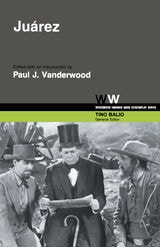
Juarez
Edited, with an introduction by Paul J. Vanderwood; Tino T. Balio, Series Editor
University of Wisconsin Press, 1983
Juárez was Warner Brothers' cinematic attempt to answer the major international question of the 1930s: would democracy or dictatorship prevail? Eager to further the foreign policy objectives of its friend Franklin Delano Roosevelt and equally willing to add to its prestigious and profitable biography series, the stuido set a record high budget and assembled special film stock, extensive scholarly research, a loose time schedule, a renowned director, and a stellar cast that included Paul Muni, Brian Aherne, and Bette Davis. The film was meant to be an ideologically clear-cut statement against fascism. The ways in which this artistic propaganda backfired make Juárez a significant historical document for students of film, Latin American history, and U.S. foreign relations.
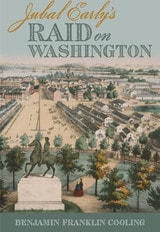
Jubal Early's Raid on Washington
Benjamin Franklin Cooling
University of Alabama Press, 2008
The raid that exposed the Union capital’s greatest danger.
The definitive description of the last Confederate invasion of the Union in 1864. The Civil War was in its fourth year, and the Union’s victory was not at all certain. The Lincoln administration seemed weak as the autumn election approached. Lee’s army remained strong in Virginia while Johnston’s forces feinted and dodged in north Georgia to shield Atlanta. The Union army and navy grew in strength, but Confederate forces continued to fight tenaciously.
Amid an air of stalemate, the Confederates planned a bold move to strike at Washington, DC and capture or scatter Lincoln and his cabinet. In command of the operation was the colorful and unpredictable Jubal “Old Jube” Anderson Early, brought in to replace the fallen Stonewall Jackson. Less well known than the bloodier Antietam and Gettysburg, Early's campaign, Cooling argues, had greater significance.
In addition to the persnickety bachelor Anderson, this account introduces many colorful participants, including railroad president John W. Garrett, the politically influential Blair family, and Elizabeth “Aunt Betty” Thomas, a free Black woman, who was said to have saved Lincoln’s life by shouting at him: “Get down, you fool!” when he came under fire at Fort Stevens. Exciting and comprehensive, Civil War scholars and readers will delight in this masterful account.

Jubilation of the Heart
Monastic Song and Mystical PoeticsKris J. Trujillo
University of Chicago Press, 0
A history of the jubilus—the complex vocal run on the last syllable of the Alleluia chant in medieval Christian liturgy.
In liturgical Christian worship, the Alleluia chant during the Mass involves extensive melismas—vocal embellishments on a single syllable sung over a complex melodic line. The melisma on the final “a” of the word “alleluia” is known as the jubilus—a climactic, musical eruption of joy. In Jubilation of the Heart, Kris J. Trujillo shows how the performance of this single syllable grew in significance during the European Middle Ages until it became a core element in Christian mystical traditions and beyond.
In various incarnations of the jubilus—from spontaneous sounds of joy to recitations of the Psalms, from meditations on the name of Jesus to glossolalia—Trujillo discovers a range of affective, embodied, and erotic modes of medieval Christian devotion with lasting influence on modern ideas about discourse, the subject, and ecstasy. Trujillo illuminates the raptures of joy expressed by theologians including Augustine, John Cassian, and Bernard of Clairvaux; thirteenth-century holy women like Hadewijch, Mechthild of Magdeburg, and Christina the Astonishing; psychoanalytic thinkers Michel de Certeau and Jacques Lacan; popular vocalists Edith Piaf, Linda Ronstadt, and Whitney Houston; and even a diverse set of queer theorists. The result is an enchanting and wide-ranging history of premodern joy and its contemporary afterlives.
Judah in the Neo-Babylonian Period
The Archaeology of DesolationAvraham Faust
SBL Press, 2012
Judaism Musical and Unmusical
Michael P. Steinberg
University of Chicago Press, 2008
Engaging the work of such figures as Sigmund Freud, Walter Benjamin, Hannah Arendt, Charlotte Salomon, Arnaldo Momigliano, Leonard Bernstein, and Daniel Libeskind, Michael Steinberg shows how modern Jews advanced cosmopolitanism and multiplicity by helping to loosen—whether by choice or by necessity—the ties that bind any culture to accounts of its origins. In the process, Steinberg composes a mosaic of texts and events, often distant from one another in time and place, that speak to his theme of musicality. As both a literal value and a metaphorical one, musicality opens the possibility of a fusion of aesthetics and analysis—a coupling analogous to European modernity’s twin concerns of art and politics.
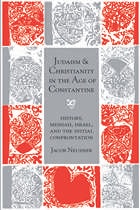
Judaism and Christianity in the Age of Constantine
History, Messiah, Israel, and the Initial ConfrontationJacob Neusner
University of Chicago Press, 1987
In a close analysis of texts by the Christian theologians Eusebius, Aphrahat, and Chrysostom on one hand, and of the central Jewish works the Talmud of the Land of Israel, the Genesis Rabbah, and the Leviticus Rabbah on the other, Neusner finds that both religious groups turned to the same corpus of Hebrew scripture to examine the same fundamental issues. Eusebius and Genesis Rabbah both address the issue of history, Chrysostom and the Talmud the issue of the Messiah, and Aphrahat and Leviticus Rabbah the issue of Israel. As Neusner demonstrates, the conclusions drawn shaped the dialogue between the two religions for the rest of their shared history in the West.

Judaism and Disability
Portrayals in Ancient Texts from the Tanach through the BavliJudith Z. Abrams
Gallaudet University Press, 1998
In Judaism and Disability, the archaic portrayals of mentally ill, mentally retarded, physically affected, deaf, blind, and other disabled people reflect the sharp contrast they presented compared to the unchanging Judaic ideal of the “perfect priest.” All of these sources describe this perfection as embodied in a person who is male, free, unblemished, with da’at (cognition that can be communicated), preferably learned, and a priest. The failure to have da’at stigmatized disabled individuals, who were also compromised by the treatment they received from nondisabled people, who were directing and constraining.
As the Judaic ideal transformed from the bodily perfection of the priest in the cult to intellectual prowess in the Diaspora, a parallel change of attitudes toward disabled persons gradually occurred. The reduced emphasis upon physical perfection as a prerequisite for a relationship with God eventually enabled the enfranchisement of some disabled people and other minorities. Scholars, students, and other readers will find the engrossing process disclosed in Judaism and Disability one that they can apply to a variety of other disciplines.
Judaism
The Genealogy of a Modern NotionBoyarin, Daniel
Rutgers University Press, 2019
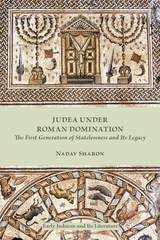
Judea under Roman Domination
The First Generation of Statelessness and Its LegacyNadav Sharon
SBL Press, 2017
Investigate a relatively neglected but momentous period in Judean history
Nadav Sharon closely examines a critical period in Judean history, which saw the end of the Hasmonean dynasty and the beginning of Roman domination of Judea leading up to the kingship of Herod (67-37 BCE). In this period renowned Roman figures such as Pompey the Great, Julius Caesar, Gaius Cassius (a conspirator against Caesar), and Mark Anthony, led the Roman Republic on the eve of its transformation into an Empire, each having his own dealings with—and holding sway over—Judea at different times. This volume explores the impact of the Roman conquest on the authors of the Dead Sea Scrolls, enhances the understanding of later Judean-Roman relations and the roots of the Great Revolt, and examines how this early period of Roman domination had on impact on later developments in Judean society and religion.
Features:
- Part one dedicating to reconstructing Judean history from the death of Alexander to the reign of King Herod
- Part two examining the effects of Roman domination on Judean society
- Maps, illustrations, and appendices
Judge Dee at Work
Eight Chinese Detective StoriesRobert van Gulik
University of Chicago Press, 1992
The eight short stories in Judge Dee at Work cover a decade during which the judge served in four different provinces of the T’ang Empire. From the suspected treason of a general in the Chinese army to the murder of a lonely poet in his garden pavilion, the cases here are among the most memorable in the Judge Dee series.
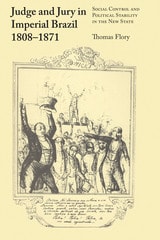
Judge and Jury in Imperial Brazil, 1808–1871
Social Control and Political Stability in the New StateBy Thomas Flory
University of Texas Press, 1981
In nineteenth-century Brazil the power of the courts rivaled that of the central government, bringing to it during its first half century of independence a stability unique in Latin America. Thomas Flory analyzes the Brazilian lower-court system, where the private interests of society and the public interests of the state intersected.
Justices of the peace—lay judges elected at the parish level—played a special role in the early years of independence, for the post represented the triumph of Brazilian liberalism’s commitment to localism and decentralization. However, as Flory shows by tracing the social history and performance of parish judges, the institution actually intensified conflict within parishes to the point of destabilizing the local regime and proved to be so independent of national interests that it all but destroyed the state.
By the 1840s the powers of the office were passed to state appointees, particularly the district judges. Flory recognizes these professional magistrates as a new elite who served as brokers between the state and the poorly articulated landowner elite, and his account of their rise reveals the mechanisms of state integration.
In focusing on the judiciary, Flory has isolated a crucial aspect of Brazil’s early history, one with broad implications for the study of nineteenth-century Latin America as a whole. He combines social, intellectual, and political perspectives—as well as national-level discussion with scrutiny of parish-level implementation—and so makes sense of a complicated, little-studied period. The study clearly shows the progression of Brazilian social thought from a serene liberal faith in the people as a nation to an abiding, very modern distrust of that nation as a threat to the state.
Judging Lincoln
Frank J. Williams. Foreword by Harold Holzer. Epilogue by John Y. Simon
Southern Illinois University Press, 2007
Judging the Supreme Court
Constructions of Motives in Bush v. GoreClarke Rountree
Michigan State University Press, 2007
This volume questions the motives of Supreme Court justices in a landmark case: The Supreme Court's intervention in the presidential election of 2000, and its subsequent decision in favor of George W. Bush, elicited immediate, heated, and widespread debate. Critics argued that the justices used weak legal arguments to overturn the Florida Supreme Court's ruling, ending a ballot recount and awarding the presidency to Bush. More fundamentally, they questioned the motives of conservative judges who arrived at a decision in favor of the candidate who reflected their political leanings.
Judging the Supreme Court examines this controversial case and the extensive attention it has received. To fully understand the case, Clarke Rountree argues, we must understand "judicial motives." These are comprised of more than each judge's personal opinions. Judges' motives, which Rountree calls "rhetorical performances," are as influential and publicly discussed as their decisions themselves. Before they are dissected in the media, judges' motives are carefully crafted by the decision- makers themselves, their critics, and their defenders. Justices consider not only the motives of the government, of military officials, of criminals, of public speakers, and of others, they also consider, construct, construe, spin, and deconstruct the motives of dissenters (whom they want to show are "misguided"), earlier courts, lower courts, and, especially, themselves.
Every judicial opinion is essentially a portrait of motives that says, "Here's what we did and here's why we did it." Well-constructed judicial motives reinforce the idea that we live under "the rule of law," while motives articulated less successfully raise questions about the legitimacy not just of individual judicial decisions but also of our political system and its foundation on an impartial judiciary. In Bush v. Gore, Rountree concludes, the judges of the majority opinion were not motivated by judicial concerns about law and justice, but rather by their own political and personal motives.
Judgment and Action
Fragments toward a HistoryEdited by Vivasvan Soni and Thomas Pfau
Northwestern University Press, 2018
Interpretation is essential to every humanistic discipline, and every interpretation is an act of judgment. Yet the work of interpretation and judgment has been called into question by contemporary methods in the humanities, which incline either toward contextual determination of meaning or toward the suspension of judgment altogether. Action is closely related to judgment and interpretation and like them, it has been rendered questionable. An action is not simply the performance of a deed but requires the deed’s intelligibility, which can be secured only through interpretation and judgment.
Organized into four broad themes—interiority/contemplation, ethics, politics/community, and aesthetics/image—the aim of this broad-ranging and insightful collection is to illuminate the histories of judgment and action, identify critical sites from which rethinking them may begin, clarify how they came to be challenged, and relocate them within a broader intellectual-historical trajectory that renders them intelligible.
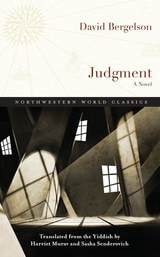
Judgment
A NovelDavid Bergelson, Translated from the Yiddish by Harriet Murav and Sasha Senderovich
Northwestern University Press, 2017
Originally published in 1929 and set in 1920 during the Russian civil war, Judgment traces the death of the shtetl and the birth of the “new, harsher world” created by the 1917 revolution. Jews and non-Jews smuggle people, goods, and anti-Bolshevik literature back and forth across the new political border. Filipov acts as the arbiter of "judgment" to prisoners in a Bolshevik outpost, who include Spivak, a counterrevolutionary; Lemberger, a pious and wealthy Jew; a seductive woman referred to as "the blonde"; and a memorable cast of smugglers and criminals.
Ordinary people, depicted in a grotesque and modernist style—comparable to Isaac Babel’s Red Cavalry—confront the overwhelming forces of history, whose ultimate outcome remains unknown.
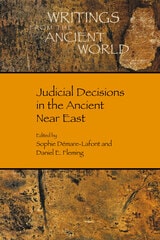
Judicial Decisions in the Ancient Near East
Sophie Démare-Lafont
SBL Press, 2023
This volume presents the first broadly inclusive collection, with accessible text and English translation, of documents related to judicial decisions in the ancient Near East, the oldest setting for such writing in the world. The texts in this volume belong to various genres, especially legal records and letters, and span almost two thousand years. With such varied material, the work depends on the expertise of specialists in each setting, from the Sumerian of early Ur to the late Akkadian of Babylonia under the Persians. The collection brings together not only 183 transliterated texts and new translations but also introductions and commentary that place these legal documents in their historical and social contexts. A glossary of legal terms, a concordance of texts included, and an index of legal terms makes this an invaluable tool for students and scholars across disciplines. The contributors are Dominique Charpin, Sophie Démare-Lafont, Daniel E. Fleming, Francis Joannès, Bertrand Lafont, Brigitte Lion, Ignacio Márquez Rowe, Cécile Michel, and Pierre Villard.
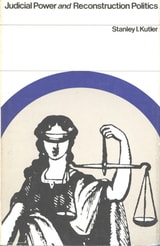
Judicial Power and Reconstruction Politics
Stanley I. Kutler
University of Chicago Press, 1968
This book investigates the political and public standing of the Supreme Court following the Dred Scott decision. Arguing against interpretations by previous historians, Kutler asserts instead that the "Chase Court" was neither enfeebled by the decision itself, nor by congressional Republicans during reconstruction. Instead, Kutler suggests that during reconstruction, the Court was characterized by forcefulness and judicious restraint rather than timidity and cowardice, holding a creative and determining role rather than abdicating its rightful powers. This volume assembles a series of essays by Kutler arguing for this characterization. Provocative and persuasive at turns, this collection of essays provides a bold and innovative reinterpretation of the Supreme Court after the Civil War.

Judith Resnik
Unsung AstronautMarlene Targ Brill
Ohio University Press, 0
Judith Resnik didn’t grow up dreaming of space, but when NASA opened its doors to women astronauts in the late 1970s, she stepped forward—and soared. One of the first six women ever accepted into NASA’s space shuttle astronaut-training program, Resnik brought her sharp mind, determination, and creativity to a field that had long been closed to women. Although she wasn’t the first American woman in space, she became one of the most accomplished astronauts of her time.
Resnik’s journey wasn’t easy. She faced challenges at home and in school, but she never let obstacles stop her. A gifted student, she excelled in math, science, and music—she even considered becoming a concert pianist before choosing a career in engineering. Her hard work paid off: She earned multiple degrees and helped design improvements for the space shuttle itself. She proved that astronauts aren’t just pilots—they’re problem solvers, inventors, and explorers.
In 1984, Resnik launched into space for the first time aboard the shuttle Discovery. Two years later, she joined the crew of Challenger. Tragically, that mission ended in disaster, cutting her life short. While the world focused on the loss of teacher Christa McAuliffe, who was a passenger on that flight, Resnik’s story was often overlooked. Yet her contributions to science and space exploration live on through programs, schools, and scholarships that bear her name.
This inspiring biography brings Resnik’s remarkable life to light. Readers will discover how a girl from Ohio became a trailblazer in space and how her courage and brilliance continue to inspire new generations. Her story reminds us that even if you’re not first, you can still make history—and that reaching for the stars starts with believing in yourself.
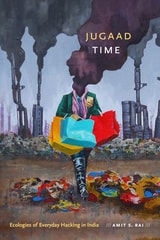
Jugaad Time
Ecologies of Everyday Hacking in IndiaAmit S. Rai
Duke University Press, 2019
Juggling
Stewart Lawrence Sinclair
Duke University Press, 2023

Julia Child's The French Chef
Dana Polan
Duke University Press, 2011
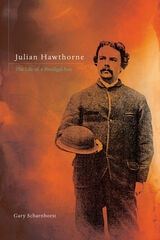
Julian Hawthorne
The Life of a Prodigal SonGary Scharnhorst
University of Illinois Press, 2014
Julian Hawthorne (1846-1934), Nathaniel Hawthorne's only son, lived a long and influential life marked by bad circumstances and worse choices. Raised among luminaries such as Thoreau, Emerson, and the Beecher family, Julian became a promising novelist in his twenties, but his writing soon devolved into mediocrity.
What talent the young Hawthorne had was spent chasing across the changing literary and publishing landscapes of the period in search of a paycheck, writing everything from potboilers to ad copy. Julian was consistently short of funds because--as biographer Gary Scharnhorst is the first to reveal--he was supporting two households: his wife in one and a longtime mistress in the other.
The younger Hawthorne's name and work ethic gave him influence in spite of his haphazard writing. Julian helped to found Cosmopolitan and Collier's Weekly. As a Hearst stringer, he covered some of the era's most important events: McKinley's assassination, the Galveston hurricane, and the Spanish-American War, among others.
When Julian died at age 87, he had written millions of words and more than 3,000 pieces, out-publishing his father by a ratio of twenty to one. Gary Scharnhorst, after his own long career including works on Mark Twain, Oscar Wilde, and other famous writers, became fascinated by the leaps and falls of Julian Hawthorne. This biography shows why.
Julius Caesar
William Shakespeare
Arizona Center for Medieval and Renaissance Studies, 2022
Julius Caesar, Shakespeare’s famous Roman tragedy, chronicles the chaos leading up to the fateful murder of Caesar and the ensuing political fallout upon his death. Shishir Kurup’s translation updates Shakespeare’s language to allow more of the playwright’s ideas to come through; it opens the wonders and blazing relevance of the play’s rhetorical brilliance to the twenty-first century.
This translation of Julius Caesar was written as part of the Oregon Shakespeare Festival’s Play On! project, which commissioned new translations of thirty-nine Shakespeare plays. These translations present the work of “The Bard” in language accessible to modern audiences while never losing the beauty of Shakespeare’s verse. Enlisting the talents of a diverse group of contemporary playwrights, screenwriters, and dramaturges from diverse backgrounds, this project reenvisions Shakespeare for the twenty-first century. These volumes make these works available for the first time in print—a new First Folio for a new era.
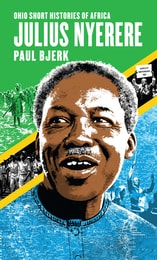
Julius Nyerere
Paul Bjerk
Ohio University Press, 2017
With vision, hard-nosed judgment, and biting humor, Julius Nyerere confronted the challenges of nation building in modern Africa. Constructing Tanzania out of a controversial Cold War union between Tanganyika and Zanzibar, Nyerere emerged as one of independent Africa’s most influential leaders. He pursued his own brand of African socialism, called Ujamaa, with unquestioned integrity, and saw it profoundly influence movements to end white minority rule in Southern Africa. Yet his efforts to build a peaceful nation created a police state, economic crisis, and a war with Idi Amin’s Uganda. Eventually—unlike most of his contemporaries—Nyerere retired voluntarily from power, paving the way for peaceful electoral transitions in Tanzania that continue today.
Based on multinational archival research, extensive reading, and interviews with Nyerere’s family and colleagues, as well as some who suffered under his rule, Paul Bjerk provides an incisive and accessible biography of this African leader of global importance. Recognizing Nyerere’s commitment to participatory government and social equality while also confronting his authoritarian turns and policy failures, Bjerk offers a portrait of principled leadership under the difficult circumstances of postcolonial Africa.
Jumano and Patarabueye
Relations at La Junta de los RiosJ. Charles Kelley with a foreword by John D. Speth
University of Michigan Press, 1986
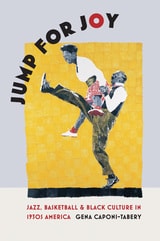
Jump for Joy
Jazz, Basketball, and Black Culture in 1930s AmericaGena Caponi-Tabery
University of Massachusetts Press, 2008
If the 1930s was the Swing Era, then the years from 1937 on might well be called the Jump Era. That summer Count Basie recorded “Jumping at the Woodside,” and suddenly jump tunes seemed to be everywhere. Along with the bouncy beat came a new dance step—the high-flying aerials of the jitterbuggers—and the basketball games that took place in the dance halls of African America became faster, higher, and flashier. Duke Ellington and a cast of hundreds put the buoyant spirit of the era on stage with their 1941 musical revue, Jump for Joy, a title that captured the momentum and direction of the new culture of exuberance.
Several high-profile public victories accompanied this increasing optimism: the spectacular successes of African American athletes at the 1936 Olympics, the 1937 union victory of the Brotherhood of Sleeping Car Porters, and Joe Louis's 1937 and 1938 heavyweight championship fights. For the first time in history, Black Americans emerged as cultural heroes and ambassadors, and many felt a new pride in citizenship.
In this book, Gena Caponi-Tabery chronicles these triumphs and shows how they shaped American music, sports, and dance of the 1930s and beyond. But she also shows how they emboldened ordinary African Americans to push for greater recognition and civil liberties—how cultural change preceded and catalyzed political action.
Tracing the path of one symbolic gesture—the jump—across cultural and disciplinary boundaries, Caponi-Tabery provides a unique political, intellectual, and artistic analysis of the years immediately preceding World War II.
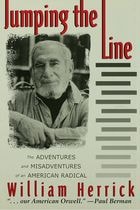
Jumping the Line
The Adventures and Misadventures of an American RadicalWilliam Herrick
University of Wisconsin Press, 1998
An eye-opening account of time served in the great battles of our century— for workers’ rights, against Fascism, Communism, and racism—Jumping the Line is the life story of an American original. William Herrick chronicles his adventures and misadventures on the front lines of the Spanish Civil War, in (and very much out of) the Communist Party, driving a tractor on a communal farm in Michigan, jumping the line as a hobo, organizing African American sharecroppers in Georgia, at work with Orson Welles, and immersed in his own writing.
Herrick chronicles a life of great conviction and great disillusion. He went to Spain in 1936 to fight against the Fascists and there witnessed the horrifying acts that Fascists and Communists alike committed, before he was felled by a near-fatal wound. Here he tells about the life that led him, a working-class Jewish kid from New York, into the idealism and then the murky politics of this internecine conflict. From the bloody fight in Spain he takes us to the battlefields of the Communist movement in the U.S., where he found himself parading up and down the garment district of Manhattan, denouncing his former comrades.
When Paul Berman interviewed Herrick in the Village Voice in 1986, for the fiftieth anniversary of the Spanish Civil War, Herrick’s remarks so incensed other veterans of the Abraham Lincoln battalion that they picketed the paper. What William Herrick has to say doesn’t always go down easily. But for those who like the truth, with a dash of wit and a healthy dose of history, it can be exhilarating.
Junctures in Women's Leadership
Higher EducationCarmen Twillie Ambar
Rutgers University Press, 2020
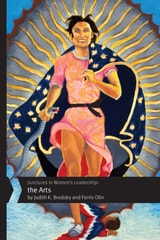
Junctures in Women's Leadership
The ArtsBrodsky, Judith K
Rutgers University Press, 2018
Amongst the women discussed are Bertha Honoré Palmer, Louise Noun, Samella Lewis, Julia Miles, Miriam Colón, Jaune Quick-To-See Smith, Bernice Steinbaum, Anne d’Harnoncourt, Martha Wilson, Jawole Willa Jo Zollar, Kim Berman, Gilane Tawadros, Joanna Smith, and Veomanee Douangdala.
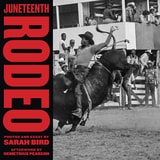
Juneteenth Rodeo
Photos and essay by Sarah Bird; Afterword by Demetrius Pearson
University of Texas Press, 2024
Award of Excellence — Communication Arts
Honorable Mention — The International Photography Awards 2024 Book Category
Jury Top 5 Selection — The International Photography Awards 2024 Book Category
Silver Winner in Zines And Photo Book/Culture— 2024 International Film Photography Award, Analog Sparks
Timeless photos offer a rare portrait of the jubilant, vibrant, vital, nearly hidden, and now all-but-vanished world of small-town Black rodeos.
Long before Americans began to officially commemorate Juneteenth, in the heat of East Texas, saddles were being cinched, buckles shined, and lassoes adjusted for a day on the Black rodeo circuit in honor of the holiday. In the late 1970s, as they had been doing for generations, Black communities across the region held local rodeos for the talented cowboys and cowgirls who were segregated from the mainstream circuit. It was to these vibrant community events that bestselling Texas writer Sarah Bird, then a young photojournalist, found herself drawn.
In Juneteenth Rodeo, Bird’s lens celebrates a world that was undervalued at the time, capturing everything, from the moment the pit master fired up his smoker, through the death-defying rides, to the last celebratory dance at a nearby honky-tonk. Essays by Bird and sports historian Demetrius Pearson reclaim the crucial role of Black Americans in the Western US and show modern rodeo riders—who still compete on today’s circuit—as “descendants” in a more than two-hundred-year lineage of Black cowboys. A gorgeous tribute to the ropers and riders—legends like Willie Thomas, Myrtis Dightman, Rufus Green, Bailey’s Prairie Kid, Archie Wycoff, and Calvin Greeley—as well as the secretaries, judges, and pick-up men and even the audience members who were as much family as fans, Juneteenth Rodeo ultimately seeks to put Black cowboys and cowgirls where they have always belonged: in the center of the frame.
Jung in Context
Modernity and the Making of a PsychologyPeter Homans
University of Chicago Press, 1995
"Jung in Context is an intellectual triumph. . . . Utilizes the resources of biography, psychology, sociology, and theology to probe the genesis of a psychological system which is currently enjoying a wide following. . . . A splendid job."—Lewis R. Rambo, Psychiatry
"Anyone seeking an introduction to Jung's thought will find a masterful précis here."—Jan Goldstein, Journal of Sociology
"An unusually perceptive and clearly written book. . . . An important advance in the understanding of Jung, and Homans's methodology sets the stage for all future efforts to understand psychological innovators."—Herbert H. Stroup, Christian Century
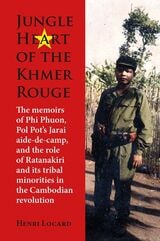
Jungle Heart of the Khmer Rouge
The memoirs of Phi Phuon, Pol Pot’s Jarai aide-de-camp, and the role of Ratanakiri and its tribal minorities in the Cambodian revolutionHenri Locard
National University of Singapore Press, 2023
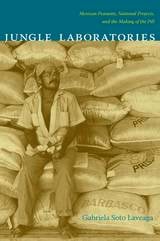
Jungle Laboratories
Mexican Peasants, National Projects, and the Making of the PillGabriela Soto Laveaga
Duke University Press, 2009
Soto Laveaga traces the political, economic, and scientific development of the global barbasco industry from its emergence in the 1940s, through its appropriation by a populist Mexican state in 1970, to its obsolescence in the mid-1990s. She focuses primarily on the rural southern region of Tuxtepec, Oaxaca, where the yam grew most freely and where scientists relied on local, indigenous knowledge to cultivate and harvest the plant. Rural Mexicans, at first unaware of the pharmaceutical and financial value of barbasco, later acquired and deployed scientific knowledge to negotiate with pharmaceutical companies, lobby the Mexican government, and ultimately transform how urban Mexicans perceived them. By illuminating how the yam made its way from the jungles of Mexico, to domestic and foreign scientific laboratories where it was transformed into pills, to the medicine cabinets of millions of women across the globe, Jungle Laboratories urges us to recognize the ways that Mexican peasants attained social and political legitimacy in the twentieth century, and positions Latin America as a major producer of scientific knowledge.
Junius And Joseph
Presidential Politics and the Assassination of the First Mormon ProphetRobert S. Wicks & Fred R. Foister
Utah State University Press, 2005
Just Anger
Representing Women's Anger in Early Modern EnglandGwynne Kennedy
Southern Illinois University Press, 2000
The first scholar to investigate the subject of women’s anger in early modern England, Gwynne Kennedy analyzes portrayals of and attitudes toward women’s anger in printed texts by or purporting to be written by women during the period.
Kennedy draws from recent critical work on emotions by historians, literary scholars, philosophers, and psychologists as well as comparative studies of the emotions by cultural anthropologists. Kennedy also examines a number of male-authored works, including sermons, conduct literature, philosophy, rhetoric, and medicine. The focus of her work, however, is on representations of women’s anger in printed works signed with women’s names in late sixteenth- and early seventeenth-century England. She addresses the ways these writings conform to, conflict with, or appear to reconfigure prevailing beliefs about women’s anger.
Kennedy looks at such literary texts as Mary Wroth’s romance, The Countess of Montgomery’s Urania, the first fiction by an English woman; Elizabeth Cary’s play, The Tragedy of Mariam, the earliest extant play in English by a woman; and Aemilia Lanyer’s verse collection, Salve Deus Rex Judaeorum. She also discusses religious writings by Protestant martyr Anne Askew and Elizabeth Cary’s history of Edward II. Kennedy considers as well defenses of women’s nature authored by women (Rachel Speght and Aemilia Lanyer) or published under female pseudonyms (“Jane Anger,” “Ester Sowernam,” and “Constantia Munda”).
Kennedy demonstrates the importance of class and race as factors affecting anger’s legitimacy and its forms of expression. She shows how early modern assumptions about women’s anger can help to create or exaggerate other differences among women. Her close scrutiny of anger against female inferiority emphasizes the crucial role of emotions in the construction of self-worth and identity.
Just Around The Corner
The Paradox Of The Jobless RecoveryStanley Aronowitz
Temple University Press, 2005
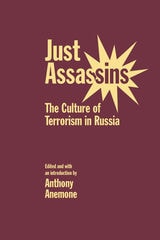
Just Assassins
The Culture of Terrorism in RussiaEdited and with an introduction by Anthony Anemone
Northwestern University Press, 2010
Just Assassins examines terrorism as it’s manifested in Russian culture past and present, with essays devoted to Russian literature, film, and theater; historical narrative; and even amateur memoir, songs, and poetry posted on the Internet. Along with editor Anthony Anemone’s introduction, these essays chart the evolution of modern political terrorism in Russia, from the Decembrist uprising to the horrific school siege in Beslan in 2004, showing how Russia’s cultural engagement with its legacy of terrorism speaks to the wider world.
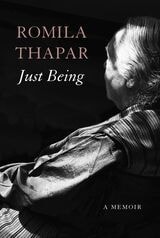
Just Being
A MemoirRomila Thapar
Seagull Books, 2026
In Just Being, historian Romila Thapar invites us into her illustrious world—a rich, extensive memoir from a scholar who has profoundly shaped our understanding of India’s past and present.
From her childhood growing up in British India, through her years of education in London, her extensive travels to archaeological sites across Asia and beyond, and her trailblazing role in shaping the Centre for Historical Studies at Jawaharlal Nehru University, Thapar reflects on a life lived in the service of inquiry and education. Composed over the past few years, Just Being is a testimony to Thapar’s ability to view herself within the larger flow of history, and to illumine it with a scholar’s depth and a storyteller’s sensitivity. It reveals not only an extraordinary, boundary-defying life but a profound conviction that understanding our past in the light of irrefutable evidence is essential to an insight into the present and to shaping a more thoughtful future.

Just Enough to Put Him Away Decent
Death Care, Life Extension, and the Making of a Healthier South, 1900-1955Kristine M. McCusker
University of Illinois Press, 2023
Kristine McCusker charts the dramatic transformation that took place when southerners in particular and Americans in general changed their thinking about when one should die, how that death could occur, and what decent burial really means. As she shows, death care evolved from being a community act to a commercial one where purchasing a purple coffin and hearse ride to the cemetery became a political statement and the norm. That evolution also required interactions between perfect strangers, especially during the world wars as families searched for their missing soldiers. In either case, being put away decent, as southerners called burial, came to mean something fundamentally different in 1955 than it had just fifty years earlier.
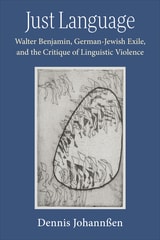
Just Language
Walter Benjamin, German-Jewish Exile, and the Critique of Linguistic ViolenceDennis Johannßen
University of Michigan Press, 2026
Just Language revisits the Weimar period and its representation in the postwar years to explore narratives of linguistic resistance in the works of Walter Benjamin, Theodor W. Adorno, Hannah Arendt, and Paul Celan. How did this generation of exile writers grapple with their experiences of oppression and persecution? How did they create a language of resistance during the decades that prepared the Third Reich and the Shoah?
Facing the devastations of World War I, the book explores how Walter Benjamin analyzed language’s ability to radically break the cyclical violence of war and examines his opposition to expansionism and imperialism in Weimar education and culture. Based on Benjamin’s analysis, Johannßen traces the postwar responses of Hannah Arendt and Paul Celan. While Arendt proposed strategies of metaphorical thinking to counteract the formation of totalitarianism, Celan mobilized silence as a poetic counterforce against oppression and erasure. Just Language argues that every linguistic act and practice, no matter how small or marginalized, entails the ethical task of opposing the normalization and institutionalization of political violence. By tracing how Benjamin and his interlocutors struggled against German fascism, Johannßen presents a memory-based critique of linguistic violence, opening a dialogue between German-Jewish writers and today’s debates on nondiscrimination, propaganda, and social justice.
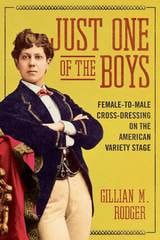
Just One of the Boys
Female-to-Male Cross-Dressing on the American Variety StageGillian Rodger
University of Illinois Press, 2018
Gillian M. Rodger uses the development of male impersonation from the early nineteenth century to the early twentieth century to illuminate the history of the variety show. Exploding notions of high- and lowbrow entertainment, Rodger looks at how both performers and forms consistently expanded upward toward respectable—and richer—audiences. At the same time, she illuminates a lost theatrical world where women made fun of middle-class restrictions even as they bumped up against rules imposed in part by audiences. Onstage, the actresses' changing performance styles reflected gender construction in the working class and shifts in class affiliation by parts of the audiences. Rodger observes how restrictive standards of femininity increasingly bound male impersonators as new gender constructions allowed women greater access to public space while tolerating less independent behavior from them.
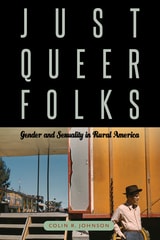
Just Queer Folks
Gender and Sexuality in Rural AmericaColin R. Johnson
Temple University Press, 2013
Most studies of lesbian and gay history focus on urban environments. Yet gender and sexual diversity were anything but rare in nonmetropolitan areas in the first half of the twentieth century. Just Queer Folks explores the seldom-discussed history of same-sex intimacy and gender nonconformity in rural and small-town America during a period when the now familiar concepts of heterosexuality and homosexuality were just beginning to take shape.
Eschewing the notion that identity is always the best measure of what can be known about gender and sexuality, Colin R. Johnson argues instead for a queer historicist approach. In so doing, he uncovers a startlingly unruly rural past in which small-town eccentrics, "mannish" farm women, and cross-dressing Civilian Conservation Corps enrollees were often just queer folks so far as their neighbors were concerned. Written with wit and verve, Just Queer Folks upsets a whole host of contemporary commonplaces, including the notion that queer history is always urban history.
Just Three Minutes, Please
Thinking Out Loud on Public RadioMichael Blumenthal
West Virginia University Press, 2014
What’s wrong with the contemporary American medical system? What does it mean when a state’s democratic presidential primary casts 40% of its votes for a felon incarcerated in another state? What’s so bad about teaching by PowerPoint? What is truly the dirtiest word in America?
These are just a few of the engaging and controversial issues that Michael Blumenthal, poet, novelist, essayist, and law professor, tackles in this collection of poignant essays commissioned by West Virginia Public Radio.
In these brief essays, Blumenthal provides unconventional insights into our contemporary political, educational, and social systems, challenging us to look beyond the headlines to the psychological and sociological realities that underlie our conventional thinking.
As a widely published poet and novelist, Blumenthal brings along a lawyer’s analytical ability with his literary sensibility, effortlessly facilitating a distinction between the clichés of today’s pallid political discourse and the deeper realities that lie beneath. This collection will captivate and provoke those with an interest in literature, politics, law, and the unwritten rules of our social and political engagements.
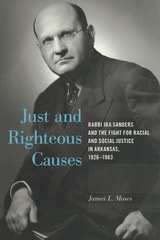
Just and Righteous Causes
Rabbi Ira Sanders and the Fight for Racial and Social Justice in Arkansas, 1926-1963James L. Moses
University of Arkansas Press, 2018
Winner, 2019 Booker Worthen Prize from the Central Arkansas Library System.
A dedicated advocate for social justice long before the term entered everyday usage, Rabbi Ira Sanders began striving against the Jim Crow system soon after he arrived in Little Rock from New York in 1926. Sanders, who led Little Rock’s Temple B’nai Israel for nearly forty years, was a trained social worker as well as a rabbi and his career as a dynamic religious and community leader in Little Rock spanned the traumas of the Great Depression, World War II and the Holocaust, and the social and racial struggles of the 1950s and 1960s.
Just and Righteous Causes—a full biographical study of this bold social-activist rabbi—examines how Sanders expertly navigated the intersections of race, religion, and gender to advocate for a more just society. It joins a growing body of literature about the lives and histories of Southern rabbis, deftly balancing scholarly and narrative tones to provide a personal look into the complicated position of the Southern rabbi and the Jewish community throughout the political struggles of the twentieth-century South.
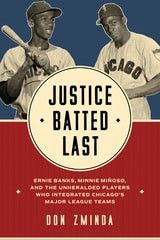
Justice Batted Last
Ernie Banks, Minnie Miñoso, and the Unheralded Players Who Integrated Chicago's Major League TeamsDon Zminda
University of Illinois Press, 2025
Don Zminda’s account looks at these interconnected events alongside the little-known chronicle of Chicago’s slow track to integrating major league baseball. By the early 1950s, the Cubs and White Sox organizations had become rich in Black and Afro-Latino stars and talented prospects. Unlike Miñoso and Banks, however, most of these minor leaguers never advanced to the majors or, if they did, it was for little more than a cup of coffee. Zminda also profiles these players, from Charles Pope, the Cubs’ first Black signee, to larger-than-life fireballer Blood Burns.
Essential and dramatic, Justice Batted Last uses the lives and careers of two Chicago legends to tell a story of integration on and off the diamond.
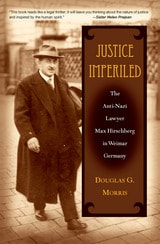
Justice Imperiled
The Anti-Nazi Lawyer Max Hirschberg in Weimar GermanyDouglas G. Morris
University of Michigan Press, 2005
-Sister Helen Prejean
Justice Imperiled is the story of the brilliant lawyer Max Hirschberg, one of Germany's most courageous defenders of justice in the face of Hitler's rise to power.
Hirschberg lived an extraordinary life at a defining moment in German and European history. By the time he fled Nazi Germany in 1934, he had argued a series of cases in Munich's courtrooms that shed light on the history of political justice in pre-Nazi Germany and, by extension, the miscarriage of justice in all Western democracies.
Hirschberg was a rare figure: he fought for cases that reflected the new democracy rather than the old monarchy, that valued equality rather than hierarchy, and that showed respect for workers as well as aristocrats.
Throughout the Weimar period Hirschberg squared off in court against Munich's conservatives, reactionaries, and Nazis-twice facing Hitler himself. As he litigated politically charged disputes, he also began fighting to reverse the criminal convictions of innocent defendants and to study what mistaken verdicts teach us about the criminal justice system as a whole.
In a unique blend of biography and courtroom drama, Justice Imperiled captures the excitement of Hirschberg's actual cases and presents legal battles that still rage, in different circumstances, to this day.
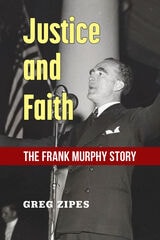
Justice and Faith
The Frank Murphy StoryGreg Zipes
University of Michigan Press, 2021
Murphy is best remembered for his immense legal contributions supporting individual liberty and fighting discrimination, particularly discrimination against the most vulnerable. Despite being a loyal ally of Franklin Delano Roosevelt, when FDR ordered the removal of Japanese Americans during World War II, Supreme Court Justice Murphy condemned the policy as “racist” in a scathing dissent to the Korematsu v. United States decision—the first use of the word in a Supreme Court opinion. Every American, whether arriving by first class or in chains in the galley of a slave ship, fell under Murphy’s definition of those entitled to the full benefits of the American dream.
Justice and Faith explores Murphy’s life and times by incorporating troves of archive materials not available to previous biographers, including local newspaper records from across the country. Frank Murphy is proof that even in dark times, the United States has extraordinary resilience and an ability to produce leaders of morality and courage.
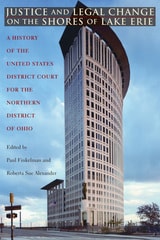
Justice and Legal Change on the Shores of Lake Erie
A History of the United States District Court for the Northern District of OhioPaul Finkelman
Ohio University Press, 2012
Justice and Legal Change on the Shores of Lake Erie explores the many ways that the United States District Court for the Northern District of Ohio has affected the region, the nation, the development of American law, and American politics.
The essays in this book, written by eminent law professors, historians, political scientists, and practicing attorneys, illustrate the range of cases and issues that have come before the court. Since the court’s inception in 1855, judges have influenced economic developments and social issues, beginning with the court’s most famous early case, involving the rescue of the fugitive slave John Price by residents of Northern Ohio. Chapters focusing on labor strikes, free speech, women’s rights, the environment, the death penalty, and immigration illustrate the impact this court and its judges have had in the development of society and the nation’s law. Some of the cases here deal with local issues with huge national implications xad—like political corruption, school desegregation, or pollution on the Cuyahoga River. But others are about major national issues that grew out of incidents, such as the prosecution of Eugene V. Debs for opposing World War I, the litigation resulting from the Kent State shootings and opposition to the Vietnam War, and the immigration status of the alleged Nazi war criminal John Demyanjuk.
This timely history confirms the significant role played by district courts in the history of the United States.
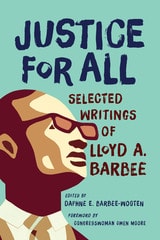
Justice for All
Selected Writings of Lloyd A. BarbeeLloyd A Barbee
Wisconsin Historical Society Press, 2017
Civil rights leader and legislator Lloyd A. Barbee frequently signed his correspondence with "Justice for All," a phrase that embodied his life’s work of fighting for equality and fairness. An attorney most remembered for the landmark case that desegregated Milwaukee Public Schools in 1972, Barbee stood up for justice throughout his career, from defending University of Wisconsin students who were expelled after pushing the school to offer black history courses, to representing a famous comedian who was arrested after stepping out of a line at a protest march. As the only African American in the Wisconsin legislature from 1965 to 1977, Barbee advocated for fair housing, criminal justice reform, equal employment opportunities, women’s rights, and access to quality education for all, as well as being an early advocate for gay rights and abortion access.
This collection features Barbee’s writings from the front lines of the civil rights movement, along with his reflections from later in life on the challenges of legislating as a minority, the logistics of coalition building, and the value of moving the needle on issues that would outlast him. Edited by his daughter, civil rights lawyer Daphne E. Barbee-Wooten, these documents are both a record of a significant period of conflict and progress, as well as a resource on issues that continue to be relevant to activists, lawmakers, and educators.