Results by title
808 books match the query 'Civilization' and 5 start with k
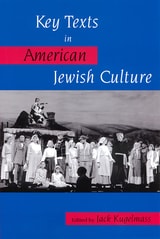
Key Texts in American Jewish Culture
Kugelmass, Jack
Rutgers University Press, 2003
Contributors come from a variety of disciplines, including American studies, anthropology, comparative literature, history, music, religious studies, and women's studies. Each provides an analysis of a specific text in art, music, television, literature, homily, liturgy, or history. Some of the works discussed, such as Philip Roth's novel Counterlife, the musical Fiddler on the Roof, and Irving Howe's World of Our Fathers, are already widely acknowledged components of the American Jewish studies canon. Others-such as Bridget Loves Bernie, infamous for the hostile reception it received among American Jews+ may be considered "key texts" because of the controversy they provoked. Still others, such as Joshua Liebman's Piece of Mind and the radio and TV sitcom The Goldbergs, demonstrate the extent to which American Jewish culture and mainstream American culture intermingle with and borrow from each other.
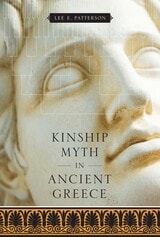
Kinship Myth in Ancient Greece
By Lee E. Patterson
University of Texas Press, 2010
In ancient Greece, interstate relations, such as in the formation of alliances, calls for assistance, exchanges of citizenship, and territorial conquest, were often grounded in mythical kinship. In these cases, the common ancestor was most often a legendary figure from whom both communities claimed descent.
In this detailed study, Lee E. Patterson elevates the current state of research on kinship myth to a consideration of the role it plays in the construction of political and cultural identity. He draws examples both from the literary and epigraphical records and shows the fundamental difference between the two. He also expands his study into the question of Greek credulity—how much of these founding myths did they actually believe, and how much was just a useful fiction for diplomatic relations? Of central importance is the authority the Greeks gave to myth, whether to elaborate narratives or to a simple acknowledgment of an ancestor. Most Greeks could readily accept ties of interstate kinship even when local origin narratives could not be reconciled smoothly or when myths used to explain the link between communities were only "discovered" upon the actual occasion of diplomacy, because such claims had been given authority in the collective memory of the Greeks.
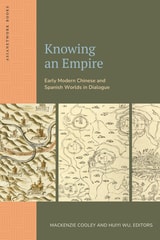
Knowing an Empire
Early Modern Chinese and Spanish Worlds in DialogueEdited by Mackenzie Cooley and Huiyi Wu
Lever Press, 2025
Knowing an Empire does not see the conveyance of information across an empire as a top-down process with an active center as a knowledge-maker. Instead, it amplifies a blend of voices that speak as much to imperial bureaucracy as to the rich local and Indigenous cultures, revealing these two early modern empires as diverse polities whose equilibria were constantly rebalanced among local powers. Comprised of 18 chapters, this edited collection reflects on the historical evolution and inner structures of the imperial epistemologies, as well as the many ways historians today read difangzhi and relaciones geográficas to understand the spatial, natural, and social order in both the Chinese and the Spanish empires. At once a comparative and a connected history, it places Chinese and Spanish imperial knowledge in the globalizing early modern world, highlighting the migration of people, goods, and ideas and revealing how these wide-ranging influences are reflected—or not—in the difangzhi and the relaciones. The book concludes by broadening our scope beyond China and Spain to reflect how other early modern empires, such as the Portuguese, failed to develop such systematized imperial genres.
With contributions from leading scholars across Latin American and Asian Studies, this book synthesizes political, environmental, and socio-economic history with historical anthropology to highlight parallel governance and knowledge structures. The contributors challenge conventional binaries of Western versus Eastern, and colonial versus non-colonial, presenting a nuanced perspective of early modern empires as dynamic, interconnected entities through the shared challenges of scale, diversity, and increasing globalization. Through these dialogues, Knowing an Empire illuminates the complex entanglement of ruling and understanding. This groundbreaking collection offers a highly innovative and dialogic approach to comparative studies of empires, with major implications for Asian, European, Latin American, transnational, and global history.
Knowledge Power And Discipline
German Studies And National IdentityPier Carlo Bontempelli
University of Minnesota Press, 2003
An essential critical history of German studies as an academic discipline
German Studies has confronted many crises, as well as severe criticism and self-criticism, and yet it has managed to maintain its disciplinary system through every upheaval—the revolution of 1848, the establishment of the Second Reich in 1871, the Weimar Republic, the Nazi Third Reich, the Second World War and the reconstruction era, the creation and reunification of the two German states. Pier Carlo Bontempelli focuses on this continuity, dating back to the early nineteenth century, when the “founding fathers” of Germanistik secured its status by grounding it in a set of fixed principles, revived by each successive generation of scholars in order to legitimize their position of power—and to ensure their capacity for cultural reproduction.
Using the works of Michel Foucault and Pierre Bourdieu, Bontempelli investigates the institution and principles of German Studies and critically reconstructs its history. Mindful of the mechanisms of choice and domination operating at every turn, his book exposes the repressed social and political history of German Studies.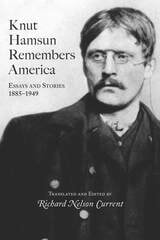
Knut Hamsun Remembers America
Essays and Stories, 1885-1949Knut Hamsun, Edited & Translated by Richard Nelson Current
University of Missouri Press, 2003