Results by title
484 books match the query 'Foreign relations' and 5 start with k
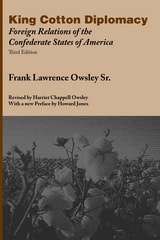
King Cotton Diplomacy
Foreign Relations of the Confederate States of AmericaFrank L. Owsley Sr., revised by Harriet Chappell Owsley, and with a new Preface by Howard Jones
University of Alabama Press, 2008
The exhaustive, definitive study of Southern attempts to gain international support for the Confederacy by leveraging the cotton supply for European intervention during the Civil War. Using previously untapped sources from Britain and France, along with documents from the Confederacy’s state department, Frank Owsley’s King Cotton Diplomacy is the first archival-based study of Confederate diplomacy.
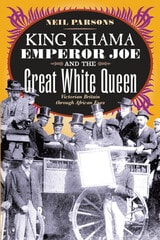
King Khama, Emperor Joe, and the Great White Queen
Victorian Britain through African EyesNeil Parsons
University of Chicago Press, 1997
The chiefs initially went to England to persuade Queen Victoria not to give their lands to ruthless Rhodes and his British South Africa Company. Abandoned by the Secretary of State for the Colonies, Joseph Chamberlain, and denied an audience with the queen, the three rulers decided to tour the British Isles to plead their case to the populace. Appealing to the middle-class morality of Victorian society, the chiefs were remarkably successful in gaining support, eventually swaying Chamberlain into drafting the agreement that secured their territories against the encroachment of Rhodesia.
Historian Neil Parsons has reconstructed this journey with the help of African archival materials and news clippings from British papers, garnered from the clippings service the chiefs had the foresight to employ. In equal parts narrative of pilgrimage, voyage of discovery, and colonial resistance, King Khama, Emperor Joe, and the Great White Queen provides a view from the other side of colonialism and imperialism. It demonstrates the nuances of cultural and religious interaction between Africans and Europeans, and it does so with the richness and depth of a fully realized novel.
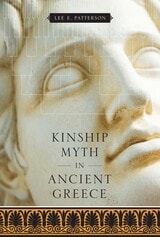
Kinship Myth in Ancient Greece
By Lee E. Patterson
University of Texas Press, 2010
In ancient Greece, interstate relations, such as in the formation of alliances, calls for assistance, exchanges of citizenship, and territorial conquest, were often grounded in mythical kinship. In these cases, the common ancestor was most often a legendary figure from whom both communities claimed descent.
In this detailed study, Lee E. Patterson elevates the current state of research on kinship myth to a consideration of the role it plays in the construction of political and cultural identity. He draws examples both from the literary and epigraphical records and shows the fundamental difference between the two. He also expands his study into the question of Greek credulity—how much of these founding myths did they actually believe, and how much was just a useful fiction for diplomatic relations? Of central importance is the authority the Greeks gave to myth, whether to elaborate narratives or to a simple acknowledgment of an ancestor. Most Greeks could readily accept ties of interstate kinship even when local origin narratives could not be reconciled smoothly or when myths used to explain the link between communities were only "discovered" upon the actual occasion of diplomacy, because such claims had been given authority in the collective memory of the Greeks.
Knowledge Regulation and National Security in Postwar America
Mario Daniels and John Krige
University of Chicago Press, 2022
In this groundbreaking book, Mario Daniels and John Krige set out to show the enormous political relevance that export control regulations have had for American debates about national security, foreign policy, and trade policy since 1945. Indeed, they argue that from the 1940s to today the issue of how to control the transnational movement of information has been central to the thinking and actions of the guardians of the American national security state. The expansion of control over knowledge and know-how is apparent from the increasingly systematic inclusion of universities and research institutions into a system that in the 1950s and 1960s mainly targeted business activities. As this book vividly reveals, classification was not the only—and not even the most important—regulatory instrument that came into being in the postwar era.
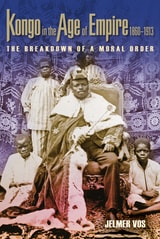
Kongo in the Age of Empire, 1860–1913
The Breakdown of a Moral OrderJelmer Vos
University of Wisconsin Press, 2015
Vos underlines that Kongo's incorporation in the European state system also had tragic consequences, including the undermining of local African structures of authority—on which the colonial system actually depended. Kongo in the Age of Empire carefully documents the involvement of Kongo's royal court in the exercise of Portuguese rule in northern Angola and the ways that Kongo citizens experienced colonial rule as an increasingly illegitimate extension of royal power.