Results by title
2817 books match the query 'Nature' and 13 start with k
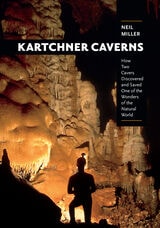
Kartchner Caverns
How Two Cavers Discovered and Saved One of the Wonders of the Natural WorldNeil Miller
University of Arizona Press, 2008
Award-winning author Neil Miller soon tells us that what lay in front of amateur spelunkers Randy Tufts and Gary Tenen was anything but routine. These young men had crawled into a virgin cave, a landscape untouched and unseen for hundreds of thousands of years. In cave terminology, this underground oasis was “living”—water still seeped down the limestone walls, depositing minerals that slowly built up into stunningly beautiful formations.
In a time when countless caves had been destroyed by vandals and looters who had defaced the walls and had broken formations, this pristine discovery was every caver’s dream. While duplicating that moment might seem difficult, this fascinating account of the fight to preserve Kartchner Caverns lends us the same sense of awe and urgency. In an arresting tale spanning the twenty-five-year period in which Tufts and Tenen struggled to protect their find, Miller skillfully weaves together personal interviews, biographical information, political maneuvering, and geological facts. Presented in full color with dazzling photographs showcasing the natural wonder of the caverns, this is an invitation to take in the mysterious, stunning beauty of a cave as if discovering it for the first time.
The triumph of the conservationists and the opening of Kartchner Caverns as a state park are known to anyone who has visited the caves as a tourist. But this narrative offers a chance to go beyond the guidebooks with its revealing look at this unspoiled natural wonder and the science of cave conservation. With as much depth and colorful detail as the caverns themselves, this page-turning account will captivate anyone interested in caves and the preservation of natural wonders.
Karánkaway Country
By Roy Bedichek
University of Texas Press, 1974
Roy Bedichek spent most of his life working in the educational field in Texas, but his main interest was always the great outdoors. His first book, Adventures with a Texas Naturalist, was published when he was almost seventy, and his second, Karánkaway Country, appeared three years later. Both were the result of a lifetime of exploring a beloved land, of searching observation, of discussion, debate, wide reading, and reflection. Long out of print, Karánkaway Country is now available in a handsome second edition with a new Foreword by W. W. Newcomb, Jr.
Karánkaway Country focuses on the natural history of a strip of coastal prairie lying roughly between Corpus Christi and Galveston and once inhabited by the poorly known and much maligned Karankawa Indians. It serves as home base for an exposition of Bedichek's philosophy, providing a convenient local setting for richly tailored essays on wildlife, soil, human skin, and a variety of other topics suggested by a wide-ranging intellect. Bedichek's philosophy, if it can be reduced to a few words, is essentially that humans must learn to live on peaceful and conciliatory terms with our natural environment.
Keepers of the Wolves
Richard P. Thiel
University of Wisconsin Press, 2018
This new edition brings Thiel's story into the twenty-first century, recounting his work monitoring wolves as they spread to central Wisconsin, conflicts of wolves with landowners and recreationalists, changes in state and federal policies, the establishment of a state wolf-hunting season in 2012, and Thiel's forecast for the future of wolves in Wisconsin.
Keepers of the Wolves
The Early Years of Wolf Recovery in WisconsinRichard P. Thiel
University of Wisconsin Press, 2001
Thus begins Keepers of the Wolves, Thiel’s tale of his ten years at the center of efforts to track and protect the recovery of wolves in Northern Wisconsin. From his early efforts as a student enthusiast to his departure in 1989 from the post of wolf biologist for the Department of Natural Resources, Thiel conveys the wonder, frustrations, humor, and everyday hard work of field biologists, as well as the politics and public relations pitfalls that so often accompany their profession.
We share in the excitement as Thiel and his colleagues find wolf tracks in the snow, howl in the forest night and are answered back, learn to safely trap wolves to attach radio collars, and track the packs’ ranges by air from a cramped Piper Cub. We follow the stories of individual wolves and their packs as pups are born and die, wolves are shot by accident and by intent, ravages of canine parvovirus and hard winters take their toll, and young adults move on to new ranges. Believing he had left his beloved wolves behind, Thiel takes a new job as an environmental educator in central Wisconsin, but soon wolves follow. By 1999, there were an estimated 200 timber wolves in 54 packs in Wisconsin.
This is a sequel to Dick Thiel's 1994 book, The Timber Wolf in Wisconsin: The Death and Life of a Majestic Predator. That book traced the wolf's history in Wisconsin, its near extinction, and the initial efforts to reestablish it in our state. Thiel's new book looks at how successful that program has been.
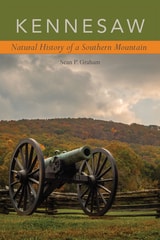
Kennesaw
Natural History of a Southern MountainSean P. Graham
University of Alabama Press, 2021
The first in-depth ecological treatment of one of the most frequently visited National Battlefield parks in the country.
Designated as a battlefield in 1917 and as a park in 1935, the 2,965-acre Kennesaw Mountain National Battlefield Park now preserves far more than the military history and fallen soldiers it was originally founded to commemorate. Featuring eighteen miles of interpretive trails looping around and over the mountain, the park is a popular destination for history buffs, outdoor recreationists, and nature enthusiasts alike. Located approximately twenty miles northwest of downtown Atlanta, Kennesaw Mountain rises 608 feet above the rolling hills and hardwood forests of the Georgia Piedmont. Kennesaw Mountain’s geology and topography create enough of a distinctive ecosystem to make it a haven for flora and fauna alike. As the tallest mountain in the metropolitan Atlanta area, it is also a magnet for human visitors.
Written for a diverse range of readers and park visitors, Kennesaw: Natural History of a Southern Mountain provides a comprehensive exploration of the entire park punctuated with humor, colorful anecdotes, and striking photographs of the landscape. Sean P. Graham begins with a brief summary of the park’s human history before transitioning to a discussion of the mountain’s nature, including its unique geology, vegetation, animals, and plant-animal interactions. Graham also focuses on Kennesaw Mountain’s most important ecological and conservation attribute—its status as a globally important bird refuge. An insightful chapter on bird watching and the region’s migrating bird populations includes details on migratory patterns, birding hot spots, and the mountain’s avian significance. An epilogue revisits the park’s Civil War history, describing how Union veterans pushed for establishment of the park as a memorial, inadvertently creating a priceless biological preserve in the process.

Keys to the Flora of Arkansas
Edwin Smith
University of Arkansas Press, 1994
Killing Animals
The Animal Studies Group
University of Illinois Press, 2000
Killing the Hidden Waters
By Charles Bowden
University of Texas Press, 1985
In the quarter-century since his first book, Killing the Hidden Waters, was published in 1977, Charles Bowden has become one of the premier writers on the American environment, rousing a generation of readers to both the wonder and the tragedy of humanity's relationship with the land.
Revisiting his earliest work with a new introduction, "What I Learned Watching the Wells Go Down," Bowden looks back at his first effort to awaken people to the costs and limits of using natural resources through a simple and obvious example—water. He drives home the point that years of droughts, rationing, and even water wars have done nothing to slake the insatiable consumption of water in the American West. Even more timely now than in 1977, Killing the Hidden Waters remains, in Edward Abbey's words, "the best all-around summary I've read yet, anywhere, of how our greed-driven, ever-expanding urban-industrial empire is consuming, wasting, poisoning, and destroying not only the resource basis of its own existence, but also the vital, sustaining basis of life everywhere."
Killing the Koala and Poisoning the Prairie
Australia, America, and the EnvironmentCorey J. A. Bradshaw and Paul R. Ehrlich
University of Chicago Press, 2015
In this book, Bradshaw and Ehrlich provide a spirited exploration of the ways in which the United States and Australia can learn from their shared problems and combine their most successful solutions in order to find and develop new resources, lower energy consumption and waste, and grapple with the dynamic effects of climate change. Peppering the book with humor, irreverence, and extensive scientific knowledge, the authors examine how residents of both countries have irrevocably altered their natural environments, detailing the most pressing ecological issues of our time, including the continuing resource depletion caused by overpopulation. They then turn their discussion to the politics behind the failures of environmental policies in both nations and offer a blueprint for what must be dramatically changed to prevent worsening the environmental crisis.
Although focused on two nations, Killing the Koala and Poisoning the Prairie clearly has global implications—the problems facing the United States and Australia are not theirs alone, and the solutions to come will benefit by being crafted in coalition. This book provides a vital opportunity to learn from both countries’ leading environmental thinkers and to heed their call for a way forward together.
Kin
Thinking with Deborah Bird RoseThom van Dooren and Matthew Chrulew, editors
Duke University Press, 2022
Contributors. The Bawaka Collective, Matthew Chrulew, Colin Dayan, Linda Payi Ford, Donna Haraway, James Hatley, Owain Jones, Stephen Muecke, Kate Rigby, Catriona (Cate) Sandilands, Isabelle Stengers, Anna Tsing, Thom van Dooren, Kate Wright

Kindred Nature
Victorian and Edwardian Women Embrace the Living WorldBarbara T. Gates
University of Chicago Press, 1999
Some of these women discovered previously unknown species, others wrote and illustrated natural histories or animal stories, and still others educated women, the working classes, and children about recent scientific advances. A number of women also played pivotal roles in the defense of animal rights by protesting overhunting, vivisection, and habitat destruction, even as they demanded their own rights to vote, work, and enter universities.
Kindred Nature shows the enormous impact Victorian and Edwardian women had on the natural sciences and the environmental movement, and on our own attitudes toward nature and human nature.
Knowing Global Environments
New Historical Perspectives on the Field SciencesVetter, Jeremy
Rutgers University Press, 2011
Collectively their essays explore the history of the field sciences, through the lens of place, practice, and the production of scientific knowledge, with a wide-ranging perspective extending outwards from the local to regional, national, imperial, and global scales. The book also shows what the history of the field sciences can contribute to environmental history-especially how knowledge in the field sciences has intersected with changing environments-and addresses key present-day problems related to sustainability, such as global climate, biodiversity, oceans, and more.
Contributors to Knowing Global Environments reveal how the field sciences have interacted with practical economic activities, such as forestry, agriculture, and tourism, as well as how the public has been involved in the field sciences, as field assistants, students, and local collaborators.
Koviashuvik
Making a Home in the Brooks RangeSam Wright
University of Arizona Press, 1997