Results by title
3785 books match the query 'Poetry' and 14 start with k
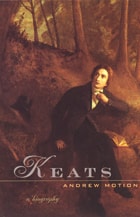
Keats
Andrew Motion
University of Chicago Press, 1999
"Motion has given us a new Keats, one who is skinned alive, a genius who wrote in a single month all the poems we cherish, a victim who was tormented by the best doctors of the age. . . . This portrait, stripped of its layers of varnish and restored to glowing colours, should last us for another generation."—Edmund White, The Observer Review
"Keats's letters fairly leap off the page. . . . [Motion] listens for the 'freely associating inquiry and incomparable verve and dash,' the 'headlong charge,' of Keats's jazzlike improvisations, which give us, like no other writing in English, the actual rush of a man thinking, a mind hurtling forward unpredictably and sweeping us along."—Morris Dickstein, New York Times Book Review
"Scrupulous and eloquent."—Gregory Feeley, Philadelphia Inquirer
Keats's Odes
A Lover's DiscourseAnahid Nersessian
University of Chicago Press, 2021
In 1819, the poet John Keats wrote six poems that would become known as the Great Odes. Some of them—“Ode to a Nightingale,” “To Autumn”—are among the most celebrated poems in the English language. Anahid Nersessian here collects and elucidates each of the odes and offers a meditative, personal essay in response to each, revealing why these poems still have so much to say to us, especially in a time of ongoing political crisis. Her Keats is an unflinching antagonist of modern life—of capitalism, of the British Empire, of the destruction of the planet—as well as a passionate idealist for whom every poem is a love poem.
The book emerges from Nersessian’s lifelong attachment to Keats’s poetry; but more, it “is a love story: between me and Keats, and not just Keats.” Drawing on experiences from her own life, Nersessian celebrates Keats even as she grieves him and counts her own losses—and Nersessian, like Keats, has a passionate awareness of the reality of human suffering, but also a willingness to explore the possibility that the world, at least, could still be saved. Intimate and speculative, this brilliant mix of the poetic and the personal will find its home among the numerous fans of Keats’s enduring work.
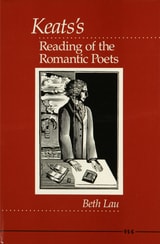
Keats's Reading of the Romantic Poets
Beth Lau
University of Michigan Press, 1991
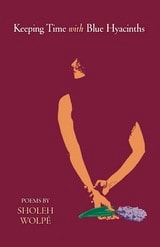
Keeping Time with Blue Hyacinths
PoemsSholeh Wolpé
University of Arkansas Press, 2013
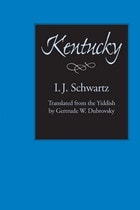
Kentucky
I. J. Schwartz
University of Alabama Press, 1990
An epic poem about life in America in the early 20th century, as perceived by a Jewish immigrant.
Kentucky is the first major work in Yiddish literature to present America as its primary theme. The long epic poem paints a rich picture of life in Kentucky just after the Civil War. Written between 1918 and 1922 by Lithuanian-born writer, I. J. Schwartz, it first appeared in the Yiddish journal Zukunft and later, in 1925, was published as a book. Although unknown to English readers until this translation, the book was a primary text for immigrants and potential immigrants in places as remote as Poland and Argentina who received their first impressions of America from its pages. Parts of it were even set to music and sung in choruses around the world.
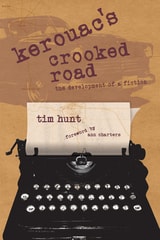
Kerouac's Crooked Road
The Development of a FictionTim Hunt
Southern Illinois University Press, 1996
Now a classic, Kerouac’s Crooked Road was one of the first critical works on the legendary Beat writer to analyze his work as serious literary art, placing it in the broader American literary tradition with canonical writers like Herman Melville and Mark Twain. Author Tim Hunt explores Kerouac’s creative process and puts his work in conversation with classic American literature and with critical theory.
This edition includes a new preface by the author, which takes a discerning look at the implications of the 2007 publication of the original typewriter scroll version of On the Road for the understanding of Kerouac and his novel. Although some critics see the scroll version of the novel as embodying Kerouac’s true artistic vision and the 1957 Viking edition as a commercialized compromise of that vision, Hunt argues that the two versions should not be viewed as antithetical but rather as discrete perspectives of a writer deeply immersed in writing as both performance and evolving process.
Hunt moves beyond the mythos surrounding the “spontaneous creation” of On the Road, which upholds Kerouac’s reputation as a cultural icon, to look more closely at an innovative writer who wanted to bridge the gap between the luscious, talk-filled world of real life and the sterilized version of that world circumscribed by overly intellectualized, literary texts, through the use of written language driven by effusive passion rather than sober reflection. With close, erudite readings of Kerouac’s major and minor works, from On the Road to Visions of Cody,Hunt draws on Kerouac’s letters, novels, poetry, and experimental drafts to position Kerouac in both historical and literary contexts, emphasizing the influence of writers such as Emerson, Melville, Wolfe, and Hemingway on his provocative work.

Kill class
Nomi Stone
Tupelo Press, 2019
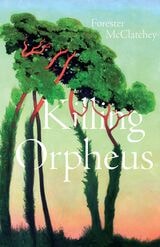
Killing Orpheus
Forester McClatchey
Carnegie Mellon University Press, 2026
A book that holds death in one hand and wonder in the other, Killing Orpheus explores the horror of mortality, the brutality of history, and the gentle miracles of love. Using received forms, especially the sonnet, this collection cycles through various speakers, including an aging Penelope, Frankenstein’s monster, Isaac beneath Abraham’s blade, and an elephant in Hannibal’s army. Here are sprays of flowers and hungry alligators, lethal snakes, and a baby’s first breath. Here are poems that reckon with death, but for the sake of life. Here is a poetic consciousness that shows us we must dare to make “a truce with loss” in order to go “spinning into love’s bizarre abyss.”
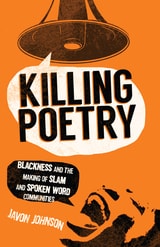
Killing Poetry
Blackness and the Making of Slam and Spoken Word CommunitiesJohnson, Javon
Rutgers University Press, 2017
Co-winner of the 2018 Ethnography Division’s Best Book from the NCA
In recent decades, poetry slams and the spoken word artists who compete in them have sparked a resurgent fascination with the world of poetry. However, there is little critical dialogue that fully engages with the cultural complexities present in slam and spoken word poetry communities, as well as their ramifications.
In Killing Poetry, renowned slam poet, Javon Johnson unpacks some of the complicated issues that comprise performance poetry spaces. He argues that the truly radical potential in slam and spoken word communities lies not just in proving literary worth, speaking back to power, or even in altering power structures, but instead in imagining and working towards altogether different social relationships. His illuminating ethnography provides a critical history of the slam, contextualizes contemporary black poets in larger black literary traditions, and does away with the notion that poetry slams are inherently radically democratic and utopic.
Killing Poetry—at times autobiographical, poetic, and journalistic—analyzes the masculine posturing in the Southern California community in particular, the sexual assault in the national community, and the ways in which related social media inadvertently replicate many of the same white supremacist, patriarchal, and mainstream logics so many spoken word poets seem to be working against. Throughout, Johnson examines the promises and problems within slam and spoken word, while illustrating how community is made and remade in hopes of eventually creating the radical spaces so many of these poets strive to achieve.
Kin
Crystal Williams
Michigan State University Press, 2000
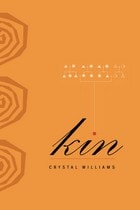
In her first book-length collection of poetry, Crystal Williams utilizes memory and music as she lyrically weaves her way through American culture, pointing to the ways in which alienation, loss, and sensed "otherness" are corollaries of recent phenomena. Williams writes about being adopted by an interracial couple, a jazz pianist/Ford Foundry worker and a school psychologist, and how that has affected her development as an African American woman. She tries to work out the answers to many difficult questions: in what way do African American artists define themselves? What do they owe the culture and what does it owe them? To what extent does our combined national memory inform our individual selves? These poems are steeped in the black literary tradition. They are brimming over with the oral tradition that Williams perfected while spending years on the poetry "slam" circuit. This, combined with her musical upbringing, give the collection not only a sense of urgency, but also a rhythm, a breath all its own. Kin tackles not only racial issues, but also the troubling realities of violent acts that can occur, especially in our inner cities. But more importantly, the landscape that Williams creates offers readers an alternative to the racial/political dichotomy in which we all live. Overall, the book resonates with a message of reconciliation that will leave the reader uplifted.
King Vulture
PoemsK. E. Duffin
University of Arkansas Press, 2005
Konbit
Sony Ton-Aime
Carnegie Mellon University Press, 2026
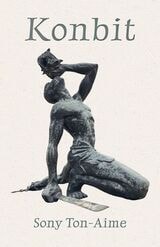
Konbit is a Haitian Creole word, a way of living, for which there is no direct translation in the English language. It captures the communal life in Haiti and is used for every event where neighbors are called upon to help each other. These poems revolve around the Bois-Caïman ceremony (the first konbit) when enslaved people in Saint-Domingue vowed to fight for their independence. The ceremony is both real and a stand-in for climate change. Like our society, everything around enslaved people in Saint-Domingue was created to uphold the status quo. Imagining an alternative would have been seen as futile. Yet, they did. This collection is an attempt to do the same, to imagine a future beyond colonialism, imperialism, and climate catastrophe. With poems influenced by and in conversation with Tyehimba Jess, Natasha Trethewey, Derek Walcott, Shara McCallum, and Adrian Matejka, Sony Ton-Aime aims to provide a new language to articulate our common past, present, and future.
Kontemporary Amerikan Poetry
John Murillo
Four Way Books, 2020
Kujibizana
Questions of Language and Power in Nineteenth- and Twentieth-Century Poetry in KishwahiliAnn Biersteker
Michigan State University Press, 1996
The author argues that reading poetry in Kiswahili provides important insights into questions of language and power, as well as into discussions of socialist practice in East Africa and East African resistance to colonialism and neo-colonialism. Includes the text of numerous poems and footnotes.