Results by title
3064 books match the query 'Social conditions' and 22 start with k
Kaleidoscopic Ethnicity
International Migration and the Reconstruction of Community Identities in IndiaKurien, Prema A
Rutgers University Press, 2002
Co-Winner of the 2003 American Sociological Association's Asia/Asian American book award.
Based on ethnographic research in three communities (Ezhava Hindu, Mappila Muslim, and Syrian Christian) in Kerala, India, which sent large numbers of workers to the Middle East for temporary jobs, Kaleidoscopic Ethnicity explores the factors responsible for the striking differences in the groups’ patterns of migration and migration-induced social change. Most broadly, Prema Kurien seeks to understand what ethnicity is and how it affects people’s activities and decisions. She argues that, in each case, a community-specific nexus of religion, gender, and status shaped migration, and was, in turn, transformed by it.
The religious background of the three groups determined their social location within colonial and postcolonial Kerala. This social location in turn affected their occupational profiles, family structures, and social networks, as well as their conceptions of gender and honor, and thus was fundamental in shaping migration patterns. The rapid enrichment brought about by international migration resulted in a reinterpretation of religious identity and practice which was manifested by changes in patterns of gendered behavior and status in each of the three communities. What makes this book unique is its focus on the sociocultural patterns of short-term international migration and its comparative ethnographic approach.

Karma Of Brown Folk
Vijay Prashad
University of Minnesota Press, 2001
The popular book challenging the idea of a model minority, now in paperback!
“How does it feel to be a problem?” asked W. E. B. Du Bois of black Americans in his classic The Souls of Black Folk. A hundred years later, Vijay Prashad asks South Asians “How does it feel to be a solution?” In this kaleidoscopic critique, Prashad looks into the complexities faced by the members of a “model minority”-one, he claims, that is consistently deployed as "a weapon in the war against black America."
On a vast canvas, The Karma of Brown Folk attacks the two pillars of the “model minority” image, that South Asians are both inherently successful and pliant, and analyzes the ways in which U.S. immigration policy and American Orientalism have perpetuated these stereotypes. Prashad uses irony, humor, razor-sharp criticism, personal reflections, and historical research to challenge the arguments made by Dinesh D’Souza, who heralds South Asian success in the U.S., and to question the quiet accommodation to racism made by many South Asians. A look at Deepak Chopra and others whom Prashad terms “Godmen” shows us how some South Asians exploit the stereotype of inherent spirituality, much to the chagrin of other South Asians. Following the long engagement of American culture with South Asia, Prashad traces India’s effect on thinkers like Cotton Mather and Henry David Thoreau, Ravi Shankar’s influence on John Coltrane, and such essential issues as race versus caste and the connection between antiracism activism and anticolonial resistance.
The Karma of Brown Folk locates the birth of the “model minority” myth, placing it firmly in the context of reaction to the struggle for Black Liberation. Prashad reclaims the long history of black and South Asian solidarity, discussing joint struggles in the U.S., the Caribbean, South Africa, and elsewhere, and exposes how these powerful moments of alliance faded from historical memory and were replaced by Indian support for antiblack racism. Ultimately, Prashad writes not just about South Asians in America but about America itself, in the tradition of Tocqueville, Du Bois, Richard Wright, and others. He explores the place of collective struggle and multiracial alliances in the transformation of self and community-in short, how Americans define themselves.

Karnali Under Stress
Livelihood Strategies and Seasonal Rhythms in a Changing Nepal HimalayaBarry C. Bishop
University of Chicago Press, 1990

Katrina's Imprint
Race and Vulnerability in AmericaWailoo, Keith
Rutgers University Press, 2010

Keeping the Faith
Ordinary People, Extraordinary LivesWayne Flynt
University of Alabama Press, 2011

Khanty, People of the Taiga
Surviving the 20th CenturyAndrew Wiget and Olga Balalaeva
University of Alaska Press, 2011

Kids on the Street
Queer Kinship and Religion in San Francisco's TenderloinJoseph Plaster
Duke University Press, 2023

Killer on the Road
Violence and the American InterstateBy Ginger Strand
University of Texas Press, 2012
Starting in the 1950s, Americans eagerly built the planet’s largest public work: the 42,795-mile National System of Interstate and Defense Highways. Before the concrete was dry on the new roads, however, a specter began haunting them—the highway killer. He went by many names: the “Hitcher,” the “Freeway Killer,” the “Killer on the Road,” the “I-5 Strangler,” and the “Beltway Sniper.” Some of these criminals were imagined, but many were real. The nation’s murder rate shot up as its expressways were built. America became more violent and more mobile at the same time.
Killer on the Road tells the entwined stories of America’s highways and its highway killers. There’s the hot-rodding juvenile delinquent who led the National Guard on a multistate manhunt; the wannabe highway patrolman who murdered hitchhiking coeds; the record promoter who preyed on “ghetto kids” in a city reshaped by freeways; the nondescript married man who stalked the interstates seeking women with car trouble; and the trucker who delivered death with his cargo. Thudding away behind these grisly crime sprees is the story of the interstates—how they were sold, how they were built, how they reshaped the nation, and how we came to equate them with violence.
Through the stories of highway killers, we see how the “killer on the road,” like the train robber, the gangster, and the mobster, entered the cast of American outlaws, and how the freeway—conceived as a road to utopia—came to be feared as a highway to hell.

Kindler of Souls
Rabbi Henry Cohen of TexasBy Rabbi Henry Cohen II
University of Texas Press, 2007
In September 1930, the New York Times published a list of the clergy whom Rabbi Stephen Wise considered "the ten foremost religious leaders in this country." The list included nine Christians and Rabbi Henry Cohen of Galveston, Texas. Little-known today, Henry Cohen was a rabbi to be reckoned with, a man Woodrow Wilson called "the foremost citizen of Texas" who also impressed the likes of William Howard Taft and Clarence Darrow. Cohen's fleeting fame, however, was built not on powerful friendships but on a lifetime of service to needy Jews—as well as gentiles—in London, South Africa, Jamaica, and, for the last sixty-four years of his life, Galveston, Texas.
More than 10,000 Jews, mostly from Eastern Europe, arrived in Galveston in the early twentieth century. Rabbi Cohen greeted many of the new arrivals in Yiddish, then helped them find jobs through a network that extended throughout the Southwest and Midwest United States. The "Galveston Movement," along with Cohen's pioneering work reforming Texas prisons and fighting the Ku Klux Klan, made the rabbi a legend in his time. As this portrait shows, however, he was also a lovable mensch to his grandson. Rabbi Henry Cohen II reminisces about his grandfather's jokes while placing the legendary rabbi in historical context, creating the best picture yet of this important Texan, a man perhaps best summarized by Rabbi Wise in the New York Times as "a soul who touches and kindles souls."

Kinethic California
Dancing Funk and Disco Era KinshipsNaomi Macalalad Bragin
University of Michigan Press, 2024
2025 American Society for Theatre Research Errol Hill Award Winner
- 2026 Dance Studies Association Oscar G. Brockett Award Shortlist Finalist
- 2025 Association for Theatre in Higher Education Outstanding Book Award for Scholarly Achievement Shortlist Finalist
Kinethic California: Dancing Funk and Disco Era Kinships documents the emergence of new forms of black social and vernacular dance invented by youth living in 1970s California, who helped build the foundations of contemporary hip hop/streetdance culture. Naomi Macalalad Bragin weaves interviews and ethnographies of first-generation (1960s-70s) dancers of strutting, boogaloo, robotting, popping, locking, waacking, and punking styles, as it advances a theory of dance as kinetic kinship formation through a focus on techniques and practices of the dancers themselves. She offers that the term given to these collective movement practices is kinethic to bring attention to motion at the core of black aesthetics that generate dances as forms of kinship beyond blood relation. Kinethics reorient dancers toward kinetic kinship in ways that give continuity to black dance lineages under persistent conditions of disappearance and loss. As dancers engage kinethics, they reinvent gestural vocabularies that describe worlds they imagine into knowing-being.
The stories in Kinethic California attend to the aesthetics of everyday movement, seen through the lens of young artists who, from childhood, listened to their family’s soul and funk records, observed the bent-leg strolls and rhythmic handshakes of people moving through their neighborhoods, and watched each other move at house parties, school gyms, and around-the-way social clubs. Their aesthetic sociality and geographic movement provided materials for collective study and creative play. Bragin attends to such multidirectional conversations between dancer, community, and tradition, by which California dance lineages emerge and take flight.
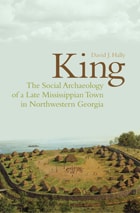
King
The Social Archaeology of a Late Mississippian Town in Northwestern GeorgiaDavid Hally
University of Alabama Press, 2008
At the time of Spanish contact in A.D. 1540, the Mississippian inhabitants of the great valley in northwestern Georgia and adjacent portions of Alabama and Tennessee were organized into a number of chiefdoms distributed along the Coosa and Tennessee rivers and their major tributaries. The administrative centers of these polities were large settlements with one or more platforms mounds and a plaza. Each had a large resident population, but most polity members lived in a half dozen or so towns located within a day’s walk of the center. This book is about one such town, located on the Coosa River in Georgia and known to archaeologists as the King site.
Excavations of two-thirds of the 5.1 acre King site reveal a detailed picture of the town’s domestic and public architecture and overall settlement plan. Intensive analysis of architectural features, especially of domestic structures, enables a better understanding of the variation in structure size, compass orientation, construction stages, and symbolic cosmological associations; the identification of multi-family households; and the position of individual structures within the town’s occupation sequence or life history. Comparison of domestic architecture and burials reveals considerable variation between households in house size, shell bead wealth, and prominence of adult members. One household is preeminent in all these characteristics and may represent the household of the town chief or his matrilineal extended family. Analysis of public architectural features has revealed the existence of a large meeting house with likely historical connections to 18th-century Creek town houses; a probable cosmological basis for the town’s physical layout; and an impressive stockade-and-ditch defensive perimeter.
The King site represents a nearly ideal opportunity to identify the kinds of status positions that were held by individual inhabitants; analyze individual households and investigate the roles they played in King site society; reconstruct the community that existed at King, including size, life history, symbolic associations, and integrative mechanisms; and place King in the larger regional political system. With excavations dating back to 1973, and supported in part by the National Endowment for the Humanities and the National Geographic Society, this is social archaeology at its best.
Kinshasa in Transition
Women's Education, Employment, and FertilityDavid Shapiro and B. Oleko Tambashe
University of Chicago Press, 2003
In this book, David Shapiro and B. Oleko Tambashe trace the impact of these changes on the lives of women, and their findings add dramatically to the field's limited knowledge of African demographic trends. They find that fertility has declined significantly in Kinshasa since the 1970s, and that women's increasing access to secondary education has played a key role in this decline. Better access to education has also given women greater access to employment opportunities. And by examining the impact of such factors as economic well-being and household demographic composition on the schooling of children, Shapiro and Tambashe reveal how one generation's fertility affects the next generation's education.
This book will be a valuable guide for anyone who wants to understand the complex and ongoing social, demographic, economic, and developmental changes in contemporary sub-Saharan Africa.
Kinship to Kingship
Gender Hierarchy and State Formation in the Tongan IslandsBy Christine Ward Gailey
University of Texas Press, 1987
Have women always been subordinated? If not, why and how did women’s subordination develop? Kinship to Kingship was the first book to examine in detail how and why gender relations become skewed when classes and the state emerge in a society.
Using a Marxist-feminist approach, Christine Ward Gailey analyzes women’s status in one society over three hundred years, from a period when kinship relations organized property, work, distribution, consumption, and reproduction to a class-based state society. Although this study focuses on one group of islands, Tonga, in the South Pacific, the author discusses processes that can be seen through the neocolonial world.
This ethnohistorical study argues that evolution from a kin-based society to one organized along class lines necessarily entails the subordination of women. And the opposite is also held to be true: state and class formation cannot be understood without analyzing gender and the status of women. Of interest to students of anthropology, political science, sociology, and women’s studies, this work is a major contribution to social history.

Kitchenspace
Women, Fiestas, and Everyday Life in Central MexicoBy Maria Elisa Christie
University of Texas Press, 2008
Throughout the world, the kitchen is the heart of family and community life. Yet, while everyone has a story to tell about their grandmother's kitchen, the myriad activities that go on in this usually female world are often devalued, and little scholarly attention has been paid to this crucial space in which family, gender, and community relations are forged and maintained. To give the kitchen the prominence and respect it merits, Maria Elisa Christie here offers a pioneering ethnography of kitchenspace in three central Mexican communities, Xochimilco, Ocotepec, and Tetecala.
Christie coined the term "kitchenspace" to encompass both the inside kitchen area in which everyday meals for the family are made and the larger outside cooking area in which elaborate meals for community fiestas are prepared by many women working together. She explores how both kinds of meal preparation create bonds among family and community members. In particular, she shows how women's work in preparing food for fiestas gives women status in their communities and creates social networks of reciprocal obligation. In a culture rigidly stratified by gender, Christie concludes, kitchenspace gives women a source of power and a place in which to transmit the traditions and beliefs of older generations through quasi-sacramental food rites.

Knock at the Door of Opportunity
Black Migration to Chicago, 1900-1919Christopher Robert Reed
Southern Illinois University Press, 2014
Disputing the so-called ghetto studies that depicted the early part of the twentieth century as the nadir of African American society, this thoughtful volume by Christopher Robert Reed investigates black life in turn-of-the-century Chicago, revealing a vibrant community that grew and developed on Chicago’s South Side in the early 1900s. Reed also explores the impact of the fifty thousand black southerners who streamed into the city during the Great Migration of 1916–1918, effectively doubling Chicago’s African American population. Those already residing in Chicago’s black neighborhoods had a lot in common with those who migrated, Reed demonstrates, and the two groups became unified, building a broad community base able to face discrimination and prejudice while contributing to Chicago’s growth and development.
Reed not only explains how Chicago’s African Americans openly competed with white people for jobs, housing and an independent political voice but also examines the structure of the society migrants entered and helped shape. Other topics include South Side housing, black politics and protest, the role of institutionalized religion, the economic aspects of African American life, the push for citizenship rights and political power for African Americans, and the impact of World War I and the race riot of 1919. The first comprehensive exploration of black life in turn-of-the-century Chicago beyond the mold of a ghetto perspective, this revealing work demonstrates how the melding of migrants and residents allowed for the building of a Black Metropolis in the 1920s.
2015 ISHS Superior Achievement Award

Korean Families Yesterday and Today
Hyunjoon Park and Hyeyoung Woo, Editors
University of Michigan Press, 2020
Korean families have changed significantly during the last few decades in their composition, structure, attitudes, and function. Delayed and forgone marriage, fertility decline, and rising divorce rates are just a few examples of changes that Korean families have experienced at a rapid pace, more dramatic than in many other contemporary societies. Moreover, the increase of marriages between Korean men and foreign women has further diversified Korean families. Yet traditional norms and attitudes toward gender and family continue to shape Korean men and women’s family behaviors.
Korean Families Yesterday and Today portrays diverse aspects of the contemporary Korean families and, by explicitly or implicitly situating contemporary families within a comparative historical perspective, reveal how the past of Korean families evolved into their current shapes. While the study of families can be approached in many different angles, our lens focuses on families with children or young adults who are about to forge family through marriage and other means. This focus reflects that delayed marriage and declined fertility are two sweeping demographic trends in Korea, affecting family formation. Moreover, “intensive” parenting has characterized Korean young parents and therefore, examining change and persistence in parenting provides important clues for family change in Korea.
This volume should be of interest not only to readers who are interested in Korea but also to those who want to understand broad family changes in East Asia in comparative perspective.
Kuna Crafts, Gender, and the Global Economy
By Karin E. Tice
University of Texas Press, 1995
Kupilikula
Governance and the Invisible Realm in MozambiqueHarry G. West
University of Chicago Press, 2005
In this historical ethnography of sorcery, Harry G. West draws on a decade of fieldwork and combines the perspectives of anthropology and political science to reveal how Muedans expect responsible authorities to monitor the invisible realm of sorcery and to overturn or, as Muedans call it, "kupilikula" sorcerers' destructive attacks by practicing a constructive form of counter-sorcery themselves. Kupilikula argues that, where neoliberal policies have fostered social division rather than security and prosperity, Muedans have, in fact, used sorcery discourse to assess and sometimes overturn reforms, advancing alternative visions of a world transformed.
Kurdistan on the Global Stage
Kinship, Land, and Community in IraqKing, Diane E
Rutgers University Press, 2014
Anthropologist Diane E. King has written about everyday life in the Kurdistan Region of Iraq, which covers much of the area long known as Iraqi Kurdistan. Following the overthrow of Saddam Hussein’s Ba’thist Iraqi government by the United States and its allies in 2003, Kurdistan became a recognized part of the federal Iraqi system. The Region is now integrated through technology, media, and migration to the rest of the world.
Focusing on household life in Kurdistan’s towns and villages, King explores the ways that residents connect socially, particularly through patron-client relationships and as people belonging to gendered categories. She emphasizes that patrilineages (male ancestral lines) seem well adapted to the Middle Eastern modern stage and viceversa. The idea of patrilineal descent influences the meaning of refuge-seeking and migration as well as how identity and place are understood, how women and men interact, and how “politicking” is conducted.
In the new Kurdistan, old values may be maintained, reformulated, or questioned. King offers a sensitive interpretation of the challenges resulting from the intersection of tradition with modernity. Honor killings still occur when males believe their female relatives have dishonored their families, and female genital cutting endures. Yet, this is a region where modern technology has spread and seemingly everyone has a mobile phone. Households may have a startling combination of illiterate older women and educated young women. New ideas about citizenship coexist with older forms of patronage.
King is one of the very few scholars who conducted research in Iraq under extremely difficult conditions during the Saddam Hussein regime. How she was able to work in the midst of danger and in the wake of genocide is woven throughout the stories she tells. Kurdistan on the Global Stage serves as a lesson in field research as well as a valuable ethnography.

Kuria Cattle Raiders
Violence and Vigilantism on the Tanzania/Kenya FrontierMichael L. Fleisher
University of Michigan Press, 2000
The reciprocal raiding of cattle by pastoralists has a long and venerable history in East Africa, but there has been, until now, no book-length treatment of the practice, and, more importantly, no detailed case study of the newer, "modern" form of cattle raiding described here. In addition, the phenomenon of Kuria cattle raiding conveys significant implications for our understanding of informal economies and globalization processes.
Kuria Cattle Raiders engages issues of theoretical as well as practical significance for anthropologists, sociologists, criminologists, cultural ecologists, economic development agencies, and all those concerned with the pressing issues of globalization and rapid social and cultural change.
Michael L. Fleisher, a Post-Doctoral Research Fellow in the Department of Rangeland Resources, Utah State University, is currently engaged in a study of conflict among pastoralists in southern Ethiopia as part of a research project jointly administered by the University of Kentucky, Utah State University, and Cornell University under a grant from U.S.A.I.D.
Kuxlejal Politics
Indigenous Autonomy, Race, and Decolonizing Research in Zapatista CommunitiesBy Mariana Mora
University of Texas Press, 2017
Over the past two decades, Zapatista indigenous community members have asserted their autonomy and self-determination by using everyday practices as part of their struggle for lekil kuxlejal, a dignified collective life connected to a specific territory. This in-depth ethnography summarizes Mariana Mora’s more than ten years of extended research and solidarity work in Chiapas, with Tseltal and Tojolabal community members helping to design and evaluate her fieldwork. The result of that collaboration—a work of activist anthropology—reveals how Zapatista kuxlejal (or life) politics unsettle key racialized effects of the Mexican neoliberal state.
Through detailed narratives, thick descriptions, and testimonies, Kuxlejal Politics focuses on central spheres of Zapatista indigenous autonomy, particularly governing practices, agrarian reform, women’s collective work, and the implementation of justice, as well as health and education projects. Mora situates the proposals, possibilities, and challenges associated with these decolonializing cultural politics in relation to the racialized restructuring that has characterized the Mexican state over the past twenty years. She demonstrates how, despite official multicultural policies designed to offset the historical exclusion of indigenous people, the Mexican state actually refueled racialized subordination through ostensibly color-blind policies, including neoliberal land reform and poverty alleviation programs. Mora’s findings allow her to critically analyze the deeply complex and often contradictory ways in which the Zapatistas have reconceptualized the political and contested the ordering of Mexican society along lines of gender, race, ethnicity, and class.

Kwaito's Promise
Music and the Aesthetics of Freedom in South AfricaGavin Steingo
University of Chicago Press, 2016
Politicians and cultural critics have long criticized kwaito for failing to provide any meaningful contribution to a society that desperately needs direction. As Steingo shows, however, these criticisms are built on problematic assumptions about the political function of music. Interacting with kwaito artists and fans, he shows that youth aren’t escaping their social condition through kwaito but rather using it to expand their sensory realities and generate new possibilities. Resisting the truism that “music is always political,” Steingo elucidates a music that thrives on its radically ambiguous relationship with politics, power, and the state.