Results by title
1295 books match the query 'Women authors' and 4 start with k
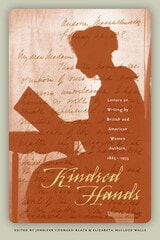
Kindred Hands
Letters on Writing by British and American Women Authors, 1865-1935Jennifer Cognard-Black
University of Iowa Press, 2006
Kindred Hands, a collection of previously unpublished letters by women writers, explores the act and art of writing from diverse perspectives and experiences. The letters illuminate such issues as authorship, aesthetics, collaboration, inspiration, and authorial intent. By focusing on letters that deal with authorship, the editors reveal a multiplicity of perspectives on female authorship that would otherwise require visits to archives and special collections.
Representing some of the most important female writers of the nineteenth and early twentieth centuries, including transatlantic correspondents, women of color, canonical writers, regional writers, and women living in the British empire, Kindred Hands will enliven scholarship on a host of topics, including reception theory, feminist studies, social history, composition theory, modernism, and nineteenth-century studies. Moreover, because it represents previously unpublished primary sources, the collection will initiate new discussions on race, class, sexuality, ethnicity, and gender with an eye to writing at the turn of the twentieth century.
Representing some of the most important female writers of the nineteenth and early twentieth centuries, including transatlantic correspondents, women of color, canonical writers, regional writers, and women living in the British empire, Kindred Hands will enliven scholarship on a host of topics, including reception theory, feminist studies, social history, composition theory, modernism, and nineteenth-century studies. Moreover, because it represents previously unpublished primary sources, the collection will initiate new discussions on race, class, sexuality, ethnicity, and gender with an eye to writing at the turn of the twentieth century.
[more]
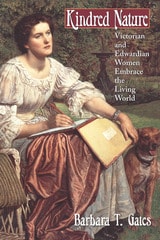
Kindred Nature
Victorian and Edwardian Women Embrace the Living WorldBarbara T. Gates
University of Chicago Press, 1999
In Kindred Nature, Barbara T. Gates highlights the contributions of Victorian and Edwardian women to the study, protection, and writing of nature. Recovering their works from the misrepresentation they often faced at the time of their composition, Gates discusses not just well-known women like Beatrix Potter but also others—scientists, writers, gardeners, and illustrators—who are little known today.
Some of these women discovered previously unknown species, others wrote and illustrated natural histories or animal stories, and still others educated women, the working classes, and children about recent scientific advances. A number of women also played pivotal roles in the defense of animal rights by protesting overhunting, vivisection, and habitat destruction, even as they demanded their own rights to vote, work, and enter universities.
Kindred Nature shows the enormous impact Victorian and Edwardian women had on the natural sciences and the environmental movement, and on our own attitudes toward nature and human nature.
[more]
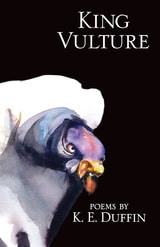
King Vulture
PoemsK. E. Duffin
University of Arkansas Press, 2005
This stunning collection heralds the debut of a most gifted poet, one who turns to the formal traditions of the past to celebrate and elegize our vast and transient world in which human stories—tragedies and triumphs—are invariably bound up with nature. K. E. Duffin’s poems are about transformations, from life to death and from death to life, from the sprawl of experience to the spare music of the poem that can reach the future only through memory. These are poems that court the ear and eye alike. They surprise us with their elegant forms and rich, classical themes; they delight us with their force of language and delicious renderings of the vast complications of things.
[more]
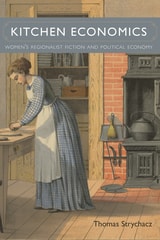
Kitchen Economics
Women’s Regionalist Fiction and Political EconomyThomas Strychacz
University of Alabama Press, 2020
An analysis of how nineteenth-century women regional writers represent political economic thought
WINNER OF THE ELIZABETH AGEE PRIZE IN AMERICAN LITERATURE
Readers of late nineteenth-century female American authors are familiar with plots, characters, and households that make a virtue of economizing. Scholars often interpret these scenarios in terms of a mythos of parsimony, frequently accompanied by a sort of elegiac republicanism whereby self-sufficiency and autonomy are put to the service of the greater good—a counterworld to the actual economic conditions of the period.
In Kitchen Economics: Women’s Regionalist Fiction and Political Economy, Thomas Strychacz takes a new approach to the question of how female regionalist fictions represent “the economic” by situating them within traditions of classical political economic thought. Offering case studies of key works by Sarah Orne Jewett, Mary Wilkins Freeman, Harriet Beecher Stowe, Rose Terry Cooke, and Alice Dunbar-Nelson, this study focuses on three complex cultural fables—the island commonwealth, stadialism (or stage theory), and feeding the body politic—which found formal expression in political economic thought, made their way into endless public debates about the economic turmoil of the late nineteenth century, and informed female authors. These works represent counterparts, not counterworlds, to modernity; and their characteristic stance is captured in the complex trope of feminaeconomica.
This approach ultimately leads us to reconsider what we mean by the term “economic,” for the emphasis of contemporary neoclassical economics on economic agents given over to infinite wants and complete self-interest has caused the “sufficiency” and “common good” models of female regionalist authors to be misinterpreted and misvalued. These fictions are nowhere more pertinent to modernity than in their alliance with today’s important alternative economic discourses.
[more]