Results by title
5448 books match the query 'History and criticism' and 182 start with l

L.A. Private Eyes
Dahlia Schweitzer
Rutgers University Press, 2019
Watch a video of the author speaking about this topic: https://goo.gl/Xr9RFD
And also: https://www.dropbox.com/s/mkqw3mplruf7jje/Detective%20Talk%20Full.mp4?dl=0 (https://www.dropbox.com/s/mkqw3mplruf7jje/Detective%20Talk%20Full.mp4?dl=0)
LITTLE SONGS
WOMEN, SILENCE, AND THE NINETEENTH-CENTURY SONNETAMY CHRISTINE BILLONE
The Ohio State University Press, 2002
LOST CAUSES
Historical Consciousness in Victorian LiteratureJason B. Jones
The Ohio State University Press, 2006
What if we didn’t always historicize when we read Victorian fiction?
Lost Causes shows that Victorian writers frequently appear to have a more supple and interesting understanding of the relationship between history, causality, and narrative than the one typically offered by readers who are burdened by the new historicism. As a return to these writers emphasizes, the press of modern historicism deforms Victorian novels, encouraging us to read deviations from strict historical accuracy as ideological bad faith. By contrast, Jason B. Jones argues through readings of works ranging from The French Revolution to Middlemarch that literature’s engagement with history has to be read otherwise.Perhaps perversely, Lost Causes suggests simultaneously that psychoanalysis speaks pressingly to the vexed relationship between history and narrative, and that the theory is neither a- nor anti-historical. Through his readings of Victorian fiction addressing the recent past, Jones finds in psychoanalysis not a set of truths, but rather a method for rhetorical reading, ultimately revealing how its troubled account of psychic causality can help us follow literary language’s representation of the real. Victorian narratives of the recent past and psychoanalytic interpretation share a fascination with effects that persist despite baffling, inexplicable, or absent causes.
In chapters focusing on Thomas Carlyle, Charles Dickens, Charlotte Brontë, and George Eliot, Lost Causes demonstrates that history can carry an ontological, as well as an epistemological, charge—one that suggests a condition of being in the world as well as a way of knowing the world as it really is. From this point of view, Victorian fiction that addresses the recent past is not a failed realism, as it is so frequently claimed, but rather an exploration of possibility in history.
La Florida del Inca and the Struggle for Social Equality in Colonial Spanish America
Jonathan D. Steigman
University of Alabama Press, 2005
A cross-disciplinary view of an important De Soto chronicle.
Among the early Spanish chroniclers who contributed to popular images of the New World was the Amerindian-Spanish (mestizo) historian and literary writer, El Inca Garcilaso de la Vega (1539-1616). He authored several works, of which La Florida del Inca (1605) stands out as the best because of its unique Amerindian and European perspectives on the De Soto expedition (1539-1543). As the child of an Indian mother and a Spanish father, Garcilaso lived in both worlds--and saw value in each. Hailed throughout Europe for his excellent contemporary Renaissance writing style, his work was characterized as literary art. Garcilaso revealed the emotions, struggles, and conflicts experienced by those who participated in the historic and grandiose adventure in La Florida. Although criticized for some lapses in accuracy in his attempts to paint both the Spaniards and the Amerindians as noble participants in a world-changing event, his work remains the most accessible of all the chronicles.
In this volume, Jonathan Steigman explores El Inca’s rationale and motivations in writing his chronicle. He suggests that El Inca was trying to influence events by influencing discourse; that he sought to create a discourse of tolerance and agrarianism, rather than the dominant European discourse of intolerance, persecution, and lust for wealth. Although El Inca's purposes went well beyond detailing the facts of De Soto’s entrada, his skill as a writer and his dual understanding of the backgrounds of the participants enabled him to paint a more complete picture than most--putting a sympathetic human face on explorers and natives alike.
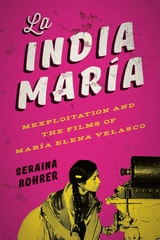
La India María
Mexploitation and the Films of María Elena VelascoBy Seraina Rohrer
University of Texas Press, 2017
La India María—a humble and stubborn indigenous Mexican woman—is one of the most popular characters of the Mexican stage, television, and film. Created and portrayed by María Elena Velasco, La India María has delighted audiences since the late 1960s with slapstick humor that slyly critiques discrimination and the powerful. At the same time, however, many critics have derided the iconic figure as a racist depiction of a negative stereotype and dismissed the India María films as exploitation cinema unworthy of serious attention. By contrast, La India María builds a convincing case for María Elena Velasco as an artist whose work as a director and producer—rare for women in Mexican cinema—has been widely and unjustly overlooked.
Drawing on extensive interviews with Velasco, her family, and film industry professionals, as well as on archival research, Seraina Rohrer offers the first full account of Velasco’s life; her portrayal of La India María in vaudeville, television, and sixteen feature film comedies, including Ni de aquí, ni de allá [Neither here, nor there]; and her controversial reception in Mexico and the United States. Rohrer traces the films’ financing, production, and distribution, as well as censorship practices of the period, and compares them to other Mexploitation films produced at the same time. Adding a new chapter to the history of a much-understudied period of Mexican cinema commonly referred to as “la crisis,” this pioneering research enriches our appreciation of Mexploitation films.
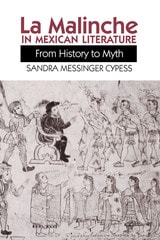
La Malinche in Mexican Literature
From History to MythBy Sandra Messinger Cypess
University of Texas Press, 1991
Of all the historical characters known from the time of the Spanish conquest of the New World, none has proved more pervasive or controversial than that of the Indian interpreter, guide, mistress, and confidante of Hernán Cortés, Doña Marina—La Malinche—Malintzin. The mother of Cortés's son, she becomes not only the mother of the mestizo but also the Mexican Eve, the symbol of national betrayal.
Very little documented evidence is available about Doña Marina. This is the first serious study tracing La Malinche in texts from the conquest period to the present day. It is also the first study to delineate the transformation of this historical figure into a literary sign with multiple manifestations.
Cypess includes such seldom analyzed texts as Ireneo Paz's Amor y suplicio and Doña Marina, as well as new readings of well-known texts like Octavio Paz's El laberinto de la soledad. Using a feminist perspective, she convincingly demonstrates how the literary depiction and presentation of La Malinche is tied to the political agenda of the moment. She also shows how the symbol of La Malinche has changed over time through the impact of sociopolitical events on the literary expression.
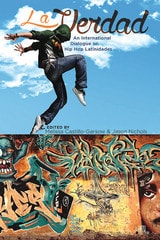
La Verdad
An International Dialogue on Hip Hop LatinidadesEdited by Melissa Castillo-Garsow and Jason Nichols
The Ohio State University Press, 2016
A truly international effort, La Verdad: An International Dialogue on Hip Hop Latinidades brings together exciting new work about Latino/a hip hop across more than a dozen countries, from scholars and practitioners in the United States and in Latin America, highlighting in new ways the participation of women, indigenous peoples, and Afro-descendants in a reimagined global, hip hop nation. From graffitera crews in Costa Rica and Nicaragua to Mexican hip hop in New York, from Aymara rap in Bolivia to Chicano rap in Taiwan, this volume explodes stereotypes of who and how hip hop is consumed, lived, and performed. Examining hip hop movements in Spanish, English, Portuguese, Aymara, and Creole, La Verdad demonstrates that Latino hip hop is a multilingual expression of gender, indigeneity, activism, and social justice.
Labor's Text
The Worker in American FictionHapke, Laura
Rutgers University Press, 2000

Labors of Fear
The Modern Horror Film Goes to WorkEdited by Aviva Briefel and Jason Middleton
University of Texas Press, 2023
2024 Best Edited Collection, Midwest Popular Culture Association / Midwest American Culture Association (MPCA/ACA)
How work and capitalism inspire horror in modern film.
American ideals position work as a source of pride, opportunity, and meaning. Yet the ravages of labor are constant grist for horror films. Going back decades to the mad scientists of classic cinema, the menial motel job that prepares Norman Bates for his crimes in Psycho, and the unemployed slaughterhouse workers of The Texas Chain Saw Massacre, horror movies have made the case that work is not so much a point of pride as a source of monstrosity.
Editors Aviva Briefel and Jason Middleton assemble the first study of horror’s critique of labor. In the 1970s and 1980s, films such as The Shining and Dawn of the Dead responded to deindustrialization, automation, globalization, and rising numbers of women in the workforce. Labors of Fear explores these critical issues and extends them in discussions of recent works such as The Autopsy of Jane Doe, Midsommar, Survival of the Dead, It Follows, Get Out, and Us. Covering films ranging from the 1970s onward, these essays address novel and newly recognized modes and conditions of labor: reproductive labor, emotion work and emotional labor, social media and self-branding, intellectual labor, service work, precarity, and underemployment. In its singular way, horror continues to make spine-tingling sense of what is most destructive in the wider sociopolitical context of US capitalism.
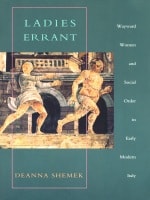
Ladies Errant
Wayward Women and Social Order in Early Modern ItalyDeanna Shemek
Duke University Press, 1998
Seeing errancy as an act of resistance rather than of error, Shemek carries her study beyond the didactic and prescriptive literature on femininity in early modern Italy to an arena in which theories about femininity are considered jointly with real and fictional instances of women’s waywardness. As prostitutes, warriors, lovers, and poets, the women of Shemek’s study are found in canonical texts, marginal works, and popular artistic activity, appearing, for instance, in literature, paintings, legal proceedings, and accounts of public festivals. By juxtaposing these varied places of errancy—from Ariosto’s chivalric Orlando furioso to the prostitutes’ race in the Palio di San Giorgio—Shemek points to the important contact between elite and popular cultures in early modernity, revealing the strength and flexibility of a gender boundary fundamental to early modern conceptions of social order.
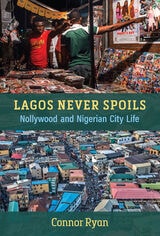
Lagos Never Spoils
Nollywood and Nigerian City LifeConnor Ryan
University of Michigan Press, 2023
Winner of the Society for Cinema and Media Studies, Media Industries Scholarly Interest Group Outstanding Book Award
The slogan “Lagos shall not spoil,” found in print media, political campaigns, and common conversation, represents a shared expression of the optimism the city embodies. However, on city streets the phrase also appears scrawled in irreverent variations—“Lagos cannot spoil more than this!”—that meet the frustrations of city life with irony. In both cases, the slogan captures the resilience and persistence with which residents of Lagos live on, despite it all. This book examines the circumstances that make it possible for residents to persist in pursuing their various projects and for the city to remain a platform that supports these projects and creates space for even more to emerge. Author Connor Ryan argues that residents continually work to combine contingency and endurance in opportunistic ways that make the city work for them, and as such, Lagos never spoils: it endures.
What makes Lagos remarkable is what residents have made of it, and Nollywood—the industry and the body of films—both embodies and represents this continual urban transformation. Lagos Never Spoils traces how Nollywood arose from the social milieu of Lagos and, in turn, generates a repertoire of stories, images, styles, and sentiments with which audiences come to grips with city life. The book traces the evolution of the screen media industry in Lagos and explores how this corresponds with historical phases in the city’s representation onscreen. It discusses important urban spaces of production and consumption, including historic movie halls, video marketplaces, film sets, and multiplex cinemas. Across six chapters, it attends to celluloid films about oil-boom wealth, television sitcoms about urban tricksters, video melodramas about urban crisis, glossy romantic comedies about young professionals, and dark thrillers on streaming platforms about the pleasure of moral transgression. In this fashion, the book offers new approaches to the interpretation of screen texts produced in and about Lagos, a place that is today the most influential image of West African city life.
Lake Methodism
Jasper Cragwall
The Ohio State University Press, 2013
Land/Scape/Theater
Elinor Fuchs and Una Chaudhuri, Editors
University of Michigan Press, 2002
Embracing subjects as diverse as the "landscape dramaturgy" of Suzan-Lori Parks, Artaud's trip to the Sierra Madre,Gertrude Stein's landscape theory and practice, Guillermo Gomez-Peña's "border subjects," and Bayreuth and Disneyland as cultic sites, Land/Scape/Theater draws on a broad range of theory, dramatic texts, and performance. All aspects of modern theater, these essays suggest, including the bedrock Aristotelian constituents of plot and character, have a landscape dimension that often goes unrecognized.
With its broad theoretical range and cross-disciplinary reach, Land/Scape/Theater will interest theater theorists and practitioners and cultural studies specialists, including historians of landscape. Theater students, scholars, teachers, directors, designers, and actors will find here a new framework and a new vocabulary for understanding both theater and the larger culture.
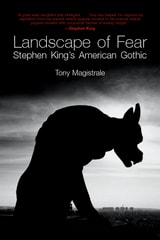
Landscape of Fear
Stephen King's American GothicTony Magistrale
University of Wisconsin Press, 1988
One of the very first books to take Stephen King seriously, Landscape of Fear (originally published in 1988) reveals the source of King's horror in the sociopolitical anxieties of the post-Vietnam, post-Watergate era. In this groundbreaking study, Tony Magistrale shows how King's fiction transcends the escapism typical of its genre to tap into our deepest cultural fears: "that the government we have installed through the democratic process is not only corrupt but actively pursuing our destruction, that our technologies have progressed to the point at which the individual has now become expendable, and that our fundamental social institutions-school, marriage, workplace, and the church-have, beneath their veneers of respectability, evolved into perverse manifestations of narcissism, greed, and violence."
Tracing King's moralist vision to the likes of Twain, Hawthorne, and Melville, Landscape of Fear establishes the place of this popular writer within the grand tradition of American literature. Like his literary forbears, King gives us characters that have the capacity to make ethical choices in an imperfect, often evil world. Yet he inscribes that conflict within unmistakably modern settings. From the industrial nightmare of "Graveyard Shift" to the breakdown of the domestic sphere in The Shining, from the techno-horrors of The Stand to the religious fanaticism and adolescent cruelty depicted in Carrie, Magistrale charts the contours of King's fictional landscape in its first decade.
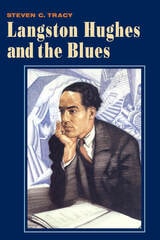
Langston Hughes and the Blues
Steven C. Tracy
University of Illinois Press, 2024

Language, Sign and Gender in Beowulf
Gillian R. Overing
Southern Illinois University Press, 1990
Not a book about what Beowulf means but how it means, and how the reader participates in the process of meaning construction.
Overing’s primary aim is to address the poem on its own terms, to trace and develop an interpretive strategy consonant with the extent of its difference. Beowulf’s arcane structure describes cyclical repetitions and patterned intersections of themes which baffle a linear perspective, and suggest instead the irresolution and dynamism of the deconstructionist free play of textual elements.
Chapter 1 posits the self/reader as a function of the text/language, examining the ways in which the text "speaks" the reader. Chapter 2 develops an interactive semiotic strategy in an attempt to describe an isomorphic relation between poem and reader, between text and self. Chapter 3 addresses the notions of text and self as more complex functions or formulations of desire, and thus complicates and expands the arguments of the two preceding chapters. The final chapter examines the issue of desire in the poem, and, to a lesser extent, desire in the reader (insofar as these may legitimately be viewed as distinct from each other).
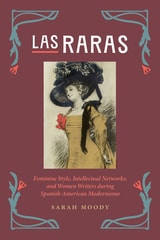
Las Raras
Feminine Style, Intellectual Networks, and Women Writers during Spanish-American ModernismoSarah Moody
Vanderbilt University Press, 2024
Premio al Mejor Libro en Humanidades, Latin American Studies Association–Nineteenth-Century Section, 2025
Premio Victoria Urbano de Monografía Crítica, Association of Gender and Sexuality Studies, 2025 (co-winner)
Segundo Premio, Adela Zamudio Prize, Feministas Unidas, 2025
Las Raras proposes that the Modernistas’ advocacy for a writing style they considered feminine helps us to understand why so few (and perhaps no) women were accepted as active participants in Modernismo. Author Sarah Moody studies how particular writers contributed to the idea of a feminine aesthetic and tracks the intellectual networks of Modernismo through periodicals and personal papers, such as albums and correspondence. Buenos Aires, Paris, and Montevideo figure prominently in this transatlantic study, which reexamines some of the most important period writers in Spanish, including Rubén Darío, Amado Nervo, and Enrique Gómez Carrillo.
This book also considers the critiques launched by women writers, such as Aurora Cáceres, Clorinda Matto de Turner, and María Eugenia Vaz Ferreira, who experienced Modernista exclusion firsthand, deconstructed the Modernista discourse of a modern, “feminine” style, and built literary success in alternative terms. These writers reoriented the discussion about women in modernity to address women’s education, professionalization, and advocacy for social and civic improvements. In this study, Modernismo emerges as both a literary style and an intellectual network, in which style and sociability are mutually determining and combine to form a system of prestige and validation that excluded women writers.
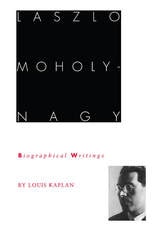
Laszlo Moholy-Nagy
Biographical WritingsLouis Kaplan
Duke University Press, 1995
In Laszlo Moholy-Nagy, Louis Kaplan applies the Derridean deconstructivist model of the "signature effect" to an intellectual biography of a Constructivist artist. Inhabiting the borderline between life and work, the book demonstrates how the signature inscribed by "Moholy" operates in a double space, interweaving signified object and signifying matter, autobiography and auto-graphy. Through interpretative readings of over twenty key artistic and photographic works, Kaplan graphically illustrates Moholy’s signature effect in action. He shows how this effect plays itself out in the complex of relations between artistic originality and plagiarism, between authorial identity and anonymity, as well as in the problematic status of the work of art in the age of technical reproduction. In this way, the book reveals how Moholy’s artistic practice anticipates many of the issues of postmodernist debate and thus has particular relevance today. Consequently, Kaplan clarifies the relationship between avant-garde Constructivism and contemporary deconstruction.
This new and innovative configuration of biography catalyzed by the life writing of Moholy-Nagy will be of critical interest to artists and writers, literary theorists, and art historians.
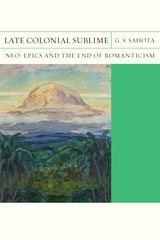
Late Colonial Sublime
Neo-Epics and the End of RomanticismG. S. Sahota
Northwestern University Press, 2018
By bringing together distinct literary canons—both metropolitan and colonial, hegemonic and subaltern, Western and Eastern, all of which took shape upon the common realities of imperial capitalism—Late Colonial Sublime takes an original dialectical approach. It experiments with fragments, parallaxes, and constellational form to explore the aporias of modernity as well as the possible futures they may signal in our midst. A bold intervention into contemporary debates that synthesizes a wealth of sources, this book will interest readers and scholars in world literature, critical theory, postcolonial criticism, and South Asian studies.
Late Star Trek
The Final Frontier in the Franchise EraAdam Kotsko
University of Minnesota Press, 2025
How Star Trek’s twenty-first-century reinventions illuminate the unique challenges and opportunities of franchise-style corporate storytelling
Late Star Trek explores the beloved science fiction franchise’s repeated attempts to reinvent itself after the end of its 1990s golden age. Beginning with the prequel series Enterprise, Adam Kotsko analyzes the wealth of content set within Star Trek’s sprawling continuity—including authorized books, the three “Kelvin Timeline” films, and the streaming series Discovery, Picard, Lower Decks, Prodigy, and Strange New Worlds—along with fan discourse, to reflect on the perils and promise of the franchise as a unique form of storytelling.
Significantly including the licensed novels and comic books that fill out the Star Trek universe for its fans, Kotsko brings the multiple productions of the early twenty-first century together as a unified whole rather than analyzing them in their current stratified view. He argues that the variety of styles and approaches in this tumultuous era of Star Trek history provides the perfect opportunity to reflect on the nature of the franchise storyworlds that now dominate popular culture. By taking the spin-offs and tie-ins seriously as creative attempts to tell a new story within an established universe, Late Star Trek highlights creative triumphs as well as the tendency for franchise faithfulness to get in the way of creating engaging characters and ideas.
Arguing forcefully against the prevailing consensus that franchises are a sign of cultural decay, Kotsko contends that the Star Trek universe exemplifies an approach to storytelling that has been perennial across cultures. Instead, he finds that what limits creativity within franchises is not their reliance on the familiar but their status as modern myths, held not as common cultural heritage but rather owned as corporate intellectual property.
Retail e-book files for this title are screen-reader friendly with images accompanied by short alt text and/or extended descriptions.
Latent Destinies
Cultural Paranoia and Contemporary U.S. NarrativePatrick O Donnell
Duke University Press, 2000
O’Donnell argues that paranoia on the broadly cultural level is essentially a narrative process in which history and postmodern identity are negotiated simultaneously. The result is an erasure of historical temporality—the past and future become the all-consuming, self-aware present. To explain and exemplify this, O’Donnell looks at such books and films as Libra, JFK, The Crying of Lot 49, The Truman Show, Reservoir Dogs, Empire of the Senseless, Oswald’s Tale, The Executioner’s Song, Underworld, The Killer Inside Me, and Groundhog Day. Organized around the topics of nationalism, gender, criminality, and construction of history, Latent Destinies establishes cultural paranoia as consonant with our contradictory need for multiplicity and certainty, for openness and secrecy, and for mobility and historical stability.
Demonstrating how imaginative works of novels and films can be used to understand the postmodern historical condition, this book will interest students and scholars of American literature and cultural studies, postmodern theory, and film studies.
Latin America's New Historical Novel
By Seymour Menton
University of Texas Press, 1993
Beginning with the 1979 publication of Alejo Carpentier's El arpa y la sombra, the New Historical Novel has become the dominant genre within Latin American fiction. In this at-times tongue-in-cheek postmodern study, Seymour Menton explores why the New Historical Novel has achieved such popularity and offers discerning readings of numerous works.
Menton argues persuasively that the proximity of the Columbus Quincentennial triggered the rise of the New Historical Novel. After defining the historical novel in general, he identifies the distinguishing features of the New Historical Novel.
Individual chapters delve deeply into such major works as Mario Vargas Llosa's La guerra del fin del mundo, Abel Posse's Los perros del paraíso, Gabriel García Márquez's El general en su laberinto, and Carlos Fuentes' La campaña. A chapter on the Jewish Latin American novel focuses on several works that deserve greater recognition, such as Pedro Orgambide's Aventuras de Edmund Ziller en tierras del Nuevo Mundo, Moacyr Scliar's A estranha nação de Rafael Mendes, and Angelina Muñiz's Tierra adentro.
Latin American Comics in the Twenty-First Century
Transgressing the FrameJames Scorer
University of Texas Press, 2024
2025 Katherine Singer Kovacs Prize, Modern Language Association
2025 Comics Studies Society Charles Hatfield Book Prize, Honorable Mention
How twenty-first-century Latin American comics transgress social, political, and cultural frontiers.
Given comics’ ability to cross borders, Latin American creators have used the form to transgress the political, social, spatial, and cultural borders that shape the region. A groundbreaking and comprehensive study of twenty-first-century Latin American comics, Latin American Comics in the Twenty-First Century documents how these works move beyond national boundaries and explores new aspects of the form, its subjects, and its creators.
Latin American comics production is arguably more interconnected and more networked across national borders than ever before. Analyzing works from Argentina, Chile, Colombia, Mexico, Peru, and Uruguay, James Scorer organizes his study around forms of “transgression,” such as transnationalism, border crossings, transfeminisms, punk bodies, and encounters in the neoliberal city. Scorer examines the feminist comics collective Chicks on Comics; the DIY comics zine world; nonfiction and journalistic comics; contagion and zombie narratives; and more. Drawing from archives across the United States, Europe, and Latin America, Latin American Comics in the Twenty-First Century posits that these comics produce micronarratives of everyday life that speak to sites of social struggle shared across nation states.
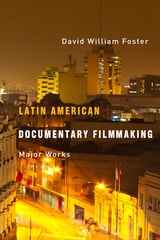
Latin American Documentary Filmmaking
Major WorksDavid William Foster
University of Arizona Press, 2013
Foster provides a series of detailed examinations of major texts of Latin American filmmaking, discussing their textual production and processes of meaning. His analysis delves deeply into the world of Latin American film and brings forth a discourse of structure that has previously been absent from the fields of filmmaking and Latin American studies. This volume provides perspective on diverse and methodological approaches, pulling from a wide scope of cinematic traditions. Using his own critical readings and research, Foster presents his findings in terms that are accessible to non-Spanish speakers and Latin American film enthusiasts.
A much-needed contribution to the field of Latin American documentary film, Foster’s research and perspective will be a valuable source for those interested in film studies, gender studies, and culture.
Latin American Identity and Constructions of Difference
Amaryll Chanady
University of Minnesota Press, 1993
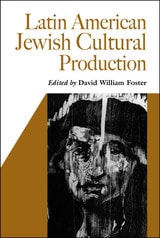
Latin American Jewish Cultural Production
David William Foster
Vanderbilt University Press, 2008
Latin American Literature at the Millennium
Local Lives, Global SpacesCecily Raynor
Bucknell University Press, 2021
Latin American Novels of the Conquest
Reinventing the New WorldKimberle S. López
University of Missouri Press, 2002
Latin American Textualities
History, Materiality, and Digital MediaEdited by Heather J. Allen and Andrew R. Reynolds
University of Arizona Press, 2018
Latin American Textualities is a wide-ranging, interdisciplinary look at textual history, textual artifacts, and digital textualities across Latin America from the colonial era to the present. Editors Heather J. Allen and Andrew R. Reynolds gather a wide range of scholars to investigate the region’s textual scholarship. Contributors offer engaging examples of not just artifacts but also the contexts in which the texts are used. Topics include Guamán Poma’s library, the effect of sound recordings on writing in Argentina, Sudamericana Publishing House’s contribution to the Latin American literary boom, and Argentine science fiction. Latin American Textualities provides new paths to reading Latin American history, culture, and literatures.
Contributors:
Heather J. Allen
Catalina Andrango-Walker
Sam Carter
Sara Castro-Klarén
Edward King
Rebecca Kosick
Silvia Kurlat Ares
Walther Maradiegue
Clayton McCarl
José Enrique Navarro
Andrew R. Reynolds
George Antony Thomas
Zac Zimmer
Latin Americanism
Roman De La Campa
University of Minnesota Press, 1999
Analyzes the way North American academics have constructed Latin America.
In this timely book, Román de la Campa asks to what degree the Latin America studied in U.S. academies is actually an entity “made in the U.S.A.” He argues that there is an ever-increasing gap between the political, theoretical, and financial pressures affecting the U.S. academy and Latin America’s own cultural, political, and literary practices, and considers what this new Latin Americanism has to say about the claims of poststructuralism, postmodern theory, and deconstruction.
De la Campa focuses on the conduct of Latin American literary criticism in U.S. universities and compares this with the “Latin Americanism” of Latin America itself. He examines the translation of Latin American works into English, the careerism of U.S. intellectuals, the conduct of Latin American literary criticism in English, and the diaspora of Third World intellectuals. In a reconsideration of the vogue in Latin American literature and magical realism in light of new work by theorists residing in Latin America, he contrasts this work with critiques of Latin American discourses in the United States.A critique of postmodern and postcolonial constructions as articulated differently in the United States and Latin America, this hard-hitting but fair-minded book provides a postdeconstructive perspective on culture and literature. ISBN 0-8166-3116-6 Cloth £00.00 $47.95xxISBN 0-8166-3117-4 Paper £00.00 $18.95x224 Pages 5 7/8 x 9 JuneCultural Studies of the Americas Series, volume 3Translation inquiries: University of Minnesota Press
LatinAsian Cartographies
History, Writing, and the National ImaginaryThananopavarn, Susan
Rutgers University Press, 2018
Thananopavarn creates a new “LatinAsian” view of the United States that emphasizes previously suppressed aspects of national history, including imperialism, domestic racism during World War II, Cold War operations in Latin America and Asia, and the politics of borders in an age of globalization. LatinAsian Cartographies ultimately reimagines national narratives in a way that transforms dominant ideas of what it means to be American.
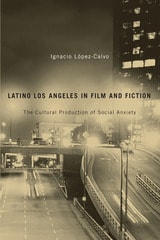
Latino Los Angeles in Film and Fiction
The Cultural Production of Social AnxietyIgnacio López-Calvo
University of Arizona Press, 2014
Latino Los Angeles in Film and Fiction sets out to reconfigure the scope of Latino literary and cultural studies. Integrating histories of different regions and nations, the book sets the interplay of unresolved contradictions in this particular metropolitan area. The novelists studied here stem from multiple areas, including the U.S. Southwest, Guatemala, and Chile. The study also incorporates non-Latino writers who have contributed to the Latino culture of the city.
The first chapter examines Latino cultural production from an ecocritical perspective on urban interethnic relations. Chapter 2 concentrates on the representation of daily life in the barrio and the marginalization of Latino urban youth. The third chapter explores the space of women and how female characters expand their area of operations from the domestic space to the public space of both the barrio and the city.
A much-needed contribution to the fields of urban theory, race critical theory, Chicana/o–Latina/o studies, and Los Angeles writing and film, López-Calvo offers multiple theoretical perspectives—including urban theory, ecocriticism, ethnic studies, gender studies, and cultural studies— contextualized with notions of transnationalism and post-nationalism.
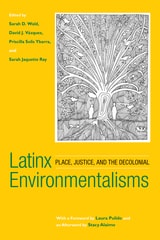
Latinx Environmentalisms
Place, Justice, and the DecolonialSarah D. Wald
Temple University Press, 2019
The whiteness of mainstream environmentalism often fails to account for the richness and variety of Latinx environmental thought. Building on insights of environmental justice scholarship as well as critical race and ethnic studies, the editors and contributors to Latinx Environmentalisms map the ways Latinx cultural texts integrate environmental concerns with questions of social and political justice.
Original interviews with creative writers, including Cherríe Moraga, Helena María Viramontes, and Héctor Tobar, as well as new essays by noted scholars of Latinx literature and culture, show how Latinx authors and cultural producers express environmental concerns in their work. These chapters, which focus on film, visual art, and literature—and engage in fields such as disability studies, animal studies, and queer studies—emphasize the role of racial capitalism in shaping human relationships to the more-than-human world and reveal a vibrant tradition of Latinx decolonial environmentalism.
Latinx Environmentalisms accounts for the ways Latinx cultures are environmental, but often do not assume the mantle of “environmentalism.”
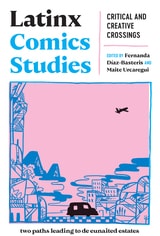
Latinx Comics Studies
Critical and Creative CrossingsFernanda Díaz-Basteris
Rutgers University Press, 2025
This collection moves beyond simply cataloguing and celebrating Latinx representation within comics. It examines how comics by, for, and about Latinx peoples creatively and conceptually experiment with the very boundaries of “Latinx” and portray the diverse lived experiences therein.
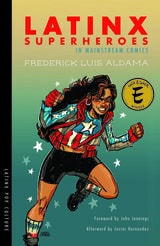
Latinx Superheroes in Mainstream Comics
Frederick Luis Aldama; Foreword by John Jennings; Afterword by Javier Hernandez
University of Arizona Press, 2017
Whether good or evil, beautiful or ugly, smart or downright silly, able-bodied or differently abled, gay or straight, male or female, young or old, Latinx superheroes in mainstream comic book stories are few and far between. It is as if finding the Latinx presence in the DC and Marvel worlds requires activation of superheroic powers.
Latinx Superheroes in Mainstream Comics blasts open barriers with a swift kick. It explores deeply and systematically the storyworld spaces inhabited by brown superheroes in mainstream comic book storyworlds: print comic books, animation, TV, and film. It makes visible and lets loose the otherwise occluded and shackled. Leaving nothing to chance, it sheds light on how creators (authors, artists, animators, and directors) make storyworlds that feature Latinos/as, distinguishing between those that we can and should evaluate as well done and those we can and should evaluate as not well done.
The foremost expert on Latinx comics, Frederick Luis Aldama guides us through the full archive of all the Latinx superheros in comics since the 1940s. Aldama takes us where the superheroes live—the barrios, the hospitals, the school rooms, the farm fields—and he not only shows us a view to the Latinx content, sometimes deeply embedded, but also provokes critical inquiry into the way storytelling formats distill and reconstruct real Latinos/as.
Thoroughly entertaining but seriously undertaken, Latinx Superheroes in Mainstream Comics allows us to truly see how superhero comic book storyworlds are willfully created in ways that make new our perception, thoughts, and feelings.
Latinx TV in the Twenty-First Century
Edited by Frederick Luis Aldama
University of Arizona Press, 2022
In this volume, editor Frederick Luis Aldama brings together leading experts who show how Latinx TV is shaped by historical, social, cultural, regional, and global contexts. Contributors address head on harmful stereotypes in Latinx representation while giving key insights to a positive path forward. TV narratives by and about Latinx people exist across all genres. In this century, we see Latinx people in sitcoms, sci-fi, noir, soap operas, rom-coms, food shows, dramas, action-adventure, and more. Latinx people appear in television across all formats, from quick webisodes, to serialized big-arc narratives, to animation and everything in between. The diverse array of contributors to this volume delve into this rich landscape of Latinx TV from 2000 to today, spanning the ever-widening range of genres and platforms.
Latinx TV in the Twenty-First Century argues that Latinx TV is not just television—it’s an entire movement. Digital spaces and streaming platforms today have allowed for Latinx representation on TV that speaks to Latinx people and non-Latinx people alike, bringing rich and varied Latinx cultures into mainstream television and addressing urbanization, immigration, family life, language, politics, gender, sexuality, class, race, and ethnicity.
Once heavily underrepresented and harmfully stereotypical, Latinx representation on TV is beginning to give careful nuance to regional, communal, and familial experiences among U.S. Latinx people. This volume unpacks the negative implications of older representation and celebrates the progress of new representation, recognizing that television has come a long way, but there is still a lot of important work to do for truly diverse and inclusive representation.
Latter-day Eloquence
Two Centuries of Mormon OratoryEdited by Richard Benjamin Crosby and Isaac James Richards
University of Illinois Press, 2026
Essential and one-of-a-kind, Latter-day Eloquence provides a foundational reference for the study of Latter-day Saint rhetoric and oratory.
Laughing Atoms, Laughing Matter
Lucretius' De Rerum Natura and SatireT. H. M. Gellar-Goad
University of Michigan Press, 2020
Gellar-Goad aims to track De Rerum Natura along two paths of satire: first, the broad boulevard of satiric literature from the beginnings of Greek poetry to the plays, essays, and broadcast media of the modern world; and second, the narrower lane of Roman verse satire, satura, beginning with early authors Ennius and Lucilius and closing with Flavian poet Juvenal. Lucilius is revealed as a major, yet overlooked, influence on Lucretius.
By examining how Lucretius’ poem employs the tools of satire, we gain a richer understanding of how it interacts with its purported philosophical program.

Laughing Matters
Comic Tradition in IndiaLee Siegel
University of Chicago Press, 1987
This question, so solemnly posed by the young Buddha, first led Lee Siegel to examine the hitherto unexplored realm of Indian comedy. Laughing Matters is Siegel's account of two intersecting journeys: a search for comic traditions created and preserved in Sanskrit literature and a journey through modern India in quest of a laughter that persists across time and culture.
Hearing a boisterous and bawdy voice from India's past, Siegel has provided original and highly entertaining translations of Sanskrit literature that reveal a sparkling sensibility embedded in the texts. These translations are integrated with a detailed analysis of the types and structures of India's mirth. Siegel develops an original theory of comedy and laughter, applying it to reveal the humor in the ancient works. Defining sacred and profane comedy and the "taste" and "erotics" of laughter, he delineates two main Indian categories of comedy—laughter at others and laughter at oneself—which are roughly parallel to the Western traditions of satire and humor. He examines these categories in all of their forms and functions: satires of manners, social satire, and religious satire; and human and divine comedy. Siegel concludes by presenting his perceptions of humor in modern India as seen through cartoons, movies, books, and social gatherings.
Laughing Matters is both a serious and a hilarious study of the Indian comic sense of life—a vision formed in the convergence of the bitter insight of satire and the sweet outlook of humor. Past and present, the contextual and the universal, scholarship and the picaresque, are all interwoven in this original treatise on the aesthetics of comedy and the psychology of laughter.

Laughing to Keep from Dying
African American Satire in the Twenty-First CenturyDanielle Fuentes Morgan
University of Illinois Press, 2020
Adventurous and perceptive, Laughing to Keep from Dying reveals how African American satirists unmask the illusions and anxieties surrounding race in the twenty-first century.
Laura Battiferra and Her Literary Circle
An Anthology: A Bilingual EditionLaura Battiferra degli Ammannati
University of Chicago Press, 2006
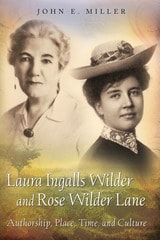
Laura Ingalls Wilder and Rose Wilder Lane
Authorship, Place, Time, and CultureJohn E. Miller
University of Missouri Press, 2008
Interpreting these writers in their larger historical and cultural contexts, Miller reconsiders their formidable artistic, political, and literary contributions to American cultural life in the 1930s. He looks at what was happening in 1932—from depression conditions and politics to chain stores and celebrity culture—to shed light on Wilder’s life, and he shows how actual “little houses” established ideas of home that resonated emotionally for both writers.
In considering each woman’s ties to history, Miller compares Wilder with Frederick Jackson Turner as a frontier mythmaker and examines Lane’s unpublished history of Missouri in the context of a contemporaneous project, Thomas Hart Benton’s famous Jefferson City mural. He also looks at Wilder’s Missouri Ruralist columns to assess her pre–Little House values and writing skills, and he readdresses her literary treatment of Native Americans. A final chapter shows how Wilder’s and Lane’s conservative political views found expression in their work, separating Lane’s more libertarian bent from Wilder’s focus on writing moralist children’s fiction.
These nine thoughtful essays expand the critical discussion on Wilder and Lane beyond the Little House. Miller portrays them as impassioned and dedicated writers who were deeply involved in the historical changes and political challenges of their times—and contends that questions over the books’ authorship do not do justice to either woman’s creative investment in the series. Miller demystifies the aura of nostalgia that often prevents modern readers from seeing Wilder as a real-life woman, and he depicts Lane as a kindred artistic spirit, helping readers better understand mother and daughter as both women and authors.
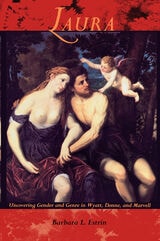
Laura
Uncovering Gender and Genre in Wyatt, Donne and MarvellBarbara L. Estrin
Duke University Press, 1994
Through close readings of the Rime sparse and the works of Wyatt, Donne, and Marvell, Estrin uncovers three Lauras: Laura-Daphne, who denies sexuality; Laura-Eve, who returns the poet’s love; and Laura-Mercury, who reinvents her own life. Estrin claims that in these three guises Laura subverts both genre and gender, thereby introducing multiple desires into the many layers of the poems. Drawing upon genre and gender theories advanced by Jean-François Lyotard and Judith Butler to situate female desire in the poem’s framework, Estrin shows how genre and gender in the Petrarchan tradition work together to undermine the stability of these very concepts.
Estrin’s Laura constitutes a fundamental reconceptualization of the Petrarchan tradition and contributes greatly to the postmodern reassessment of the Renaissance period. In its descriptions of how early modern poets formulate questions about sexuality, society and poetry, Laura will appeal to scholars of the English and Italian Renaissance, of gender studies, and of literary criticism and theory generally.
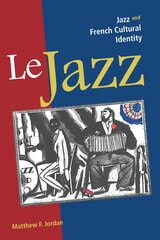
Le Jazz
Jazz and French Cultural IdentityMatthew F. Jordan
University of Illinois Press, 2010
In Le Jazz, Matthew F. Jordan deftly blends textual analysis, critical theory, and cultural history in a wide-ranging and highly readable account of how jazz progressed from a foreign cultural innovation met with resistance by French traditionalists to a naturalized component of the country's identity. Jordan draws on sources including ephemeral critical writing in the press and twentieth-century French literature to trace the country's reception of jazz, from the Cakewalk dance craze and the music's significance as a harbinger of cultural recovery after World War II to its place within French ethnography and cultural hybridity.
Countering the histories of jazz's celebratory reception in France, Jordan delves in to the reluctance of many French citizens to accept jazz with the same enthusiasm as the liberal humanists and cosmopolitan crowds of the 1930s. Jordan argues that some listeners and critics perceived jazz as a threat to traditional French culture, and only as France modernized its identity did jazz become compatible with notions of Frenchness. Le Jazz speaks to the power of enlivened debate about popular culture, art, and expression as the means for constructing a vibrant cultural identity, revealing crucial keys to understanding how the French have come to see themselves in the postwar world.

Le Maya Q’atzij / Our Maya Word
Emil’ Keme
University of Minnesota Press, 2021
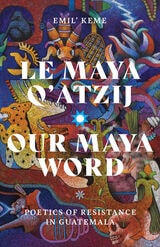
Le Maya Q’atzij/Our Maya Word
Poetics of Resistance in GuatemalaEmil’ Keme
University of Minnesota Press, 2021
Bringing to the fore the voices of Maya authors and what their poetry tells us about resistance, sovereignty, trauma, and regeneration
In 1954, Guatemala suffered a coup d’etat, resulting in a decades-long civil war. During this period, Indigenous Mayans were subject to displacement, disappearance, and extrajudicial killing. Within the context of the armed conflict and the postwar period in Guatemala, K’iche’ Maya scholar Emil’ Keme identifies three historical phases of Indigenous Maya literary insurgency in which Maya authors use poetry to dignify their distinct cultural, political, gender, sexual, and linguistic identities.
Le Maya Q’atzij / Our Maya Word employs Indigenous and decolonial theoretical frameworks to critically analyze poetic works written by ten contemporary Maya writers from five different Maya nations in Iximulew/Guatemala. Similar to other Maya authors throughout colonial history, these authors and their poetry criticize, in their own creative ways, the continuing colonial assaults to their existence by the nation-state. Throughout, Keme displays the decolonial potentialities and shortcomings proposed by each Maya writer, establishing a new and productive way of understanding Maya living realities and their emancipatory challenges in Iximulew/Guatemala.
This innovative work shows how Indigenous Maya poetics carries out various processes of decolonization and, especially, how Maya literature offers diverse and heterogeneous perspectives about what it means to be Maya in the contemporary world.
Learning from Other Worlds
Estrangement, Cognition, and the Politics of Science Fiction and UtopiaPatrick Parrinder, ed.
Duke University Press, 2001
In exploring the relationship between imaginative invention and that of allegory or fable, the essays in Learning from Other Worlds comment on the field’s most abiding concerns and employ a variety of critical approaches—from intellectual history and genre studies to biographical criticism, feminist cultural studies, and political textual analysis. Among the topics discussed are the works of John Wyndham, Kim Stanley Robinson, Stanislau Lem, H.G. Wells, and Ursula Le Guin, as well as the media’s reactions to the 1997 cloning of Dolly the Sheep. Darko Suvin’s characteristically outspoken and penetrating afterword responds to the essays in the volume and offers intimations of a further stage in his long and distinguished career.
This useful compendium and companion offers a coherent view of science fiction studies as it has evolved while paying tribute to the debt it owes Suvin, one of its first champions. As such, it will appeal to critics and students of science fiction, utopia, and fantasy writing.
Contributors. Marc Angenot, Marleen S. Barr, Peter Fitting, Carl Freedman, Edward James, Fredric Jameson, David Ketterer, Gerard Klein, Tom Moylan, Rafail Nudelman, Darko Suvin
Learning to Live with Crime
American Crime Narrative in the Neoconservative TurnChristopher P. Wilson
The Ohio State University Press, 2010
Since the mid-1960s, the war on crime has reshaped public attitudes about state authority, criminal behavior, and the responsibilities of citizenship. But how have American writers grappled with these changes? What happens when a journalist approaches the workings of organized crime not through its legendary Godfathers but through a workaday, low-level figure who informs on his mob? Why is it that interrogation scenes have become so central to prime-time police dramas of late? What is behind writers’ recent fascination with “cold case” homicides, with private security, or with prisons?
In Learning to Live with Crime, Christopher P. Wilson examines this war on crime and how it has made its way into cultural representation and public consciousness. Under the sway of neoconservative approaches to criminal justice and public safety, Americans have been urged to see crime as an inevitable risk of modern living and to accept ever more aggressive approaches to policing, private security, and punishment. The idea has been not simply to fight crime but to manage its risks; to inculcate personal vigilance in citizens; and to incorporate criminals’ knowledge through informants and intelligence gathering. At its most scandalous, this study suggests, contemporary law enforcement has even come to mimic crime’s own operations.
Lectures on Rhetoric and Belles Lettres
Hugh Blair. Edited by Linda Ferreira-Buckley and S. Michael Halloran
Southern Illinois University Press, 2005
This new edition of Hugh Blair’s Lectures on Rhetoric and Belles Lettres, edited by Linda Ferreira-Buckley and S. Michael Halloran, answers the need for a complete, reliable text. The book seeks to generate a renewed interest in Blair by provoking new inquiries into the tradition of belletristic rhetoric and by serving as both aid and incentive to others who may join in the project of improving understanding of this landmark rhetorical scholarship.
This editioncontains forty-seven lectures and remains faithful to the text of the 1785 London edition. The editors contextualize Hugh Blair’s motivations and thinking by providing in their introduction an extended account of Blair’s life and era. The bibliography of works by and about Blair is an invaluable aid, surpassing previous research on Blair.
Although the extent of its influence cannot be measured fully, Blair’s Lectures on Rhetoric and Belles Lettres was undoubtedly a primary vehicle for introducing many eighteenth- and nineteenth-century scholars to classical rhetoric and French belletristic rhetoric—its success due in part to the ease with which the lectures combine neoclassical and Enlightenment thought, accommodating emerging social concerns. Ferreira-Buckley and Halloran’s extensive treatment revives the tradition of belletristic rhetoric, improving the understanding of Blair’s place in the study of eighteenth- and nineteenth-century discourse, while finding him relevant in the twenty-first century.
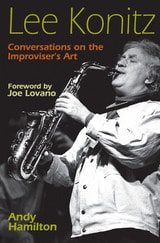
Lee Konitz
Conversations on the Improviser's ArtAndy Hamilton
University of Michigan Press, 2007
“Meticulously researched, detailed and documented, this long awaited overview justly establishes Konitz as one of the most consistently brilliant, adventurous and original improvisers in the jazz tradition—a genius as rare as Bird himself.”
—John Zorn
“Hamilton’s work may well mark the inception of a format new to writing on Western music, one which avoids both the self-aggrandizing of autobiography and the stylized subjectification of biography.”
—The Wire
“An extraordinary approach to a biography, with the man himself speaking for extended sessions. The main vibration I felt from Lee’s words was total honesty, almost to a fault. Konitz shows himself to be an acute observer of the scene, full of wisdom and deep musical insights, relevant to any historical period regardless of style. The asides by noted musicians are beautifully woven throughout the pages. I couldn’t put the book down—it is the definition of a living history.”
—David Liebman
The preeminent altoist associated with the “cool” school of jazz, Lee Konitz was one of the few saxophonists of his generation to forge a unique sound independent of the influence of Charlie Parker. In the late 1940s, Konitz began his career with the Claude Thornhill band, during which time he came into contact with Miles Davis, with whom he would later work on the legendary Birth of the Cool sessions. Konitz is perhaps best known through his association with Lennie Tristano, under whose influence much of his sound evolved, and for his work with Stan Kenton and Warne Marsh. His recordings have ranged from cool bop to experimental improvisation and have appeared on such labels as Prestige, Atlantic, Verve, and Polydor.
Crafted out of numerous interviews between the author and his subject, the book offers a unique look at the story of Lee Konitz’s life and music, detailing Konitz’s own insights into his musical education and his experiences with such figures as Miles Davis, Stan Kenton, Warne Marsh, Lennie Tristano, Charles Mingus, Bud Powell, and Bill Evans.
Andy Hamilton is a jazz pianist and contributor to major jazz and contemporary music magazines. He teaches philosophy, and the history and aesthetics of jazz, at Durham University in the United Kingdom. He is also the author of the book Aesthetics and Music (Continuum 2007).
Joe Lovano is a Grammy Award–winning tenor saxophonist. His most recent album is Streams of Expression.