Results by title
219 books match the query 'Holocaust, Jewish (1939-1945)' and 22 start with l
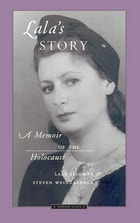
Lala's Story
A Memoir of the HolocaustLala Fishman
Northwestern University Press, 1997
Born into a middle-class Jewish family in 1932, Lala Weintraub grew up in Lvov, Poland. When the Nazis came, Lala—who had blond hair and blue eyes—survived by convincing them she was a Christian. This book tells her remarkable story. Fiercely determined and greatly aided by her Aryan looks, she managed to convince everyone—German soldiers, interrogators, fellow Poles—that she was a Polish gentile. Within a year after the Germans captured Lvov, many of Lala's family members were missing and presumed dead.
Lala's Story follows her as she moves from town to town, driven by her fear of being discovered. More than a story of survival, this is the story of a young girl's resolute struggle to defy, resist, and ultimately defeat the evil forces pursuing her.
Lamentation for 77,297 Victims
Jirí Weil
Karolinum Press, 2020
So begins Jiří Weil’s unforgettable prose poem, Lamentation for 77, 297 Victims, his literary monument to the Czech Jews killed during the Holocaust. A Czech-Jewish writer who worked at Prague’s Jewish Museum both during and after the Nazi Occupation—he survived the Holocaust by faking his own death and hiding out until the war had ended—Weil wrote Lamentation while he served as the museum’s senior librarian in the 1950s. This remarkable literary experiment presents a number of innovative approaches to writing about a horror many would deem indescribable, combining a narrative account of the Shoah with newspaper-style reportage on a handful of the lives ended by the Holocaust and quotes from the Hebrew Bible to create a specific and powerful portrait of loss and remembrance. Translated by David Lightfoot, Lamentation for 77,297 Victims is a startling and singular introduction to a writer whose works have been acclaimed by Philip Roth, Michiko Kakutani, and Siri Hustvedt.
Landscape with Smokestacks
The Case of the Allegedly Plundered DegasHoward J. Treinens
Northwestern University Press, 2000
Last Days of Theresienstadt
Eva Noack-Mosse; Translated by Skye Doney and Biruté Ciplijauskaité
University of Wisconsin Press, 2018
Noack-Mosse's aim in documenting the horrors of daily life within Theresienstadt was to ensure that such a catastrophe could never be repeated. She also gathered from surviving inmates information about earlier events within the walled fortress, witnessed the defeat and departure of the Nazis, saw the arrival of the International Red Cross and the Soviet Army takeover of the camp and town, assisted in administration of the camp's closure, and aided displaced persons in discovering the fates of their family and friends. After the war ended, and she returned home, Noack-Mosse cross-referenced her data with that of others to provide evidence of Nazi crimes. At least 35,000 people died at Theresienstadt and another 90,000 were sent on to death camps.
Last Train to Auschwitz
The French National Railways and the Journey to AccountabilitySarah Federman
University of Wisconsin Press, 2021
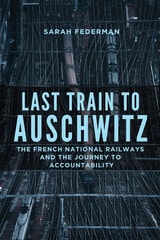
In the immediate decades after World War II, the French National Railways (SNCF) was celebrated for its acts of wartime heroism. However, recent debates and litigation have revealed the ways the SNCF worked as an accomplice to the Third Reich and was actively complicit in the deportation of 75,000 Jews and other civilians to death camps. Sarah Federman delves into the interconnected roles—perpetrator, victim, and hero—the company took on during the harrowing years of the Holocaust.
Grounded in history and case law, Last Train to Auschwitz traces the SNCF’s journey toward accountability in France and the United States, culminating in a multimillion-dollar settlement paid by the French government on behalf of the railways.The poignant and informative testimonies of survivors illuminate the long-term effects of the railroad’s impact on individuals, leading the company to make overdue amends. In a time when corporations are increasingly granted the same rights as people, Federman’s detailed account demonstrates the obligations businesses have to atone for aiding and abetting governments in committing atrocities. This volume highlights the necessity of corporate integrity and will be essential reading for those called to engage in the difficult work of responding to past harms.
Lessons and Legacies II
Teaching the Holocaust in a Changing WorldDonald G. Schilling
Northwestern University Press, 1998
Lessons and Legacies II focuses on matters unique to Holocaust education. Consisting of selected papers delivered at the second Lessons and Legacies conference in 1992, the volume is organized in three sections: Issues, Resources, and Applications. Taken individually, the essays speak directly to specific concerns surrounding Holocaust education: the growing maturity of the Holocaust as a field of study; the difficult issue of explaining the perpetrators' behavior; the process of decision-making within Jewish communities during the Holocaust; issues of gender and family; the scope and content of survivor literature; and the structure of courses and the implications of being an educator in the field. Taken as a whole, the volume speaks to the reciprocal and mutually reinforcing relationship between teaching and scholarship in this important field.
Lessons and Legacies III
Memory, Memorialization, and DenialPeter Hayes
Northwestern University Press, 1999
A collection of nineteen essays, this book is organized into four sections: the first focuses on how various fields of study can open new perspectives on the Holocaust and sharpen old ones; the second examines culture and politics in Germany before and after 1933; the third addresses the problems associated with the memorialization of those years; and the final section examines the shocking denials of the Holocaust.
Lessons and Legacies IX
Memory, History, and Responsibility: Reassessments of the Holocaust, Implications for the FutureJonathan Petropoulos
Northwestern University Press, 2010
Memory, History, and Responsibility: Reassessments of the Holocaust, Implications for the Future contains the highlights from the ninth "Lessons and Legacies" conference. The conference, held during the height of the genocide in Darfur, sought to reexamine how the darkness of the Holocaust continues to shadow human existence more than sixty years after World War II left the Third Reich in ruins.
The collection opens with Saul Friedländer’s call for interdisciplinary approaches to Holocaust research. The essays that follow draw on the latest methodologies in the fields of history, literature, philosophy, religion, film, and gender studies, among others. Together both the leading scholars of the Holocaust and the next generation of scholars engage the difficult reality—as raised by editors Petropoulos, Rapaport, and Roth in their introduction—that the legacies of the Holocaust have not proved sufficient in intervening against human-made mass death, let alone preventing or eliminating it.
Lessons and Legacies VI
New Currents in Holocaust ResearchJeffry Diefendorf
Northwestern University Press, 2004
Several of the essays-such as one on nonarmed "amidah" or resistance and others on the role of gender in the behavior of perpetrators and victims-provide innovative and potentially significant interpretive frameworks for the field of Holocaust studies. Others; for instance, the rounding up of Jews in Italy, Nazi food policy in Eastern Europe, and Nazi anti-Jewish scholarship, emphasize the importance of new sources for reconstructing the historical record. Still others, including essays on the 1964 Frankfurt trial of Auschwitz guards and on the response of the Catholic Church to the question of German guilt, bring a new depth and sophistication to highly charged, sharply politicized topics. Together these essays will inform the future of the Holocaust in scholarly research and in popular understanding.
Lessons and Legacies VII
The Holocaust in International PerspectiveDagmar Herzog
Northwestern University Press, 2006
A thorough, thoughtful, and insightful introduction clarifies the volume's themes and concisely places them within the larger context of Holocaust scholarship; and an introductory essay by Omer Bartov brings into focus the numerous paradoxes structuring early twenty-first-century retrospective thinking about the significance of the Holocaust as a central theme of the twentieth century.
Lessons and Legacies VIII
From Generation to GenerationDoris L. Bergen
Northwestern University Press, 2008
Primo Levi opened his memoir Survival in Auschwitz with a call to remember, reflect upon, and teach about the Holocaust—or to face the rejection of subsequent generations. The transmittal of this urgent knowledge between generations was the theme of the eighth Lessons and Legacies Conference on the Holocaust, and it is the focus of this volume. The circular formulation—from generation to generation—points backward and forward: where do we locate the roots of the Holocaust, and how do its repercussions manifest themselves? The contributors address these questions from various perspectives—history, cultural studies, psychiatry, literature, and sociology. They also bring to bear the personal aspect of associated issues such as continuity and rupture. What has the generation of the Shoah passed on to its descendants? What have subsequent generations taken from these legacies? Contributions by scholars, some of whom are survivors and children of survivors, remind us that the Holocaust does—and must—remain present from generation to generation.
Lessons and Legacies X
Back to the Sources: Reexamining Perpetrators, Victims, and BystandersSara R Horowitz
Northwestern University Press, 2012
Lessons and Legacies XI
Expanding Perspectives on the Holocaust in a Changing WorldEdited and with an introduction by Hilary Earl and Karl A. Schleunes
Northwestern University Press, 2015
Lessons and Legacies XII
New Directions in Holocaust Research and EducationEdited and with an introduction by Wendy Lower and Lauren Faulkner Rossi
Northwestern University Press, 2017
Lessons and Legacies XIII
New Approaches to an Integrated History of the Holocaust: Social History, Representation, TheoryEdited and with an introduction by Alexandra Garbarini and Paul B. Jaskot
Northwestern University Press, 2018
Lessons and Legacies XIV
The Holocaust in the Twenty-First Century; Relevance and Challenges in the Digital AgeEdited and with an introduction by Tim Cole and Simone Gigliotti
Northwestern University Press, 2021
The Holocaust in the Twenty-First Century: Relevance and Challenges in the Digital Age challenges a number of key themes in Holocaust studies with new research. Essays in the section “Tropes Reconsidered” reevaluate foundational concepts such as Primo Levi’s gray zone and idea of the muselmann. The chapters in “Survival Strategies and Obstructions” use digital methodologies to examine mobility and space and their relationship to hiding, resistance, and emigration. Contributors to the final section, “Digital Methods, Digital Memory,” offer critical reflections on the utility of digital methods in scholarly, pedagogic, and public engagement with the Holocaust.
Although the chapters differ markedly in their embrace or eschewal of digital methods, they share several themes: a preoccupation with the experiences of persecution, escape, and resistance at different scales (individual, group, and systemic); methodological innovation through the adoption and tracking of micro- and mezzohistories of movement and displacement; varied approaches to the practice of Saul Friedländer’s “integrated history”; the mainstreaming of oral history; and the robust application of micro- and macrolevel approaches to the geographies of the Holocaust. Taken together, these chapters incorporate gender analysis, spatial thinking, and victim agency into Holocaust studies. In so doing, they move beyond existing notions of perpetrators, victims, and bystanders to portray the Holocaust as a complex and multilayered event.
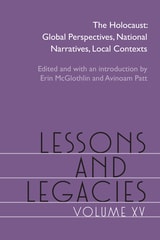
Lessons and Legacies, Volume XV
The Holocaust: Global Perspectives, National Narratives, Local ContextsErin McGlothlin; Avinoam Patt
Northwestern University Press, 2024
The contributions to this volume not only indicate the intellectual vibrancy and diversity of cutting-edge research in Holocaust studies but also reflect multiple approaches to the necessary work of expanding the canon of research in the field and of adopting varied disciplinary perspectives, engaging with global perspectives as well as local studies.
This collection’s chapters manifest three broad categories: history, literature, and memory; at the same time, however, as the interdisciplinary nature of these chapters indicate, these categories should not be regarded as mutually exclusive or discrete. On the contrary, they overlap and intersect in compelling ways, demonstrating the dynamic character of contemporary Holocaust studies, which views history, narrative representation, and commemoration as mutually informative. Further, the contributors continue the recent trend in Holocaust studies whereby specific regional and national narratives are integrated into a more global approach to the event: Newer studies have continued to incorporate what was once termed the periphery into a more global examination of the experiences of Jewish refugees in flight to Latin America, Africa, and the Soviet Union. At the same time, very specific local studies deepen our knowledge of the mechanics of genocide, along with the experiences of refugees in flight, and the subsequent dimensions of Holocaust memory and representation.
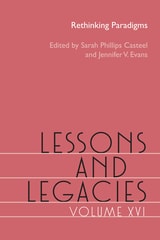
Lessons and Legacies, Volume XVI
Rethinking ParadigmsSarah Phillips Casteel and Jennifer V. Evans
Northwestern University Press, 2027
Bringing forth new perspectives previously unrepresented in Holocaust studies
Lessons and Legacies, Volume XVI: Rethinking Paradigms does the difficult but crucial work of thinking through new methods and modes of representation that speak to where we find ourselves in Holocaust studies today, responding to—and developing new tools to analyze—the shifting shape of Holocaust memory: spatially, temporally, and in and across diverse media. The collection foregrounds the challenges visual sources pose to how we think about the Holocaust, including how it is represented differently in visual media, from photography to graphic novels, and establishes translation as a crucial concept for reframing Holocaust testimony and memory. The contributing authors also model ethical, nuanced ways to conduct comparative, connective work that challenges Eurocentric narratives of the Holocaust. The volume concludes with a section on memory work and activism that approaches the subject of post-1945 memory through different lenses to surface lesser-known aspects of Holocaust history.
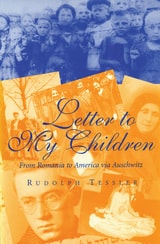
Letter to My Children
From Romania to America via AuschwitzRudolph Tessler
University of Missouri Press, 1999
"Sixty-seven members of my family—my mother, her father, my three sisters, three of my brothers, aunts, uncles, and cousins—were murdered at Auschwitz."
As Rudolph Tessler's mother stepped from the train in Auschwitz, shortly before she was sent to the gas chamber, she heard "Hello, Esther." In a polite tone, a young German SS officer greeted her as he would any old friend. His family lived down the road from the Tessler family in Viseu, their hometown in northern Romania. They, like the rest of the town, admired Esther for her wonderful cooking, particularly the delicious cakes she brought them each Christmas. Now he ushered her and six of her children to their deaths.Throughout Letter to My Children, Tessler offers vivid glimpses of the senselessness that surrounded him during World War II. Of the thousands packed in trains and transported from Viseu to Auschwitz, just a small group survived to see liberation. Among the survivors were Tessler, his father, and two of his brothers. This is the amazing story of their experiences as Hasidic Jews caught in the chaos and terror of the Holocaust.
Tessler's upbringing had emphasized community and family devotion—traits not forgotten in the concentration camps, where he and his family members often rescued one another from certain death. Few fathers and sons survived the concentration camps together. In spite of the odds, Tessler and his brother Buroch managed to stick together, sharing their father's labor assignments to protect him from death, preserving not only their family bond but also their spirituality. Tessler's father, always a source of strength and guidance to his family, provided counsel to many prisoners in the camp and eventually assumed the role of rabbi.
Despite an environment in which their captors tried to reduce them to animals, Tessler's remaining family and seven other Jews from Viseu made a special effort to observe their faith. Bending rules in ways that risked their lives, they worked together to smuggle wheat, grind it into flour, and bake matzos to distribute for Passover. The group also secretly gathered to pray on the eve of Rosh Hashanah. These religious observances offered some comfort in the camp.
In addition to vividly portraying the daily struggles of camp life, Letter to My Children follows Tessler beyond liberation, recounting his days as a displaced person struggling for a new life in the midst of the devastation of postwar Europe, as an American immigrant striving to rebuild his family and succeed in business, and as a philanthropist for education and health care. Recalling the age-old way of life in Viseu that was erased by the Holocaust, this inspiring story conveys the hope, determination, and perseverance that made Tessler a survivor.
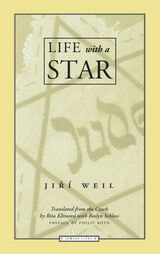
Life with a Star
Jiri Weil
Northwestern University Press, 1998
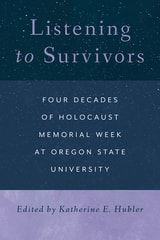
Listening to Survivors
Four Decades of Holocaust Memorial Week at Oregon State UniversityKatherine E. Hubler
Oregon State University Press, 2024
Historian Katherine Hubler has arranged these recollections thematically in chapters centered on discrimination, refuge, resistance, rescue, and transitional justice. These themes align with Oregon’s Holocaust and Genocide Education learning concepts, discussion questions accompany each chapter to facilitate use in classrooms, and the introduction situates the speakers’ diverse experiences within the broader context of World War Two and the Nazis’ genocidal project.
Intended to bring the history of the Holocaust to all Oregonians, Listening to Survivors honors the legacy of outreach work of local survivors and serves as a reminder of the state’s connection to the Holocaust and commitment to genocide education and prevention.
Living with Antisemitism
Modern Jewish ResponsesJehuda Reinharz
Brandeis University Press, 1988