4917 books match the query 'Philosophy' and 152 start with l
cover of L'hypothèse d'instabilité financière: Les processus capitalistes et le comportement de l'économie

L'hypothèse d'instabilité financière

Les processus capitalistes et le comportement de l'économie

Hyman P. Minsky

Diaphanes, 2013

Comment expliquer et prévoir l’instabilité qui caractérise le développement des systèmes économiques ? Comment appréhender les « marchés sauvages » qui constituent notre réalité actuelle ? Dès les années 1960, Hyman Minsky développe une théorie consacrée à l’instabilité des systèmes. Il démontre que le krach financier est un phénomène intervenant régulièrement, qui n’est dû ni à des causes externes, ni à des erreurs d’appréciation : C’est la logique des marchés financiers elle-même, bien plus que des secousses issues de la périphérie du système, qui serait à l’origine des crises. En présentant le texte central de la théorie économique d’Hyman P. Minsky, L’hypothèse d’instabilité financière offre au lecteur une première approche passionnante de cette œuvre dense, fondamentale et jusqu’à présent méconnue en France.
[more]
cover of L. Annaeus Cornutus: Greek Theology, Fragments, and Testimonia

L. Annaeus Cornutus

Greek Theology, Fragments, and Testimonia

George Boys-Stones

SBL Press, 2018

The first English translation of Greek Theology

The first-century CE North African philosopher Cornutus lived in Rome as a philosopher and is best known today for his surviving work Greek Theology, which explores the origins and names of the Greek gods. However, he was also interested in the language and literature of the poets Persius and Lucan and wrote one of the first commentaries on Virgil. This book collects and translates all of our evidence for Cornutus for the first time and includes the first published English translation of Greek Theology. This collection offers entirely fresh insight into the intellectual world of the first century.

Features

  • Translation based on the latest critical text
  • The first truly holistic picture of Cornutus’s intellectual profile
  • A new account of the early debate over Aristotle’s Categories and the Stoic contribution to it
[more]
cover of La Mettrie: Medicine, Philosophy, and Enlightenment

La Mettrie

Medicine, Philosophy, and Enlightenment

Kathleen Wellman

Duke University Press, 1992

Julien Offray de la Mettrie, best known as the author of L’Homme machine, appears as a minor character in most accounts of the Enlightenment. But in this intellectual biography by Kathleen Wellman, La Mettrie—physician-philosophe—emerges as a central figure whose medical approach to philosophical and moral issues had a profound influence on the period and its legacy.
Wellman’s study presents La Mettrie as an advocate of progressive medical theory and practice who consistently applied his medical concerns to the reform of philosophy, morals, and society. By examining his training with the Dutch physician Hermann Boerhaave, his satires lampooning the ignorance and venality of the medical profession, and his medical treatises on subjects ranging from vertigo to veneral disease, Wellman illuminates the medical roots of La Mettrie’s philosophy. She shows how medicine encouraged La Mettrie to undertake an impiricist critique of the philosophical tradition and provided the foundation for a medical materialism that both shaped his understanding of the possibilities of moral and social reform and led him to espouse the cause of the philosophers.
Elucidating the medical view of nature, human beings, and society that the Enlightenment and La Mettrie in particular bequethed to the modern world, La Mettrie makes an important contribution to our understanding of both that period and our own.
[more]
cover of Labor of Fire: The Ontology of Labor between Economy and Culture

Labor of Fire

The Ontology of Labor between Economy and Culture

Bruno Gullì

Temple University Press, 2005

In Labor of Fire, Bruno Gullì offers a timely and much needed re-examination of the concept of labor. Distinguishing between "productive labor" (working for money or subsistence) and "living labor" (working for artistic creation), Gullì convincingly argues for a definition of work that recognizes the importance of artistic and social creativity to our definition of labor and the self.

Gullì lays the groundwork for his book by offering a critique of productive labor, and then maps out his productive/living labor distinction in detail, reviewing the work of Marx and others.
[more]
cover of Laboratory Epistemologies: A Hands-On Perspective

Laboratory Epistemologies

A Hands-On Perspective

Jenny Boulboullé

Duke University Press, 2024
In Laboratory Epistemologies: A Hands-On Perspective, Jenny Boulboullé examines the significance of hands-on experiences in contemporary life sciences laboratories. Addressing the relationship between contemplation and manipulation in epistemology, Boulboullé combines participant observations in molecular genetics labs and microbiological cleanrooms with a longue durée study of the history and philosophy of science. She radically rereads Descartes’s key epistemological text Meditations on First Philosophy, reframing the philosopher as a hands-on knowledge maker. With this reading, Boulboullé subverts the pervasive modern conception of the disembodied knower and puts the hands-on experimenter at the heart of life sciences research. In so doing, she contributes a theoretical model for understanding how life processes on cellular and molecular levels are manually produced in today’s techno-scientific spaces. By reassessing the Cartesian legacy and arguing that epistemology should be grounded in the standpoint of a hands-on practitioner, Boulboullé offers the philosophical and historical foundation to understand and study contemporary life sciences research as multisensory embodied practices.
[more]
cover of Labyrinths: Explorations in the Critical History of Ideas

Labyrinths

Explorations in the Critical History of Ideas

Richard Wolin

University of Massachusetts Press, 1995

This book offers a series of probing reflections on issues at the heart of recent debates in philosophy, literary theory, and intellectual history. In ten powerfully articulated essays, Richard Wolin calls into question the implied radicalism of the so-called postmodern turn, exposes the unstated agenda of neoconservative cultural theory, and provides a major reinterpretation of Walter Benjamin’s place in contemporary cultural studies. 

At the center of the book lie the peculiar and troubling affinities between two groups of cultural critics usually seen as antithetical: the radical conservative thinkers of Germany’s Weimar Republic and the French poststructuralists who came to the prominence in the aftermath of the May 1968 uprising. 

Wolin concludes the volume with a cogent reappraisal of “antihumanism” as a leitmotif of postwar French intellectual culture, along with a reassessment of the “de Man affair” and its implications for the poststructuralist interpretation of fascism. 
[more]
cover of Land and the Given Economy: The Hermeneutics and Phenomenology of Dwelling

Land and the Given Economy

The Hermeneutics and Phenomenology of Dwelling

Todd S. Mei

Northwestern University Press, 2017

Alarming environmental degradation makes ever more urgent the reconciliation of political economy and sustainability. Land and the Given Economy examines how the landed basis of human existence converges with economics, and it offers a persuasive new conception of land that transcends the flawed and inadequate accounts in classical and neoclassical economics.

Todd S. Mei grounds this work in a rigorous review of problematic economic conceptions of land in the work of John Locke, Adam Smith, David Ricardo, John Stuart Mill, Karl Marx, Henry George, Alfred Marshall, and Thorstein Veblen.

Mei then draws on the thought of Martin Heidegger to posit a philosophical clarification of the meaning of land—its ontological nature. He argues that central to rethinking land is recognizing its unique manner of being, described as its "givenness." Concluding with a discussion of ground rent, Mei reflects on specific strategies for incorporating the philosophical account of land into contemporary economic policies.

Revivifying economic frameworks that fail to resolve the impasse between economic development and sustainability, Land and the Given Economy offers much of interest to scholars and readers of philosophy, environmentalism, and the full spectrum of political economy.
[more]
cover of Lands of Likeness: For a Poetics of Contemplation

Lands of Likeness

For a Poetics of Contemplation

Kevin Hart

University of Chicago Press, 2023

An original and profound exploration of contemplation from philosopher, theologian, and poet Kevin Hart.
 
In Lands of Likeness, Kevin Hart develops a new hermeneutics of contemplation through a meditation on Christian thought and secular philosophy. Drawing on Kant, Schopenhauer, Coleridge, and Husserl, Hart first charts the emergence of contemplation in and beyond the Romantic era. Next, Hart shows this hermeneutic at work in poetry by Gerard Manley Hopkins, Marianne Moore, Wallace Stevens, and others. Delivered in its original form as the prestigious Gifford Lectures, Lands of Likeness is a revelatory meditation on contemplation for the modern world.
[more]
cover of Language Beyond Postmodernism: Saying and Thinking in Gendlin Philosophy

Language Beyond Postmodernism

Saying and Thinking in Gendlin Philosophy

David Kleinberg-Levin

Northwestern University Press, 1997
Eugene Gendlin's contribution to the theory of language is the focus of this collection of essays edited by David Michael Levin. This compilation of critical studies—each followed by a comment from Gendlin himself—investigates how concepts grow out of experience, and explores relations between Gendlin's philosophy of language and experience and the philosophies of Wittgenstein, Dilthey, and Heidegger.
[more]
cover of Language and Death: The Place of Negativity

Language and Death

The Place of Negativity

Giorgio Agamben

University of Minnesota Press, 2006
A formidable and influential work, Language and Death sheds a highly original light on issues central to Continental philosophy, literary theory, deconstruction, hermeneutics, and speech-act theory. Focusing especially on the incompatible philosophical systems of Hegel and Heidegger within the space of negativity, Giorgio Agamben offers a rigorous reading of numerous philosophical and poetic works to examine how these issues have been traditionally explored. Agamben argues that the human being is not just “speaking” and “mortal” but irreducibly “social” and “ethical.”Giorgio Agamben teaches philosophy at the Collège International de Philosophie in Paris and at the University of Macerata in Italy. He is the author of Means without End (2000), Stanzas (1993), and The Coming Community (1993), all published by the University of Minnesota Press. Karen E. Pinkus is professor of French and Italian at the University of Southern California. Michael Hardt is professor of literature and romance studies at Duke University.
[more]
cover of Language and Human Understanding

Language and Human Understanding

David Braine

Catholic University of America Press, 2014
Philosopher, psychologist and linguist are all concerned with natural language. Accordingly, in seeking a unified view, Braine draws on insights from all these fields, sifting through the discordant schools of linguists. He concludes that one extended logic or “integrated semantic syntax” shapes grammar, but without constricting languages to being of one grammatical type.
[more]
cover of Language and Power in the Early Middle Ages

Language and Power in the Early Middle Ages

Patrick J. Geary

Brandeis University Press, 2013
The eminent historian Patrick J. Geary has written a provocative book, based on lectures delivered at the Historical Society of Israel about the role of language and ideology in the study and history of the early Middle Ages. He includes a fascinating discussion of the rush by nationalist philologists to rediscover the medieval roots of their respective vernaculars, the rivalry between vernacular languages and Latin to act as transmitters of Christian sacred texts and administrative documents, and the rather sloppy and ad hoc emergence in different places of the vernacular as the local administrative idiom. This is a fascinating look at the weakness of language as a force for unity: ideology, church authority, and emerging secular power always trumped language.
[more]
cover of Language and the Rise of the Algorithm

Language and the Rise of the Algorithm

Jeffrey M. Binder

University of Chicago Press, 2022

A wide-ranging history of the algorithm.

Bringing together the histories of mathematics, computer science, and linguistic thought, Language and the Rise of the Algorithm reveals how recent developments in artificial intelligence are reopening an issue that troubled mathematicians well before the computer age: How do you draw the line between computational rules and the complexities of making systems comprehensible to people? By attending to this question, we come to see that the modern idea of the algorithm is implicated in a long history of attempts to maintain a disciplinary boundary separating technical knowledge from the languages people speak day to day.
 
Here, Jeffrey M. Binder offers a compelling tour of four visions of universal computation that addressed this issue in very different ways: G. W. Leibniz’s calculus ratiocinator; a universal algebra scheme Nicolas de Condorcet designed during the French Revolution; George Boole’s nineteenth-century logic system; and the early programming language ALGOL, short for algorithmic language. These episodes show that symbolic computation has repeatedly become entangled in debates about the nature of communication. Machine learning, in its increasing dependence on words, erodes the line between technical and everyday language, revealing the urgent stakes underlying this boundary.
 
The idea of the algorithm is a levee holding back the social complexity of language, and it is about to break. This book is about the flood that inspired its construction.
[more]
cover of Language of the Gun: Youth, Crime, and Public Policy

Language of the Gun

Youth, Crime, and Public Policy

Bernard E. Harcourt

University of Chicago Press, 2006

Legal and public policies concerning youth gun violence tend to rely heavily on crime reports, survey data, and statistical methods. Rarely is attention given to the young voices belonging to those who carry high-powered semiautomatic handguns. In Language of the Gun, Bernard E. Harcourt recounts in-depth interviews with youths detained at an all-malecorrectional facility, exploring how they talk about guns and what meanings they ascribe to them in a broader attempt to understand some of the assumptions implicit in current handgun policies. In the process, Harcourt redraws the relationships among empirical research, law, and public policy.

Home to over 150 repeat offenders ranging in age from twelve to seventeen, the Catalina Mountain School is made up of a particular stratum of boys—those who have committed the most offenses but will still be released upon reaching adulthood. In an effort to understand the symbolic and emotional language of guns and gun carrying, Harcourt interviewed dozens of these incarcerated Catalina boys. What do these youths see in guns? What draws them to handguns? Why do some of them carry and others not? For Harcourt, their often surprising answers unveil many of the presuppositions that influence our laws and policies.
[more]
cover of Language, Proof, and Logic: Second Edition

Language, Proof, and Logic

Second Edition

Dave Barker-Plummer, Jon Barwise, and John Etchemendy

CSLI, 2011

Language Proof and Logic is available as a physical book with the software included and as a downloadable package of software plus the book in PDF format. The all-electronic version is available from Openproof at gradegrinder.net.

The textbook/software package covers first-order language in a method appropriate for first and second courses in logic. An on-line grading services instantly grades solutions to hundred of computer exercises. It is designed to be used by philosophy instructors teaching a logic course to undergraduates in philosophy, computer science, mathematics, and linguistics.

Introductory material is presented in a systematic and accessible fashion. Advanced chapters include proofs of soundness and completeness for propositional and predicate logic, as well as an accessible sketch of Godel's first incompleteness theorem. The book is appropriate for a wide range of courses, from first logic courses for undergraduates (philosophy, mathematics, and computer science) to a first graduate logic course.

The software package includes four programs:

Tarski's World, a new version of the popular program that teaches the basic first-order language and its semantics;

Fitch, a natural deduction proof environment for giving and checking first-order proofs;

Boole, a program that facilitates the construction and checking of truth tables and related notions (tautology, tautological consequence, etc.);

Submit, a program that allows students to submit exercises done with the above programs to the Grade Grinder, the automatic grading service.

Grade reports are returned to the student and, if requested, to the student's instructor, eliminating the need for tedious checking of homework. All programs are available for Windows and Macintosh systems. Instructors do not need to use the programs themselves in order to be able to take advantage of their pedagogical value. More about the software can be found at gradegrinder.net.

The price of a new text/software package includes one Registration ID, which must be used each time work is submitted to the grading service. Once activated, the Registration ID is not transferable.
[more]
cover of Lao-Tzu, or the Way of The Dragon

Lao-Tzu, or the Way of The Dragon

Miriam Henke

Diaphanes, 2018

At its most basic, philosophy is about learning how to think about the world around us. It should come as no surprise, then, that children make excellent philosophers! Naturally inquisitive, pint-size scholars need little prompting before being willing to consider life’s big questions, however strange or impractical. Plato & Co. introduces children—and curious grown-ups—to the lives and work of famous philosophers, from Socrates to Descartes, Einstein, Marx, Freud, and Wittgenstein. Each book in the series features an engaging—and often funny—story that presents basic tenets of philosophical thought alongside vibrant color illustrations.
            In Lao-Tzu, or the Way of The Dragon, we follow the ancient Chinese philosopher who founded Taoism, from the comet that announced his birth up to his inspired composition, more than fifty years later, of the Tao Te Ching, the Book of the Way. In body and mind an old sage from birth, Lao-Tzu devotes his life to deciphering the endless book of the world. But he soon becomes frustrated with the silliness of human order, impatient kings, and greedy people, and rides off on the back of a water buffalo in search of the Way. He encounters clouds that solidify under his feet, a cave guarded by a golden monkey, and the venerable Confucius himself, and ultimately finds the wisdom of the dragon already residing deep in his own heart.
[more]
cover of Last Works

Last Works

Moses Mendelssohn. Translated by Bruce Rosenstock

University of Illinois Press, 2012
Moses Mendelssohn (1729–1786) was the central figure in the emancipation of European Jewry. His intellect, judgment, and tact won the admiration and friendship of contemporaries as illustrious as Johann Gottfried Herder, Gotthold Ephraim Lessing, and Immanuel Kant. His enormously influential Jerusalem (1783) made the case for religious tolerance, a cause he worked for all his life.
 
Last Works includes, for the first time complete and in a single volume, the English translation of Morning Hours: Lectures on the Existence of God (1785) and To the Friends of Lessing (1786). Bruce Rosenstock has also provided an historical introduction and an extensive philosophical commentary to both texts.
 
At the center of Mendelssohn's last works is his friendship with Lessing. Mendelssohn hoped to show that he, a Torah-observant Jew, and Lessing, Germany's leading dramatist, had forged a life-long friendship that held out the promise of a tolerant and enlightened culture in which religious strife would be a thing of the past.
 
Lessing's death in 1781 was a severe blow to Mendelssohn. Mendelssohn wrote his last two works to commemorate Lessing and to carry on the work to which they had dedicated much of their lives. Morning Hours treats a range of major philosophical topics: the nature of truth, the foundations of human knowledge, the basis of our moral and aesthetic powers of judgment, the reality of the external world, and the grounds for a rational faith in a providential deity. It is also a key text for Mendelssohn's readings of Spinoza. In To the Friends of Lessing, Mendelssohn attempts to unmask the individual whom he believes to be the real enemy of the enlightened state: the Schwärmer, the religious fanatic who rejects reason in favor of belief in suprarational revelation.
[more]
cover of Last Writings on the Philosophy of Psychology, Volume 1

Last Writings on the Philosophy of Psychology, Volume 1

Ludwig Wittgenstein

University of Chicago Press, 1996

This bilingual volume—English and German on facing pages—brings together the writings Wittgenstein composed during his stay in Dublin between October 1948 and March 1949, one of his most fruitful periods. He later drew more than half of his remarks for Part II of Philosophical Investigations from this Dublin manuscript. A direct continuation of the writing that makes up the two volumes of Remarks on the Philosophy of Psychology, this collection offers scholars a glimpse of Wittgenstein's preliminary thinking on one of his most important works.

G. H. von Wright and Heikki Nyman both teach at the University of Helsinki.
[more]
cover of Late Theory: Fredric Jameson, or The Persistence of Reading

Late Theory

Fredric Jameson, or The Persistence of Reading

Phillip E. Wegner

University of Minnesota Press, 2026

A bold, dialectic engagement with Fredric Jameson’s thought

Fredric Jameson (1934–2024) is widely regarded as the most influential literary and cultural theorist of the past fifty years. The culmination of more than three decades of sustained engagement with Jameson’s work, Late Theory offers a critical response to his late writings, namely the final volumes of his “Poetics of Social Forms,” to develop an original and dialectical reading practice in conversation with his evolving thought.

Jameson’s final works bring renewed clarity to three foundational concerns that structure his intellectual legacy. These are the problem of periodization and the challenge of grasping the present as a historical category, the dangers posed by the rise of moralizing modes of critique in literary and cultural studies, and the radical interpretive potential unlocked by allegory and the semiotic method. Phillip E. Wegner shows how these late interventions mark not a conclusion but an extension of Jameson’s long-standing project: envisioning the dialectic as a living, collective form of reasoning—a “thought mode of the future” capable of transforming our lives.

At its core, Late Theory is a passionate argument for cultural and aesthetic education as a practice of solidarity and imagination. Foregrounding Jameson’s enduring effort to build heterogeneous communities of readers committed to shared inquiry, Wegner affirms the urgency of reading, teaching, and thinking together in a moment of crisis for the university and global culture.

Retail e-book files for this title are screen-reader friendly with images accompanied by short alt text and/or extended descriptions.
[more]
cover of Lateness and Longing: On the Afterlife of Photography

Lateness and Longing

On the Afterlife of Photography

George Baker

University of Chicago Press, 2023

How a generation of women artists is transforming photography with analogue techniques.
 
Beginning in the 1990s, a series of major artists imagined the expansion of photography, intensifying its ideas and effects while abandoning many of its former medium constraints. Simultaneous with this development in contemporary art, however, photography was moving toward total digitalization.
 
Lateness and Longing presents the first account of a generation of artists—focused on the work of Zoe Leonard, Tacita Dean, Sharon Lockhart, and Moyra Davey—who have collectively transformed the practice of photography, using analogue technologies in a dissident way and radicalizing signifiers of older models of feminist art. All these artists have resisted the transition to the digital in their work. Instead—in what amounts to a series of feminist polemics—they return to earlier, incomplete, or unrealized moments in photography’s history, gravitating toward the analogue basis of photographic mediums. Their work announces that photography has become—not obsolete—but “late,” opened up by the potentially critical forces of anachronism.
 
Through a strategy of return—of refusing to let go—the work of these artists proposes an afterlife and survival of the photographic in contemporary art, a formal lateness wherein photography finds its way forward through resistance to the contemporary itself.
 
[more]
cover of Latin American Immigration Ethics

Latin American Immigration Ethics

Edited by Amy Reed-Sandoval Luis Rubén Díaz Cepeda

University of Arizona Press, 2021

Following an extended period of near silence on the subject, many social and political philosophers are now treating immigration as a central theme of the discipline. For the first time, this edited volume brings together original works by prominent philosophers writing about immigration ethics from within a Latin American context.

Without eschewing relevant conceptual resources derived from European and Anglo-American philosophies, the essays in this book emphasize Latin American and Latinx philosophies, decolonial and feminist theories, and Indigenous philosophies of Latin America, in the pursuit of an immigration ethics. The contributors explore the moral challenges of immigration that either arise within Latin America, or when Latin Americans and Latina/o/xs migrate to and reside within the United States. Uniquely, some chapters focus on south to south migration. Contributors also examine Latina/o/x experiences in the United States, addressing the lacuna of philosophical writing on migration, maternity, and childhood.

Latin American Immigration Ethics advances philosophical conversations and debates about immigration by theorizing migration from the Latin American and Latinx context.

Contributors
Luis Rubén Díaz Cepeda, Lori Gallegos, Margaret Griesse, Eduardo Mendieta, José Jorge Mendoza, Amos Nascimento, Carlos Pereda, Silvana Rabinovich, Amy Reed-Sandoval, Raúl Villarroel, Allison B. Wolf
 
[more]
cover of Laughing and Crying: A Study of the Limits of Human Behavior

Laughing and Crying

A Study of the Limits of Human Behavior

Helmuth Plessner; Translated from the German by James Spencer Churchill and Marjorie Grene and with a new foreword by J. M. Bernstein

Northwestern University Press, 2020

First published in German in 1940 and widely recognized as a classic of philosophical anthropology, Laughing and Crying is a detailed investigation of these two particularly significant types of expressive behavior, both in themselves and in relation to human nature. Elaborating the philosophical account of human life he developed in Levels of Organic Life and the Human: An Introduction to Philosophical Anthropology, Plessner suggests that laughing and crying are expressions of a crisis brought about in certain situations by the relation of a person to their body.
 
With a new foreword by J. M. Bernstein that situates the book within the broader framework of Plessner’s philosophical anthropology and his richly suggestive and powerful account of human bodily life, Laughing and Crying is essential reading for anyone interested in the philosophy of the body, emotions, and human behavior.
 
[more]
cover of Law and Religion in a Secular Age

Law and Religion in a Secular Age

Rafael Domingo

Catholic University of America Press, 2023
Law and Religion in a Secular Age seeks to restore the connection between spirituality and justice, religion and law, theology and jurisprudence, and natural law and positive law by building a new bridge suitable for pluralistic societies in the secular age. The author argues for a multidimensional view of reality that includes legal, political, moral, and spiritual dimensions of human nature and society. Each of these dimensions of life needs to recognize the existence, influence, and function of the others, which act as a filter or check on the excesses of each other. This multidimensionality of reality clarifies why no legal theory can fully account for law from the legal dimension alone, just as no moral theory makes perfect sense of morality from the moral dimension—and, for that matter, nothing in physics can fully interpret the physical dimension of reality. The premises of a legal system cannot be fully explained by the legal dimension alone because the fundamental conditions and qualities of justice, freedom, and dignity touch all the dimensions of reality in which the human person acts, including the moral and the spiritual, not just the legal. Building on this multidimensional theory of reality, the author explores the core differences and the essential interconnections between law, morality, religion, and spirituality and some of the legal implications of these connections. Rafael Domingo reminds readers of the vital role of religion in shaping the conceptual framework of Western legal systems, underscores the spirit of Christianity that inspired legal institutions, principles, and values, and recalls the contributions of specific Christian jurists as central figures for the development of justice in society. Law and Religion in a Secular Age aims to be a valuable antidote against the dominant legal positivism that has cornered public morality, the defiant secularism that has marginalized religion, and any other legal doctrine that diminishes the spiritual dimension of law and justice.
[more]
cover of Law and the Good Life: On the Political Philosophy of Aristotle

Law and the Good Life

On the Political Philosophy of Aristotle

Robert C. Bartlett

University of Chicago Press, 2026

A fresh reading of the relationship between moral and political philosophy in Aristotle’s thought.

Our democracies promise the rights to life, liberty, and the pursuit of happiness—at least, within the confines of the law. Yet the law is an ineffective guide to the good life; laws can be arbitrary, even immoral. What other limit, then, should direct us as we pursue our own fulfillment? 

In Law and the Good Life, philosopher Robert C. Bartlett examines Aristotle’s consideration of this question. Rather than defer to authority, Aristotle invites us to ground ourselves in moral virtue and intellectual fulfillment, an argument he develops in both Politics and Nicomachean Ethics. As political creatures, Aristotle tells us, we are capable of moral action and therefore must embrace that capacity; at the same time, as rational creatures, we must understand what is true, even without regard to action. In taking these insights together, Bartlett offers a new reading of Aristotle’s political philosophy, one he hopes might serve as a prudent lodestar in our own turbulent times.
[more]
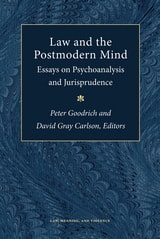
cover of Law and the Postmodern Mind: Essays on Psychoanalysis and Jurisprudence

Law and the Postmodern Mind

Essays on Psychoanalysis and Jurisprudence

Peter Goodrich and David Gray Carlson, Editors

University of Michigan Press, 1998
David Gray Carlson and Peter Goodrich argue that the postmodern legal mind can be characterized as having shifted the focus of legal analysis away from the modernist understanding of law as a system that is unitary and separate from other aspects of culture and society. In exploring the various "other dimensions" of law, scholars have developed alternative species of legal analysis and recognized the existence of different forms of law. Carlson and Goodrich assert that the postmodern legal mind introduced a series of "minor jurisprudences" or partial forms of legal knowledge, which both compete with and subvert the modernist conception of a unitary system of law. In doing so scholars from a variety of disciplines pursue the implications of applying the insights of their disciplines to law. Carlson and Goodrich have assembled in this volume essays from some of our leading thinkers that address what is arguably one of the most fundamental of interdisciplinary encounters, that of psychoanalysis and law.
While psychoanalytic interpretations of law are by no means a novelty within common law jurisprudence, the extent and possibilities of the terrain opened up by psychoanalysis have yet to be extensively addressed. The intentional subject and "reasonable man" of law are disassembled in psychoanalysis to reveal a chaotic and irrational libidinal subject, a sexual being, a body and its drives. The focus of the present collection of essays is upon desire as an inner law, upon love as an interior idiom of legality, and represents a signficant and at times surprising development of the psychoanalytic analysis of legality.
These essays should appeal to scholars in law and in psychology.
The contributors are Drucilla Cornell, Jacques Derrida, Peter Goodrich, Pierre Legendre, Alain Pottage, Michel Rosenfeld, Renata Salecl, Jeanne L. Schroeder, Anton Schutz, Henry Staten, and Slavoj Zizek.
David Gray Carlson is Professor of Law, Benjamin Cardozo School of Law, Yeshiva University. Peter Goodrich is Professor of Law, University of London and University of California, Los Angeles.
[more]
cover of Law in Everyday Life

Law in Everyday Life

Austin Sarat and Thomas R. Kearns, Editors

University of Michigan Press, 1995
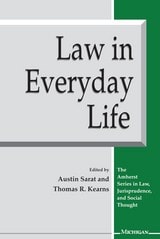
"Sarat and Kearns . . . have edited a truly marvelous work on the impact of the law on daily life and vice versa. . . . the essays are all exemplary, thought- provoking works worthy of a long, contemplative read by scholars, lawyers, and judges alike." --Choice
"The subject of law in everyday life is timely in theory and in practice. The essays collected here are stimulating for the very different ways in which they reconfigure the meanings of 'the law' as cultural practice, and 'the everyday' as a cultural domain in which the state expresses a range of interests and engagements. Readers looking for an introduction to this topic will come away from the book with a clear sense of the varied voices and modes of inquiry now involved in sociolegal studies, and what distinguishes them. More experienced readers will appreciate the book's meticulous reconsideration of the instrumentalities, agencies, and constructedness of law." --Carol Greenhouse, Indiana University
Contributors include David Engel, Hendrik Hartog, Thomas R. Kearns, David Kennedy, Catharine MacKinnon, George Marcus, Austin Sarat, and Patricia Williams.
Austin Sarat is William Nelson Cromwell Professor of Jurisprudence and Political Science, and Chair of the Department of Law, Jurisprudence, and Social Thought, Amherst College. Thomas R. Kearns is William H. Hastie Professor of Philosophy and Professor of Law, Jurisprudence, and Social Thought, Amherst College.
[more]
cover of Law's Violence

Law's Violence

Austin Sarat and Thomas R. Kearns, Editors

University of Michigan Press, 1995
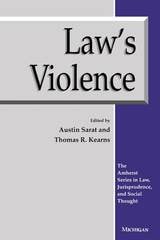
"In bringing together accomplished and thoughtful scholars of different disciplines, with a command of literature ranging from the legal to the literary, and in relating the works to the central arguments of the late Professor Robert Cover, Sarat and Kearns have created a first-rate up-to-date exposition of this important and complicated issue, namely, how to understand better the violence implicit and explicit in law."--Legal Studies Forum
The relationship between law and violence is made familiar to us in vivid pictures of police beating suspects, the large and growing prison population, and the tenacious attachment to capital punishment in the United States. Yet the link between law and violence and the ways that law manages to impose pain and death while remaining aloof and unstained are an unexplored mystery. Each essay in this volume considers the question of how violence done by and in the name of the law differs from illegal or extralegal violence--or, indeed, if they differ at all.
Each author draws on a distinctive disciplinary tradition-- literature, history, anthropology, philosophy, political science, or law. Yet each reminds us that law, constituted in response to the metaphorical violence of the state of nature, is itself a doer of literal violence.
Austin Sarat is William Nelson Cromwell Professor of Jurisprudence and Political Science and Chair of the Program in Law, Jurisprudence, and Social Thought, Amherst College. Thomas R. Kearns is William H. Hastie Professor of Philosophy, Amherst College.
[more]
cover of Law, Intellect, and Education

Law, Intellect, and Education

Francis A. Allen

University of Michigan Press, 1979
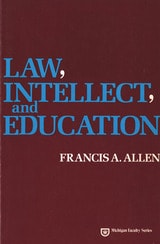
In Law, Intellect, and Education, Francis A. Allen presents a compelling collection of essays that argue for an education system grounded in intellectual rigor and humanistic motivation. Spanning nearly thirty years, these essays collectively defend the importance of a liberal and professional education that is under threat in the modern world. Allen, drawing from his extensive involvement with the Association of American Law Schools, underscores the need to advocate for this education, asserting its critical role in developing thoughtful and rational legal minds. The book delves into key themes in essays like "Mr. Justice Holmes and 'The Life of the Mind'," which critiques the separation of legal theory from moral considerations, and "On Winning and Losing," which examines the cultural fixation on success within the legal profession. Allen also reflects on past legal thought, such as Jerome Frank's "Law and the Modern Mind," to address the continuing relevance of recognizing human limitations in judicial processes. Throughout, Allen calls for a renewed commitment to cultivating intellectual discipline, emphasizing its necessity in achieving justice and fulfilling the demands of a complex legal system.
[more]
cover of Law, Legislation, and Liberty, Volume 19

Law, Legislation, and Liberty, Volume 19

F. A. Hayek

University of Chicago Press, 2021

A new edition of F. A. Hayek’s three-part opus Law, Legislation, and Liberty, collated in a single volume
In this critical entry in the University of Chicago’s Collected Works of F. A. Hayek series, political philosopher Jeremy Shearmur collates Hayek’s three-part study of law and liberty and places Hayek’s writings in careful historical context. Incisive and unrestrained, Law, Legislation, and Liberty is Hayek at his late-life best, making it essential reading for understanding the philosopher’s politics and worldview. 

These three volumes constitute a scaling up of the framework offered in Hayek’s famed The Road to Serfdom. Volume 1, Rules and Order, espouses the virtues of classical liberalism; Volume 2, The Mirage of Social Justice, examines the societal forces that undermine liberalism and, with it, liberalism’s capacity to induce “spontaneous order”; and Volume 3, The Political Order of a Free People, proposes alternatives and interventions against emerging anti-liberal movements, including a rule of law that resides in stasis with personal freedom. 

Shearmur’s treatment of this challenging work—including an immersive new introduction, a conversion of Hayek’s copious endnotes to footnotes, corrections to Hayek’s references and quotations, and the provision of translations to material that Hayek cited only in languages other than English—lends it new importance and accessibility. Rendered anew for the next generations of scholars, this revision of Hayek’s Law, Legislation, and Liberty is sure to become the standard.
[more]
cover of Le principe d’anarchie: Heidegger et la question de l'agir

Le principe d’anarchie

Heidegger et la question de l'agir

Reiner Schürmann

Diaphanes, 2013

Par une lecture à rebours de l’oeuvre de Martin Heidegger, Reiner Schürmann vise à mettre au jour ce qu’il identifie comme son impensé : le principe d’anarchie. Affirmant que le projet de destruction de l’ontologie annoncé dans Être et temps n’est pleinement intelligible qu’à partir des derniers jalons de cette pensée, Schürmann fait ainsi apparaître ce que Heidegger n’avait pu expliciter lui-même. Selon lui, la question de l’être telle qu’elle est posée par le philosophe de Fribourg est indissociable de celle de l’agir. Déconstruisant la métaphysique occidentale, Heidegger aurait ainsi sapé toute possibilité de donner une arché à l'action humaine. Le paradoxe d’un principe d’anarchie, principe de « dépérissement de la règle », est aux yeux de Schürmann ce qui permet de penser l’ambiguïté de la transition opérée par Heidegger.

Interprétation audacieuse et vivifiante de l’une des oeuvres philosophiques les plus marquantes du XXᵉ siècle, Le principe d’anarchie a influencé de nombreux philosophes français contemporains. Trente ans après la première publication, la présente réédition témoigne que cette oeuvre longtemps épuisée n’a rien perdu de son actualité ni de sa force.

[more]
cover of Le socialisme du capital

Le socialisme du capital

Christian Marazzi

Diaphanes, 2017

Depuis l'effondrement des banques en 2008, le capitalisme semble être entré dans une phase de stagnation durable, mais aussi dans une instabilité géopolitique et monétaire. Le scénario qui se joue sous nos yeux évoque une sorte de « socialisme du capital » : l’État, qui subvient aux besoins des « soviets de la finance », impose à la société la dictature du marché. Plutôt qu’un effet parasite du capitalisme, cette financiarisation pourrait bien constituer la forme aussi essentielle que perverse de son nouveau régime.
Les textes rassemblés dans le présent recueil analysent et commentent les changements économiques survenus ces dix dernières années en revenant sur leurs acteurs principaux, sur certains symptômes de la crise ainsi que sur des phénomènes qui ont pu apparaître jusque-là comme marginaux. Loin d’adopter une approche simplificatrice ou moralisante, Christian Marazzi relit les enseignements de Michel Foucault sur la biopolitique pour tenter d’interpréter les bouleversements contemporains comme des transformations fondamentales du politique.
[more]
cover of Le spectre du capital

Le spectre du capital

Joseph Vogl

Diaphanes, 2010
Dans un contexte de crise financière omniprésente et durablement installée, Joseph Vogl interroge le système capitaliste, ses arcanes, ses modes de fonctionnement, la manière dont il se perpétue. Censé reposer sur une confiance multilatérale, le système des marchés est en réalité traversé d’inquiétude et d’instabilité. Ce qu’on définit comme ses « excès », en particulier la spéculation sous ses formes les plus extrêmes, semble au contraire en faire partie intégrante. Inscrit dans un rapport au temps qui refuse toute réflexion à long terme et passe d’un présent à l’autre ; régi par des responsabilités diluées dans une « main invisible », un spectre agitant dans l’ombre les flux de capitaux ; le monde financier se voit entouré d’une aura mystérieuse, aussi incompréhensible qu’imprévisible. L’enjeu de ce livre est de saisir comment l’économie financière tente de comprendre un monde qu’elle a elle-même engendré.
[more]
cover of Leading a Human Life: Wittgenstein, Intentionality, and Romanticism

Leading a Human Life

Wittgenstein, Intentionality, and Romanticism

Richard Eldridge

University of Chicago Press, 1997

In this provocative new study, Richard Eldridge presents a highly original and compelling account of Wittgenstein's Philosophical Investigations, one of the most enduring yet enigmatic works of the twentieth century. He does so by reading the text as a dramatization of what is perhaps life's central motivating struggle—the inescapable human need to pursue an ideal of expressive freedom within the difficult terms set by culture.

Eldridge sees Wittgenstein as a Romantic protagonist, engaged in an ongoing internal dialogue over the nature of intentional consciousness, ranging over ethics, aesthetics, and philosophy of mind. The picture of the human mind that emerges through this dialogue unsettles behaviorism, cognitivism, and all other scientifically oriented orthodoxies. Leading a human life becomes a creative act, akin to writing a poem, of continuously seeking to overcome both complacency and skepticism. Eldridge's careful reconstruction of the central motive of Wittgenstein's work will influence all subsequent scholarship on it.
[more]
cover of Learning in the Plural: Essays on the Humanities and Public Life

Learning in the Plural

Essays on the Humanities and Public Life

David D. Cooper

Michigan State University Press, 2014
Can civic engagement rescue the humanities from a prolonged identity crisis? How can the practices and methods, the conventions and innovations of humanities teaching and scholarship yield knowledge that contributes to the public good? These are just two of the vexing questions David D. Cooper tackles in his essays on the humanities, literacy, and public life. As insightful as they are provocative, these essays address important issues head-on and raise questions about the relevance and roles of humanities teaching and scholarship, the moral footings and public purposes of the humanities, engaged teaching practices, institutional and disciplinary reform, academic professionalism, and public scholarship in a democracy. Destined to stir discussion about the purposes of the humanities and the problems we face during an era of declining institutional support, public alienation and misunderstanding, student ambivalence, and diminishing resources, the questions Cooper raises in this book are uncomfortable and, in his view, necessary for reflection, renewal, and reform. With frank, deft assessments, Cooper reports on active learning initiatives that reenergized his own teaching life while reshaping the teaching mission of the humanities, including service learning, collaborative learning, the learning community movement, and student-centered and deliberative pedagogy.
[more]
cover of Learning to Unlearn: Decolonial Reflections from Eurasia and the Americas

Learning to Unlearn

Decolonial Reflections from Eurasia and the Americas

Madina V. Tlostanova and Walter D. Mignolo

The Ohio State University Press, 2012

Learning to Unlearn: Decolonial Reflections from Eurasia and the Americas is a complex, multisided rethinking of the epistemic matrix of Western modernity and coloniality from the position of border epistemology. Colonial and imperial differences are the two key concepts to understanding how the logic of coloniality creates ontological and epistemic exteriorities. Being at once an enactment of decolonial thinking and an attempt to define its main grounds, mechanisms, and concepts, the book shifts the politics of knowledge from “studying the other” (culture, society, economy, politics) toward “the thinking other” (the authors).

  Addressing areas as diverse as the philosophy of higher education, gender, citizenship, human rights, and indigenous agency, and providing fascinating and little-known examples of decolonial thinking, education, and art, Madina V. Tlostanova and Walter D. Mignolo deconstruct the modern architecture of knowledge—its production and distribution as manifested in the corporate university. In addition, the authors dwell on and define the echoing global decolonial sensibilities as expressed in the Americas and in peripheral Eurasia.   The book is an important addition to the emerging transoceanic inquiries that introduce decolonial thought and non-Western border epistemologies not only to update or transform disciplines but also to act and think decolonially in the global futures to come.
[more]
cover of Leave Me Alone and I'll Make You Rich: How the Bourgeois Deal Enriched the World

Leave Me Alone and I'll Make You Rich

How the Bourgeois Deal Enriched the World

Deirdre Nansen McCloskey and Art Carden

University of Chicago Press, 2020

The economist and historian Deirdre Nansen McCloskey has been best known recently for her Bourgeois Era trilogy, a vigorous defense, unrivaled in scope, of commercially tested betterment.  Its massive volumes, The Bourgeois Virtues, Bourgeois Dignity, and Bourgeois Equality, solve Adam Smith’s puzzle of the nature and causes of the wealth of nations, and of the moral sentiments of modernity.   The world got rich, she argues, not chiefly by material causes but by an idea and a sentiment, a new admiration for the middle class and its egalitarian liberalism.  

For readers looking for a distillation of McCloskey’s magisterial work, Leave Me Alone and I’ll Make You Rich is what you’ve been waiting for. In this lively volume, McCloskey and the economist and journalist Carden bring together the trilogy’s key ideas and its most provocative arguments. The rise of the west, and now the rest, is the story of the rise of ordinary people to a dignity and liberty inspiring them to have a go. The outcome was an explosion of innovation after 1800, and a rise of real income by an astounding 3,000 percent.  The Great Enrichment, well beyond the conventional Industrial Revolution, did not, McCloskey and Carden show, come from the usual suspects, capital accumulation or class struggle.  It came from the idea of economic liberty in Holland and the Anglosphere, then Sweden and Japan, then Italy and  Israel and China and India, an idea that bids fair in the next few generations to raise up the wretched of the earth.  The original shift to liberalism arose from 1517 to 1789 from theological and political revolutions in northwest Europe, upending ancient hierarchies.  McCloskey and Carden contend further that liberalism and “innovism” made us better humans as well as richer ones.  Not matter but ideas.  Not corruption but improvement.

Leave Me Alone and I’ll Make You Rich draws in entertaining fashion on history, economics, literature, philosophy, and popular culture, from growth theory to the Simpsons. It is the perfect introduction for a broad audience to McCloskey’s influential explanation of how we got rich.  At a time when confidence in the economic system is under challenge, the book mounts an optimistic and persuasive defense of liberal innovism, and of the modern world it has wrought.
 
[more]
cover of Lectures on Ethics, 1900 - 1901: John Dewey

Lectures on Ethics, 1900 - 1901

John Dewey

Donald F. Koch

Southern Illinois University Press, 1991

In Lectures on Ethics, 1900–1901,Donald F. Koch supplies the only extant complete transcription of the annual three-course sequence on ethics John Dewey gave at the University of Chicago.

In his introduction Koch argues that these lectures offer the best systematic, overall introduction to Dewey’s approach to moral philosophy and are the only account showing the unity of his views in nearly all phases of ethical inquiry. These lectures are the only work by Dewey to set forth a complete theory of moral language. They offer a clear illustration of the central methodological questions in the development of a pragmatic instrumentalist ethic and the actual working out of the instrumentalist approach as distinct from simply presenting it as a conclusion.
[more]
cover of Lectures on Imagination

Lectures on Imagination

Paul Ricoeur

University of Chicago Press, 2024

Ricoeur’s theory of productive imagination in previously unpublished lectures.

The eminent philosopher Paul Ricoeur was devoted to the imagination. These previously unpublished lectures offer Ricoeur’s most significant and sustained reflections on creativity as he builds a new theory of imagination through close examination, moving from Aristotle, Pascal, Spinoza, Hume, and Kant to Ryle, Price, Wittgenstein, Husserl, and Sartre. These thinkers, he contends, underestimate humanity’s creative capacity. While the Western tradition generally views imagination as derived from the reproductive example of the image, Ricoeur develops a theory about the mind’s power to produce new realities. Modeled most clearly in fiction, this productive imagination, Ricoeur argues, is available across conceptual domains. His theory provocatively suggests that we are not constrained by existing political, social, and scientific structures. Rather, our imaginations have the power to break through our conceptual horizons and remake the world.
[more]
cover of Lectures on Kant's Political Philosophy

Lectures on Kant's Political Philosophy

Hannah Arendt

University of Chicago Press, 1982
Hannah Arendt's last philosophical work was an intended three-part project entitled The Life of the Mind. Unfortunately, Arendt lived to complete only the first two parts, Thinking and Willing. Of the third, Judging, only the title page, with epigraphs from Cato and Goethe, was found after her death. As the titles suggest, Arendt conceived of her work as roughly parallel to the three Critiques of Immanuel Kant. In fact, while she began work on The Life of the Mind, Arendt lectured on "Kant's Political Philosophy," using the Critique of Judgment as her main text. The present volume brings Arendt's notes for these lectures together with other of her texts on the topic of judging and provides important clues to the likely direction of Arendt's thinking in this area.
[more]
cover of Left Legalism/Left Critique

Left Legalism/Left Critique

Wendy Brown and Janet Halley, eds.

Duke University Press, 2002

In recent decades, left political projects in the United States have taken a strong legalistic turn. From affirmative action to protection against sexual harassment, from indigenous peoples’ rights to gay marriage, the struggle to eliminate subordination or exclusion and to achieve substantive equality has been waged through courts and legislation. At the same time, critiques of legalism have generally come to be regarded by liberal and left reformers as politically irrelevant at best, politically disunifying and disorienting at worst. This conjunction of a turn toward left legalism with a turn away from critique has hardened an intellectually defensive, brittle, and unreflective left sensibility at a moment when precisely the opposite is needed. Certainly, the left can engage strategically with the law, but if it does not also track the effects of this engagement—effects that often exceed or even redound against its explicit aims—it will unwittingly foster political institutions and doctrines strikingly at odds with its own values.

Brown and Halley have assembled essays from diverse contributors—law professors, philosophers, political theorists, and literary critics—united chiefly by their willingness to think critically from the left about left legal projects. The essays themselves vary by topic, by theoretical approach, and by conclusion. While some contributors attempt to rework particular left legal projects, others insist upon abandoning or replacing those projects. Still others leave open the question of what is to be done as they devote their critical attention to understanding what we are doing. Above all, Left Legalism/Left Critique is a rare contemporary argument and model for the intellectually exhilarating and politically enriching dimensions of left critique—dimensions that persist even, and perhaps especially, when critique is unsure of the intellectual and political possibilities it may produce.

Contributors: Lauren Berlant, Wendy Brown, Judith Butler, Drucilla Cornell, Richard T. Ford, Katherine M. Franke, Janet Halley, Mark Kelman, David Kennedy, Duncan Kennedy, Gillian Lester, Michael Warner
[more]
cover of Left and Right: The Significance of a Political Distinction

Left and Right

The Significance of a Political Distinction

Norberto Bobbio

University of Chicago Press, 1996

Politicians and pundits have long disparaged their opponents with polemicist cries of "leftist!" or "rightist!" But with the fall of communism and the recent conservative ascendancy in the United States and Europe, many commentators have flatly declared that the traditional left/right distinction has lost its relevance. Now, even as political players scramble to redefine themselves with freshly "spun" labels, Norberto Bobbio asserts that the demise of the left/right distinction has been greatly exaggerated.

Bobbio argues that left and right are not absolute terms, but represent a shifting map of the political spectrum, relative to the particular cultural and historical contexts of a given time. The distinction continues to endure because it reflects the essentially antithetical nature and dynamics of democratic politics. In his accessible yet provocative style, Bobbio constructs a historically informed, analytic division of the political universe along two foundational axes, from equality to inequality, from liberty to authoritarianism. He then charts the past and present tendencies of the left and the right, in both their more moderate and more virulently extreme forms. Ultimately, for Bobbio, the measure of post-modern democracy will indeed lie in where and how we situate ourselves relative to these critical left/right parameters, in whether we cast ourselves, our votes, and our era in terms of political expediency, social viability, or moral responsibility.

A bestseller in Italy, where it sold over three hundred thousand copies, Left and Right is an important contribution to our understanding of global political developments in the 1990s and beyond.

[more]
cover of Leftist Theories of Sport: A Critique and Reconstruction

Leftist Theories of Sport

A Critique and Reconstruction

William J. Morgan

University of Illinois Press, 1994
The degradation of modern sport--its commercialization, trivialization, widespread cheating, cult of athletic stars and celebrities, and manipulation by the media--has led to calls for its transformation. William J. Morgan constructs a critical theory of sport that shores up the weak arguments of past attempts and points a way forward to making sport more humane, compelling, and substantive. Drawing on the work of social theorists, Morgan challenges scholars and fans alike to explore new spaces in sport culture and imagine the rich cultural and political possibilities to be found in the pastimes we follow with such passion.
[more]
cover of Legal Modernism

Legal Modernism

David Luban

University of Michigan Press, 1997
Modernism in legal theory is no different from modernism in the arts: both respond to a cultural crisis, a sense that institutions and traditions have lost their validity. Some doubt the importance of the rule of law, others question the objectivity of legal reasoning. We have lost confidence in the justice of our legal institutions, and even in our very capacity to identify justice.
Legal philosopher David Luban argues that we cannot escape the modernist predicament. Accusing contemporary legal theorists of evading rather than confronting the challenge of modernity, he offers important and original objections to pragmatism, traditionalism, and nihilism. He argues that only by weaving together the broken narrative and forgotten voices of history's victims can we come to appreciate the nature of justice in modern society. Calling a trial the embodiment of the law's self-criticism, Luban demonstrates the centrality of narrative by analyzing the trial of Martin Luther King, the Nuremberg trials, and trial scenes in Homer, Hesiod, and Aeschylus. With these examples, Luban explores several of the tensions that motivate much more contemporary legal theory: order versus justice, obedience versus resistance, statism versus communitarianism.
". . . an illuminating account of how contemporary legal theory can be understood as an expression of 'the modernist predicament' by exploring the analogy between modernism in the arts and modernism in law, politics, and philosophy. . . . a valuable critical discussion of modern legal theory." --Choice
David Luban is Morton and Sophia Macht Professor of Law at the University of Maryland and Research Scholar at the Institute for Philosophy and Public Policy. His other books include Lawyers and Justice: An Ethical Study.
[more]
cover of Legal Rights: Historical and Philosophical Perspectives

Legal Rights

Historical and Philosophical Perspectives

Austin Sarat and Thomas R. Kearns, Editors

University of Michigan Press, 1997
The idea of legal rights today enjoys virtually universal appeal, yet all too often the meaning and significance of rights are poorly understood. The purpose of this volume is to clarify the subject of legal rights by drawing on both historical and philosophical legal scholarship to bridge the gap between these two genres--a gap that has divorced abstract and normative treatments of rights from an understanding of their particular social and cultural contexts.
Legal Rights: Historical and Philosophical Perspectives shows that the meaning and extent of rights has been dramatically expanded in this century, though along with the widespread and flourishing popularity of rights, voices of criticism have increasingly been raised. The authors take up the question of the foundation of rights and explore the postmodern challenges to efforts to ground rights outside of history and language. Drawing rich historical analysis and careful philosophical inquiry into productive dialogue, this book explores the many facets of rights at the end of the twentieth century. In these essays, potentially abstract debates come alive as they are related to the struggles of real people attempting to cope with, and improve, their living conditions. The significance of legal rights is measured not just in terms of philosophical categories or as a collection of histories, but as they are experienced in the lives of men and women seeking to come to terms with rights in contemporary life.
Contributors are Hadley Arkes, William E. Cain, Thomas Haskell, Morton J. Horwitz, Annabel Patterson, Michael J. Perry, Pierre Schlag, and Jeremy Waldron.
Austin Sarat is William Nelson Cromwell Professor of Jurisprudence and Political Science, Amherst College. Thomas R. Kearns is William H. Hastie Professor of Philosophy, Amherst College.
[more]
cover of Leo Strauss On Plato's Symposium

Leo Strauss On Plato's Symposium

Leo Strauss

University of Chicago Press, 2001
The first major piece of unpublished work by Leo Strauss to appear in more than thirty years, this volume offers the public the unprecedented experience of encountering this renowned scholar as his students did. Given as a course in autumn 1959 under the title "Plato's Political Philosophy," these provocative lectures—until now, never published, but instead passed down from one generation of students to the next—show Strauss at his subtle and insightful best.
[more]
cover of Leo Strauss and His Catholic Readers

Leo Strauss and His Catholic Readers

Geoffrey M. Vaughan

Catholic University of America Press, 2018
This book looks at the work and influence of Leo Strauss in a variety of ways that will be of interest to readers of political philosophy. It will be of particular interest to Catholics and scholars of other religious traditions. Strauss had a great deal of interaction with his contemporary Catholic scholars, and many of his students or their students teach or have taught at Catholic colleges and universities in America. Leo Strauss and His Catholic Readers brings together work by scholars from two continents, some of whom knew Strauss, one of whom was his student at the University of Chicago. The first section of essays considers Catholic responses to Strauss’s project of recovering Classical natural right as against modern individual rights. Some of the authors suggest that his approach can be a fruitful corrective to an uncritical reception of modern ideas. Nevertheless, most point out that the Catholic cannot accept all of Strauss’s project. The second section deals with areas of overlap between Strauss and Catholics. Some of the chapters explore encounters with his contemporary scholars while others turn to more current concerns. The final section approaches the theological-political question itself, a question central to both Strauss’s work and that of the Catholic intellectual tradition. This section of the book considers the relationship of Strauss’s work to Christianity and Christian commitments at a broader level. Because Christianity does not have an explicit political doctrine, Christians have found themselves as rulers, subjects, and citizens in a variety of political regimes. Leo Strauss’s return to Platonic political philosophy can provide a useful lens through which his Catholic readers can assess what it means for there to be a best regime.
[more]
cover of Leo Strauss and Nietzsche

Leo Strauss and Nietzsche

Laurence Lampert

University of Chicago Press, 1995

The influential political philosopher Leo Strauss has been credited by conservatives with the recovery of the great tradition of political philosophy stretching back to Plato. Among Strauss's most enduring legacies is a strongly negative assessment of Nietzsche as the modern philosopher most at odds with that tradition and most responsible for the sins of twentieth-century culture—relativism, godlessness, nihilism, and the breakdown of family values. In fact, this apparent denunciation has become so closely associated with Strauss that it is often seen as the very core of his thought.

In Leo Strauss and Nietzsche, the eminent Nietzsche scholar Laurence Lampert offers a controversial new assessment of the Strauss-Nietzsche connection. Lampert undertakes a searching examination of the key Straussian essay, "Note on the Plan of Nietzsche's Beyond Good and Evil." He shows that this essay, written toward the end of Strauss's life and placed at the center of his final work, reveals an affinity for and debt to Nietzsche greater than Strauss's followers allow. Lampert argues that the essay comprises the most important interpretation of Nietzsche ever published, one that clarifies Nietzsche's conception of nature and of human spiritual history and demonstrates the logical relationship between the essential themes in Nietzsche's thought—the will to power and the eternal return.
[more]
cover of Leo Strauss and the Politics of Exile: The Making of a Political Philosopher

Leo Strauss and the Politics of Exile

The Making of a Political Philosopher

Eugene Sheppard

Brandeis University Press, 2007
Born in rural Hesse, Germany, Leo Strauss (1899–1973) became an active Zionist and philosopher during the tumultuous and fractious Weimar Republic. As Eugene R. Sheppard demonstrates in this groundbreaking and engaging book, Strauss gravitated towards such thinkers as Franz Rosenzweig, Martin Heidegger, and Carl Schmitt as he sought to identify and overcome fundamental philosophical, political, and theological crises. The rise of Nazism impelled Strauss as a young Jewish émigré, first in Europe and then in America, to grapple with—and accommodate his thought to—the pressing challenges of exile. In confronting his own state of exile, Strauss enlisted premodern Jewish thinkers such as Moses Maimonides and Baruch Spinoza who earlier addressed the problem of reconciling their competing loyalties as philosophers and Jews. This is the first study to frame Strauss’s political philosophy around his critique of liberalism and the problem of exile. Sheppard follows Strauss from Europe to the United States, a journey of a conservative Weimar Jew struggling with modern liberalism and the existential and political contours of exile. Strauss sought to resolve the conflicts of a Jew unwilling to surrender loyalty to his ancestral community and equally unwilling to adhere to the strictures of orthodox observance. Strauss saw truth and wisdom as transcending particular religious and national communities, as well as the modern enlightened humanism in which he himself had been nurtured. In his efforts to navigate between the Jewish and the philosophical, the ancient and the modern, Berlin and New York, Strauss developed a distinctively programmatic way of reading and writing “between the lines.” Sheppard recaptures the complexity and intrigue of this project which has been ignored by those who both reject and claim Strauss’s legacy.
[more]
cover of Leo Strauss and the Problem of Political Philosophy

Leo Strauss and the Problem of Political Philosophy

Michael P. Zuckert and Catherine H. Zuckert

University of Chicago Press, 2014
Leo Strauss and his alleged political influence regarding the Iraq War have in recent years been the subject of significant media attention, including stories in the Wall Street Journal and New York Times.Time magazine even called him “one of the most influential men in American politics.” With The Truth about Leo Strauss, Michael and Catherine Zuckert challenged the many claims and speculations about this notoriously complex thinker. Now, with Leo Strauss and the Problem of Political Philosophy, they turn their attention to a searching and more comprehensive interpretation of Strauss’s thought as a whole, using the many manifestations of the “problem of political philosophy” as their touchstone.
 
For Strauss, political philosophy presented a “problem” to which there have been a variety of solutions proposed over the course of Western history. Strauss’s work, they show, revolved around recovering—and restoring—political philosophy to its original Socratic form. Since positivism and historicism represented two intellectual currents that undermined the possibility of a Socratic political philosophy, the first part of the book is devoted to Strauss’s critique of these two positions. Then, the authors explore Strauss’s interpretation of the history of philosophy and both ancient and modern canonical political philosophers, including Plato, Aristotle, Machiavelli, and Locke. Strauss’s often-unconventional readings of these philosophers, they argue, pointed to solutions to the problem of political philosophy. Finally, the authors examine Strauss’s thought in the context of the twentieth century, when his chief interlocutors were Schmitt, Husserl, Heidegger, and Nietzsche.
 
The most penetrating and capacious treatment of the political philosophy of this complex and often misunderstood thinker, from his early years to his last works, Leo Strauss and the Problem of Political Philosophy reveals Strauss’s writings as an attempt to show that the distinctive characteristics of ancient and modern thought derive from different modes of solving the problem of political philosophy and reveal why he considered the ancient solution both philosophically and politically superior.
[more]
cover of Leo Strauss and the Rediscovery of Maimonides

Leo Strauss and the Rediscovery of Maimonides

Kenneth Hart Green

University of Chicago Press, 2013

In Leo Strauss and the Rediscovery of Maimonides, Kenneth Hart Green explores the critical role played by Maimonides in shaping Leo Strauss’s thought. In uncovering the esoteric tradition employed in Maimonides’s Guide of the Perplexed, Strauss made the radical realization that other ancient and medieval philosophers might be concealing their true thoughts through literary artifice. Maimonides and al-Farabi, he saw, allowed their message to be altered by dogmatic considerations only to the extent required by moral and political imperatives and were in fact avid advocates for enlightenment. Strauss also revealed Maimonides’s potential relevance to contemporary concerns, especially his paradoxical conviction that one must confront the conflict between reason and revelation rather than resolve it.
           
An invaluable companion to Green’s comprehensive collection of Strauss’s writings on Maimonides, this volume shows how Strauss confronted the commonly accepted approaches to the medieval philosopher, resulting in both a new understanding of Maimonides and a new depth and direction for his own thought. It will be welcomed by anyone engaged with the work of either philosopher.
 

[more]