Results by title
3785 books match the query 'Poetry' and 131 start with l
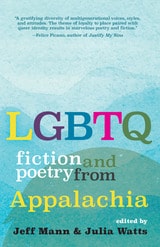
LGBTQ Fiction and Poetry from Appalachia
Jeff Mann
West Virginia University Press, 2018
This collection, the first of its kind, gathers original and previously published fiction and poetry from lesbian, gay, bisexual, transgender, and queer authors from Appalachia. Like much Appalachian literature, these works are pervaded with an attachment to family and the mountain landscape, yet balancing queer and Appalachian identities is an undertaking fraught with conflict. This collection confronts the problematic and complex intersections of place, family, sexuality, gender, and religion with which LGBTQ Appalachians often grapple.
With works by established writers such as Dorothy Allison, Silas House, Ann Pancake, Fenton Johnson, and Nickole Brown and emerging writers such as Savannah Sipple, Rahul Mehta, Mesha Maren, and Jonathan Corcoran, this collection celebrates a literary canon made up of writers who give voice to what it means to be Appalachian and LGBTQ.

LOST, HURT, OR IN TRANSIT BEAUTIFUL
Rohan Chhetri
Tupelo Press, 2021
—from the Judge’s Citation by Kristina Marie Darling
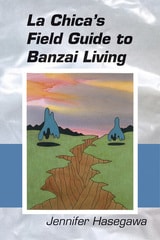
La Chica's Field Guide to Banzai Living
Jennifer Hasegawa
Omnidawn, 2019
Hasegawa’s poems not only rearrange our ways of seeing the world, but they also reset the language we use in it. Banzai, with a literal translation of “10,000 years,” was used by the Japanese as a rallying cry in imperialistic and militaristic contexts. Today, the understanding of this word has shifted to a comparatively neutral translation of the enthusiastic expression “Hurrah!” in both in Japan and beyond. In La Chica’s Field Guide to Banzai Living, Hasegawa aims to reclaim banzai, recasting the language of war and unwavering loyalty and forming it into one that stands against aggression and racism and embraces tolerance and self-acceptance. Here banzai becomes a rallying cry not of war but of grand potential. La Chica’s Field Guide to Banzai Living chronicles a celebratory life and poetry filled with wonder.
La Far
Eric Linsker
University of Iowa Press, 2014
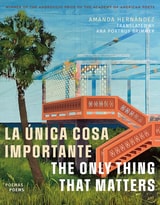
La única cosa importante / The Only Thing That Matters
Poemas / PoemsAmanda Hernández; Translated by Ana Portnoy Brimmer
University of Arizona Press, 2027
The poems featured in this award-winning collection contemplate the realities of the contemporary Puerto Rican experience. Rooted in the archipelago’s landscapes and the emotional topographies of diaspora, this collection confronts the fallout from colonialism while celebrating the sustaining power of friendship, memory, artistry, and collective love.
Holding together a scattered geography, the poems recognize land as both tangible territory and collective imaginary, reflecting on interconnected political, social, and economic crises that shape the intimacies of everyday life. With striking clarity and intimate reverence, Amanda Hernández names the fractures—and the hopes—that shape contemporary Puerto Rican life, ultimately affirming love as the force that endures.
Lacemakers
Claire McQuerry
Southern Illinois University Press, 2012
Ladder of Cranes
Tom Sexton
University of Alaska Press, 2015
Travelers along the way include the fabled wolf of Gubbio, old and lame and long past his taming encounter with Saint Francis of Assisi, and Chinese poet Li Bai chanting to a Yangtze River dolphin. Yet, while Sexton’s journey crosses borders—and occasionally centuries—his ultimate destination is always the landscape and people of Alaska. A Ladder of Cranes showcases Sexton’s mastery of both traditional forms and free verse. The tensions of his formal influences, Chinese and European, force the reader to experience these spare lines and tight observations in stunning new ways.
Lame God
M. B. McLatchey
Utah State University Press, 2013
In The Lame God, author M. B. McLatchey reminds us of the inevitable bond between art and empathy. With a controlled language that finds its echo chamber in the immortal themes and characters of classical literature, this courageous work accompanies the author on her journey through a parent’s anguish in the face of a horrific crime. Using the art of poetry she gives voice to a suffering—and a love—that might otherwise go unheard.
Lamentation for 77,297 Victims
Jirí Weil
Karolinum Press, 2020
So begins Jiří Weil’s unforgettable prose poem, Lamentation for 77, 297 Victims, his literary monument to the Czech Jews killed during the Holocaust. A Czech-Jewish writer who worked at Prague’s Jewish Museum both during and after the Nazi Occupation—he survived the Holocaust by faking his own death and hiding out until the war had ended—Weil wrote Lamentation while he served as the museum’s senior librarian in the 1950s. This remarkable literary experiment presents a number of innovative approaches to writing about a horror many would deem indescribable, combining a narrative account of the Shoah with newspaper-style reportage on a handful of the lives ended by the Holocaust and quotes from the Hebrew Bible to create a specific and powerful portrait of loss and remembrance. Translated by David Lightfoot, Lamentation for 77,297 Victims is a startling and singular introduction to a writer whose works have been acclaimed by Philip Roth, Michiko Kakutani, and Siri Hustvedt.

Land and Sea
The Lyric Poetry of Philip FreneauRichard C. Vitzthum
University of Minnesota Press, 1978
Land and Sea was first published in 1978. Minnesota Archive Editions uses digital technology to make long-unavailable books once again accessible, and are published unaltered from the original University of Minnesota Press editions.
Although Philip Freneau is best known as the poet of the American Revolution, half his poems had nothing to do with the war, Professor Vitzthum points out, and this, the first systematic, in-depth study of Freneau's lyric poetry, provides a fresh perspective on the poet's non-political work. Demonstrating that there is a heretofore unrecognized pattern of land-sea imagery and symbolism in Freneau's best work. Professor Vitzthum traces changes reflected in this imagery to developments in the poet's thought, which in turn related to major intellectual and literary trends in revolutionary and early republican America. An introductory chapter assesses twentieth century biographical and critical estimates of Freneau, outlines the key themes in his work, and links his thirty-year career as sailor and ship captain to his creation of a covert, symbolistic poetic method. The following five chapters chronologically discuss Freneau's non-political poems from 1772 through 1815. Professor Vitzthum concludes that Freneau was not the derivative and unsuccessful artist he is currently thought to have been but, rather, one of America's genuinely important poets.
Land of Fire
PoemsMario Chard
Tupelo Press, 2018
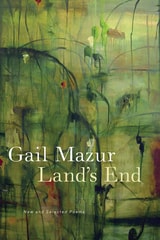
Land's End
New and Selected PoemsGail Mazur
University of Chicago Press, 2020
In Land’s End, we see Mazur writing with the kind of lyric authority, ever-deepening emotional range, and intellectual and social scope that her readers have come to expect in her poetry. Beautifully crafted elegies meet with reflections on her own life, her family, and artists who have come and gone. In the title poem, she leads readers through a garden, where new and old growth twists together in an “almanac of inheritances” that conjures the rich memory of poets who have passed on. In this space of remembrance, Mazur also charges us with the responsibility of nurturing art and artists of the future, especially in the face of the disheartening absurdities of contemporary politics. Contemplating the growth and decay so entwined in life, these poems invite us to consider both inevitable brokenness and necessary hope, writing “My work now: to continue learning to absorb the loss, / and live.”
Through tidal creeks and the weightless scenes of ukiyo-e woodcuts, in artists’ studios and along the frozen Charles River, Mazur connects passionately with the world around her. Carrying with her the undeniable presence of loss and of time past, she engages deeply with the present, her historic memory informing a deep concern for contemporary life. Reading Land’s End, we find ourselves with the poet:
together we’d have energies to do battle forever.
Landlocked
Julia McConnell
Michigan State University Press, 2023
Landscape Portrait Figure Form
Dean Rader
Omnidawn, 2014
Landscape with Bloodfeud
Wendy Barnes
University of Massachusetts Press, 2022
Landscape with Human Figure
Rafael Campo
Duke University Press, 2002
Landsickness
Leigh Lucas
Tupelo Press, 2024
Landsickness explores the inelegant progress of grief and pursues a relentless search for evidence of the beloved’s presence through the physics of splashes, the history of seasickness, and the science of depression. While full of tenderness, the poems employ humor and honesty to observe the ugliness of grief and the failure of elegy to restore the dead.
From the funeral to the office of her dead-end job to navigating the streets of New York, the speaker experiences a series of false starts as she learns to cope with her new life. Still, there is a real sense of progression in the collection’s end, even as the speaker continues to ask herself: “Why am I obsessed with the physics of his fall?"
Langston Hughes and the Blues
Steven C. Tracy
University of Illinois Press, 2024
Language, Sign and Gender in Beowulf
Gillian R. Overing
Southern Illinois University Press, 1990
Not a book about what Beowulf means but how it means, and how the reader participates in the process of meaning construction.
Overing’s primary aim is to address the poem on its own terms, to trace and develop an interpretive strategy consonant with the extent of its difference. Beowulf’s arcane structure describes cyclical repetitions and patterned intersections of themes which baffle a linear perspective, and suggest instead the irresolution and dynamism of the deconstructionist free play of textual elements.
Chapter 1 posits the self/reader as a function of the text/language, examining the ways in which the text "speaks" the reader. Chapter 2 develops an interactive semiotic strategy in an attempt to describe an isomorphic relation between poem and reader, between text and self. Chapter 3 addresses the notions of text and self as more complex functions or formulations of desire, and thus complicates and expands the arguments of the two preceding chapters. The final chapter examines the issue of desire in the poem, and, to a lesser extent, desire in the reader (insofar as these may legitimately be viewed as distinct from each other).
Lantern Puzzle
Ye Chun
Tupelo Press, 2015
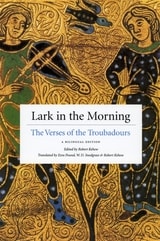
Lark in the Morning
The Verses of the Troubadours, a Bilingual EditionEdited by Robert Kehew
University of Chicago Press, 2005
Lark in the Morning honors the meter, word play, punning, and sound effects in the troubadours' works while celebrating the often playful, bawdy, and biting nature of the material. Here, Robert Kehew augments his own verse translations with those of two seminal twentieth-century poets—Ezra Pound and W. D. Snodgrass—to provide a collection that captures both the poetic pyrotechnics of the original verse and the astonishing variety of troubadour voices. This bilingual edition contains an introduction to the three major periods of the troubadours—their beginning, rise, and decline—as well as headnotes that briefly put each poet in context. Lark in the Morning will become an essential collection for those interested in learning about and teaching the origins of Western vernacular poetry.
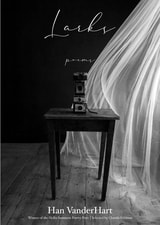
Larks
PoemsHan VanderHart
Ohio University Press, 2025
The core of Larks is rural and mythic and true, existential and domestic, tender while full of sharp grief and documentation. Circling genealogies of silence and harm in a southern family, Larks centers on the relationship and memories of three sisters and Ovid’s telling of Philomel. In a landscape inhabited as much by farm animals (cows, goats, chickens, and barn kittens) as by the family, the lyric poem parses and articulates the self’s history—from the experience of a sister’s home birth to the traumatic erasure (and recovery) of the speaker’s memory. A work of poetic memoir, Larks asks if poetry can hold the heaviest truths we carry. The answer is a resounding yes.
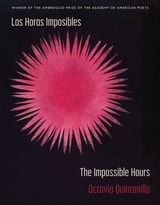
Las Horas Imposibles / The Impossible Hours
Octavio Quintanilla; Translated by Octavio Quintanilla and Natalia Treviño
University of Arizona Press, 2025
Presented in Spanish with English translations, this poetry collection comprises lyric and concrete poems—or frontextos—that explore intimacy and different shades of violence as a means to reconcile the speaker’s sense of belonging in the world. From the opening poem to the last in the first section, Quintanilla captures the perilous journeys that migrants undertake crossing borders as well as the paths that lovers forge to meet their endless longing. These themes are skillfully woven by Quintanilla, guiding us back and forth across the Rio Grande to encounter the apparitions of the disappeared and to witness the willingness of many to risk life and limb for a better life. The second half of the collection is one long poem, a letter addressed to a lost lover who will never get to read the speaker’s secret thoughts. Haunted by loss—of parents, of children, of the self—the speaker reaches an inevitable epiphany: “[A]nd sometimes it’s hard to know / on which side of the river I stand.” Stylistically, these poems destabilize our notions and expectations of genre and lyricism.
Las Horas Imposibles / The Impossible Hours is more than just an exercise in poetic virtuosity; it is an excavation into the complexities of what it means to be a human being in our contemporary world.
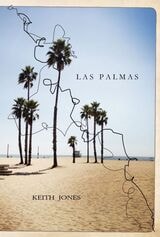
Las Palmas
Keith Jones
Omnidawn, 2026
The poems of Las Palmas conjure, walk beside, and tarry with the entangled grief of the long histories and violences in which we are all still embedded. Jones offers homage to the anguished beauties and truths that poet Jay Wright once said were “the disturbances” that “our ancestors create in us.” Grounded in musicality and haptics, Las Palmas seeks to salvage and mend while meditating on materiality, loss, cartography, kinship, displacement, coloniality, the “modern” world, and climate disasters. Throughout this collection, Keith Jones finds truth and community amid despair and the cruelest of circumstances, working through traumatic intimacies and mapping new imaginaries.
Las Palmas is the winner of the 2023 Omnidawn Poetry Chapbook Contest, selected by Brody Parrish Craig.
Las hormigas de oro / Ants of Gold
Poemas / PoemsEduardo Urios-Aparisi
Swan Isle Press, 2000
Last Day of My Face
James Shea
University of Iowa Press, 2025
Rich with reversals, short poems are wedged against skittery contemplations, and an easeful tone coexists with a vein of darkness. Akin to lucid dreaming, this startling volume builds toward a final poem that gathers fragments of selves into a wondrous whole.
Last Lake
Reginald Gibbons
University of Chicago Press, 2016
A slow parade of old west enthusiasts,
camp song and hymn, came in along the winding
way where rural declined to suburban, slow
riders and wagoners passing a cow staked
to graze, some penned cattle looking vacantly
up—not in vacant lots the ancient icons
of wealth they had been in odes, prayers and epics,
in sacrifices and customs of bride-price
or dowry. (It’s good people no longer make
blood sacrifices, at gas stations and stores,
for example, and in the crunching gravel
parking lots of small churches—oh but we do.)
“The evening forgives the alleyway,” Reginald Gibbons writes in his tenth book of poems—but such startling simplicities are overwhelmed in us by the everyday and the epochal. Across the great range of Gibbons’s emblematic, vividly presented scenes, his language looks hard at and into experience and feeling. Words themselves have ideas, and have eyes—inwardly looking down through their own meanings, as the poet considers a lake in the Canadian north, a Chicago neighborhood, a horse caravan in Texas, a church choir, a bookshelf, or an archeological dig on the steppes near the Volga River. The last lake is the place of both awe and elegy.
Last Seen
Jacqueline Jones LaMon
University of Wisconsin Press, 2011
Inspired by actual case histories of long-term missing African American children, this provocative and heartrending collection of poems evokes the experience of what it means to be among the missing in contemporary America. This thought-provoking collection of persona poems looks at absence from the standpoint of the witnesses surrounding the void and offers an intimate depiction of those impossible moments of aftermath lived by those who remain accounted for and present. While enabling us to question our own sense of identity, this unique collection of poems reveals the blurred edges of separation between them and us and the impact that the missing have upon our present and future.
Finalist, NAACP Image Awards
Late Fire, Late Snow
New and Uncollected PoemsRobert Francis
University of Massachusetts Press, 1992
Late Invocation for Magic
Jim Daniels
Michigan State University Press, 2026
In poems selected from his long career, Jim Daniels focuses on Detroit and other Rust Belt cities, where issues of class and race and justice play out in the streets and kitchens and backyards and garages of the Americans trying to live and make a living there. Known for his courage, clarity, and accessibility, Daniels examines the tension between our idealized country and the messier cultural and economic divides, often focusing on those who can’t afford or have access to “magic.”
Late Psalm
Betshy Sholl
University of Wisconsin Press, 2004
Late Psalm takes themes from those ancient songs of joy and grief and transposes them into the language of contemporary life.

Late Self-Portraits
Mary Morris
Michigan State University Press, 2022
From “Dinner with Hades”:
He shows me a birthday cake, candled. My name is written in pomegranate
seeds. It’s like vertigo. Just before he seeks to devour, he halts to birdsong—
sound of goldfinch, bluebird, hawk, lilting of sparrows. Of whippoorwill
and dove. Wings flap, so many wings, a cool breeze as leaves unfurl into a
once forgotten green and I am back on earth, held in my mother’s arms.

Laughing Africa
Terese Svoboda
University of Iowa Press, 1990
There is a large intelligence present in Terese Svoboda's poetry and not a shred of sentimentality. From the dramatic coming-of-age in the title poem to the question posed in the last section, "What will I say to my child as it snows / that last winter's papery afterglow?" she continually searches for a responsible, compassionate world, one in which the only illusion is art.
The mythological central poem, "The Ranchhand's Daughter," shows the gods of isolation and incest warring against each other, destroying a triangle of love and cut into the granite-faced Badlands. It is only in the sensuous landscape of the domestic that possible redemption occurs: the father who dreams of running for president, the mother who signs in the mirror, the couple in the shower with "confidence rising between them." Faced with the inevitable losses, Svoboda strives for meaning and beauty.

Laughing Lost in the Mountains
Poems of Wang WeiWei Wang
University Press of New England, 1992
Laughter Before Sleep
Robert Pack
University of Chicago Press, 2011
One of America’s most eminent nature poets, Robert Pack has won the acclaim of writers, critics, and readers from Stephen Jay Gould to Mark Strand. In his latest collection, Laughter Before Sleep, Pack carries on his themes of family and friends, responsibility to the natural world of evolved diversity, the transience of life, the fragility of happiness, and the consolations offered by art and music.
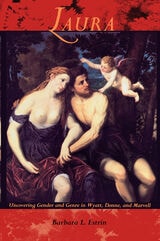
Laura
Uncovering Gender and Genre in Wyatt, Donne and MarvellBarbara L. Estrin
Duke University Press, 1994
Through close readings of the Rime sparse and the works of Wyatt, Donne, and Marvell, Estrin uncovers three Lauras: Laura-Daphne, who denies sexuality; Laura-Eve, who returns the poet’s love; and Laura-Mercury, who reinvents her own life. Estrin claims that in these three guises Laura subverts both genre and gender, thereby introducing multiple desires into the many layers of the poems. Drawing upon genre and gender theories advanced by Jean-François Lyotard and Judith Butler to situate female desire in the poem’s framework, Estrin shows how genre and gender in the Petrarchan tradition work together to undermine the stability of these very concepts.
Estrin’s Laura constitutes a fundamental reconceptualization of the Petrarchan tradition and contributes greatly to the postmodern reassessment of the Renaissance period. In its descriptions of how early modern poets formulate questions about sexuality, society and poetry, Laura will appeal to scholars of the English and Italian Renaissance, of gender studies, and of literary criticism and theory generally.
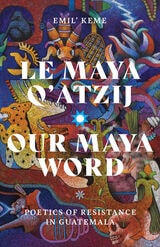
Le Maya Q’atzij/Our Maya Word
Poetics of Resistance in GuatemalaEmil’ Keme
University of Minnesota Press, 2021
Bringing to the fore the voices of Maya authors and what their poetry tells us about resistance, sovereignty, trauma, and regeneration
In 1954, Guatemala suffered a coup d’etat, resulting in a decades-long civil war. During this period, Indigenous Mayans were subject to displacement, disappearance, and extrajudicial killing. Within the context of the armed conflict and the postwar period in Guatemala, K’iche’ Maya scholar Emil’ Keme identifies three historical phases of Indigenous Maya literary insurgency in which Maya authors use poetry to dignify their distinct cultural, political, gender, sexual, and linguistic identities.
Le Maya Q’atzij / Our Maya Word employs Indigenous and decolonial theoretical frameworks to critically analyze poetic works written by ten contemporary Maya writers from five different Maya nations in Iximulew/Guatemala. Similar to other Maya authors throughout colonial history, these authors and their poetry criticize, in their own creative ways, the continuing colonial assaults to their existence by the nation-state. Throughout, Keme displays the decolonial potentialities and shortcomings proposed by each Maya writer, establishing a new and productive way of understanding Maya living realities and their emancipatory challenges in Iximulew/Guatemala.
This innovative work shows how Indigenous Maya poetics carries out various processes of decolonization and, especially, how Maya literature offers diverse and heterogeneous perspectives about what it means to be Maya in the contemporary world.
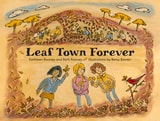
Leaf Town Forever
Beth Rooney
University of Minnesota Press, 2025
The true story of a Midwestern “town” created with leaves, sticks, and children’s imaginations
Leaf Town suddenly springs up. One day the clearing outside the school is empty, and the next it’s a bustling town complete with a hotel, shop, and mayor. Children gather and find treasures everywhere: feathers, acorns, lost rings, an old medal, and plenty of leaves and pine needles. They even uncover a silver skeleton key in the muddy banks of a nearby creek and proclaim it the heart of Leaf Town. As the town grows, it attracts the attention of the kids up the street, and a colossal fight threatens to destroy everything that was built. But the heart of Leaf Town is saved, and the kids rally to rebuild their city together, expanding to welcome the neighboring kids as well as all sorts of birds and animals. They hang a sign, Leaf Town Forever, and pass the key to the next generation of children who will look after their beloved town.
Based on a true story, Leaf Town Forever is the gentle tale of a town created by children with vivid imaginations. The timeless and universal saga, written in haiku, reminds both kids and adults that some dreams are worth protecting. Unfurling over the cycle of seasons, this is the story of an enchanting place full of tenacity and hope, creativity and fun—a connection to the natural world within reach for us all if we unite to make and maintain it.

Leap & Grow Feathers
Yona Harvey
Four Way Books, 2026
Both an instruction and a divination, Leap & Grow Feathers is an extraordinary transmission. In her third full-length collection, Yona Harvey listens — to her predecessors, her instincts, and her environment — gleaning sense from the static fraying our nerves, knowing the personal and the historical travel along the same frequency. Responding to the physical disruption and emotional disassociation of of the COVID-19 pandemic, the poet argues that the societal insistence on returning to “business as usual” reflects an institutional, academic, and political ineptitude to provide either physiological healing or social repair, a structural denial that erodes our humanity. As authoritarianism and ecological devastation progressively encroach on our lives, these poems prioritize hoodoo, spirit, intuition, and ancestral conversations in their readings, invoking the carekeeping and persistence of Harriet Tubman, Nikki Giovanni, and the countless forbears, unnamed and named, who traveled the Middle Passage and the Kalunga Crossing. This book channels the power and promise of that legacy as well as the full emotional range of sisterhood, the heartache and borrowed strength and shared laughter. Its humor, whitespace, sparseness, and longform narratives elicit reader participation and, in turn, enduring consideration. "This float. This bob. This drown. This rock. // (This Rock. This Rock.) // This Great Goddamn." What do we find in this vastness, the simultaneity of the ever expanding time that lies ahead and full presence of history consolidating here now? An invitation to join Harvey in her vow: “May I never pretend, / May eye be I.” This collection unveils our vision so we can see it all, not only yesterday’s “Nina Simone lyric / Spun out over a newborn Sunday” in this very moment but also the music unfurling over each incipient morning of the future world we might build together. Leap & Grow Feathers describes and directs: everything we need to survive, to shelter one another, and to protect the Earth lives already in our bodies, our lineages, and our lore.
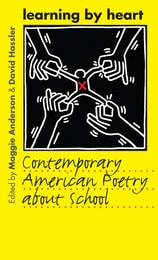
Learning by Heart
Contemporary American Poetry about SchoolMaggie Anderson
University of Iowa Press, 1999
Learning by Heart brings together a unique and diverse collection of poems about the experience of school as seen through the eyes of America's best contemporary poets. These poets capture the educational process not only in the classroom but as it takes place in libraries and hallways, on playing fields and at dances. Alternately joyous and defiant, they demonstrate how it is that young people come to find their place in the world.
Most of the poems in this anthology were written between 1970 and 1995, a period that encompasses both the halcyon years of poets-in-the-schools programs and the primary and secondary school years of many of the poets included. Their poems define school in that most contemporary sense — “with a multitude of voices”—reflecting perspectives from African American, Hispanic American, Asian American, and Native American as well as Anglo American backgrounds, from both public and private schools in rural and urban environments.
Learning by Heart offers a profound and timely statement about schools and learning as well as the role of art in education. Finally, these poems validate that most important lesson: even the most common of experiences is worthy of creative expression.
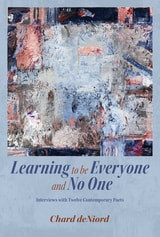
Learning to Be Everyone and No One
Interviews with Twelve Contemporary PoetsChard deNiord
University of Alabama Press, 2026
Intimate, unfiltered conversations with major contemporary poets that reveal how craft, conscience, and lived experience shape poetry
Learning to Be Everyone and No One is a compelling collection of intimate interviews that captures poets speaking with uncommon candor about the making of their art. Through lively, unguarded conversations, Chard deNiord draws out moments of insight, humor, struggle, and revelation, revealing how poetry grows from lived experience and sustained attention. The result is an experience that feels immediate and alive, offering readers a sense of presence inside the creative act as it unfolds in real time.
Gathering voices that have helped shape contemporary poetry, the book features conversations with Robert Hass, T. R. Hummer, Major Jackson, Ali Kinsella, Halyna Kruk, Li-Young Lee, Ada Limón, Dennis Nurske, Dzvinia Orlowsky, Robert Pinsky, Charles Simic, Bruce Smith, Gerald Stern, Ruth Stone, and Chase Twichell. Together, these poets reflect on identity, politics, race, gender, memory, and the natural world with wit, urgency, and precision. More than a record of distinguished careers, this volume forms a chorus of perspectives that affirms poetry’s enduring power to challenge, console, and remain “the news that stays the news.”
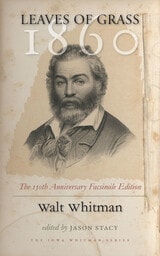
Leaves of Grass, 1860
The 150th Anniversary Facsimile EditionWhitman, Walt
University of Iowa Press, 2009
In May 1860, Walt Whitman published a third edition of Leaves of Grass. His timing was compelling. Printed during a period of regional, ideological, and political divisions, written by a poet intimately concerned with the idea of a United States as “essentially the greatest poem,” this new edition was Whitman’s last best hope for national salvation. Now available in a facsimile edition, Leaves of Grass, 1860 faithfully reproduces Whitman’s attempt to create a “Great construction of the New Bible” to save the nation on the eve of civil war and, for the first time, frames the book in historical rather than literary terms.
In his third edition, Whitman added 146 new poems to the 32 that comprised the second edition, reorganized the book into a bible of American civic religion that could be cited chapter and verse, and included erotic poetry intended to bind the nation in organic harmony. This 150th anniversary edition includes a facsimile reproduction of the original 1860 volume, a thought-provoking introduction by antebellum historian and Whitman scholar Jason Stacy that situates Whitman in nineteenth-century America, and annotations that provide detailed historical context for Whitman’s poems.
A profoundly rich product of a period when America faced its greatest peril, this third edition finds the poet transforming himself into a prophet of spiritual democracy and the Whitman we celebrate today—boisterous, barbaric, and benevolent. Reprinting it now continues the poet’s goal of proclaiming for “the whole of America for each / individual, without exception . . . uncompromising liberty and equality.”
Leaving
Laton Carter
University of Chicago Press, 2004
Leaving Tulsa
Jennifer Elise Foerster
University of Arizona Press, 2013
In her first magical collection of poetry, Jennifer Elise Foerster weaves together a mythic and geographic exploration of a woman’s coming of age in a dislocated time. Leaving Tulsa, a book of road elegies and laments, travels from Oklahoma to the edges of the American continent through landscapes at once stark and lush, ancient and apocalyptic. The imagery that cycles through the poems—fire, shell, highway, wing—gives the collection a rich lyrical-dramatic texture. Each poem builds on a theme of searching for a lost “self”—an “other” America—that crosses biblical, tribal, and ecological mythologies.
In Leaving Tulsa, Foerster is not afraid of the strange or of estrangement. The narrator occupies a space in between and navigates the offbeat experiences of a speaker that is of both Muscogee and European heritage. With bold images and candid language, Foerster challenges the perceptions of what it means to be Native, what it means to be a woman, and what it means to be an American today. Ultimately, these brave and luminous poems engage and shatter the boundaries of time, self, and continent.
Foerster’s journey transcends both geographic space and the confines of the page to live vividly in the mind of the reader.
Ledger
Wheeler, Susan
University of Iowa Press, 2005

Left Turns in Brown Study
Sandra Ruiz
Duke University Press, 2024
Leprosarium
PoemsLise Goett
Tupelo Press, 2018
Let It Be Broke
Ed Pavlic
Four Way Books, 2020
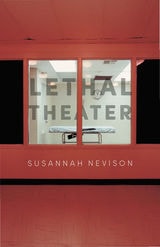
Lethal Theater
Susannah Nevison
The Ohio State University Press, 2019
Reckons with the rituals of violence that underpin the American prison system, asking readers to consider the act and complications of looking at violence and suffering.
In Lethal Theater, Susannah Nevison offers a stark and lyrical reckoning with the hidden architectures of the American prison system. These poems inhabit the charged territory where medicine and punishment converge, revealing how the body becomes both patient and instrument under state control. Moving through histories of wartime confinement, interrogation, and isolation, Nevison writes a poetry of witness to the carceral state, illuminating what is so often kept from view.
With precision and moral force, Nevison examines the shadows cast by medical experimentation on imprisoned bodies, the blurred boundary between hospital anesthesia and the drugs used in lethal injection protocols, and the rituals of surveillance that shape life behind bars. This is a work rooted in the medical humanities of confinement, an inquiry into how suffering is recorded, observed, and, at times, rendered invisible.
Lethal Theater makes visible the brutal logics beneath state-sanctioned pain and insists on the urgency—and responsibility—of looking closely at what the nation asks its incarcerated to endure.

Letters and Poems to and from Her Mentor and Other Members of Her Circle
Anna Maria van Schurman
Iter Press, 2021
This volume presents in translation a remarkable collection of her letters and poems—many of which were previously unpublished—that span almost four decades of her life, from 1631 to 1669.