Results by title
382 books match the query 'Southwest (AZ, NM, OK, TX)' and 19 start with l
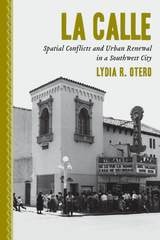
La Calle
Spatial Conflicts and Urban Renewal in a Southwest CityLydia R. Otero
University of Arizona Press, 2010
Otero examines conflicting claims to urban space, place, and history as advanced by two opposing historic preservationist groups: the La Placita Committee and the Tucson Heritage Foundation. Otero gives voice to those who lived in, experienced, or remembered this contested area, and analyzes the historical narratives promoted by Anglo American elites in the service of tourism and cultural dominance.
La Calle explores the forces behind the mass displacement: an unrelenting desire for order, a local economy increasingly dependent on tourism, and the pivotal power of federal housing policies. To understand how urban renewal resulted in the spatial reconfiguration of downtown Tucson, Otero draws on scholarship from a wide range of disciplines: Chicana/o, ethnic, and cultural studies; urban history, sociology, and anthropology; city planning; and cultural and feminist geography.
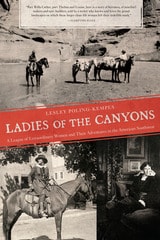
Ladies of the Canyons
A League of Extraordinary Women and Their Adventures in the American SouthwestLesley Poling-Kempes
University of Arizona Press, 2015
Educated, restless, and inquisitive, Natalie Curtis, Carol Stanley, Alice Klauber, and Mary Cabot Wheelwright were plucky, intrepid women whose lives were transformed in the first decades of the twentieth century by the people and the landscape of the American Southwest. Part of an influential circle of women that included Louisa Wade Wetherill, Alice Corbin Henderson, Mabel Dodge Luhan, Mary Austin, and Willa Cather, these ladies imagined and created a new home territory, a new society, and a new identity for themselves and for the women who would follow them.
Their adventures were shared with the likes of Theodore Roosevelt and Robert Henri, Edgar Hewett and Charles Lummis, Chief Tawakwaptiwa of the Hopi, and Hostiin Klah of the Navajo. Their journeys took them to Monument Valley and Rainbow Bridge, into Canyon de Chelly, and across the high mesas of the Hopi, down through the Grand Canyon, and over the red desert of the Four Corners, to the pueblos along the Rio Grande and the villages in the mountains between Santa Fe and Taos.
Although their stories converge in the outback of the American Southwest, the saga of Ladies of the Canyons is also the tale of Boston’s Brahmins, the Greenwich Village avant-garde, the birth of American modern art, and Santa Fe’s art and literary colony.
Ladies of the Canyons is the story of New Women stepping boldly into the New World of inconspicuous success, ambitious failure, and the personal challenges experienced by women and men during the emergence of the Modern Age.
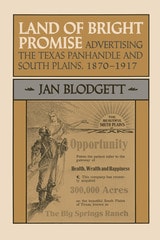
Land of Bright Promise
Advertising the Texas Panhandle and South Plains, 1870-1917By Jan Blodgett
University of Texas Press, 1988
“It shall be the chosen land, perpetual sunshine shall kiss its trees and vines, and, being storied in luscious fruits and compressed into ruddy wine, will be sent to the four points of the compass to gladden the hearts of all mankind . . . They will breathe the pure and bracing air, bask in the healing sunshine, drink the invigorating wine, and eat the life prolonging fruit.” —from a brochure advertising the Staked Plains from the Missouri Pacific Railway Company, 1889
Land of Bright Promise is a fascinating exploration of the multitude of land promotions and types of advertising that attracted more than 175,000 settlers to the Panhandle–South Plains area of Texas from the late years of the nineteenth century to the early years of the twentieth. Shunned by settlers for decades because of its popular but forbidding image as a desert filled with desperados, savage Indians, and solitary ranchers, the region was seen as an agricultural and cultural wasteland. The territory, consequently, was among the last to be settled in the United States.
But from 1890 to 1917, land companies and agents competed to attract new settlers to the plains. To this end, the combined efforts of local residents, ranchers and landowners, railroads, and professional real estate agents were utilized. Through brochures, lectures, articles, letters, fairs, and excursion trips, midwestern farmers were encouraged to find new homes on what was once feared as the “Great American Desert.” And successful indeed were these efforts: from 13,787 in 1890, the population grew to 193,371 in 1920, with a corresponding increase in the amount of farms and farm acreage.
The book looks at the imagination, enthusiasm, and determination of land promoters as they approached their task, including their special advertisements and displays to show the potential of the area. Treating the important roles of the cattlemen, the railroads, the professional land companies, and local boosters, Land of Bright Promise also focuses on the intentions and expectations of the settlers themselves. Of special interest are the fifteen historical photographs and reproductions of promotional pieces from the era used to spur the land boom. What emerges is an engaging look at a critical period in the development of the Texas Panhandle and an overview of the shift from cattle to agriculture as the primary industry in the area.

Land of the Underground Rain
Irrigation on the Texas High Plains, 1910-1970By Donald E. Green
University of Texas Press, 1973
The scarcity of surface water which has so marked the Great Plains is even more characteristic of its subdivision, the Texas High Plains. Settlers on the plateau were forced to use pump technology to tap the vast ground water resources—the underground rain—beneath its flat surface.
The evolution from windmills to the modern high-speed irrigation pumps took place over several decades. Three phases characterized the movement toward irrigation. In the period from 1910 to 1920, large-volume pumping plants first appeared in the region, but, due to national and regional circumstances, these premature efforts were largely abortive. The second phase began as a response to the drouth of the Dust Bowl and continued into the 1950s. By 1959, irrigation had become an important aspect of the flourishing High Plains economy. The decade of the 1960s was characterized chiefly by a growing alarm over the declining ground water table caused by massive pumping, and by investigations of other water sources.
Land of the Underground Rain is a study in human use and threatened exhaustion of the High Plains' most valuable natural resource. Ground water was so plentiful that settlers believed it flowed inexhaustibly from some faraway place or mysteriously from a giant underground river. Whatever the source, they believed that it was being constantly replenished, and until the 1950s they generally opposed effective conservation of ground water. A growing number of weak and dry wells then made it apparent that Plains residents were "mining" an exhaustible resource.
The Texas High Plains region has been far more successful in exploiting its resource than in conserving it. The very success of its pump technology has produced its environmental crisis. The problem brought about by the threatened exhaustion of this resource still awaits a solution.
This study is the first comprehensive history of irrigation on the Texas High Plains, and it is the first comprehensive treatment of the development of twentieth-century pump irrigation in any area of the United States.

Landmarks of Texas Architecture
Lawrence W. Speck
University of Texas Press, 1986
"This selection of twenty of Texas' proudest architectural achievements is a tiny sampling of the state's rich, but little-heralded, architectural heritage. The visual presentation of these buildings in Richard Payne's insightful photographs is evidence enough to any student of Texas culture that there are deep and meaningful tracks of our civilization in the state's built environment. . . . In the stones of the Alamo and the steel and glass of our downtown skyscrapers lie the silent embodiment of who we are and where we have been."
—from the Introduction
Texas architecture has never been, nor is it likely to be in the future, an easily digested whole. This collection, drawn from the 1983 Texas Society of Architects' exhibit "Creating Tomorrow's Heritage," provides a look at twenty of the most interesting responses to the challenges posed by Texas history and geography. It reveals that what Texas architecture lacks in cohesiveness, it more than compensates for in vitality. Variations in circumstance and background, coupled with the kind of freedom which heterogeneity breeds, have produced a lively climate for architectural development in Texas—a place where, in the absence of pat answers, intriguing questions have been raised. The same freedom which has produced a dearth of cohesion has encouraged exploration and invention. The same disparities which have made tidy categorization of historical movements or periods difficult have led to some evocative hybrids—new and telling syntheses which are genuinely of their place.
Of interest to anyone who has strolled the Paseo del Rio in San Antonio or admired the dramatically lit State Capitol at night, Landmarks of Texas Architecture is a book to be looked at and enjoyed, a place to start in creating one's own list of architectural favorites. Part of the growing interest in Texas history and culture, Landmarks adds to our understanding of the forces which shaped the Texas of yesterday and will build the Texas of tomorrow.

Last Gangster in Austin
Frank Smith, Ronnie Earle, and the End of a Junkyard MafiaJesse Sublett
University of Texas Press, 2021
Ronnie Earle was a Texas legend. During his three decades as the district attorney responsible for Austin and surrounding Travis County, he prosecuted corrupt corporate executives and state officials, including the notorious US congressman Tom DeLay. But Earle maintained that the biggest case of his career was the one involving Frank Hughey Smith, the ex-convict millionaire, alleged criminal mastermind, and Dixie Mafia figure.
With the help of corrupt local authorities, Smith spent the 1970s building a criminal empire in auto salvage and bail bonds. But there was one problem: a rival in the salvage business threatened his dominance. Smith hired arsonists to destroy the rival; when they botched the job, he sent three gunmen, but the robbery they planned was a bloody fiasco. Investigators were convinced that Smith was guilty, but many were skeptical that the newly elected and inexperienced Earle could get a conviction. Amid the courtroom drama and underworld plots the book describes, Willie Nelson makes a cameo. So do the private eyes, hired guns, and madams who kept Austin not only weird but also riddled with vice. An extraordinary true story, Last Gangster in Austin paints an unusual picture of the Texas capital as a place that was wild, wonderful, and as crooked as the dirt road to paradise.
Late Prehistoric Bison Procurement in Southeastern New Mexico
The 1977 Season at the Garnsey SiteJohn D. Speth and William J. Parry
University of Michigan Press, 1978
Late Prehistoric Bison Procurement in Southeastern New Mexico
The 1978 Season at the Garnsey Site (LA-18399)John D. Speth and William J. Parry
University of Michigan Press, 1980

Letters from Wupatki
Courtney Reeder Jones; Edited by Lisa Rappoport
University of Arizona Press, 1995
The year was 1938, and the newlyweds had come to Wupatki National Monument as full-time National Park Service caretakers for the ruin. Remote in time and place, their story as described in Courtney's letters will take readers into a dramatic landscape of red rocks, purple volcanoes, and endless blue sky. Here, some 60 years ago, two young people came to terms with their new life together and with their nearly total reliance upon each other and their Navajo neighbors.
"They helped us in any way that a neighbor would, and we helped them as we could," wrote Courtney in her memoirs years later. Vivid and engaging, her letters home spill over with descriptions of their friendship with local Navajo families, their sings and celebrations, and her good luck in being able to be a part of it all.
Letters from Wupatki captures a more innocent era in southwestern archaeology and the history of the National Park Service before the post-war years brought paved roads, expanded park facilities, and ever-increasing crowds of visitors. Courtney's letters to her family and friends reflect all the charm of the earlier time as they convey the sense of rapid transition that came after the war.
Tracking those changes in the development of Wupatki National Monument and the National Park Service, the letters also—and perhaps more important—reveal changes in the Joneses themselves. Of particular interest to anthropologists and historians, their story also gives the general reader captivating glimpses of a partnership between two people who only grew stronger for the struggles they shared together.
Letters from the Southwest
Charles Lummis; Edited by James W. Byrkit
University of Arizona Press, 0
In the fall of 1884, journalist Charles Lummis set out on foot from Ohio to California on assignment for the Los Angeles Times. The reports he mailed ahead to that newspaper were later refashioned for the book A Tramp Across the Continent, a work that helped to establish Lummis as the most active promoter of Southwestern culture who ever lived.
Lummis wrote another set of letters during his journey, however, which he sent back to Ohio for publication by the Chillicothe Leader. Although these letters contain basically the same narrative as those sent to Los Angeles and later found in A Tramp, the Ohio letters more closely reflect the author’s thoughts and observations while on the journey. In fact, a comparison of the two drafts indicates that Lummis spent considerable effort removing spontaneous details from the Ohio letters in favor or a more commercial, self-promoting, and politic reporting for the California paper.
The twenty-four Ohio letters, assembled here by James W. Byrkit, offer a far more candid look at the Southwest than Lummis was later to bring to print, as well as greater insight into the author’s own personality. Byrkit’s introductory essay provides the background for Lummis’s career, compares the three bodies of work relating to the trek, and offers an account of Lummis’s transformation from chronicler to promoter.

Life and Labor on the Border
Working People of Northeastern Sonora, Mexico, 1886–1986Josiah McC. Heyman
University of Arizona Press, 1991
Life and Labor on the Border traces the development of the urban working class in northern Sonora over the period of a century. Drawing on an extensive collection of life histories, Heyman describes what has happened to families over several generations as people have left the countryside to work for American-owned companies in northern Sonora or to cross the border to find other employment.
Heyman searches for the origins of "working classness" in these family histories, revealing aspects of life that strengthen people' s involvement with a consumer economy, including the role of everyday objects like sewing machines, cars, and stoves. He considers the consequences of changing political and economic tides, and also the effects on family life of the new role of women in the labor force. Within the broad sweep of family chronicles, key junctures in individual lives—both personal and historical crises—offer additional insights into social class dynamics.
Heyman's work dispels the notion that border inhabitants are uniformly impoverished or corrupted by proximity to the United States. These life stories instead convey the positive sense of people's goals in life and reveal the origins of a distinctive way of life in the Borderlands.

Life on the Periphery
Economic Change in Late Prehistoric Southeastern New MexicoEdited by John D. Speth
University of Michigan Press, 2004
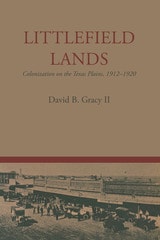
Littlefield Lands
Colonization on the Texas Plains, 1912–1920By David B. Gracy II
University of Texas Press, 1968
The phenomenon of colonization by big land companies, common throughout the history of the United States, came late to the Panhandle-Plains of West Texas. Ranchers held sway there up into the 20th century. Then, realizing that the future followed the plow, they, joined by business owners and speculators, founded towns on their land, competed for railroad connections, provided irrigation wells and other improvements, and engaged in a variety of advertising activities to interest prospective settlers and to sell the land to farmers at a profit. Trainloads of such "prospectors" were brought in to tour the land; and salesmen of all kinds roamed all the more settled states painting enticing pictures of the fertile lands which their employers offered for sale.
Major George W. Littlefield created the Littlefield Lands Company and founded the town of Littlefield, Texas, in 1912, in order to sell as farmland a part of his Yellow House Ranch. His sales manager, Arthur P. Duggan (his nephew by marriage, and grandfather of the author of this study), used many of the techniques then current to attract buyers for the Lamb County land in and around Littlefield. He dug wells and operated a demonstration farm; he planted trees, planned a park, and otherwise beautified the town; he helped to create and maintain a school, a bank, and a number of businesses; and he negotiated contracts and coordinated the activities of innumerable independent land agents.
Because the role of the big land company in the settlement of the United States has not, on the whole, received the attention which it deserves, this detailed examination of the operations of one such company is of particular significance. Most of the book is devoted to the creation of the company, the steps taken to make the area attractive to potential settlers, and the problems which beset the building of the community. One chapter discusses the techniques and the difficulties of selling land through independent agents. The final chapter considers the people who moved onto the Littlefield tracts—where they came from, why they came, what their reactions were to the plains country, and how they learned to cope with their new environment. An appendix gives pertinent information about all land transactions conducted by the company between 1912 and 1920, and about each buyer.
For this study the author made use of previously unknown records discovered while he was gathering information for a biography of Major Littlefield.

Lizards on the Mantel, Burros at the Door
A Big Bend MemoirBy Etta Koch with June Cooper Price
University of Texas Press, 1999
A woman who went West with her husband in the 1840s must have expected hardships and privation, but during the 1940s, when Etta Koch stopped off in Big Bend with her young family and a 23-foot travel trailer in tow, she anticipated no more than a civilized camping trip between her old home in Ohio and a new one in Arizona. It was only when she found herself moving into an old rock house without plumbing or electricity in the new Big Bend National Park that Etta realized, "From the sheltered life of a city girl of moderate circumstances, I too would have to face the reality of frontier living."
In this book based on her journals and letters, Etta Koch and her daughter June Cooper Price chronicle their family's first years (1944-1946) in the Big Bend. Etta describes how her photographer husband Peter Koch became captivated by the region as a place for natural history filmmaking-and how she and their three young daughters slowly adapted to a pioneer lifestyle during his months' long absences on the photo-lecture circuit. In vivid, often humorous anecdotes, she describes making the rock house into a home, getting to know the Park Service personnel and other neighbors, coping with the local wildlife, and, most of all, learning to love the rugged landscape and the hardy individuals who call it home.

Lone Star Vistas
Travel Writing on Texas, 1821-1861By Astrid Haas
University of Texas Press, 2021
Every place is a product of the stories we tell about it—stories that do not merely describe but in fact shape geographic, social, and cultural spaces. Lone Star Vistas analyzes travelogues that created the idea of Texas. Focusing on the forty-year period between Mexico’s independence from Spain (1821) and the beginning of the US Civil War, Astrid Haas explores accounts by Anglo-American, Mexican, and German authors—members of the region’s three major settler populations—who recorded their journeys through Texas. They were missionaries, scientists, journalists, emigrants, emigration agents, and military officers and their spouses. They all contributed to the public image of Texas and to debates about the future of the region during a time of political and social transformation. Drawing on sources and scholarship in English, Spanish, and German, Lone Star Vistas is the first comparative study of transnational travel writing on Texas. Haas illuminates continuities and differences across the global encounter with Texas, while also highlighting how individual writers’ particular backgrounds affected their views on nature, white settlement, military engagement, Indigenous resistance, African American slavery, and Christian mission.

Lone Stars III
A Legacy of Texas Quilts, 1986-2011By Karoline Patterson Bresenhan and Nancy O'Bryant Puentes
University of Texas Press, 2011
From frontier times in the Republic of Texas until today, Texans have been making gorgeous quilts. Karoline Patterson Bresenhan and Nancy O'Bryant Puentes documented the first 150 years of the state's rich heritage of quilt art in Lone Stars: A Legacy of Texas Quilts, 1836–1936 and Lone Stars II: A Legacy of Texas Quilts, 1936–1986. Now in Lone Stars III, they bring the Texas quilt story into the twenty-first century, presenting two hundred traditional and art quilts that represent "the best of the best" quilts created since 1986.
The quilts in Lone Stars III display the explosion of creativity that has transformed quilting over the last quarter century. Some of the quilts tell stories, create landscapes, record events, and memorialize people. Others present abstract designs that celebrate form and color. Their makers have embraced machine quilting, as well as hand sewing, and they often embellish their quilts with buttons, beads, lace, ribbon, and even more exotic items. Each quilt is pictured in its entirely, and some entries also include photographs of quilt details. The accompanying text describes the quilt's creation, its maker, and its physical details.
With 16.3 million American quilters who spend $3.6 billion annually on their pastime, the quilting community has truly become a force to reckon with both artistically and socially. Lone Stars III is the perfect introduction to this world of creativity.
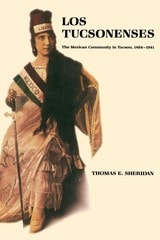
Los Tucsonenses
The Mexican Community in Tucson, 1854–1941Thomas E. Sheridan
University of Arizona Press, 1986
Lucky 7
A Cowman's AutobiographyBy Will Tom Carpenter
University of Texas Press, 1957
"No. 7"—as Carpenter, the youngest of seven children, called himself—was born in Missouri in 1854 and moved west with his family, first to Kansas, then to the settlements near Pikes Peak, and finally, in 1872, to Texas with his elder brother. From the time he made his first cattle drive, he wanted no other life but that of herding longhorns across the free and flat grasslands of the West. His schooling was the trail, the campfire, the saddle. In 1900, after a full and active life, he retired to his own ranch west of the Pecos. As the years passed, he sadly watched the fences go up and the free range disappear. Thus this book came to be written from the longing memory of a time-stranded cowman. He tells his story in the hard-punching, gritty language, direct humor, and attachment to bald fact and frank opinion that characterize the true Westerner.
Elton Miles has provided an introduction that fills in the details of Carpenter's life and completes a "vivid picture of the genuine old-time cowman," as Southwest Review observed.
Lynching and Leisure
Race and the Transformation of Mob Violence in TexasTerry Anne Scott
University of Arkansas Press, 2022
Winner, 2022 Ottis Lock Endowment “Best Book” Award from the East Texas Historical Association
In Lynching and Leisure, Terry Anne Scott examines how white Texans transformed lynching from a largely clandestine strategy of extralegal punishment into a form of racialized recreation in which crowd involvement was integral to the mode and methods of the violence. Scott powerfully documents how lynchings came to function not only as tools for debasing the status of Black people but also as highly anticipated occasions for entertainment, making memories with friends and neighbors, and reifying whiteness. In focusing on the sense of pleasure and normality that prevailed among the white spectatorship, this comprehensive study of Texas lynchings sheds new light on the practice understood as one of the chief strategies of racial domination in the nineteenth- and twentieth-century South.