Results by title
461 books match the query 'Teaching' and 13 start with l

Leaping into Dance Literacy through the Language of Dance®
Teresa Heiland
Intellect Books, 2023
This book presents the theory and purpose underpinning the approaches to dance literacy as explored by the Language of Dance community in the United States and the United Kingdom. Through their teacher training programs, the community is changing the face of dance-based dance literacy using the practice of motif notation.
Arts literacy can deepen dance craft and transfer arts knowledge, capacities, and skills to lifelong learning. Dance-based dance literacy practices using notation enhance learners’ flexibility, adaptability, self-direction, initiative, productivity, responsibility, leadership, and cross-cultural skills. This volume ushers in a new era for educating with dance notation that focuses on learners’ engagement by making connections between the learning domains using constructivist and constructionist learning approaches. Based on work by dance educator Ann Hutchinson Guest and expanded upon by her protégés, this is the first book of its kind to bring together theory, praxis, original research outcomes, taxonomies, model lesson plans, learning domain taxonomies of dance, and voices of dance teachers who have explored using dance notation literacy.

Learning and Teaching the Ways of Knowing
Edited by Elliot Eisner
University of Chicago Press, 1985
Legal Interpreting
Teaching, Research, and PracticeJeremy L. Brunson
Gallaudet University Press, 2022
Each chapter features discussion questions and prompts that interpreter educators can use in the classroom. While intended as a foundational text for use in courses, this body of work also provides insight into the current state of the legal interpreting field and will be a valuable resource for scholars, practitioners, and consumers.
Leonard Covello and the Making of Benjamin Franklin High School
Education As If Citizenship MatteredMichael C. Johanek and John L. Puckett
Temple University Press, 2006
Lessons and Legacies II
Teaching the Holocaust in a Changing WorldDonald G. Schilling
Northwestern University Press, 1998
Lessons and Legacies II focuses on matters unique to Holocaust education. Consisting of selected papers delivered at the second Lessons and Legacies conference in 1992, the volume is organized in three sections: Issues, Resources, and Applications. Taken individually, the essays speak directly to specific concerns surrounding Holocaust education: the growing maturity of the Holocaust as a field of study; the difficult issue of explaining the perpetrators' behavior; the process of decision-making within Jewish communities during the Holocaust; issues of gender and family; the scope and content of survivor literature; and the structure of courses and the implications of being an educator in the field. Taken as a whole, the volume speaks to the reciprocal and mutually reinforcing relationship between teaching and scholarship in this important field.
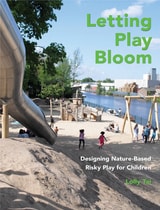
Letting Play Bloom
Designing Nature-Based Risky Play for ChildrenLolly Tai
Temple University Press, 2022
Children love to play in risky—often misunderstood to mean unsafe—ways. It is often how they learn. Research shows that activities like climbing on trees and boulders, hiking in nature, and playing in a creek are excellent ways for kids to develop their creativity and their senses, because playing outdoors evokes different sights, sounds, smells, and textures.
Letting Play Bloom analyzes five outstanding case studies of children’s nature-based risky play spaces—the Slide Hill at Governors Island in New York, the Berkeley (CA) Adventure Playground, and Wildwoods at Fernbank Museum in Atlanta, as well as sites in the Netherlands and Australia. Author Lolly Tai provides detailed explanations of their background and design, and what visitors can experience at each site.
She also outlines the six categories of risky—not hazardous—play, which involve great heights, rapid speeds, dangerous tools, dangerous elements, rough-and-tumble play, and wandering or getting lost. These activities allow children to explore and challenge themselves (testing their limits) to foster greater self-worth while also learning valuable risk-management skills such as dealing with fear-inducing situations.
Filled with more than 200 photographs, Letting Play Bloom advocates for a thoughtful landscape design process that incorporates the specific considerations children need to fully experience the thrill that comes from playing in nature.
Linking Assignments to Assessments
A Guide for TeachersDeborah Crusan and Todd Ruecker
University of Michigan Press, 2022
The book shares foundational information on the importance of assessment literacy and on how language acquisition, student backgrounds, and language standards need to be considered. Linking Assignments to Assessments offers step-by-step instructions on creating effective assessments for listening and reading, speaking and writing, grammar and vocabulary. Teachers are provided context for understanding standardized assessments and strategies to advocate for and prepare English learners in high-stakes assessment contexts. Each chapter includes activities, discussion questions, and strategies for developing an assessment philosophy to help educators link their theory and practice.
Listening Myths
Applying Second Language Research to Classroom TeachingSteven Brown
University of Michigan Press, 2011
This volume was conceived as a "best practices" resource for teachers of ESL listening courses in the way that Vocabulary Myths by Keith S. Folse (and Writing Myths by Joy Reid) is one for reading and vocabulary teachers. It was written to help ensure that teachers of listening are not perpetuating the myths of teaching listening.
Both the research and pedagogy in this book are based on the newest research in the field of second language acquisition. Steven Brown is the author of the Active Listening textbook series and is a teacher trainer.
The myths debunked in this book are:
§ Listening is the same as reading.
§ Listening is passive.
§ Listening equals comprehension.
§ Because L1 language ability is effortlessly acquired, L2 listening ability is too.
§ Listening means listening to conversations.
§ Listening is an individual, inside-the-head process.
§ Students should only listen to authentic materials.
§ Listening can’t be taught
Listening to People
A Practical Guide to Interviewing, Participant Observation, Data Analysis, and Writing It All UpAnnette Lareau
University of Chicago Press, 2021
In-depth interviews and close observation are essential to the work of social scientists, but inserting one’s researcher-self into the lives of others can be daunting, especially early on. Esteemed sociologist Annette Lareau is here to help. Lareau’s clear, insightful, and personal guide is not your average methods text. It promises to reduce researcher anxiety while illuminating the best methods for first-rate research practice.
As the title of this book suggests, Lareau considers listening to be the core element of interviewing and observation. A researcher must listen to people as she collects data, listen to feedback as she describes what she is learning, listen to the findings of others as they delve into the existing literature on topics, and listen to herself in order to sift and prioritize some aspects of the study over others. By listening in these different ways, researchers will discover connections, reconsider assumptions, catch mistakes, develop and assess new ideas, weigh priorities, ponder new directions, and undertake numerous adjustments—all of which will make their contributions clearer and more valuable.
Accessibly written and full of practical, easy-to-follow guidance, this book will help both novice and experienced researchers to do their very best work. Qualitative research is an inherently uncertain project, but with Lareau’s help, you can alleviate anxiety and focus on success.
Lit to Lit
Composition/Rhetoric and the Literary ArtsEli Goldblatt
Utah State University Press, 2026
Lit to Lit examines the traditional split between the study of literature and composition and rhetoric programs, asking writing studies scholars to think critically and creatively about the role literature can play in the teaching of writing and the field’s conceptions of its own relation to writing. Grounded in diverse experiences and practices, contributors offer provocative but thoughtful analyses of how composition and literature can be brought together in the study and teaching of writing.
Complex forms of writing should not be the sole territory of one subfield or discipline but rather should benefit from multiple perspectives generated by those with keen and abiding interests in writing writ large. Many in the field of composition and rhetoric also have an active engagement in the literary arts, particularly the flowering of literature from diverse cultural experiences in the last decades. What new teaching and learning approaches could emerge from a synthesis of theoretical, literary, rhetorical, poetic, and compositional methods? This question becomes even more compelling when considering how English departments often house programs in journalism and creative writing, allowing robust opportunities for multiple ways of thinking about and studying complex texts.
Lit to Lit makes visible the generative overlap between subfields already present in the broad field of English, pointing to new ways forward that value each area’s separate endeavors while highlighting the possibilities for what could be built together.
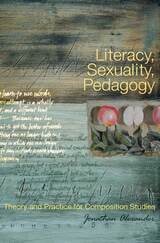
Literacy, Sexuality, Pedagogy
Theory and Practice for Composition StudiesJonathan Alexander
Utah State University Press, 2008
In Literacy, Sexuality, Pedagogy, Jonathan Alexander argues for the development of students' "sexual literacy." Such a literacy is not just concerned with developing fluency with sexuality as a "hot" topic, but with understanding the intimate interconnectedness of sexuality and literacy in Western culture. Using the work of scholars in queer theory, sexuality studies, and the New Literacy Studies, Alexander unpacks what he sees as a crucial--if often overlooked--dimension of literacy: the fundamental ways in which sexuality has become a key component of contemporary literate practice, of the stories we tell about ourselves, our communities, and our political investments.
Alexander then demonstrates through a series of composition exercises and writing assignments how we might develop students' understanding of sexual literacy. Examining discourses of gender, heterosexuality, and marriage allows students (and instructors) a critical opportunity to see how the languages we use to describe ourselves and our communities are saturated with ideologies of sexuality. Understanding how sexuality is constructed and deployed as a way to "make meaning" in our culture gives us a critical tool both to understand some of the fundamental ways in which we know ourselves and to challenge some of the norms that govern our lives. In the process, we become more fluent with the stories that we tell about ourselves and discover how normative notions of sexuality enable (and constrain) narrations of identity, culture, and politics. Such develops not only our understanding of sexuality, but of literacy, as we explore how sexuality is a vital, if vexing, part of the story of who we are.
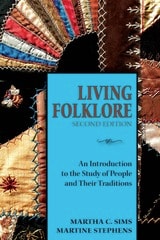
Living Folklore, 2nd Edition
An Introduction to the Study of People and Their TraditionsMartha Sims and Martine Stephens
Utah State University Press, 2011
Living Folklore is a comprehensive, straightforward introduction to folklore as it is lived, shared and practiced in contemporary settings. Drawing on examples from diverse American groups and experiences, this text gives the student a strong foundation—from the field's history and major terms to theories and interpretive approaches.
Living Folklore moves beyond genres and classifications, and encourages students who are new to the field to see the study of folklore as a unique approach to understanding people, communities, and day-to-day artistic communication.
This revised edition incorporates new examples, research, and theory along with added discussion of digital and online folklore.
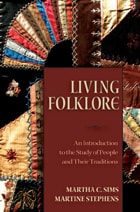
Living Folklore
Introduction to the Study of People and their TraditionsMartha Sims and Martine Stephens
Utah State University Press, 2005
Living Folklore is a comprehensive, straightforward introduction to folklore as it is lived, shared and practiced in contemporary settings. Drawing on examples from diverse American groups and experiences, this text gives the student a strong foundation—from the field’s history and major terms to theories, interpretive approaches, and fieldwork.
Many teachers of undergraduates find the available folklore textbooks too complex or unwieldy for an introductory level course. It is precisely this criticism that Living Folklore addresses; while comprehensive and rigorous, the book is specifically intended to meet the needs of those students who are just beginning their study of the discipline. Its real strength lies in how it combines carefully articulated foundational concepts with relevant examples and a student-oriented teaching philosophy.