Results by title
28164 books match the query 'History' and 932 start with l
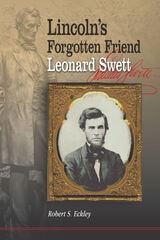
Lincoln's Forgotten Friend, Leonard Swett
Robert S. Eckley
Southern Illinois University Press, 2012
In 1849, while traveling as an attorney on the Eighth Judicial Circuit in Illinois, Abraham Lincoln befriended Leonard Swett (1825–89), a fellow attorney sixteen years his junior. Despite this age difference, the two men built an enduring friendship that continued until Lincoln’s assassination in 1865. Until now, no historian has explored Swett’s life or his remarkable relationship with the sixteenth president. In this welcome volume, Robert S. Eckley provides the first biography of Swett, crafting an intimate portrait of his experiences as a loyal member of Lincoln’s inner circle.
Eckley chronicles Swett’s early life and the part he played in Lincoln’s political campaigns, including his role as an essential member of the team behind Lincoln’s two nominations and elections for the presidency. Swett counseled Lincoln during the formation of his cabinet and served as an unofficial advisor and sounding board during Lincoln’s time in office. Throughout his life, Swett wrote a great deal on Lincoln, and planned to write a biography about him, but Swett’s death preempted the project. His eloquent and interesting writings about Lincoln are described and reproduced in this volume, some for the first time.
With Lincoln’s Forgotten Friend, Eckley removes Swett from the shadows of history and sheds new light on Lincoln’s personal relationships and their valuable contributions to his career.
Superior Achievement from the Illinois State Historical Society, 2013
Lincoln's Gettysburg Address
Echoes of the Bible and Book of Common PrayerA. E. Elmore
Southern Illinois University Press, 2009
While it has long been determined that Abraham Lincoln’s writings were influenced by the King James Bible, until now no full-length study has shown the precise ways in which the Gettysburg Address uses its specific language. Refuting the view that the address was crafted with traditional classical references, this revealing investigation provides a new way to think about the speech and the man who wrote it. A. E. Elmore offers chapter and verse evidence from the Bible as well as specific examples from the Episcopal Book of Common Prayer to illustrate how Lincoln borrowed from these sources to imbue his speech with meanings that would resonate with his listeners. He cites every significant word and phrase—conceived, brought forth, struggled, remaining, consecrate, dedicate, hallow, devotion, new birth, to name a few—borrowed by Lincoln from these two religious texts for use in his dedication of the Gettysburg National Cemetery.
Lincoln’s Gettysburg Address focuses on a number of overlooked themes and ideas, such as the importance of literary allusion and the general public’s knowledge of the Bible in the age of Lincoln. It provides fresh answers to old questions and poses new questions: Was Lincoln a common thief who made use of words from previously published materials as well as from works by his contemporaries? Was he a genius whose literary and political skills were unmatched? No one who reads this highly engaging study will ever think about Lincoln or the Gettysburg Address the same way again.
Lincoln's Journalist
John Hay's Anonymous Writings for the Press, 1860 - 1864Edited by Michael Burlingame
Southern Illinois University Press, 2006
Michael Burlingame presents anonymous and pseudonymous newspaper articles written by Lincoln's assistant personal secretary, John Hay, between 1860 and 1864. In the White House, Hay became the ultimate insider, the man who had the president's ear. "Only an extremely small number of persons ever saw Abraham Lincoln both day and night in public as well as private settings from 1860 to 1864," notes Wayne C. Temple, chief deputy director, Illinois State Archives. "And only one of them had the literary flair of John Milton Hay."
Burlingame takes great pains to establish authorship of the items reproduced here. He convincingly demonstrates that the essays and letters written for the Providence Journal, the Springfield Illinois State Journal, and the St. Louis Missouri Democrat under the pseudonym "Ecarte" are the work of Hay. And he finds much circumstantial and stylistic evidence that Hay wrote as "our special correspondent" for the Washington World and for the St. Louis Missouri Republican. Easily identifiable, Hay's style was "marked by long sentences, baroque syntactical architecture, immense vocabulary, verbal pyrotechnics, cocksure tone (combining acid contempt and extravagant praise), offbeat adverbs, and scornful adjectives."
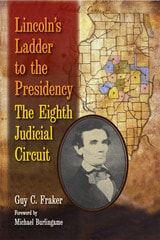
Lincoln's Ladder to the Presidency
The Eighth Judicial CircuitGuy C. Fraker, with a foreword by Michael Burlingame
Southern Illinois University Press, 2012
University Press Books for Public and Secondary Schools, 2013 edition
Superior Achievement by the Illinois State Historical Society, 2013
Throughout his twenty-three-year legal career, Abraham Lincoln spent nearly as much time on the road as an attorney for the Eighth Judicial Circuit as he did in his hometown of Springfield, Illinois. Yet most historians gloss over the time and instead have Lincoln emerge fully formed as a skillful politician in 1858. In this innovative volume, Guy C. Fraker provides the first-ever study of Lincoln’s professional and personal home away from home and demonstrates how the Eighth Judicial Circuit and its people propelled Lincoln to the presidency.
Each spring and fall, Lincoln traveled to as many as fourteen county seats in the Eighth Judicial Circuit to appear in consecutive court sessions over a ten- to twelve-week period. Fraker describes the people and counties that Lincoln encountered, discusses key cases Lincoln handled, and introduces the important friends he made, friends who eventually formed the team that executed Lincoln’s nomination strategy at the Chicago Republican Convention in 1860 and won him the presidential nomination.
As Fraker shows, the Eighth Judicial Circuit provided the perfect setting for the growth and ascension of Lincoln. A complete portrait of the sixteenth president depends on a full understanding of his experience on the circuit, and Lincoln’s Ladder to the Presidency provides that understanding as well as a fresh perspective on the much-studied figure, thus deepening our understanding of the roots of his political influence and acumen.
Lincoln's Legacy
Ethics and PoliticsEdited by Phillip Shaw Paludan
University of Illinois Press, 2007
The four new essays in Lincoln's Legacy describe major ethical problems that the sixteenth president navigated what can be learned from how he did so. The distinguished and award-winning Lincoln scholars William Miller, Mark E. Neely Jr., Phillip Shaw Paludan, and Mark Summers describe Lincoln’s attitudes and actions during encounters with questions of politics, law, constitutionalism, patronage, and democracy. The remarkably focused essays include an assessment of Lincoln's virtues in the presidency, the first study on Lincoln and patronage in more than a decade, a challenge to the cliché of Lincoln the democrat, and a study of habeas corpus, Lincoln, and state courts. On the eve of the bicentennial celebration of Lincoln’s birth, Lincoln’s Legacy highlights his enduring importance in contemporary conversations about law, politics, and democracy.
Lincoln's New Salem
Benjamin P. Thomas
Southern Illinois University Press, 1988
Thomas tells the story of the village where Abraham Lincoln lived from 1831 to 1837. His three-part examination of the village often referred to as Lincoln’s "Alma Mater" features the founding and early history of New Salem, Lincoln’s impact on the village and its effect on him, and the story of the Lincoln legend and the reconstruction of the town.
Thomas argues convincingly that New Salem was the town where Lincoln acquired faith in himself, faith in people. At 22 the future president drifted into town seeking to become a blacksmith. Thomas introduces us to the people who created New Salem and who knew, influenced, and befriended Lincoln.
Thomas highlights Lincoln’s arrival, his relationships with his neighbors, his important wrestling match with Jack Armstrong, his self-education, his quiet career as an Indian fighter, his experience as a postmaster largely indifferent to postal regulations, his financial woes as a businessman, his loyal friends who often came to his aid, and his election to the legislature.
This colorful history closes with a discussion of the Lincoln legend. The truth of the stories is unimportant. What matters is that the growing Lincoln legend prompted the gradual realization that New Salem was not a dismal mire from which President Lincoln had had to extricate himself but was, in fact, an energizing force. This realization led to research and finally to the restoration of New Salem, which began in 1932.

Lincoln's New Salem
Benjamin P. Thomas
Southern Illinois University Press, 1954
Lincoln’s New Salem highlights the young Lincoln’s arrival, his important wrestling match with Jack Armstrong, his self-education, his brief military career in the Black Hawk War, his experience as a postmaster largely indifferent to postal regulations, his financial woes with the general store, and his election to the state legislature. Making the point that New Salem was where Lincoln acquired faith in himself and in other people, Thomas introduces us to those who created New Salem and who knew, influenced, and befriended Lincoln, delving into his relationships with his neighbors and the loyal friends who often came to his aid.
This colorful history closes with a discussion of the Lincoln legend, which prompted the gradual realization that New Salem was not a dismal mire from which Abraham Lincoln had to extricate himself but was, in fact, an energizing force. This realization led to research and finally to the restoration of New Salem, which began in 1932. The preservation of the village remains vitally important.
First published in 1934 and revised by the author in 1954, this reissue includes a previously unpublished piece about New Salem and Illinois governor Henry Horner by Benjamin Thomas, a new introduction by Kenneth J. Winkle, and new photos by Robert Shaw, in addition to original drawings by Romaine Proctor and a 1971 foreword by Ralph G. Newman.
Lincoln's Political Generals
David Work
University of Illinois Press, 2012
As the war proceeded, the value of the political generals became a matter of serious dispute. Could politicians make the shift from a political campaign to a military one? Could they be trusted to fight? Could they avoid destructive jealousies and the temptations of corruption? And with several of the generals being Irish or German immigrants, what effect would ethnic prejudices have on their success or failure?
In this book, David Work examines Lincoln's policy of appointing political generals to build a national coalition to fight and win the Civil War. Work follows the careers of sixteen generals through the war to assess their contributions and to ascertain how Lincoln assessed them as commander-in-chief. Eight of the generals began the war as Republicans and eight as Democrats. Some commanded armies, some regiments. Among them were some of the most famous generals of the Union--such as Francis P. Blair Jr., John A. Dix, John A. Logan, James S. Wadsworth--and others whose importance has been obscured by more dramatic personalities.
Work finds that Lincoln's policy was ultimately successful, as these generals provided effective political support and made important contributions in military administration and on the battlefield. Although several of them proved to be poor commanders, others were effective in exercising influence on military administration and recruitment, slavery policy, and national politics.
Lincoln's Preparation for Greatness
THE ILLINOIS LEGISLATIVE YEARSPaul Simon
University of Illinois Press, 1971
"Abraham Lincoln was a member of the Illinois Legislature from
1834 to 1842 -- one of the Long Nine, as the Sangamon County delegation
was known, all its members being more than six feet tall. It was during
these eight years that he came as close to scandal as he was ever to come
in his public or private life. Did he, or did he not, engage in shameless
logrolling to get the state capital moved to Springfield? This and other
aspects of Lincoln's apprenticeship in the legislator . . . are thoroughly
investigated."
-- Chicago Sun-Times
"The wealth of detail it contains makes it a worthwhile addition
to the study of Lincoln's legislative career."
-- Los Angeles Times
Lincoln's Rise to Eloquence
How He Gained the Presidential NominationD. Leigh Henson
University of Illinois Press, 2024
Insightful and revealing, Lincoln’s Rise to Eloquence follows Lincoln from his early career through the years-long clashes with Stephen A. Douglas to trace the future president’s evolution as a communicator and politician.
Lincoln's Sense of Humor
Richard Carwardine
Southern Illinois University Press, 2017
Winner, ISHS Annual Award for a Scholarly Publication, 2018
Abraham Lincoln was the first president to make storytelling, jokes, and laughter tools of the office, and his natural sense of humor has become legendary. Lincoln’s Sense of Humor registers the variety, complexity of purpose, and ethical dimension of Lincoln’s humor and pinpoints the political risks Lincoln ran in telling jokes while the nation was engaged in a bloody struggle for existence.
Complete with amusing anecdotes, this book shows how Lincoln’s uses of humor evolved as he matured and explores its versatility, range of expressions, and multiple sources: western tall tales, morality stories, bawdy jokes, linguistic tricks, absurdities, political satire, and sharp wit. While Lincoln excelled at self-mockery, nothing gave him greater pleasure than satirical work lampooning hypocrisy and ethical double standards. He particularly enjoyed David R. Locke’s satiric writings by Petroleum V. Nasby, a fictional bigoted secessionist preacher, and the book explores the nuances of Lincoln’s enthusiasm for what he called Locke’s genius, showing the moral springs of Lincoln’s humor.
Richard Carwardine methodically demonstrates that Lincoln’s funny stories were the means of securing political or personal advantage, sometimes by frontal assault on opponents but more often by depiction through parable, obfuscation through hilarity, refusal through wit, and diversion through cunning. Throughout his life Lincoln worked to develop the humorist’s craft and hone the art of storytelling. His jokes were valuable in advancing his careers as politician and lawyer and in navigating his course during a storm-tossed presidency. His merriness, however, coexisted with self-absorbed contemplation and melancholy. Humor was his lifeline; dark levity acted as a tonic, giving Lincoln strength to tackle the severe challenges he faced. At the same time, a reputation for unrestrained, uncontrollable humor gave welcome ammunition to his political foes. In fact, Lincoln’s jocularity elicited waves of criticism during his presidency. He was dismissed as a “smutty joker,” a “first rate second rate man,” and a “joke incarnated.”
Since his death, Lincoln’s anecdotes and jokes have become detached from the context that had given them their political and cultural bite, losing much of the ironic and satiric meaning that he had intended. With incisive analysis and laugh-inducing examples, Carwardine helps to recapture a strong component of Lincoln’s character and reanimates the good humor of our sixteenth president.

Lincoln's Supreme Court
David M. Silver
University of Illinois Press, 1956
Lincoln's Trident
The West Gulf Blockading Squadron during the Civil WarRobert M. Browning Jr.
University of Alabama Press, 2014
Lincoln’s Trident is the definitive account of the US Navy’s West Gulf Blockading Squadron’s quarantine of the Confederacy in the central and western Gulf of Mexico and adjacent river systems.
In Lincoln’s Trident, Coast Guard historian Robert M. Browning Jr. continues his magisterial series about the Union’s naval blockade of the Confederacy during the American Civil War. Established by the Navy Department in 1862, the West Gulf Blockading Squadron operated from St. Andrews Bay (Panama City), Florida to the Rio Grande River. As with the Navy’s blockade squadrons operating in the Atlantic, the mission of the West Gulf Blockading Squadron was to cripple the South’s economy by halting imports and disrupting cotton exports, the South’s main source of hard currency. The blockade also limited transportation within the South and participated in combined operations with Union land forces.
The history of the squadron comprises myriad parts and players, deployed in a variety of missions across the thousand-mile-wide Western Theater. From disorganized beginnings, the squadron’s leaders and sailors had to overcome setbacks, unfulfilled expectations, and lost opportunities. Browning masterfully captures the many variables that influenced the strategic choices of Navy commanders as they both doggedly pursued unchanging long-term goals as well as improvised and reacted to short-term opportunities.
Notable among its leaders was David Glasgow Farragut, believed by many to be America’s greatest naval hero, who led the squadron through most of the war and the climactic Battle of Mobile Bay. Under his legendary leadership, the squadron not only sealed Confederate sea ports, but also made feints and thrusts up the Mississippi River as far north as Vicksburg, Mississippi.
Knowing the Navy’s role in isolating the Confederate economy and preventing the movement of troops and supplies within the South is crucial to understanding of the outcomes of the Civil War, as well as the importance of naval power in military conflicts. With thirty-five maps and illustrations, Lincoln’s Trident expounds upon an essential part of the Civil War as well as naval and American history.
Lincoln's White House Secretary
The Adventurous Life of William O.StoddardEdited by Harold Holzer
Southern Illinois University Press, 2007
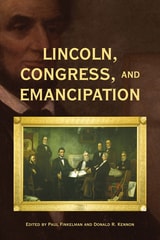
Lincoln, Congress, and Emancipation
Paul Finkelman
Ohio University Press, 2016
“When Lincoln took office, in March 1861, the national government had no power to touch slavery in the states where it existed. Lincoln understood this, and said as much in his first inaugural address, noting: ‘I have no purpose, directly or indirectly, to interfere with the institution of slavery in the States where it exists.’” How, then, asks Paul Finkelman in the introduction to Lincoln, Congress, and Emancipation, did Lincoln—who personally hated slavery—lead the nation through the Civil War to January 1865, when Congress passed the constitutional amendment that ended slavery outright?
The essays in this book examine the route Lincoln took to achieve emancipation and how it is remembered both in the United States and abroad. The ten contributors—all on the cutting edge of contemporary scholarship on Lincoln and the Civil War—push our understanding of this watershed moment in US history in new directions. They present wide-ranging contributions to Lincoln studies, including a parsing of the sixteenth president’s career in Congress in the 1840s and a brilliant critique of the historical choices made by Steven Spielberg and writer Tony Kushner in the movie Lincoln, about the passage of the Thirteenth Amendment.
As a whole, these classroom-ready readings provide fresh and essential perspectives on Lincoln’s deft navigation of constitutional and political circumstances to move emancipation forward.
Contributors: L. Diane Barnes, Jenny Bourne, Michael Burlingame, Orville Vernon Burton, Seymour Drescher, Paul Finkelman, Amy S. Greenberg, James Oakes, Beverly Wilson Palmer, Matthew Pinsker
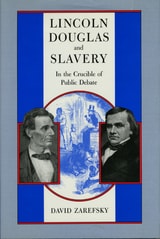
Lincoln, Douglas, and Slavery
In the Crucible of Public DebateDavid Zarefsky
University of Chicago Press, 1990
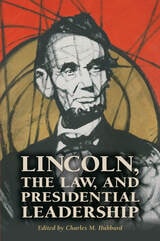
Lincoln, the Law, and Presidential Leadership
Edited by Charles M. Hubbard
Southern Illinois University Press, 2015
The volume’s contributors not only address specific situations and issues that assisted in Lincoln’s development of a new understanding of law and its application but also show Lincoln’s remarkable presidential leadership. Among the topics covered are civil liberties during wartime; presidential pardons; the law and Lincoln’s decision-making process; Lincoln’s political ideology and its influence on his approach to citizenship; Lincoln’s defense of the Constitution, the Union, and popular government; constitutional restraints on Lincoln as he dealt with slavery and emancipation; the Lieber codes, which set forth how the military should deal with civilians and with prisoners of war; the loyalty (or treason) of government employees, including Lincoln’s domestic staff; and how Lincoln’s image has been used in presidential rhetoric. Although varied in their strategies and methodologies, these essays expand the understanding of Lincoln’s vision for a united nation grounded in the Constitution.
Lincoln, the Law, and Presidential Leadership shows how the sixteenth president’s handling of complicated legal issues during the Civil War, which often put him at odds with the Supreme Court and Congress, brought the nation through the war intact and led to a transformation of the executive branch and American society.
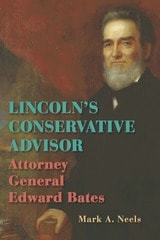
Lincoln’s Conservative Advisor
Attorney General Edward BatesMark A. Neels
Southern Illinois University Press, 2025
How a traditionalist became part of Lincoln's volatile team of rivals
Edward Bates, a founding father of Missouri and leader of the Missouri Whig Party, served as Abraham Lincoln’s attorney general during the American Civil War. The first full biography of Bates in nearly sixty years, Lincoln’s Conservative Advisor reveals a striking portrait of this complex figure in Lincoln’s cabinet.
Author Mark A. Neels begins with Bates’s youth in Virginia and follows him through his political and judicial career, his candidacy as a Republican presidential nominee in 1860, and his appointment to Abraham Lincoln’s cabinet as attorney general. Bates became an essential advisor to the president on key legal, military, and political matters from emancipation to civil liberties and equal rights, and his official opinion on Habeas Corpus would have a permanent effect on presidential authority and separation of powers. When Lincoln drafted the Emancipation Proclamation, Bates found himself at odds with the president and the radical anti-slavery members of the cabinet. But more than simply highlighting the conflict within Lincoln’s administration, Bates’s example lays bare the strong philosophical divisions within the Republican Party during the Civil War era. These divisions were present at the party’s inception, crystallized during the war, and ultimately sparked a political realignment during Reconstruction. Bates was at the center of this divide for most of its existence, and in some cases assisted in its promulgation.
Bates, a fierce opponent of radical Republicanism, embodies the conflict among Republicans over issues of slavery and citizenship. In both judicial and elective office, he was compelled by a sense of duty to defy the populism of President Andrew Jackson and Senator Thomas Hart Benton, and, later, the proslavery forces that threatened to tear the nation apart. Though he had owned slaves, Bates represented at least one enslaved woman’s suit for freedom, released from bondage the people he had enslaved, and aided Lincoln in his efforts to end slavery nationwide. Bates’s opinion on citizenship as attorney general helped pave the way for equal rights. His opinions were not always popular with either his colleagues or the greater populace, but Bates remained true to his conservative principles—a set of values shared by a large swath of Lincoln’s Republican Party—which positioned him as a leading opponent of radical Republicanism during the Reconstruction Era.
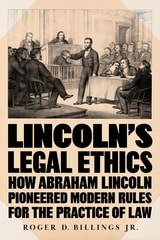
Lincoln’s Legal Ethics
How Abraham Lincoln Pioneered Modern Rules for the Practice of LawRoger D. Billings Jr.
University of Illinois Press, 2027
Roger D. Billings Jr. examines how Lincoln’s practices in Illinois helped shape the development of the legal standards that lawyers follow today. Lincoln learned the law through self-study, experience, and mentorship. Billings focuses on actual cases to show Lincoln’s ethical choices when confronted with issues like conflict of interest, client trust, and honesty with the court. In addition, the studies shine a light on the future president’s on-the-job performance. Though an imperfect practitioner, Lincoln and his energetic work on behalf of clients and way of doing business, among other practices, influenced the evolution of the ABA Model Rules of Professional Conduct in the United States.
An original study of Lincoln’s years at the bar, Lincoln’s Legal Ethics connects the self-styled country lawyer with modern legal standards.
Line upon Line
Essays on Mormon DoctrineGary J. Bergera
Signature Books, 1989
Among the contributors are Thomas G. Alexander, Peter C. Appleby, George Boyd, David John Buerger, Van Hale, Boyd Kirkland, Blake Ostler, Stephen L Richards, Kent E. Robson, Thaddeus E. Shoemaker, Vern Swanson, Dan Vogel, and Linda P. Wilcox.
For anyone who has assumed that Mormon doctrine appeared whole-cloth in a single revelation, Line Upon Line is an important primer. No issue, however central to Latter-day Saint theology, is exempt from gradual development over time. This includes the nature of God, the progression of the soul, free agency, the possibility of repentance and forgiveness through a divine sacrifice, the creation of the world, evolution of the species, and the nature and origin of evil.
In Line Upon Line, sixteen thoughtful, compelling essays offer reflective historical discussions of the development of Mormon doctrine from the statements of church leaders to the writings of LDS theologians to canonized scripture, rather than on the authors’ personal speculations. Noting the relative strengths and weaknesses of various theological or doctrinal teachings due to limited human understanding, the contributors suggest that differences of opinion can indicate the presence of genuine and sincere faith that God’s truth is nevertheless present in scriptural metaphor.
Lineages Of State Fragility
Rural Civil Society In Guinea-BissauJoshua B. Forrest
Ohio University Press, 2003
In Guinea-Bissau, as elsewhere in Africa, there is a disjuncture between the central state and rural civil society. It is this significant and overlooked aspect of Guinea-Bissau’s political evolution—the continuing ability of civil society to evade and thwart state power—that is at the heart of Joshua B. Forrest’s Lineages of State Fragility.
Professor Forrest argues that despite European influences, the contemporary fragility of African states can be fully appreciated only by examining the indigenous social context in which these states evolved. Focusing on Guinea-Bissau, Forrest exposes the emergence of a strong and adaptable “rural civil society” that can be traced back to precolonial times.
Lineages of State Fragility analyzes the social, political, and military experiences of this rural civil society to account for the origins of Guinea-Bissau’s soft state. For example, Forrest identifies interethnic social and military practices that became entrenched in rural social structures and continued to evolve through the colonial period, enabling Guinea-Bissauans to resist state predation.
Lineages of State Fragility offers an unorthodox explanation of African politics by tracing the direct social links among the precolonial, colonial, and postcolonial periods and affirms the role of rural actors in determining present-day political outcomes.
Based on remarkably extensive research conducted in archives in Guinea-Bissau, Senegal, and Portugal, Lineages of State Fragility represents both a new approach to the region’s past and present and an important synthesis of the political analysis that has come before.
Lineages of European Political Thought
Explorations along the Medieval/Modern Divide from John of Salisbury to HegelCary J. Nederman
Catholic University of America Press, 2009
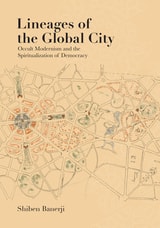
Lineages of the Global City
Occult Modernism and the Spiritualization of DemocracyShiben Banerji
University of Texas Press, 2025
2026 PROSE Award in Architecture & Urban Planning, Association of American Publishers (AAP)
2026 Book Prize Shortlist, Modernist Studies Association (MSA)
The forgotten history of the occult foundations of the early twentieth-century global city.
War, revolution, genocide, rebellion, slump. The economic and political turmoil of the early twentieth century seemed destined to rip asunder the ties that bound colonizers and the colonized to one another. The upheaval represented an opportunity, and not just to nationalists who imagined new homelands or to socialists who dreamed of international brotherhood. For modernists in the orbit of various occultisms, the crisis of empire also represented an opportunity to reveal humanity’s fundamental unity and common fate.
Lineages of the Global City recounts a continuous, if also contentious, transnational exchange among modernists and occultists across the Americas, Europe, South Asia, and Australia between 1905 and 1949. At stake were the feelings and affect of a new global subject who would perceive themselves as belonging to humanity as a unified whole, and the urban environment that would foster their subjectivity. The interventions in this debate, which drew in the period’s most renowned modernists, took the form of a succession of plans for cities, suburbs, and communes, as well as experiments in building, drawing, printmaking, filmmaking, and writing. Weaving together postcolonial, feminist, and Marxist insight on subject formation, Shiben Banerji advances a new way of understanding modernist urban space as the design of subjective effects.
Lines in the Sand
Congressional Redistricting in Texas and the Downfall of Tom DeLayBy Steve Bickerstaff
University of Texas Press, 2007
The events of 2003 in Texas were important to the political history of this country. Congressman Tom DeLay led a Republican effort to gerrymander the state's thirty-two congressional districts to defeat all ten of the Anglo Democratic incumbents and to elect more Republicans; Democratic state lawmakers fled the state in an effort to defeat the plan. The Lone Star State uproar attracted attention worldwide. The Republicans won this showdown, gaining six additional seats from Texas and protecting the one endangered Republican incumbent. Some of the methods used by DeLay to achieve this result, however, led to his criminal indictment and ultimately to his downfall.
With its eye-opening research, readable style, and insightful commentary, Lines in the Sand provides a front-line account of what happened in 2003, often through the personal stories of members of both parties and of the minority activist groups caught in a political vortex. Law professor Steve Bickerstaff provides much-needed historical perspective and also probes the aftermath of the 2003 redistricting, including the criminal prosecutions of DeLay and his associates and the events that led to DeLay's eventual resignation from the U.S. House of Representatives. As a result, Bickerstaff graphically shows a dark underside of American politics—the ruthless use of public institutional power for partisan gain.
Lines of Activity
Performance, Historiography, Hull-House DomesticityShannon Jackson
University of Michigan Press, 2001
This groundbreaking book demonstrates how performance analysis can contribute to the historical study of American reform as well as to critical inquiry on the arts and social change. She develops connections between performativity and sex/gender difference by interpreting Hull-House as a sphere of queer kinship and alternative gender performance. Lines of Activity also engages a variety of debates on the nature of historical representation, and the role of "theory" in historical writing.
As the notion of "performance historiography" gains currency, Jackson's study exposes the gender politics of such scholarly trends. By selecting the Progressive Era and Hull-House as arenas of inquiry, Jackson foregrounds how past discourses of domesticity, pragmatism, transnationalism, and environmentalism already contain performance-centered notions of identity, space, and community. Through these and other arguments, Lines of Activity reveals the intimate connection between a history of Hull-House performance and the performance of Hull-House history.
Shannon Jackson is Assistant Professor of Rhetoric and of Dramatic Art and Dance, University of California, Berkeley.
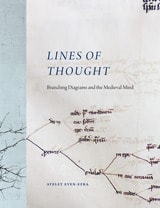
Lines of Thought
Branching Diagrams and the Medieval MindAyelet Even-Ezra
University of Chicago Press, 2021
These diagrams not only allow a glimpse into the thinking practices of the past but also constitute a chapter in the history of how people learned to rely on external devices—from stone to parchment to slide rules to smartphones—for recording, storing, and processing information. Beautifully illustrated throughout with previously unstudied and unedited diagrams, Lines of Thought is a historical overview of an important cognitive habit, providing a new window into the world of medieval scholars and their patterns of thinking.
Lingering Inland
A Literary Tour of the MidwestEdited by Andy Oler Foreword by José Olivarez
University of Illinois Press, 2025
Linguistic Diversity and National Unity
Language Ecology in ThailandWilliam A. Smalley
University of Chicago Press, 1994
Smalley contends that because the people of Thailand perceive their social hierarchy as the normal order, Standard Thai, spoken by members of the higher levels of society, prevails as the uncontested national language. By examining the hierarchy of Thailand's diverse languages and dialects in light of Thai history, education, culture, and religion, Smalley shows how Thailand has been able to keep its many ethnic groups at peace.
Linguistic Diversity and National Unity explores the intricate relationship between language and power and the ways in which social and linguistic rank can be used to perpetuate order.
Linkages of Financial Groups in the European Union
Financial Conglomeration Developments in the Old and New Member StatesIngrid Ulst
Central European University Press, 2005
Linked Labor Histories
New England, Colombia, and the Making of a Global Working ClassAviva Chomsky
Duke University Press, 2008
Chomsky examines labor and management at two early-twentieth-century Massachusetts factories: one that transformed the global textile industry by exporting looms around the world, and another that was the site of a model program of labor-management collaboration in the 1920s. She follows the path of the textile industry from New England, first to the U.S. South, and then to Puerto Rico, Japan, Mexico, Central America, the Caribbean, and Colombia. She considers how towns in Rhode Island and Massachusetts began to import Colombian workers as they struggled to keep their remaining textile factories going. Most of the workers eventually landed in service jobs: cleaning houses, caring for elders, washing dishes.
Focusing on Colombia between the 1960s and the present, Chomsky looks at the Urabá banana export region, where violence against organized labor has been particularly acute, and, through a discussion of the AFL-CIO’s activities in Colombia, she explores the thorny question of U.S. union involvement in foreign policy. In the 1980s, two U.S. coal mining companies began to shift their operations to Colombia, where they opened two of the largest open-pit coal mines in the world. Chomsky assesses how different groups, especially labor unions in both countries, were affected. Linked Labor Histories suggests that economic integration among regions often exacerbates regional inequalities rather than ameliorating them.
Linking Community and Corrections in Japan
Elmer H. Johnson with Carol H. Jonnson
Southern Illinois University Press, 2000
Completing Elmer H. Johnson’s impressive three-volume examination of corrections in Japan, Linking Community and Corrections in Japan (written with the assistance of Carol H. Johnson) focuses on the Rehabilitation Bureau’s responsibilities regarding probation, parole, and aftercare as well as the Correction Bureau’s role in Japan’s version of community-oriented corrections. Johnson first outlines the tasks of the Rehabilitation Bureau, then turns to historical and contemporary views of community and corrections. In discussions of the probation and parole system for both adults and juveniles, he describes in detail the Japanese version of supervision and the return of prisoners to the community. One strength of this study is Johnson’s impartiality. As an investigator, he functions as a "friend of the court," an adviser who is free to conduct an objective pursuit of the fundamental strengths and shortcomings of the Japanese prison system. He also follows the Foucauldian dictum: "With the prisons there would be no sense of limiting oneself to discourses about prisons; just as important are the discourses which arise within the prison, the decisions and regulations which are among its constituent elements, its means of functioning, along with its strategies."

Linus Pauling
Clifford Mead
Oregon State University Press, 2001

Lion Songs
Thomas Mapfumo and the Music That Made ZimbabweBanning Eyre
Duke University Press, 2015
Lion's Share
Remaking South African CopyrightVeit Erlmann
Duke University Press, 2022
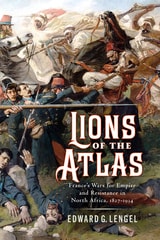
Lions of the Atlas
France's Wars for Empire and Resistance in North Africa, 1827–1934Edward G. Lengel
Westholme Publishing, 2026
France’s century-long wars of conquest in Algeria, Morocco, and Tunisia remain both understudied and symbolic of European imperialism. Launched to provide political legitimacy for the House of Bourbon during unstable times, these wars of empire ironically ended by generating nationalist sentiments that undermined French imperial aspirations, although France was successful on the battlefield after tremendous effort. The controversy both at the time and today about France’s North African ambitions has overshadowed the significant history of this conflict. Fought across some of the world’s most unforgiving, yet spectacular, terrain, these wars featured innovative military campaigns, epic battles, inspiring resistance leaders, and countless episodes of remarkable courage. Profoundly relevant, the French North African wars had a major global impact, influencing the development of military organization, tactics, and technology in the American Civil War, both world wars, and even modern Middle Eastern conflicts. Yet it is the human element that is most compelling. Based on extensive primary source research, Lions of the Atlas: France’s Wars for Empire and Resistance in North Africa, 1827–1934 is the first-ever comprehensive study, in any language, of these pivotal wars and those who fought them.
Beginning with the French naval blockade and amphibious invasion of Algeria in 1827–1830, the book tells the story of the large-scale campaigns and huge set-piece battles that ensued over the following several decades, across the highest peaks of the Atlas Mountains, in hills and valleys, along and over rivers, through scorching deserts, and even in fierce urban combat in town and city streets. Engagements include two unforgettable campaigns to capture the mountain fortress at Constantine, bold and devastating forays by Algerian cavalrymen and mountain warriors, and the pivotal 1844 Battle of Isly. The story continues with the French invasion of Tunisia in 1881, and then the thirty-year French campaign for the subjugation of Morocco, concluding with the Rif War of the 1920s that shocked the world. The narrative features charismatic resistance leaders such as Algeria’s Emir Abd-el-Kader, legendary military units such as the colorful Zouaves and the Foreign Legion, and changes in military technology, including the use of aircraft and armored vehicles. A major contribution to our understanding of one of the world’s most storied regions, Lions of the Atlas provides gripping and insightful reading while presenting the complex history of war and resistance in North Africa.

Liquor and Labor in Southern Africa
Jonathan Crush
Ohio University Press, 1992
In June 1976 political demonstrations in the black township of Soweto exploded into an insurrection that would continue sporadically and spread to urban areas across South Africa. In their assault on apartheid the youths who spearheaded the rebellion attacked and often destroyed the state institutions that they linked to their oppression: police stations, government offices, schools, and state-owned liquor outlets. In Soweto alone during the first days of the revolt protestors smashed and burned eighteen beerhalls and a similar number of bottle stores; as the rebellion spread more were destroyed. This study sets out to demonstrate that liquor outlets were not simply convenient symbols of oppression. The anger that launched gasoline bombs into beerhalls across South Africa had specific origins in deep and complicated struggles over the control of alcohol production and consumption in South Africa.
Conflict over alcohol has continuously intruded upon the lives of the black residents of southern African towns, cities, and labor compounds and upon the rural communities to which these people traced their origins. Yet the subject has received little systematic scholarly attention until now. In Liquor and Labor in Southern Africa scholars explore the complex relationship between alcohol use and the emergence of the modern urban-industrial system. In examining the role of alcohol in social control and the state, they also reveal the vibrant subcultures nurtured in beerhalls and underground shebeens and expose the bitter conflicts over alcohol that run along the fault lines of age, gender, class, and ethnicity.
Lisbon
A BiographyMagda Pinheiro
Tagus Press, 2019
Throughout the pages of this highly original and meticulously researched book, we follow the rich and fascinating history of Lisbon—European capital city and cosmopolitan metropolis—from its legendary founding by Ulysses to the present day, covering the most remarkable moments of the city, such as the conquest of Lisbon, the period of discoveries, the great earthquake of 1755, the departure of the royal court for Brazil, the Liberal revolts, the Estado Novo, Carnation Revolution, and Expo '98. Abounding with episodes that shaped the history of this vibrant port city, accounts of everyday life, and tales about traditional neighborhoods and the innumerable streets where we can still discover traces of the past, this amply illustrated and engaging book makes the seductively enchanting city of Lisbon come to life.

Listen but Don't Ask Question
Hawaiian Slack Key Guitar across the TransPacificKevin Fellezs
Duke University Press, 2019
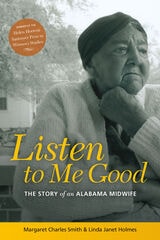
Listen to Me Good
The Story of an Alabama MidwifeMargaret Charles Smith and Linda Janet Holmes
The Ohio State University Press, 1996
Margaret Charles Smith, a ninety-one-year-old Alabama midwife, has thousands of birthing stories to tell. Sifting through nearly five decades of providing care for women in rural Greene County, she relates the tales that capture the life-and-death struggle of the birthing experience and the traditions, pharmacopeia, and spiritual attitudes that influenced her practice. She debunks images of the complacent southern “granny” midwife and honors the determination, talent, and complexity of midwifery.
Fascinating to read, this book is part of the new genre of writing that recognizes the credibility of midwives who have emerged from their own communities and were educated through apprenticeship and personal experience. Past descriptions of southern black midwives have tended to denigrate their work in comparison with professional established medicine. Believed to be the oldest living (though retired) traditional African American midwife in Alabama, Smith is one of the few who can recount old-time birthing ways. Despite claims that midwives contributed to high infant mortality rates, Smith’s story emphasizes midwives' successes in facing medical challenges and emergencies.
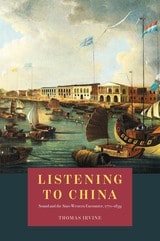
Listening to China
Sound and the Sino-Western Encounter, 1770-1839Thomas Irvine
University of Chicago Press, 2020
Through these stories, Irvine not only investigates how the Sino-Western encounter sounded, but also traces the West’s shifting response to China. As the trading relationships between China and the West broke down, travelers and music theorists abandoned the vision of shared musical approaches, focusing instead on China’s noisiness and sonic disorder and finding less to like in its music. At the same time, Irvine reconsiders the idea of a specifically Western music history, revealing that it was comparison with China, the great “other,” that helped this idea emerge. Ultimately, Irvine draws attention to the ways Western ears were implicated in the colonial and imperial project in China, as well as to China’s importance to the construction of musical knowledge during and after the European Enlightenment. Timely and original, Listening to China is a must-read for music scholars and historians of China alike.
Listening to Homer
Tradition, Narrative, and AudienceRuth Scodel
University of Michigan Press, 2002
---Greece & Rome
---Irene J.F. de Jong, Gnomon
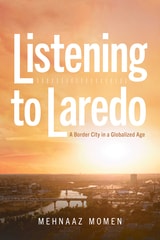
Listening to Laredo
A Border City in a Globalized AgeMehnaaz Momen
University of Arizona Press, 2023
Bringing together issues of growth, globalization, and identity, Mehnaaz Momen traces Laredo’s trajectory through the voices of its people. In contrast to the many studies of border cities defined by the outside—and seldom by the people who live at the border—this volume collects oral histories from seventy-five in-depth interviews that collectively illuminate the evolution of the city’s cultural and economic infrastructure, its interdependence with its sister city across the national boundary, and, above all, the strength of its community as it adapts to and even challenges the national narrative regarding the border. The resonant and lively voices of Laredo’s people convey proud ownership of an archetypal border city that has time and again resurrected itself.
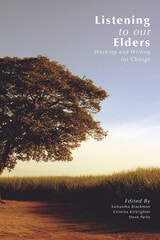
Listening to Our Elders
Working and Writing for ChangeSamantha Blackmon, Cristina Kirklighter, and Steve Parks, eds.
Utah State University Press, 2011
In 2011, the National Council of Teachers of English (NCTE) turned one hundred years old. But our profession is endlessly beginning, constantly transforming itself and its purpose as new voices and identities claim their rights in our classrooms and in our country. The recognition of such claims, however, does not occur without a struggle, without collective work.
Listening to our Elders attempts to capture the history of those collective moments where teachers across grade levels and institutions of higher education organized to insure that the voices, heritages, and traditions of their students and colleagues were recognized within our professional organizations as a vital part of our classrooms and our discipline. In doing so, Listening to Our Elders demonstrates this recognition was not always easily given. Instead, whether the issue was race, sexuality, class, or disability, committed activist organizations have often had to push against the existing limits of our field and its organizations to insure a broader sense of common responsibility and humanity was recognized.
Listening to Our Elders features interviews with Malea Powell (Native American Caucus), Joyce Rain Anderson (Native American Caucus), Jeffery Paul Chan (Asian/Asian American), James Hill (Black Caucus), James Dolmage (Committee for Disability Issue in College Composition), Geneva Smitherman (Language Policy Commitee), Carlota Cárdenas de Dwyer (Latino/a Caucus), Victor Villanueva (Latino/a Caucus), Louise Dunlap (Progressive Caucus), Karen Hollis (Progressive Caucus), Louie Crew (Queer Caucus), William Thelin (Working Class Culture and Pedagogy SIG), Bill Macauley (Working Class Culture and Pedagogy SIG).
Listening to Survivors
Four Decades of Holocaust Memorial Week at Oregon State UniversityKatherine E. Hubler
Oregon State University Press, 2024
Historian Katherine Hubler has arranged these recollections thematically in chapters centered on discrimination, refuge, resistance, rescue, and transitional justice. These themes align with Oregon’s Holocaust and Genocide Education learning concepts, discussion questions accompany each chapter to facilitate use in classrooms, and the introduction situates the speakers’ diverse experiences within the broader context of World War Two and the Nazis’ genocidal project.
Intended to bring the history of the Holocaust to all Oregonians, Listening to Survivors honors the legacy of outreach work of local survivors and serves as a reminder of the state’s connection to the Holocaust and commitment to genocide education and prevention.
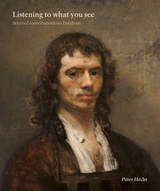
Listening to What You See
Selected Contributions on Dutch ArtPeter Hecht
Paul Holberton Publishing, 2024
Listening to What You See brings together more than twenty-five scholarly essays, reviews, and shorter contributions by Peter Hecht, preceded by an introduction on what he thinks his life in art history has taught him. The title indicates what his collected papers have in common: together they represent an attitude of listening to what you see. Hecht is very suspicious of applying a method and believes that looking at an image until it speaks is essential to understanding it. Apart from a few scholarly reviews, Listening to What You See also contains a sample of Hecht’s writings for the public at large, and some of his best-known critical papers are included here. It covers a range of different topics, including defending public art collections, showing what art can mean in times of crisis when it is not accessible (as was the case when Covid forced the museums to shut down), and talking about what art may do for us–provided that we listen.
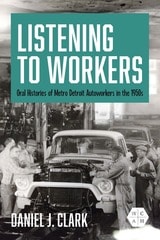
Listening to Workers
Oral Histories of Metro Detroit Autoworkers in the 1950sDaniel J. Clark
University of Illinois Press, 2024
Historians and readers alike often overlook the everyday experiences of workers. Drawing on years of interviews and archival research, Daniel J. Clark presents the rich, interesting, and sometimes confounding lives of men and women who worked in Detroit-area automotive plants in the 1950s.
In their own words, the interviewees frankly discuss personal matters like divorce and poverty alongside recollections of childhood and first jobs, marriage and working women, church and hobbies, and support systems and workplace dangers. Their frequent struggles with unstable jobs and economic insecurity upend notions of the 1950s as a golden age of prosperity while stories of domestic violence and infidelity open a door to intimate aspects of their lives. Taken together, the narratives offer seldom-seen accounts of autoworkers as complex and multidimensional human beings.
Compelling and surprising, Listening to Workers foregoes the union-focused strain of labor history to provide ground-level snapshots of a blue-collar world.
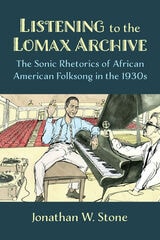
Listening to the Lomax Archive
The Sonic Rhetorics of African American Folksong in the 1930sJonathan W. Stone
University of Michigan Press, 2021
In 1933, John A. Lomax and his son Alan set out as emissaries for the Library of Congress to record the folksong of the “American Negro” in several southern African-American prisons. Listening to the Lomax Archive: The Sonic Rhetorics of African American Folksong in the 1930s asks how the Lomaxes’ field recordings—including their prison recordings and a long-form oral history of jazz musician Jelly Roll Morton—contributed to a new mythology of Americana for a nation in the midst of financial, social, and identity crises. Jonathan W. Stone argues that folksongs communicate complex historical experiences in a seemingly simple package, and can thus be a key element—a sonic rhetoric—for interpreting the ebb and flow of cultural ideals within contemporary historical moments. He contends that the Lomaxes, aware of the power folk music, used the folksongs they collected to increase national understanding of and agency for the subjects of their recordings (including the reconstitution of prevailing stereotypes about African American identity) even as they used the recordings to advance their own careers. Listening to the Lomax Archive gives readers the opportunity to listen in on these seemingly contradictory dualities, demonstrating that they are crucial to the ways that we remember and write about the subjects of the Lomaxes archive and other repositories of historicized sound.

Listening to the Voices of the Dead
The 3-11 Tohoku Disaster SpeaksIsomae Jun'ichi
University of Michigan Press, 2024
Lister Hill
Statesman from the SouthVirginia Van der Veer Hamilton
University of Alabama Press, 2004

Lisu
Far from the RulerMichele Zack
University Press of Colorado, 2017
This book brings the ironic worldview of the Lisu to life through vivid, often amusing accounts of individuals, communities, regions, and practices. One of the smallest and last groups of stateless people, and the most egalitarian of all Southeast Asian highland minorities, the Lisu have not only survived extremes at the crossroads of civil wars, the drug trade, and state-sponsored oppression but adapted to modern politics and technology without losing their identity.
The Lisu weaves a lively narrative that condenses humanity’s transition from border-free tribal groupings into today’s nation-states and global market economy. Journalist and historian Michele Zack first encountered the Lisu in the 1980s and conducted research and fieldwork among them in the 1990s. In 2014 she again traveled extensively in tribal areas of Thailand, Myanmar, and China, when she documented the transformative changes of globalization. Some Lisu have adopted successful new urban occupations in business and politics, while most continue to live as agriculturists “far from the ruler.”
The cohesiveness of Lisu culture has always been mysterious—they reject hierarchical political organization and traditionally had no writing system—yet their culture provides a particular skillset that has helped them navigate the terrain of the different religious and political systems they have recently joined. They’ve made the transition from living in lawless, self-governing highland peripheries to becoming residents and citizens of nation-states in a single generation.
Ambitious and written with journalist’s eye for detail and storytelling, The Lisu introduces the unique and fascinating culture of this small Southeast Asian minority. Their path to national and global citizenship illustrates the trade-offs all modern people have made, and their egalitarian culture provides insight into current political choices in a world turning toward authoritarianism.