Results by title
1917 books match the query 'Law' and 143 start with l
Law and the Social Sciences
Leon Lipson
Russell Sage Foundation, 1987
The notion of law as a social phenomenon would have surprised educators and scholars a century ago. For them, law was a science and the library was the ultimate source of all legal knowledge. Our contemporary willingness to see law in a social context—reflecting social relations, for example, or precipitating social changes—is a relatively recent development, spurred during the last quarter century by the work of a generation of scholars (mostly social scientists and law professors) who believe the perspectives of the social sciences are essential to a better understanding of the law.
Law and the Social Sciences provides a unique and authoritative assessment of modern sociolegal research. Its impressive range and depth, the centrality of its concerns, and the stature of its contributors all attest to the vitality of the law-and-society movement and the importance of interdisciplinary work in this field.
Each chapter is both an exposition of its author’s point of view and a survey of the pertinent literature. In treating such topics as law and the economic order, legal systems of the world, the deterrence doctrine, and access to justice, the authors explore overlapping themes—the tension between public and private domains, between diffused and concentrated power, between the goals of uniformity and flexibility, between costs and benefits—that are significant to observers not only of our legal institutions but of other social systems as well.

Law and the Social Sciences
The Second Half CenturyJulius Stone
University of Minnesota Press, 1966
Law and the Social Sciences was first published in 1966. Minnesota Archive Editions uses digital technology to make long-unavailable books once again accessible, and are published unaltered from the original University of Minnesota Press editions.
The author, a distinguished authority on law, provides an illuminating and challenging discussion of the social aspects of law and legal problems. As a background to some penetrating observations, he takes stock of the contributions and interrelations of the bodies of knowledge, from both the juristic and the social science side, which bear upon the study of law at the present time. He is concerned to show the respects in which jurisprudential ideas in this area have been stimulated and clarified by work in the social sciences, and, conversely, to draw attention to the need for the increased interest of social scientists in this area to take account of juristic insights, many of them of long standing. He points out some of the dangers, not limited to waste of effort, arising from "parochialism" on the part of either the lawyer or the social scientist. The final section is devoted to a study of the contributions, potentialities, and limits of behavioralist and computer techniques in understanding and operating the appellate judicial process.
The book is based on a series of three lectures given by the author as the William S. Pattee Memorial Lectures sponsored by the University of Minnesota Law School.
Law and the Visible
Edited by Austin Sarat, Lawrence Douglas, and Martha Merrill Umphrey
University of Massachusetts Press, 2021
Individual essays discuss the culpability of those who record violence, the history of racialized violence as it streams through police bodycams, the idea of digital images as objective or neutral, the logics of surveillance and transparency, and a defense of anonymity in the digital age.
Contributors include Benjamin J. Goold, Torin Monahan, Kelli Moore, Eden Osucha, Jennifer Peterson, and Carrie A. Rentschler.
Law as Politics
Carl Schmitt’s Critique of LiberalismDavid Dyzenhaus, ed.
Duke University Press, 1998
One of the major players in the 1920s debates, an outspoken critic of the Versailles Treaty and the Weimar Constitution, and a member of the Nazi party who provided juridical respectability to Hitler’s policies, Schmitt contended that people are a polity only to the extent that they share common enemies. He saw the liberal notion of a peaceful world of universal citizens as a sheer impossibility and attributed the problems of Weimar to liberalism and its inability to cope with pluralism and political conflict. In the decade since his death, Schmitt’s writings have been taken up by both the right and the left and scholars differ greatly in their evaluation of Schmitt’s ideas. Law as Politics thematically organizes in one volume the varying engagements and confrontations with Schmitt’s work and allows scholars to acknowledge—and therefore be in a better position to negotiate—an important paradox inscribed in the very nature of liberal democracy.
Law as Politics will interest political philosophers, legal theorists, historians, and anyone interested in Schmitt’s relevance to current discussions of liberalism.
Contributors. Heiner Bielefeldt, Ronald Beiner, Ernst-Wolfgang Bockenforde, Renato Cristi, David Dyzenhaus, Robert Howse, Ellen Kennedy, Dominique Leydet, Ingeborg Maus, John P. McCormick, Reinhard Mehring, Chantal Mouffe, William E. Scheuerman, Jeffrey Seitzer
Law at the End of Life
The Supreme Court and Assisted SuicideCarl E. Schneider, Editor
University of Michigan Press, 2000
Law by Night
Jonathan Goldberg-Hiller
Duke University Press, 2023

Law in Everyday Japan
Sex, Sumo, Suicide, and StatutesMark D. West
University of Chicago Press, 2005
Compiling case studies based on seven fascinating themes—karaoke-based noise complaints, sumo wrestling, love hotels, post-Kobe earthquake condominium reconstruction, lost-and-found outcomes, working hours, and debt-induced suicide—Law in Everyday Japan offers a vibrant portrait of the way law intermingles with social norms, historically ingrained ideas, and cultural mores in Japan. Each example is informed by extensive fieldwork. West interviews all of the participants-from judges and lawyers to defendants, plaintiffs, and their families-to uncover an everyday Japan where law matters, albeit in very surprising ways.

Law in Everyday Life
Austin Sarat and Thomas R. Kearns, Editors
University of Michigan Press, 1995

Law in Film
RESONANCE AND REPRESENTATIONDavid A. Black
University of Illinois Press, 1999
Drawing on both film studies and legal scholarship, David A. Black explores the implications of representing court procedure, as well as other phases of legal process, in film. His study ranges from an inquiry into the common metaphorical ground between film and law, explored through "the detective" and "the witness," to a critical survey of legal writings about the cinema, to close analyses of key films about law. In examining multiple aspects of law in film, Black sustains a focus on the central importance of narrative while also unearthing the influences—pleasure in film, power in law—that lie beyond the narrative realm. Black's penetrating study treats questions of narrative authority and structure, social authority, and cultural history, revealing the underlying historical, cultural, and cognitive connections between legal and cinematic practices.
Law in Sport
Concepts and Cases: Fifth EditionJohn Grady
FiT Publishing, 2022
Designed to make introductory legal concepts and their application to sport and physical activity easy to understand, this new edition explores an array of legal issues facing the contemporary sport manager, applying concepts from the laws of negligence, intentional torts, product liability, contracts, constitution, labor, agency, intellectual property, and more. The new edition includes updated chapters and relies upon recent litigation to explore the most frequent legal issues impacting the business of sport. This new edition also presents expanded analyses of Title IX and recent NCAA litigation, and a thorough explanation of laws intended to ensure gender equity in sport. Law in Sport: Concepts and Cases, 5th edition is an invaluable resource for students interested in pursuing a career in sport management.

Law in a Lawless Land
Diary of a Limpieza in ColombiaMichael Taussig
University of Chicago Press, 2005
Law in a Lawless Land offers a rare and penetrating insight into the nature of Colombia's present peril. In a nuanced account of the human consequences of a disintegrating state, anthropologist Michael Taussig chronicles two weeks in a small town in Colombia's Cauca Valley taken over by paramilitaries that brazenly assassinate adolescent gang members. Armed with automatic weapons and computer-generated lists of names and photographs, the paramilitaries have the tacit support of the police and even many of the desperate townspeople, who are seeking any solution to the crushing uncertainty of violence in their lives. Concentrating on everyday experience, Taussig forces readers to confront a kind of terror to which they have become numb and complacent.
"If you want to know what it is like to live in a country where the state has disintegrated, this moving book by an anthropologist well known for his writings on murderous Colombia will tell you."—Eric Hobsbawm
Law in the Domains of Culture
Austin Sarat and Thomas R. Kearns, Editors
University of Michigan Press, 2000
Law in the Laboratory
A Guide to the Ethics of Federally Funded Science ResearchRobert P. Charrow
University of Chicago Press, 2010
The National Institutes of Health and the National Science Foundation together fund more than $40 billon of research annually in the United States and around the globe. These large public expenditures come with strings, including a complex set of laws and guidelines that regulate how scientists may use NIH and NSF funds, how federally funded research may be conducted, and who may have access to or own the product of the research.
Until now, researchers have had little instruction on the nature of these laws and how they work. But now, with Robert P. Charrow’s Law in the Laboratory, they have a readable and entertaining introduction to the major ethical and legal considerations pertaining to research under the aegis of federal science funding. For any academic whose position is grant funded, or for any faculty involved in securing grants, this book will be an essential reference manual. And for those who want to learn how federal legislation and regulations affect laboratory research, Charrow’s primer will shed light on the often obscured intersection of government and science.

Law of Accumulation and Breakdown of the Capitalist System
Henryk Grossmann
Pluto Press, 1992
Law's Madness
Austin Sarat, Lawrence Douglas, and Martha Merrill Umphrey, Editors
University of Michigan Press, 2006
The distinguished contributors to Law's Madness propose a fascinating interdisciplinary approach to the instability and mutual permeability of law and madness. Their essays examine a variety of discursive forms—from the literary to the historical to the psychoanalytic—in which law is driven more by narrative than by reason. Their studies delineate the ways in which the law takes its definition in part from that which it excludes, suppresses, or excises from itself, illuminating the drive to enforce barriers between non-reason and legality, while simultaneously shedding new light on the constitutive force of the irrational in legal doctrine.
Law's Madness suggests that the tense and paradoxical relationship between law and madness is precisely what erects and sustains law. This provocative collection asks what must be forgotten in order to uphold the rule of law.
Austin Sarat is William Nelson Cromwell Professor of Jurisprudence and Political Science at Amherst College. Lawrence Douglas is Associate Professor of Law, Jurisprudence, and Social Thought at Amherst College. Martha Merrill Umphrey is Associate Professor of Law, Jurisprudence, and Social Thought at Amherst College.
Law's Mistakes
Austin Sarat
University of Massachusetts Press, 2016
The essays in Law's Mistakes explore the things that law recognizes as errors and the way it responds to them. They identify the jurisprudential and political perspectives that underlie different understandings of what is or is not a legal mistake, and examine the fraught, contested, and evolving relationship between law and error. And they offer templates for thinking about what mistakes can tell us about the aspirations and limits of law, and for understanding how our imagining of law is enabled and shaped by its juxtaposition to a condition labeled mistake.
In addition to the volume editors, contributors include Paul Schiff Berman, Sonali Chakravarti, Jody L. Medeira, Stewart Motha, Kunal Parker, and Jordan Steiker.

Law's Violence
Austin Sarat and Thomas R. Kearns, Editors
University of Michigan Press, 1995

Law, Family, and Women
Toward a Legal Anthropology of Renaissance ItalyThomas Kuehn
University of Chicago Press, 1991
influence of law on Italian society during the Renaissance,
especially in the spheres of family and women. Kuehn's use
of legal sources along with letters, diaries, and
contemporary accounts allows him to present a compelling
image of the social processes that affected the shape and
function of the law.
The numerous law courts of Italian city-states
constantly devised and revised statutes. Kuehn traces the
permutations of these laws, then examines their use by
Florentines to arbitrate conflict and regulate social
behavior regarding such issues as kinship, marriage,
business, inheritance, illlegitimacy, and gender. Ranging
from one man's embittered denunciation of his father to
another's reaction to his kinsmen's rejection of him as
illegitimate, Law, Family, and Women provides
fascinating evidence of the tensions riddling family life in
Renaissance Florence. Kuehn shows how these same tensions,
often articulated in and through the law, affected women. He
examines the role of the mundualdus—a male legal guardian
for women—in Florence, the control of fathers over their
married daughters, and issues of inheritance by and through
women. An ambitious attempt to reformulate the agenda of
Renaissance social history, Kuehn's work will be of value to
both legal anthropologists and social historians.
Thomas Kuehn is professor of history at Clemson
University.
Law, Intellect, and Education
Francis A. Allen
University of Michigan Press, 1979
Law, Legislation and Liberty, Volume 1
Rules and OrderF. A. Hayek
University of Chicago Press, 1978
Law, Legislation and Liberty, Volume 2
The Mirage of Social JusticeF. A. Hayek
University of Chicago Press, 1977

Law, Legislation and Liberty, Volume 3
The Political Order of a Free PeopleF. A. Hayek
University of Chicago Press, 1981
Law, Legislation, and Liberty, Volume 19
F. A. Hayek
University of Chicago Press, 2021
In this critical entry in the University of Chicago’s Collected Works of F. A. Hayek series, political philosopher Jeremy Shearmur collates Hayek’s three-part study of law and liberty and places Hayek’s writings in careful historical context. Incisive and unrestrained, Law, Legislation, and Liberty is Hayek at his late-life best, making it essential reading for understanding the philosopher’s politics and worldview.
These three volumes constitute a scaling up of the framework offered in Hayek’s famed The Road to Serfdom. Volume 1, Rules and Order, espouses the virtues of classical liberalism; Volume 2, The Mirage of Social Justice, examines the societal forces that undermine liberalism and, with it, liberalism’s capacity to induce “spontaneous order”; and Volume 3, The Political Order of a Free People, proposes alternatives and interventions against emerging anti-liberal movements, including a rule of law that resides in stasis with personal freedom.
Shearmur’s treatment of this challenging work—including an immersive new introduction, a conversion of Hayek’s copious endnotes to footnotes, corrections to Hayek’s references and quotations, and the provision of translations to material that Hayek cited only in languages other than English—lends it new importance and accessibility. Rendered anew for the next generations of scholars, this revision of Hayek’s Law, Legislation, and Liberty is sure to become the standard.
Law, Liberty, and the Pursuit of Terrorism
Roger Douglas
University of Michigan Press, 2014
Roger Douglas compares responses to terrorism by five liberal democracies—the United States, the United Kingdom, Canada, Australia, and New Zealand—over the past 15 years. He examines each nation’s development and implementation of counterterrorism law, specifically in the areas of information-gathering, the definition of terrorist offenses, due process for the accused, detention, and torture and other forms of coercive questioning.
Douglas finds that terrorist attacks elicit pressures for quick responses, often allowing national governments to accrue additional powers. But emergencies are neither a necessary nor a sufficient condition for such laws, which may persist even after fears have eased. He argues that responses are influenced by both institutional interests and prior beliefs, and complicated when the exigencies of office and beliefs point in different directions. He also argues that citizens are wary of government’s impingement on civil liberties and that courts exercise their capacity to restrain the legislative and executive branches. Douglas concludes that the worst antiterror excesses have taken place outside of the law rather than within, and that the legacy of 9/11 includes both laws that expand government powers and judicial decisions that limit those very powers.

Law, Sex, and Christian Society in Medieval Europe
James A. Brundage
University of Chicago Press, 1990
"Brundage's book is consistently learned, enormously useful, and frequently entertaining. It is the best we have on the relationships between theological norms, legal principles, and sexual practice."—Peter Iver Kaufman, Church History

Lawful Repair
Reimagining Law Through Queer DissentDanish Sheikh
Duke University Press, 2027

Laws of Early Iceland
Gragas IAndrew Dennis
University of Manitoba Press, 2007

Laws of Early Iceland
Gragas IIAndrew Dennis
University of Manitoba Press, 2000

Laws of the Postcolonial
Eve Darian-Smith and Peter Fitzpatrick, Editors
University of Michigan Press, 1999
In perceptions of Western law there is an enduring disparity between law's pervasive power and its fragility. Many of these essays provide graphic accounts of law's tremendous shaping power in that massive occidental movement which settled and unsettled the globe. These accounts point to the West's encompassing and transforming of other peoples and other legal systems in ways which constitute and confirm the West in its own self-creation. Other essays deal with situations "within" the West which show how its identity is created, sustained, and also challenged in a constant reference to those contrary "others" which a powerful law has shaped and transformed. This challenge comes not least from the resistance of those "others" --resistances that profoundly disrupt the West and its law, revealing them as fractured at the seemingly confident core of their own self-constitution.
Contributors include Antony Anghie, Rolando Gaete, Alan Norrie, Dianne Otto, Paul Passavant, Jeannine Perdy, Colin Perrin, Annelise Riles, Roshan de Silva, and John Strawson, in addition to the editors.
Eve Darian-Smith is Assistant Professor of Anthropology, University of California, Santa Barbara. Peter Fitzpatrick is Professor of Law, Queen Mary and Westfield College, University of London.
Lawsuits in a Market Economy
The Evolution of Civil LitigationStephen C. Yeazell
University of Chicago Press, 2018
Lawsuits in a Market Economy explains how contemporary civil litigation in the United States works and how it has changed over the past century. The book corrects common misconceptions—some of which have proved remarkably durable even in the face of contrary evidence—and explores how our constitutional structure, an evolving economy, and developments in procedural rules and litigation financing systems have moved us from expecting that lawsuits end in trial and judgments to expecting that they will end in settlements. Yeazell argues that today’s system has in some ways overcome—albeit inconsistently—disparities between the rich and poor in access to civil justice. Once upon a time, might regularly triumphed over right. That is slightly less likely today—even though we continue to witness enormous disparities in wealth and power.
The book concludes with an evaluation of recent changes and their possible consequences.
Lawyer and Client
Who's in ChargeDouglas E. Rosenthal
Russell Sage Foundation, 1974

Lawyering an Uncertain Cause
Immigration Advocacy and Chinese Youth in the USMichele Statz
Vanderbilt University Press, 2018
In and beyond the legal realm, the figure of the "vulnerable Chinese child" powerfully legitimates legal claims and attorneys' efforts. At the same time, the transnational ambitions and obligations of Chinese youth implicitly unsettle this figure. The maneuvers of these youth not only belie attorneys' reliance on racialized discourses of childhood and the Chinese family, but they also reveal more broad uncertainties around legal frameworks, institutional practices, health and labor rights—and cause lawyering itself.
Based on three years of fieldwork across the United States, Lawyering an Uncertain Cause is a novel study of the complex and often contradictory rights, responsibilities, and expectations that motivate global youth and the American attorneys who work on their behalf.

Lawyers Beyond Borders
Advancing International Human Rights Through Local Laws and CourtsMaria Armoudian
University of Michigan Press, 2021
Despite international conventions and human rights declarations, millions of people have suffered and continue to suffer torture, slavery, or violent deaths, with no remedy or recourse. They have fallen, in essence, “below the law,” outside of law’s protection. Often violated by their own governments, sometimes with support from transnational corporations, or nations benefiting from human rights violations, how can these victims find justice? Lawyers Beyond Borders reveals the inner workings of the advances and retreats in the quest for redress and restoration of human rights for those whom international legal-political systems have failed. The process of justice begins in the US, with a handful of human rights lawyers steeped in the American tradition of advancing civil rights through civil litigation. As the civil rights movement gained traction and an ample supply of lawyers, this small cadre turned their attention toward advancing international human rights, via the US legal system. They sought to build another piece of the rights revolution, this time for survivors of egregious human rights violations in faraway lands. These cases were among the most unlikely to be slated for victory: The abuses occurred abroad; the victims are aliens, usually with few, if any, resources; the perpetrators are politically powerful, resourced, and well connected, often members of governments, militaries, or multinational corporations. The legal and political systems’ structures are mostly stacked against these survivors, many who bear the scars of trauma and terror.
Lawyers Beyond Borders is about agency. It is about how, in the face of powerful interests and seemingly insurmountable obstacles—political, psychological, economic, geographical, and physical—a small group of lawyers and survivors navigated a terrain of daunting barriers to begin building, case-by-case, new pathways to justice for those who otherwise would have none.
Lawyers in Practice
Ethical Decision Making in ContextEdited by Leslie C. Levin and Lynn Mather
University of Chicago Press, 2012
How do lawyers resolve ethical dilemmas in the everyday context of their practice? What are the issues that commonly arise, and how do lawyers determine the best ways to resolve them? Until recently, efforts to answer these questions have focused primarily on rules and legal doctrine rather than the real-life situations lawyers face in legal practice.
The first book to present empirical research on ethical decision making in a variety of practice contexts, including corporate litigation, securities, immigration, and divorce law, Lawyers in Practice fills a substantial gap in the existing literature. Following an introduction emphasizing the increasing importance of understanding context in the legal profession, contributions focus on ethical dilemmas ranging from relatively narrow ethical issues to broader problems of professionalism, including the prosecutor’s obligation to disclose evidence, the management of conflicts of interest, and loyalty to clients and the court. Each chapter details the resolution of a dilemma from the practitioner’s point of view that is, in turn, set within a particular community of practice. Timely and practical, this book should be required reading for law students as well as students and scholars of law and society.
Lawyers of the Right
Professionalizing the Conservative CoalitionAnn Southworth
University of Chicago Press, 2008
Drawing on in-depth interviews with more than seventy lawyers who represent conservative and libertarian nonprofit organizations, Ann Southworth explores their values and identities and traces the implications of their shared interest in promoting political strategies that give lawyers leading roles. She goes on to illuminate the function of mediator organizations—such as the Heritage Foundation and the Federalist Society for Law and Public Policy—that have succeeded in promoting cooperation among different factions of conservative lawyers. Such cooperation, she finds, has aided efforts to drive law and the legal profession politically rightward and to give lawyers greater prominence in the conservative movement. Southworth concludes, though, that tensions between the conservative law movement’s elite and populist elements may ultimately lead to its undoing.
Learning to Love Form 1040
Two Cheers for the Return-Based Mass Income TaxLawrence Zelenak
University of Chicago Press, 2013
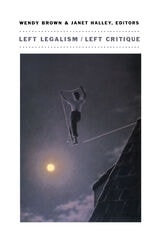
Left Legalism/Left Critique
Wendy Brown and Janet Halley, eds.
Duke University Press, 2002
Brown and Halley have assembled essays from diverse contributors—law professors, philosophers, political theorists, and literary critics—united chiefly by their willingness to think critically from the left about left legal projects. The essays themselves vary by topic, by theoretical approach, and by conclusion. While some contributors attempt to rework particular left legal projects, others insist upon abandoning or replacing those projects. Still others leave open the question of what is to be done as they devote their critical attention to understanding what we are doing. Above all, Left Legalism/Left Critique is a rare contemporary argument and model for the intellectually exhilarating and politically enriching dimensions of left critique—dimensions that persist even, and perhaps especially, when critique is unsure of the intellectual and political possibilities it may produce.
Contributors: Lauren Berlant, Wendy Brown, Judith Butler, Drucilla Cornell, Richard T. Ford, Katherine M. Franke, Janet Halley, Mark Kelman, David Kennedy, Duncan Kennedy, Gillian Lester, Michael Warner
Legal Advocacy
Lawyers and Nonlawyers at WorkHerbert M. Kritzer
University of Michigan Press, 1998
The analysis shows clearly that nonlawyers can be effective advocates and, in some situations, more effective than many lawyers. Kritzer combines an examination of case outcomes with a systematic observation of advocates in the hearing room, providing a compelling portrait of their work and a solid basis for understanding the differences in the effectiveness of advocates with different training. The author's findings have important implications for our policies toward restrictions on those who can provide legal assistance, specialization in training and practice, and the meaning of professional monopolies in a world of increasing complexity.
This book will appeal to student of the legal process, the sociology of professions, and all concerned with the operation of the U.S. legal system.
Herbert M. Kritzer is Professor of Political Science and Law, University of Wisconsin--Madison. He is the author of Let's Make a Deal and The Justice Broker.
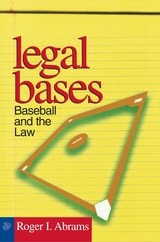
Legal Bases
Baseball And The LawRoger Abrams
Temple University Press, 1998
But how does collective bargaining and labor arbitration work in the major leagues? Why is baseball exempt from the antitrust laws? In Legal Bases, Roger Abrams has assembled an all-star baseball law team whose stories illuminate the sometimes uproarious, sometimes ignominious relationship between law and baseball that has made the business of baseball a truly American institution.

Legal Care
Advocacy and Friction in Family DetentionErin Routon
University of Arizona Press, 2026
Family detention garnered much public attention when it expanded dramatically in 2014 as significantly increased numbers of migrant groups began arriving and requesting asylum at the Mexico-U.S. border. During this period, the Obama administration designated three detention facilities, two in South Texas, to hold such families while they underwent part of the asylum legal process. One became the largest immigrant detention facility in the country.
In Legal Care anthropologist Erin Routon explores the operations of these facilities through the unique perspectives of volunteer legal advocates. Routon offers a compelling ethnographic account of the hidden labor and emotional resilience of those advocates. Through the lens of “legal care,” Routon reframes legal aid as a form of caregiving, revealing how these advocates resist the structural and legal violence of family detention while supporting asylum-seeking parents and children. Drawing on immersive fieldwork and firsthand narratives, the book exposes the human cost of administrative incarceration and the quiet power of care in spaces designed to exclude.
Timely, urgent, and deeply humane, this work speaks to scholars and practitioners across anthropology, law and society, migration studies, and carceral justice. Routon’s accessible and evocative writing invites readers to reconsider activism and advocacy, offering new language for understanding resistance and solidarity in the face of institutional violence. This book is essential reading for anyone committed to justice, care, and the future of immigration policy in the United States.
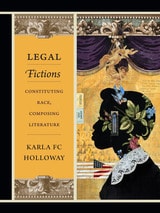
Legal Fictions
Constituting Race, Composing LiteratureKarla FC Holloway
Duke University Press, 2014
Legal Interpreting
Teaching, Research, and PracticeJeremy L. Brunson
Gallaudet University Press, 2022
Each chapter features discussion questions and prompts that interpreter educators can use in the classroom. While intended as a foundational text for use in courses, this body of work also provides insight into the current state of the legal interpreting field and will be a valuable resource for scholars, practitioners, and consumers.
Legal Inversions
Lesbians, Gay Men, and the Politics of the Lawedited by Didi Herman and Carl Stychin
Temple University Press, 1995
Law reform struggles have always been a part of the grassroots lesbian and gay agenda. These critical essays examine the politics of these engagements, of lesbians, gay men, and the law in the United States, Canada, and the United Kingdom. From a wide range of perspectives, the contributors combine new conceptual insights with a concern for the practicalities of political engagements, tackling such vital topics as legal definitions of homosexuality, AIDS activism, and race and sexuality.
Contributors: Katherine Arnup, Susan Boyd, Peter M. Cicchino, Davina Cooper, Bruce R. Deming, Mary Eaton, William F. Flanagan, Leo Flynn, Shelley A. M. Gavigan, Leslie J. Moran, Katherine M. Nicholson, Cynthia Petersen, Ruthann Robson, and the editors.
Legal Language
Peter M. Tiersma
University of Chicago Press, 1999
"Legal Language will resonate with lawyers . . . and any non-lawyer who has waded through legal documents, or has tuned in to the latest trial on Court TV."—Carmie D. Boccuzzi, Jr., Boston Book Review
"[A] masterful, highly readable, and enjoyable book. . . . Legal Language is truly a fun book to read."—David Schultz, Law and Politics Book Review
Legal Modernism
David Luban
University of Michigan Press, 1997
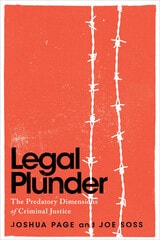
Legal Plunder
The Predatory Dimensions of Criminal JusticeJoshua Page and Joe Soss
University of Chicago Press, 2025
A searing, historically rich account of how US policing and punishment have been retrofitted over the last four decades to extract public and private revenues from America’s poorest and most vulnerable communities.
Alongside the rise of mass incarceration, a second profound and equally disturbing development has transpired. Since the 1980s, US policing and punishment have been remade into tools for stripping resources from the nation’s most oppressed communities and turning them into public and private revenues. Legal Plunder analyzes this development’s origins, operations, consequences, and the political struggles that it has created.
Drawing on historical and contemporary evidence, including original ethnographic research, Joshua Page and Joe Soss examine the predatory dimensions of criminal legal governance to show how practices that criminalize, police, and punish have been retrofitted to siphon resources from subordinated groups, subsidize governments, and generate corporate profits. As tax burdens have declined for the affluent, this financial extraction—now a core function of the country’s sprawling criminal legal apparatus—further compounds race, class, and gender inequalities and injustices. Legal Plunder shows that we can no longer afford to overlook legal plunder or the efforts to dismantle it.
Legal Plunder
The Predatory Dimensions of Criminal JusticeJoshua Page and Joe Soss
University of Chicago Press, 2025
This is an auto-narrated audiobook version of this book.
A searing, historically rich account of how US policing and punishment have been retrofitted over the last four decades to extract public and private revenues from America’s poorest and most vulnerable communities.
Alongside the rise of mass incarceration, a second profound and equally disturbing development has transpired. Since the 1980s, US policing and punishment have been remade into tools for stripping resources from the nation’s most oppressed communities and turning them into public and private revenues. Legal Plunder analyzes this development’s origins, operations, consequences, and the political struggles that it has created.
Drawing on historical and contemporary evidence, including original ethnographic research, Joshua Page and Joe Soss examine the predatory dimensions of criminal legal governance to show how practices that criminalize, police, and punish have been retrofitted to siphon resources from subordinated groups, subsidize governments, and generate corporate profits. As tax burdens have declined for the affluent, this financial extraction—now a core function of the country’s sprawling criminal legal apparatus—further compounds race, class, and gender inequalities and injustices. Legal Plunder shows that we can no longer afford to overlook legal plunder or the efforts to dismantle it.

Legal Records at Risk
A Strategy for Safeguarding our Legal HeritageClare Cowling
University of London Press, 2019
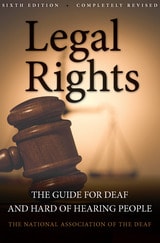
Legal Rights, 6th Ed.
The Guide for Deaf and Hard of Hearing PeopleGallaudet University Press, 2015
The new Legal Rights also explains the significant amendments to these laws, including the ADA Amendments Act (ADAAA) and new regulations to its Title II concerning public entities and Title III pertaining to public accommodations and commercial facilities. The reauthorization of IDEA expanded the No Child Left Behind Act requirement for highly qualified teachers to all students with disabilities. This new edition also tracks the trend of passing a Deaf and Hard of Hearing Children’s Bill of Rights in a growing number of state legislatures.
This completely new resource also delineates new legislation such as the Twenty-First Century Communications Video and Accessibility Act, which ensures access to the newest communications technology for deaf and hard of hearing people. Legal Rights also includes information on the use of interpreters in the legal system, securing its position as the most comprehensive reference of legal information for deaf and hard of hearing people now available.

Legal Rights
Historical and Philosophical PerspectivesAustin Sarat and Thomas R. Kearns, Editors
University of Michigan Press, 1997