Results by title
275 books match the query 'Letters' and 77 start with l
Letters to Kate
Life after LifeCarl H. Klaus
University of Iowa Press, 2006
Letters to Women
New Letters, volume 2Theodore Dreiser. Edited by Thomas P. Riggio
University of Illinois Press, 2008
Theodore Dreiser led a long and controversial life, almost always pursuing some serious question, and not rarely pursuing women. This collection, the second volume of Dreiser correspondence to be published by the University of Illinois Press, gathers previously unpublished letters Dreiser wrote to women between 1893 and 1945, many of them showing personal feelings Dreiser revealed nowhere else. Here he both preens and mocks himself, natters and scolds, relates his jaunts with Mencken and his skirmishes with editors and publishers. He admits his worries, bemoans his longings, and self-consciously embarks on love letters that are unafraid to smolder and flame. To one reader he sends “Kisses, Kisses, Kisses, for your sweety mouth” and urges his needy requests: “Write me a love-letter Honey girl.” Alongside such amorous play, he often expressed his deepest feelings on philosophical, religious, and social issues that characterize his public writing.
Chronologically arranged and meticulously edited by Thomas P. Riggio, these letters reveal how wide and deep Dreiser’s needs were. Dreiser often discussed his writing in his letters to women friends, telling them what he wanted to do, where he thought he succeeded and failed, and seeking approval or criticism. By turns seductive, candid, coy, and informative, these letters provide an intimate view of a master writer who knew exactly what he was after.
Letters to a Fellow Seeker
A Short Introduction to the Quaker WaySteve Chase
QuakerPress, 2012

Letters with Smokie
Blindness and More-than-Human RelationsRod Michalko
University of Manitoba Press, 2023
Letters, 1-30
Peter Damian
Catholic University of America Press, 1989
Letters, 1-91
Saint Ambrose
Catholic University of America Press, 1954
Letters, 121-150
Owen J. Peter Damian
Catholic University of America Press, 2004
Letters, 151-180
Owen J. Peter Damian
Catholic University of America Press, 2005
Letters, 31-60
Peter Damian
Catholic University of America Press, 1990
Letters, 61-90
Peter Damian
Catholic University of America Press, 1992
Letters, Kinship, and Social Mobility in Nigeria
Olufemi Vaughan
University of Wisconsin Press, 2023
Letter writing was a dominant form of communication for Western-educated elites in colonial Africa, especially in Nigeria. Exposure to the modern world and a growing sense of nationalism were among the factors that led people to begin exchanging letters, particularly in their interactions with British colonial authorities. Through careful textual analysis and broad contextualization, Vaughan reconstructs dominant storylines, including themes such as kinship, social mobility, Western education, modernity, and elite consolidation in colonial and post-colonial Nigeria. Vaughan brings his prodigious skills as an interdisciplinary scholar to bear on this wealth of information, bringing to life a portrait, at once intimate and expansive, of a community during a transformative period in African history.
Letters, Numbers, Forms
Essays, 1928-70Raymond Queneau
University of Illinois Press, 2007
Compiled from two volumes of Raymond Queneau's essays (Bâtons, chiffres et lettres and Le Voyage en Grèce), these selections find Queneau at his most playful and at his most serious, eloquently pleading for a certain classicism even as he reveals the roots of his own wildly original oeuvre. Ranging from the funny to the furious, they follow Queneau from modernism to postmodernism by way of countless fascinating detours, including his thoughts on language, literary fashions, myth, politics, poetry, and other writers (Faulkner, Flaubert, Hugo, and Proust). Translator Jordan Stump provides an introduction as well as explanatory notes about key figures and Queneau himself.
Letters, Volume 1
John Barsanuphius and John
Catholic University of America Press, 2006
Letters, Volume 1 (1–185)
Saint Basil
Catholic University of America Press, 1951
Letters, Volume 1 (1–82)
Saint Augustine
Catholic University of America Press, 1951
Letters, Volume 2
John Barsanuphius and John
Catholic University of America Press, 2006
Letters, Volume 2 (186–368)
Saint Basil
Catholic University of America Press, 1955
Letters, Volume 2 (83–130)
Saint Augustine
Catholic University of America Press, 1953
Letters, Volume 3 (131-164)
Saint Augustine
Catholic University of America Press, 1953
Letters, Volume 4 (165–203)
Saint Augustine
Catholic University of America Press, 1955
Letters, Volume 5 (204–270)
Saint Augustine
Catholic University of America Press, 1956
Letters, Volume 6 (1*–29*)
Saint Augustine
Catholic University of America Press, 1989
Letters
A Bilingual EditionHortense Mancini
Iter Press, 2025
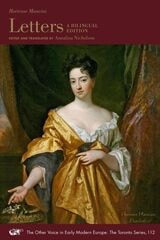
During the seventeenth century, Hortense Mancini, Duchess of Mazarin (1646–99), became an icon of women’s emancipation. In 1668, she shocked Europe when she fled her coercive husband and began a nomadic exile. Her notoriety increased in 1675 with the publication of her memoir—one of the first to appear in French by a woman—and was later magnified by her stint as the royal mistress of Charles II of England and by her establishment of a freethinking salon in London. As a salonnière, an exile, and a litigant fighting for legal separation from her husband, Mancini’s letters were a means of connection, collusion, and survival as well as cultural collaboration. Collected and translated here for the first time, this correspondence charts her struggle for autonomy in her own words.
Life and Letters of General W. H. L. Wallace
Isabel Wallace. Foreword by John Y. Simon
Southern Illinois University Press, 2000
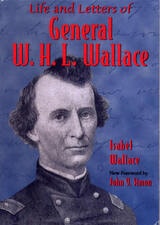
Originally published in 1909, this biography by Isabel Wallace recounts the life of her adoptive father, the little-recognized William Hervy Lamme Wallace, the highest-ranking Union officer to fall at the battle of Shiloh.
Born in 1821 in Ohio, Wallace and his family moved to Illinois in 1834, where he was educated at Rock Springs Seminary in Mount Morris. On his way to study law with Abraham Lincoln in Springfield in 1844, Wallace was persuaded by local attorney T. Lyle Dickey, a close friend of Lincoln, to join his practice in Ottawa instead. Wallace eventually married Dickey’s daughter, Martha Ann, in 1851.
When the Civil War broke out, both Wallace and Dickey immediately volunteered for service with the Eleventh Illinois, which assembled in Springfield. Wallace was elected as the unit’s colonel; a successful lawyer, a friend of President Lincoln, a generation older than most privates, and an officer with Mexican War experience, he was entirely suited for such command. Wallace was appointed brigadier general for his performance at Fort Donelson, the first notable Union victory in the Civil War. Wallace’s troops had saved the day, although the Eleventh Illinois had lost nearly two-thirds of its men. He then moved with his troops to Pittsburg Landing, Tennessee, where Confederates launched a surprise attack on the forces of Major General Ulysses S. Grant at Shiloh Church on Sunday, April 6, 1862. Wallace, who held only temporary command of one of Grant’s six divisions, fought bravely but was mortally wounded as he began to withdraw his men on the afternoon of the battle. His wife, who had arrived at Pittsburg Landing by steamer on the day of the battle, was at his side when he died three days later. Grant praised Wallace in 1868 as “the equal of the best, if not the very best, of the Volunteer Generals with me at the date of his death.”
Isabel Wallace traces her father’s life from his upbringing in Ottawa through his education, his service in the Mexican War, his law practice, his courtship of and marriage to her mother, and his service in the Eleventh Illinois until his mortal injury at Shiloh. She also details his funeral and her and her mother’s life in the postwar years. Based on the copious letters and family papers of the general and his wife, the biography also provides historical information on federal politics of the period, including commentary on Lincoln’s campaign and election and on state politics, especially regarding T. Lyle Dickey, Wallace’s father-in-law and law partner, prominent Illinois politician, and associate of Lincoln. It is illustrated with fifteen black-and-white halftones.
Lives, Letters, and Quilts
Women and Everyday Rhetorics of ResistanceVanessa Kraemer Sohan
University of Alabama Press, 2020
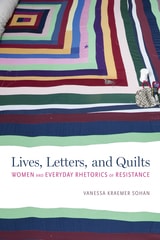
In Lives, Letters, and Quilts: Women and Everyday Rhetorics of Resistance, Vanessa Kraemer Sohan applies a translingual and transmodal framework informed by feminist rhetorical practice to three distinct case studies that demonstrate women using unique and effective rhetorical strategies in political, religious, and artistic contexts. These case studies highlight a diverse set of actors uniquely situated by their race, gender, class, or religion, but who are nevertheless connected by their capacity to envision and recontextualize the seemingly ordinary means and materials available to them in order to effectively persuade others.
The Great Depression provides the backdrop for the first case study, a movement whereby thousands of elderly citizens proselytized and fundraised for a monthly pension plan dreamt up by a California doctor in the hopes of lifting themselves out of poverty. Sohan investigates how the Townsend Plan’s elderly supporters—the Townsendites—worked within and across language, genre, mode, and media to enable them for the first time to be recognized by others, and themselves, as a viable political constituency.
Next, Sohan recounts the story of Quaker minister Eliza P. Kirkbride Gurney who met President Abraham Lincoln in 1862. Their subsequent epistolary exchanges concerning conscientious objectors made such an impression on him that one of her letters was rumored to be in his pocket the night of his assassination. Their exchanges and Gurney’s own accounts of her transnational ministry in her memoir provide useful examples of how, throughout history, women rhetors have adopted and transformed typically underappreciated forms of rhetoric—such as the epideictic—for their particular purposes.
The final example focuses on the Gee’s Bend quiltmakers—a group of African American women living in rural Alabama who repurpose discarded work clothes and other cast-off fabrics into the extraordinary quilts for which they are known. By drawing on the means and materials at hand to create celebrated works of art in conditions of extreme poverty, these women show how marginalized artisans can operate both within and outside the bounds of established aesthetic traditions and communicate the particulars of their experience across cultural and economic divides.

Love, H
The Letters of Helene Dorn and Hettie JonesHettie Jones
Duke University Press, 2016
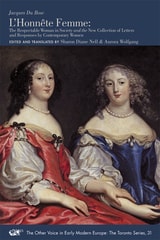
L’Honnête Femme
The Respectable Woman in Society and the New Collection of Letters and Responses by Contemporary WomenJacques Du Bosc
Iter Press, 2014
—Reverend John J. Conley, SJ
Knott Professor of Philosophy, Loyola University Maryland