Results by title
3745 books match the query 'Europe' and 107 start with l
Love of Country
A Journey through the HebridesMadeleine Bunting
University of Chicago Press, 2017
After years of hearing about Scotland as a place deeply interwoven with the story of her family, Madeleine Bunting was driven to see for herself this place so symbolic and full of history. Most people travel in search of the unfamiliar, to leave behind the comfort of what’s known to explore some suitably far-flung corner of the globe. From the first pages, it’s clear that Madeleine Bunting’s Love of Country marks a different kind of journey—one where all paths lead to a closer understanding of home, but a home bigger than Bunting’s corner of Britain, the drizzly, busy streets of London with their scream of sirens and high-rise developments crowding the sky. Over six years, Bunting returned again and again to the Hebrides, fascinated by the question of what it means to belong there, a question that on these islands has been fraught with tenacious resistance and sometimes tragedy. With great sensitivity, she takes readers through the Hebrides’ history of dispossession and displacement, a history that can be understand only in the context of Britain’s imperial past, and she shows how the Hebrides have been repeatedly used to define and imagine Britain. In recent years, the relationship between Britain and Scotland has been subject to its most testing scrutiny, and Bunting’s travels became a way to reflect on what might be lost and what new possibilities might lie ahead.
For all who have wondered how it might feel to stand face-out at the edge of home, Love of Country is a revelatory journey through one of the world’s most remote, beautiful landscapes that encourages us to think of the many identities we wear as we walk our paths, and how it is possible to belong to many places while at the same time not wholly belonging to any.
Love's Quarrels
Reading Charity in Early Modern EnglandEvan Gurney
University of Massachusetts Press, 2018
Early modern English writers often complained that “charity had grown cold,” lamenting the dissolution of society's communal bonds. But far from diminishing in scope or influence, charity generated heated debates, animated by social, political, and religious changes that prompted urgent questions about the virtue's powers and functions. Charity was as much a problem as it was a solution, a sure sign of trouble even when invoked on behalf of peace and community.
Love's Quarrels charts charity's complex history from the 1520s to the 1640s and details the ways in which it can be best understood in biblical translations of the early sixteenth century, in Elizabethan polemic and satire, and in the political and religious controversies arriving at the outset of civil war. As key works from Edmund Spenser, Ben Jonson, and John Milton reveal, “reading charity” was fraught with difficulty as early modern England reconsidered its deepest held convictions in the face of mounting social disruption and spiritual pressure.
Loving Dr. Johnson
Helen Deutsch
University of Chicago Press, 2005
Loving Dr. Johnson uses the enormous popularity of Johnson to understand a singular case of author love and to reflect upon what the love of authors has to do with the love of literature. Helen Deutsch's work is driven by several impulses, among them her affection for both Johnson's work and Boswell's biography of him, and her own distance from the largely male tradition of Johnsonian criticism—a tradition to which she remains indebted and to which Loving Dr. Johnson is ultimately an homage. Limning sharply Johnson's capacious oeuvre, Deutsch's study is also the first of its kind to examine the practices and rituals of Johnsonian societies around the world, wherein Johnson's literary work is now dwarfed by the figure of the writer himself.
An absorbing look at one iconic author and his afterlives, Loving Dr. Johnson will be of enormous value to students of English literature and literary scholars keenly interested in canon formation.
Loving Literature
A Cultural HistoryDeidre Shauna Lynch
University of Chicago Press, 2014
That question led Deidre Shauna Lynch into the historical and cultural investigation of Loving Literature. How did it come to be that professional literary scholars are expected not just to study, but to love literature, and to inculcate that love in generations of students? What Lynch discovers is that books, and the attachments we form to them, have played a vital role in the formation of private life—that the love of literature, in other words, is deeply embedded in the history of literature. Yet at the same time, our love is neither self-evident nor ahistorical: our views of books as objects of affection have clear roots in eighteenth- and nineteenth-century publishing, reading habits, and domestic history.
While never denying the very real feelings that warm our relationship to books, Loving Literature nonetheless serves as a riposte to those who use the phrase “the love of literature” as if its meaning were transparent. Lynch writes, “It is as if those on the side of love of literature had forgotten what literary texts themselves say about love’s edginess and complexities.” With this masterly volume, Lynch restores those edges and allows us to revel in those complexities.
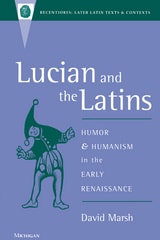
Lucian and the Latins
Humor and Humanism in the Early RenaissanceDavid Marsh
University of Michigan Press, 1998
Until now, no study has attempted to connect the Latin translators and imitators of Lucian with his wider European influence. In Lucian and the Latins, David Marsh describes how Renaissance authors rediscovered the comic writings of Lucian. He traces how Lucianic themes and structures made an essential contribution to European literature beginning with a survey of Latin translations and imitations, which gave new direction to European letters in the fifteenth and sixteenth centuries. The Lucianic dialogues of the dead and dialogues of the gods were immensely popular, despite the religious backlash of the sixteenth century. The paradoxical encomium, represented by Lucian's "The Fly" and "The Parasite," inspired so-called serious humanists like Leonardo Bruni and Guarino of Verona. Lucian's "True Story" initiated the genre of the fantastic journey, which enjoyed considerable popularity during the Renaissance age of discovery. Humanist descendants of this work include Thomas More's Utopia and much of Rabelais' Pantagruel.
Lucian and the Latins will attract readers interested in a wide variety of subjects: the classical tradition, the early Italian Renaissance, the origins of modern European literature, and the uses of humor and satire as instruments of cultural critique.
David Marsh is Professor of Italian, Rutgers University.
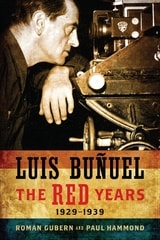
Luis Buñuel
The Red Years, 1929–1939Román Gubern
University of Wisconsin Press, 2011
The turbulent years of the 1930s were of profound importance in the life of Spanish film director Luis Buñuel (1900–1983). He joined the Surrealist movement in 1929 but by 1932 had renounced it and embraced Communism. During the Spanish Civil War (1936–39), he played an integral role in disseminating film propaganda in Paris for the Spanish Republican cause.
Luis Buñuel: The Red Years, 1929–1939 investigates Buñuel’s commitment to making the politicized documentary Land without Bread (1933) and his key role as an executive producer at Filmófono in Madrid, where he was responsible in 1935–36 for making four commercial features that prefigure his work in Mexico after 1946. As for the republics of France and Spain between which Buñuel shuttled during the 1930s, these became equally embattled as left and right totalitarianisms fought to wrest political power away from a debilitated capitalism.
Where it exists, the literature on this crucial decade of the film director’s life is scant and relies on Buñuel’s own self-interested accounts of that complex period. Román Gubern and Paul Hammond have undertaken extensive archival research in Europe and the United States and evaluated Buñuel’s accounts and those of historians and film writers to achieve a portrait of Buñuel’s “Red Years” that abounds in new information.
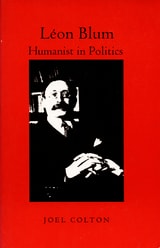
Léon Blum
Humanist in PoliticsJoel Colton
Duke University Press, 0