Results by title
22279 books match the query 'Social Science' and 714 start with l
Latin American Indigenous Warfare and Ritual Violence
Edited by Richard J. Chacon and Rubén G. Mendoza
University of Arizona Press, 2007
All of the chapters advance our knowledge of the causes, extent, and consequences of indigenous violence—including ritualized violence—in Latin America. Each major historical/cultural group in Latin America is addressed by at least one contributor. Incorporating the results of dozens of years of research, this volume documents evidence of warfare, violent conflict, and human sacrifice from the fifteenth century to the twentieth, including incidents that occurred before European contact. Together the chapters present a convincing argument that warfare and ritual violence have been woven into the fabric of life in Latin America since remote antiquity.
For the first time, expert subject-area work on indigenous violence—archaeological, osteological, ethnographic, historical, and forensic—has been assembled in one volume. Much of this work has heretofore been dispersed across various countries and languages. With its collection into one English-language volume, all future writers—regardless of their discipline or point of view—will have a source to consult for further research.
CONTENTS
Acknowledgments
Introduction
Richard J. Chacon and Rubén G. Mendoza
1. Status Rivalry and Warfare in the Development and Collapse of Classic Maya Civilization
Matt O’Mansky and Arthur A. Demarest
2. Aztec Militarism and Blood Sacrifice: The Archaeology and Ideology of Ritual Violence
Rubén G. Mendoza
3. Territorial Expansion and Primary State Formation in Oaxaca, Mexico
Charles S. Spencer
4. Images of Violence in Mesoamerican Mural Art
Donald McVicker
5. Circum-Caribbean Chiefly Warfare
Elsa M. Redmond
6. Conflict and Conquest in Pre-Hispanic Andean South America: Archaeological Evidence from Northern Coastal Peru
John W. Verano
7. The Inti Raymi Festival among the Cotacachi and Otavalo of Highland Ecuador: Blood for the Earth
Richard J. Chacon, Yamilette Chacon, and Angel Guandinango
8. Upper Amazonian Warfare
Stephen Beckerman and James Yost
9. Complexity and Causality in Tupinambá Warfare
William Balée
10. Hunter-Gatherers’ Aboriginal Warfare in Western Chaco
Marcela Mendoza
11. The Struggle for Social Life in Fuego-Patagonia
Alfredo Prieto and Rodrigo Cárdenas
12. Ethical Considerations and Conclusions Regarding Indigenous Warfare and Ritual Violence in Latin America
Richard J. Chacon and Rubén G. Mendoza
References
About the Contributors
Index
Latin American Jewish Cultural Production
David William Foster
Vanderbilt University Press, 2008
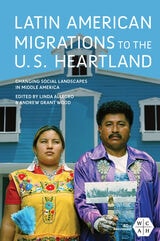
Latin American Migrations to the U.S. Heartland
Changing Social Landscapes in Middle AmericaEdited by Linda Allegro and Andrew Grant Wood
University of Illinois Press, 2019
Filled with varied and eye-opening perspectives, Latin American Migrations to the U.S. Heartland reveals how identities, economies, and geographies are changing as Latin Americans adjust to their new homes, jobs, and communities.
Contributors: Linda Allegro, Tisa M. Anders, Scott Carter, Caitlin Didier, Miranda Cady Hallett, Edmund Hamann, Albert Iaroi, Errol D. Jones, Jane Juffer, László J. Kulcsár, Janelle Reeves, Jennifer F. Reynolds, Sandi Smith-Nonini, and Andrew Grant Wood.
Latin American Textualities
History, Materiality, and Digital MediaEdited by Heather J. Allen and Andrew R. Reynolds
University of Arizona Press, 2018
Latin American Textualities is a wide-ranging, interdisciplinary look at textual history, textual artifacts, and digital textualities across Latin America from the colonial era to the present. Editors Heather J. Allen and Andrew R. Reynolds gather a wide range of scholars to investigate the region’s textual scholarship. Contributors offer engaging examples of not just artifacts but also the contexts in which the texts are used. Topics include Guamán Poma’s library, the effect of sound recordings on writing in Argentina, Sudamericana Publishing House’s contribution to the Latin American literary boom, and Argentine science fiction. Latin American Textualities provides new paths to reading Latin American history, culture, and literatures.
Contributors:
Heather J. Allen
Catalina Andrango-Walker
Sam Carter
Sara Castro-Klarén
Edward King
Rebecca Kosick
Silvia Kurlat Ares
Walther Maradiegue
Clayton McCarl
José Enrique Navarro
Andrew R. Reynolds
George Antony Thomas
Zac Zimmer
Latin American Women and the Search for Social Justice
Francesca Miller
University Press of New England, 1991
Latin Americanism
Roman De La Campa
University of Minnesota Press, 1999
Analyzes the way North American academics have constructed Latin America.
In this timely book, Román de la Campa asks to what degree the Latin America studied in U.S. academies is actually an entity “made in the U.S.A.” He argues that there is an ever-increasing gap between the political, theoretical, and financial pressures affecting the U.S. academy and Latin America’s own cultural, political, and literary practices, and considers what this new Latin Americanism has to say about the claims of poststructuralism, postmodern theory, and deconstruction.
De la Campa focuses on the conduct of Latin American literary criticism in U.S. universities and compares this with the “Latin Americanism” of Latin America itself. He examines the translation of Latin American works into English, the careerism of U.S. intellectuals, the conduct of Latin American literary criticism in English, and the diaspora of Third World intellectuals. In a reconsideration of the vogue in Latin American literature and magical realism in light of new work by theorists residing in Latin America, he contrasts this work with critiques of Latin American discourses in the United States.A critique of postmodern and postcolonial constructions as articulated differently in the United States and Latin America, this hard-hitting but fair-minded book provides a postdeconstructive perspective on culture and literature. ISBN 0-8166-3116-6 Cloth £00.00 $47.95xxISBN 0-8166-3117-4 Paper £00.00 $18.95x224 Pages 5 7/8 x 9 JuneCultural Studies of the Americas Series, volume 3Translation inquiries: University of Minnesota Press
Latin Numbers
Playing Latino in Twentieth-Century U.S. Popular PerformanceBrian Eugenio Herrera
University of Michigan Press, 2015
Latin Politics, Global Media
Edited by Elizabeth Fox and Silvio Waisbord
University of Texas Press, 2002
The globalization of media industries that began during the 1980s and 1990s occurred at the same time as the establishment of or return to democratic forms of government in many Latin American countries. In this volume of specially commissioned essays, thirteen well-known media experts examine how the intersection of globalization and democratization has transformed media systems and policies throughout Latin America.
Following an extensive overview by editors Elizabeth Fox and Silvio Waisbord, the contributors investigate the interaction of local politics and global media in individual Latin American countries. Some of the issues they discuss include the privatization and liberalization of the media, the rise of media conglomerates, the impact of trade agreements on media industries, the role of the state, the mediazation of politics, the state of public television, and the role of domestic and global forces. The contributors address these topics with a variety of theoretical approaches, combining institutional, historical, economic, and legal perspectives.
Latin and Greek in American Education
With Symposia on the Value of Humanistic StudiesEdited by Francis W. Kelsey
University of Michigan Press, 1911
Latin* Students in Engineering
An Intentional Focus on a Growing PopulationLara Perez-Felkner
Rutgers University Press, 2024
Winner of the American Association of Hispanics in Higher Education Edited Volume Book of the Year Award
Winner of the 2026 Distinguished Contributions to Gender Equity in Educational Research Award from the American Educational Research Association
The growing population of engineering students who identify as Latin* are underrepresented in the field of engineering. Latin* refers to an individual of Latin American origin or descent, without restricting to a specific gender. The asterisk (*) includes related identity terms such as Latina/é/o/u/x.There is, however, a rising need to train U.S. students in engineering skills to meet the demands of our increasingly technological workforce. Structurally excluding Latin* students hinders their economic and educational opportunities in engineering. Latin* Students in Engineering examines the state of Latin* engineering education at present as well as considerations for policy and practice regarding engineering education aimed at enhancing opportunity and better serving Latin* students. The essays in this volume first consider, theoretically and empirically, the experiences of Latin* students in engineering education and then expand beyond the student level to focus on institutional and social structures that challenge Latin* students' success and retention. Finally, it illuminates emergent work and considers future research, policy, and practice.
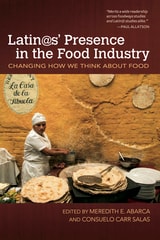
Latin@s' Presence in the Food Industry
Changing How We Think about FoodMeredith E. Abarca
University of Arkansas Press, 2016
The networks Latin@s create, the types of identities they fashion through food, and their relationship to the US food industry are analyzed to understand Latin@s as active creators of food-based communities, as distinctive cultural representations, and as professionals. This vibrant new collection acknowledges issues of labor conditions, economic politics, and immigration laws—structural vulnerabilities that certainly cannot be ignored—and strives to understand more fully the active and conscious ways that Latina@s create spaces to maneuver global and local food systems.
LatinAsian Cartographies
History, Writing, and the National ImaginaryThananopavarn, Susan
Rutgers University Press, 2018
Thananopavarn creates a new “LatinAsian” view of the United States that emphasizes previously suppressed aspects of national history, including imperialism, domestic racism during World War II, Cold War operations in Latin America and Asia, and the politics of borders in an age of globalization. LatinAsian Cartographies ultimately reimagines national narratives in a way that transforms dominant ideas of what it means to be American.

LatinX
Claudia Milian
University of Minnesota Press, 2019
Nationality is not enough to understand “Latin”-descended populations in the United States
LatinX has neither country nor fixed geography. LatinX, according to Claudia Milian, is the most powerful conceptual tool of the Latino/a present, an itinerary whose analytic routes incorporate the Global South and ecological devastation. Milian’s trailblazing study deploys the indeterminate but thunderous “X” as intellectual armor, a speculative springboard, and a question for our times that never stops being asked. LatinX sorts out and addresses issues about the unknowability of social realities that exceed our present knowledge.
Forerunners: Ideas First
Short books of thought-in-process scholarship, where intense analysis, questioning, and speculation take the lead
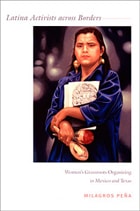
Latina Activists across Borders
Women's Grassroots Organizing in Mexico and TexasMilagros Peña
Duke University Press, 2007
Drawing on interviews with the leaders of more than two dozen women’s NGOs in Michoacán and El Paso/Ciudad Juárez, Peña examines the influence of the Roman Catholic Church and liberation theology on Latina activism, and she describes how activist affiliations increasingly cross ethnic, racial, and class lines. Women’s NGOs in Michoacán put an enormous amount of energy into preparations for the 1995 United Nations–sponsored World Conference on Women in Beijing, and they developed extensive activist networks as a result. As Peña demonstrates, activists in El Paso/Ciudad Juárez were less interested in the Beijing conference; they were intensely focused on issues related to immigration and to the murders and disappearances of scores of women in Ciudad Juárez. Ultimately, Peña’s study highlights the consciousness-raising work done by NGOs run by and for Mexican and Mexican American women: they encourage Latinas to connect their personal lives to the broader political, economic, social, and cultural issues affecting them.
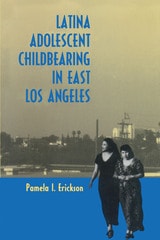
Latina Adolescent Childbearing in East Los Angeles
By Pamela I. Erickson
University of Texas Press, 1998
Preventing teen pregnancy has become a national goal, but a one-size-fits-all strategy for achieving it may never be found. Because varying social and cultural factors lead to pregnancy among different ethnic/class groups, understanding these factors is essential in designing pregnancy prevention programs that work. This book explores the factors that lead to childbearing among Latina adolescents.
Pamela Erickson draws on both quantitative data and case histories to trace the pathways to motherhood for Latina teens. After situating her study within current research on teen pregnancy, she looks specifically at teen mothers enrolled in programs at Women's Hospital in East L.A. She describes the teens' relationships to their babies' fathers and their own families and discusses how these relationships affect whether teen mothers want to become pregnant, their use of prenatal, postpartum, and family planning services, and their ability to prevent a repeat pregnancy. Erickson describes culturally appropriate intervention efforts and assesses the limitations of prevention programs in institutional settings such as schools and clinics.
Latina Lives in Milwaukee
Theresa Delgadillo
University of Illinois Press, 2015
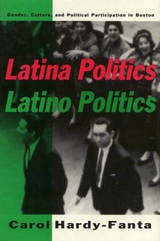
Latina Politics, Latino Politics
Gender, Culture, and Political Participation in BostonCarol Hardy-Fanta
Temple University Press, 1993
Through an in-depth study of the Latino community in Boston, Carol hardy-Fanta addressees three key debates in American politics: how to look at the ways in which women and men envision the meaning of politics and political participation; how to understand culture and the political life of expanding immigrant populations; and how to create a more participatory America. The author's interviews with Latinos from Puerto Rico, the Dominican Republic, and Central and South America and her participation in community events in North Dorchester, Jamaica Plain, and the South End document the often ignored contribution of Latina women as candidates, political mobilizers, and community organizers. Hardy-Fanta examines critical gender differences in how politics is defined, what strategies Latina women and Latino men use to generate political participation, and how culture and gender interact in the political empowerment of the ethic communities.
Hardy-Fanta challenges the notion of political apathy among Latinos and presents factors that stimulate political participation. She finds that the vision of politics promoted by Latina women—one based on connectedness, collectivity, community, and consiousness-raising—contrasts sharply with a male political concern for status, hierarchy, and personal opportunity.
Latina/o Midwest Reader
Omar Valerio-Jimenez , Santiago Vaquera-Vasquez
University of Illinois Press, 2017
Eye-opening and provocative, The Latina/o Midwest Reader rewrites the conventional wisdom on today's Latina/o community and how it faces challenges—and thrives—in the heartland.
Contributors: Aidé Acosta, Frances R. Aparicio, Jay Arduser, Jane Blocker, Carolyn Colvin, María Eugenia Cotera, Theresa Delgadillo, Lilia Fernández, Claire F. Fox, Felipe Hinojosa, Michael D. Innis-Jiménez, José E. Limón, Marta María Maldonado, Louis G. Mendoza, Amelia María de la Luz Montes, Kim Potowski, Ramón H. Rivera-Servera, Rebecca M. Schreiber, Omar Valerio-Jiménez, Santiago Vaquera-Vásquez, Darrel Wanzer-Serrano, Janet Weaver, and Elizabeth Willmore
Latina/o Sexualities
Probing Powers, Passions, Practices, and PoliciesAsencio, Marysol
Rutgers University Press, 2010
Situated at the juncture of Latina/o studies and sexualities studies, Latina/o Sexualities provides a single resource that addresses the current state of knowledge from a multidisciplinary perspective. Contributors synthesize and critique the literature and carve a separate space where issues of Latina/o sexualities can be explored given the limitations of prevalent research models. This work compels the current wave in sexuality studies to be more inclusive of ethnic minorities and sets an agenda that policy makers and researchers will find invaluable.

Latina/o Stars in U.S. Eyes
The Making and Meanings of Film and TV StardomMary C. Beltran
University of Illinois Press, 2008
Latina/o/x Education in Chicago
Roots, Resistance, and TransformationEdited by Isaura Pulido, Angelica Rivera, and Ann M. Aviles
University of Illinois Press, 2022
Insightful and enlightening, Latina/o/x Education in Chicago brings to light the ongoing struggle for educational equity in the Chicago Public Schools.
Latina/os and World War II
Mobility, Agency, and IdeologyEdited by Maggie Rivas-Rodriguez and B.V. Olguín
University of Texas Press, 2014
The first book-length study of Latina/o experiences in World War II over a wide spectrum of identities and ancestries—from Cuban American, Spanish American, and Mexican American segments to the under-studied Afro-Latino experience—Latina/os and World War II probes the controversial aspects of Latina/o soldiering and citizenship in the war, the repercussions of which defined the West during the twentieth century. The editors also offer a revised, more accurate tabulation of the number of Latina/os who served in the war.
Spanning imaginative productions, such as vaudeville and the masculinity of the soldado razo theatrical performances; military segregation and the postwar lives of veterans; Tejanas on the homefront; journalism and youth activism; and other underreported aspects of the wartime experience, the essays collected in this volume showcase rarely seen recollections. Whether living in Florida in a transformed community or deployed far from home (including Mexican Americans who were forced to endure the Bataan Death March), the men and women depicted in this collection yield a multidisciplinary, metacritical inquiry. The result is a study that challenges celebratory accounts and deepens the level of scholarly inquiry into the realm of ideological mobility for a unique cultural crossroads. Taking this complex history beyond the realm of war narratives, Latina/os and World War II situates these chapters within the broader themes of identity and social change that continue to reverberate in postcolonial lives.
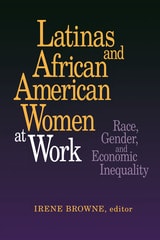
Latinas and African American Women at Work
Race, Gender, and Economic InequalityIrene Browne
Russell Sage Foundation, 1999
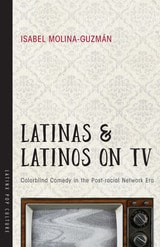
Latinas and Latinos on TV
Colorblind Comedy in the Post-racial Network EraIsabel Molina-Guzmán
University of Arizona Press, 2018
Sofia Vergara became the highest paid woman and Latina on TV for her starring role on Modern Family. In the first successful dramedy starring a Latina since ABC’s Ugly Betty, Gina Rodriguez gained critical acclaim for her role on the CW’s Jane the Virgin. And the first Latina leading lady of TV, America Ferrera (Ugly Betty), returned to TV stardom in NBC’s Superstore.
This period of diversity brought U.S. Latina and Latino lives to the screen, yet a careful look at TV comedic content and production reveals a more troubling terrain for Latinas/os producers, writers, actors, and audiences.
Interweaving discussions about the ethnic, racial, and linguistic representations of Latinas/os within network television comedies, Isabel Molina-Guzmán probes published interviews with producers and textual examples from hit programs like Modern Family, The Office, and Scrubs to understand how these primetime sitcoms communicate difference in the United States.
Understanding the complex ways that audiences interpret these programs, Molina-Guzmán situates her analysis within the Obama era, a period when ethnicity and race became increasingly grounded in “hipster racism,” and argues that despite increased inclusion, the feel-good imperative of TV comedies still inevitably leaves racism, sexism, and homophobia uncontested.
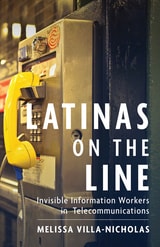
Latinas on the Line
Invisible Information Workers in TelecommunicationsMelissa Villa-Nicholas
Rutgers University Press, 2022
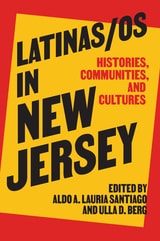
Latinas/os in New Jersey
Histories, Communities, and CulturesAldo A. Lauria Santiago
Rutgers University Press, 2025
Contributors: Yamil Avivi; Jennifer Ayala; Ulla D. Berg; Giovani Burgos; Elsa Candelario; Laura Curran; Lilia Fernández; Ismael García Colón; Olga Jiménez de Wagenheim; Benjamin Lapidus; Aldo A. Lauria Santiago; Johana Londoño; Kathleen Lopez; Giancarlo Muschi; Melanie Z. Plasencia; Ana Y. Ramos-Zayas; Elena Sabogal; Raymond Sanchez Mayers; William Suárez Gómez; Alex F. Trillo; Daniela Valdez; Anil Venkatesh; Lyna L. Wiggins
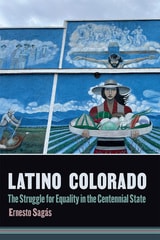
Latino Colorado
The Struggle for Equality in the Centennial StateErnesto Sagás
University Press of Colorado, 2026
Author Ernesto Sagás also explores the ways in which Latinos—as a racialized, subordinate group—have historically interacted with Colorado’s Anglo society in carving out their own spaces while struggling for social and legal equality. He presents a demographic and socioeconomic profile of Latinos in Colorado based on field research and the latest US Census data to dispel common stereotypes while also pointing out areas of concern for state policymakers.
Latino Colorado sheds light on this marginalized community and advances the understanding of the state’s racialized dynamics. It is about everyone in the American West—Anglos, Latinos, and others—and how they interact with and continue to (re)define one another in real and imagined ways in the most mythologized of American regions.
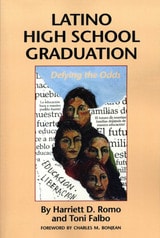
Latino High School Graduation
Defying the OddsBy Harriett D. Romo and Toni Falbo
University of Texas Press, 1996
While high school drop-out rates have steadily declined among white and African American students over the 1970s and 1980s a constant 35 percent of Latino students continued to quit school before graduation. In this pioneering work, Harriett Romo and Toni Falbo reveal how a group of at-risk Latino students defied the odds and earned a high school diploma.
Romo and Falbo tracked the progress of 100 students in Austin, Texas, from 1989 to 1993. Drawing on interviews with the students and their parents, school records, and fieldwork in the schools and communities, the authors identify both the obstacles that caused many students to drop out and the successful strategies that other students and their parents pursued to ensure high school graduation.
The authors conclude with seven far-reaching recommendations for changes in the public schools. Sure to provoke debate among all school constituencies, this book will be required reading for school administrators, teachers, parents, legislators, and community leaders.
Latino Lives in America
Making It HomeLuis R. Fraga, John A. Garcia, Rodney E. Hero, Michael Jones-Correa, Valerie Martinez-Ebers and Gary Segura
Temple University Press, 2010
Latinos are the largest and fastest growing ethnic group in the United States, with increased levels of political mobilization and influence. In the timely and thoroughgoing Latino Lives in America, six prominent Latino scholars explore the profound implications of Latinos’ population growth and geographic dispersion for American politics and society, tracking key changes and continuities in Latinos' attitudes, behavior, and social experiences.
Utilizing a unique set of “narratives” from focus group interviews, supplemented with quantitative findings from the 2006 Latino National Survey, the authors provide a snapshot of Latino life in America. The Latinos interviewed provide their thoughts regarding their sense of belonging and group identification, assimilation and transnationalism, housing, education, civic engagement, and perceptions of discrimination, as well as their experiences in new destinations, where they are trying to realize the “Americano” dream.
Latino Lives in America uses these conversations and the survey data to offer both a micro and macro look at how Latinos are transforming various aspects of American politics, culture, and life and how their experiences in the United States are changing them and their families.
Latino Los Angeles
Transformations, Communities, and ActivismEdited by Enrique C. Ochoa and Gilda L. Ochoa
University of Arizona Press, 2005
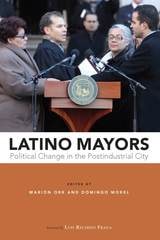
Latino Mayors
Political Change in the Postindustrial CityMarion Orr
Temple University Press, 2018
As recently as the early 1960s, Latinos were almost totally excluded from city politics. This makes the rise of Latino mayors in the past three decades a remarkable American story—one that explains ethnic succession, changing urban demography, and political contexts. The vibrant collection Latino Mayors features case studies of eleven Latino mayors in six American cities: San Antonio, Los Angeles, Denver, Hartford, Miami, and Providence.
The editors and contributors analyze Latino mayors for their governing styles and policies. They describe how candidates shaped race, class, and economic issues—particularly in deracialized campaigns. Latino Mayors also addresses coalition politics, political incorporation, and how community groups operate, as well as the challenges these pioneers have faced in office from political tensions and governance issues that sometimes even harm Latinos.
Ultimately, Latino Mayors charts the performances, successes, and failures of these elected officials to represent their constituents in a changing economic and urban environment.
Contributors include: Stefanie Chambers, Carlos E. Cuéllar, Emily M. Farris, Maria Ilcheva, Robert Preuhs, Heywood T. Sanders, Ellen Shiau, and the editors.
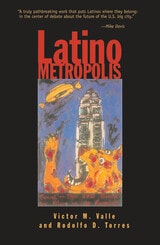
Latino Metropolis
Victor M. Valle
University of Minnesota Press, 2000
A readable look at culture and politics in Los Angeles through a Latino lens.
Los Angeles: scratch the surface of the city’s image as a rich mosaic of multinational cultures and a grittier truth emerges-its huge, shimmering economy was built on the backs of largely Latino immigrants and still depends on them. This book exposes the underside of the development and restructuring that have turned Los Angeles into a global city, and in doing so it reveals the ways in which ideas about ethnicity-Latino identity itself-are implicated and elaborated in the process. A penetrating analysis of the social, economic, cultural, and political consequences of the growth of the Latino working-class populations in Los Angeles, Latino Metropolis is also a nuanced account of the complex links between political economy and the social construction of ethnicity.
Lifting examples from recent news stories, political encounters, and cultural events, the authors demonstrate how narratives about Latinos are used to maintain the status quo-particularly the existing power grid-in the city. In media representations of riots, in the recasting (and "whitening") of Mexican food as Spanish-American cuisine, in the community displacement that occurred as part of the development of the Staples Center-in telling instances large and small, we see how Los Angeles and its Latino population are mutually transforming. And we see how an old Latino politics of "racial" identity is inevitably giving way to a new politics of class. Combining political and economic insight with trenchant social and cultural analysis, this work offers the clearest statement to date of how ethnicity and class intersect in defining racialized social relations in the contemporary metropolis.Globalization and Community Series, volume 7Translation Inquiries: University of Minnesota Press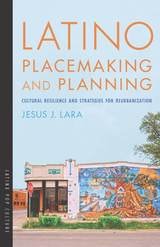
Latino Placemaking and Planning
Cultural Resilience and Strategies for ReurbanizationJesus J. Lara
University of Arizona Press, 2018
Latino Placemaking and Planning offers a pathway to define, analyze, and evaluate the role that placemaking can have with respect to Latino communities in the context of contemporary urban planning, policy, and design practices. Using strategically selected case studies, Jesus J. Lara examines how Latinos contribute to the phenomenon of urban revitalization through the (re)appropriation of physical space for their own use and the consequent transformation of what were previously economically downtrodden areas into vibrant commercial and residential centers.
The book examines the formation of urban cultures and reurbanization strategies from the perspective of Latino urbanism and is divided into four key sections, which address (1) emerging new urban geographies; (2) the power of place and neighborhood selection; (3) Latino urbanism case studies; and (4) lessons and recommendations for “reurbanizing” the city. Latino Placemaking and Planning illustrates the importance of placemaking for Latino communities and provides accessible strategies for planners, students, and activists to sustainable urban revitalization.
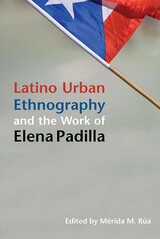
Latino Urban Ethnography and the Work of Elena Padilla
Merida M. Rua
University of Illinois Press, 2010
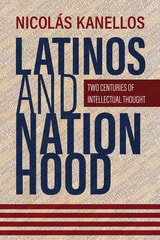
Latinos and Nationhood
Two Centuries of Intellectual ThoughtNicolás Kanellos
University of Arizona Press, 2023
Over the course of two centuries, these Latino or Hispanic intellectuals were natural-born citizens of the United States, immigrants, or political refugees. Many of these intellectuals, whether citizens or not, strove to embrace and enliven such democratic principles as freedom of speech and of the press, the protection of minorities in the Bill of Rights and in subsequent laws, and the protection of linguistic and property rights, among many others, guaranteed by treaties when the United States incorporated their homelands into the Union.
The first six chapters present the work of lesser-known historical figures—most of whom have been consistently ignored by Anglo- and Euro-centric history and whose works have been widely inaccessible until recently—who were revolutionaries, editors of magazines and newspapers, and speechmakers who influenced the development of a Latino consciousness. The last three chapters deal with three foundational figures of the Chicano Movement, the last two of whom either subverted the concept of nationhood or went beyond it to embrace internationalism in an outreach to humanity as a whole.
Latinos and Nationhood sheds new light on the biographies of Félix Varela, José Alvarez de Toledo y Dubois, Francisco Ramírez, Tomás Rivera, Rolando Hinojosa-Smith, and Gloria E. Anzaldúa, among others.
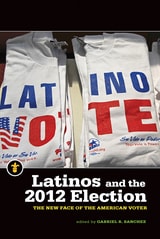
Latinos and the 2012 Election
The New Face of the American VoterGabriel R. Sanchez
Michigan State University Press, 2015
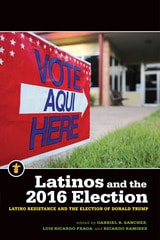
Latinos and the 2016 Election
Latino Resistance and the Election of Donald TrumpGabriel R. Sanchez
Michigan State University Press, 2020
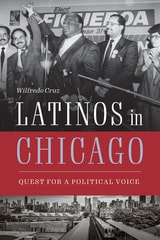
Latinos in Chicago
Quest for a Political VoiceWilfredo Cruz
Southern Illinois University Press, 2022
The path to political power for Latinos in Chicago
In the Midwest’s largest city, Latinos have been fighting for political representation for more than half a century. In this exploration of urban politics in Chicago, Wilfredo Cruz shows for the first time how Latinos went from being ignored by the Irish-controlled political machine to becoming a respected constituency.
Beginning with the Latino community’s first attempt to acquire a political voice in Chicago politics in 1911 and continuing through Latino officeholders of the early twenty-first century, Cruz surveys not only the struggles of this community—specifically the two largest Latino groups in the city, Mexicans and Puerto Ricans—but also the ways in which Chicago’s Latinos overcame those challenges to gain their political voice.
For most of the twentieth century, Chicago politicians ignored the growing Latino community. This disregard changed with the 1983 election of Mayor Harold Washington, an African American who defied the political machine and actively recruited Latinos to his administration and helped them win city and statewide political offices. His actions opened the doors of government for Latinos in Chicago. Subsequent mayors, seeing the political success of Washington’s move, continued his policies.
Many up-and-coming Latino politicians making strides in Chicago, including state representative Aarón Ortíz, Alderman Andre Vasquez, and Alderman Rossana Rodríguez-Sanchez, contribute their takes on the struggle for political power and the challenges facing the rising new generation of elected officials. With this book, Cruz asks and answers this question: What does the future hold for Latinos politically in Chicago?
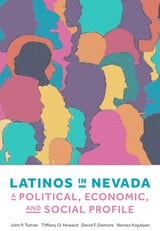
Latinos in Nevada
A Political, Economic, and Social ProfileJohn P. Tuman
University of Nevada Press, 2021
This extensive study by a distinguished and multidisciplinary team of scholars discusses the impact of the Latinx population from the early development of the state of Nevada and highlights their roles in society, as well as the specific implications of their growing presence in the state. It also contemplates the future of the Latinx population and the role they will continue to play in politics and the economy.
This in-depth examination of a large and relatively understudied population will be of interest to scholars and students who study disparities in health and education opportunities as well as the political and economic climate among Latinos and other groups in Nevada and beyond. A political, economic, and demographic profile, this book:
- Explores the history, growth, and diversity of the Latinx population.
- Draws on an array of census data, voter surveys, statistics, interviews, and health, education, employment, wages, and immigration statistics.
- Evaluates key trends in employment, education, religion, and health.
- Analyzes the dynamics of political participation, including implications of a growing Latino political electorate in a western swing state.
- Assesses key determinants of health disparities, educational inequities, and civic engagement among Latinos in the state.
- Demonstrates the impact of the Great Recession of 2008 and provides a preliminary assessment of the COVID-19 pandemic on Latino employment.
Latinos in New England
edited by Andrés Torres
Temple University Press, 2006
Latinos in the Midwest
Rubén O. Martinez
Michigan State University Press, 2011
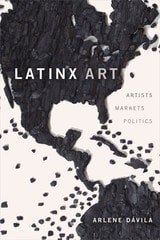
Latinx Art
Artists, Markets, and PoliticsArlene Dávila
Duke University Press, 2020
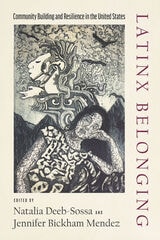
Latinx Belonging
Community Building and Resilience in the United StatesEdited by Natalia Deeb-Sossa and Jennifer Bickham Mendez
University of Arizona Press, 2022
What does it mean to be Latinx? This pressing question forms the core of Latinx Belonging, which brings together cutting-edge research to discuss the multilayered ways this might be answered.
Latinx Belonging is anchored in the claim that Latinx people are not defined by their marginalization but should instead be understood as active participants in their communities and contributors to U.S. society. The volume’s overarching analytical approach recognizes the differences, identities, and divisions among people of Latin American origin in the United States, while also attending to the power of mainstream institutions to shape their lives and identities. Contributors to this volume view “belonging” as actively produced through struggle, survival, agency, resilience, and engagement.
This work positions Latinxs’ struggles for recognition and inclusion as squarely located within intersecting power structures of gender, race, sexuality, and class and as shaped by state-level and transnational forces such as U.S. immigration policies and histories of colonialism. From the case of Latinxs’ struggles for recognition in the arts, to queer Latinx community resilience during COVID-19 and in the wake of mass shootings, to Indigenous youth’s endurance and survival as unaccompanied minors in Los Angeles, the case studies featured in this collection present a rich and textured picture of the diversity of the U.S. Latinx experience in the twenty-first century.
Contributors
Andrés Acosta
Jack “Trey” Allen
Jennifer Bickham Mendez
Stephanie L. Canizales
Christopher Cuevas
Natalia Deeb-Sossa
Yvette G. Flores
Melanie Jones Gast
Monika Gosin
Pierrette Hondagneu-Sotelo
Nolan Kline
Verónica Montes
Yvonne Montoya
Michael De Anda Muñiz
Suzanne Oboler
Gilda L. Ochoa
Dina G. Okamoto
Marco Antonio Quiroga
Michelle Téllez
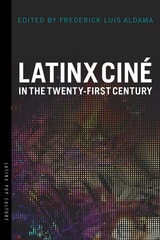
Latinx Ciné in the Twenty-First Century
Edited by Frederick Luis Aldama
University of Arizona Press, 2019
Twenty-first-century Latinx film offers much to celebrate, but as noted pop culture critic Frederick Luis Aldama writes, there’s still room to be purposefully critical. In Latinx Ciné in the Twenty-First Century contributors offer groundbreaking scholarship that does both, bringing together a comprehensive presentation of contemporary film and filmmakers from all corners of Latinx culture.
The book’s seven sections cover production techniques and evolving genres, profile those behind and in front of the camera, and explore the distribution and consumption of contemporary Latinx films. Chapters delve into issues that are timely, relevant, and influential, including representation or the lack thereof, identity and stereotypes, hybridity, immigration and detention, historical recuperation, and historical amnesia.
With its capacious range and depth of vision, this timeless volume of cutting-edge scholarship blazes new paths in understanding the full complexities of twenty-first century Latinx filmmaking.
Contributors
Contributors
Iván Eusebio Aguirre Darancou
Frederick Luis Aldama
Juan J. Alonzo
Lee Bebout
Debra A. Castillo
Nikolina Dobreva
Paul Espinosa
Mauricio Espinoza
Camilla Fojas
Rosa-Linda Fregoso
Desirée J. Garcia
Enrique García
Clarissa Goldsmith
Matthew David Goodwin
Monica Hanna
Sara Veronica Hinojos
Carlos Gabriel Kelly
Jennifer M. Lozano
Manuel M. Martín-Rodríguez
J. V. Miranda
Valentina Montero Román
Danielle Alexis Orozco
Henry Puente
John D. “Rio” Riofrio
Richard T. Rodríguez
Ariana Ruiz
Samuale Saldívar III
Jorge Santos
Rebecca A. Sheehan
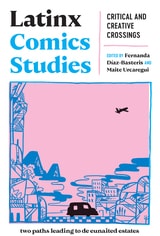
Latinx Comics Studies
Critical and Creative CrossingsFernanda Díaz-Basteris
Rutgers University Press, 2025
This collection moves beyond simply cataloguing and celebrating Latinx representation within comics. It examines how comics by, for, and about Latinx peoples creatively and conceptually experiment with the very boundaries of “Latinx” and portray the diverse lived experiences therein.
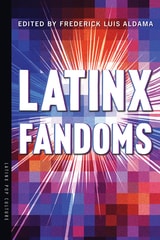
Latinx Fandoms
Edited by Frederick Luis Aldama
University of Arizona Press, 2027
What makes one a fan? What’s the difference between cultivating taste for a genre and dedicating time, space, labor, and resources to collecting, practicing, and following in a singularly focused way? What does fandom look like and what does it do when racialized communities embrace media that rarely imagined them?
Latinx Fandoms is the first book to theorize the intersection of fandoms and Latinx identity. This groundbreaking collection examines how Latinx fans create meaning, build community, and imagine new worlds through their engagement with popular culture. From comics, science fiction, and gaming to music, sports, wrestling, television, and fan fiction, the essays demonstrate how fandoms become powerful sites of identity formation, cultural expression, and belonging for communities often overlooked in both media industries and academic scholarship.
Spanning thirty-six chapters organized into eight thematic sections, Latinx Fandoms explores a remarkable range of fan practices and cultural phenomena. Contributors examine topics as diverse as Pokémon, Barbie, Star Wars, Hello Kitty, Taylor Swift, BTS, Bad Bunny, lucha libre, fútbol, Nintendo, cosplay, fan fiction, bodybuilding, and Latinx goth subcultures. Through historical analysis, personal narrative, ethnography, and cultural critique, the essays reveal how Latinx fans transform global media into spaces of creativity, resistance, joy, and connection. The collection confronts enduring questions about race, representation, gender, sexuality, language, and power within contemporary fan cultures.
A foundational volume in the Latinx Pop Culture series, this collection shows that Latinx fans are not simply consumers of culture but active creators of scenes of joy and struggle, memory and invention, resistance, and sometimes complicity.
Contributors
Paloma Ada Aguirre
Frederick Luis Aldama
René X. Arteaga
Ryan Banfi
Lucas Leite Borba
Jennifer Caroccio Maldonado
Melissa Castillo-Garsow
Samantha Ceballos
Nicholas F. Centino
Andrea M. Escalante
Mauricio Espinoza
Laura Fernández
Elena Foulis
Kathryn M. Frank
Jennifer Gómez Menjívar
Christopher González
Rachel V. González-Martin
Itzayana Gutiérrez Arillo
Cristina Herrera
Dan Johnson
Carlos Gabriel Kelly González
Alexander Lalama
Héctor Fernández L’Hoeste
Regina Marie Mills
Guilherme Sfredo Miorando
Josh Mishaw
Meagan Negron
Dante Olivas
Rose Padilla
Domino Perez
Ricardo Quintana-Vallejo
Nayeli Rincon
Jessica Rutherford
Martín Alejandro Salinas
Alexandra Sanchez
Nicholas Villanueva Jr.
Ralph Villanueva
Benjamin Woo
Cassandra Yatron
Irma J. Zamora Fuerte

Latinx Lives in Hemsipheric Context
Maria A. Windell, special issue editor
Duke University Press, 2018
Contributors: Elise Bartosik-Vélez, Ralph Bauer, Rachel Conrad Bracken, Anna Brickhouse, John Alba Cutler, Kenya C. Dworkin y Méndez, Joshua Javier Guzmán, Anita Huizar-Hernández, Kelley Kreitz, Rodrigo Lazo, Marissa K. López, Claudia Milian, Yolanda Padilla, Juan Poblete, David Sartorius, Alberto Varon

Latinx Shakespeares
Staging U.S. Intracultural TheaterCarla Della Gatta
University of Michigan Press, 2023
2024 American Society for Theatre Research Barnard Hewitt Award Finalist
- 2023 Theatre Library Association George Freedley Memorial Award Finalist
- Best Academic-Themed Book, College-Level - English at the International Latino Book Awards Honorable Mention
Latinx peoples and culture have permeated Shakespearean performance in the United States for over 75 years—a phenomenon that, until now, has been largely overlooked as Shakespeare studies has taken a global turn in recent years. Author Carla Della Gatta argues that theater-makers and historians must acknowledge this presence and influence in order to truly engage the complexity of American Shakespeares. Latinx Shakespeares investigates the history, dramaturgy, and language of the more than 140 Latinx-themed Shakespearean productions in the United States since the 1960s—the era of West Side Story. This first-ever book of Latinx representation in the most-performed playwright’s canon offers a new methodology for reading ethnic theater looks beyond the visual to prioritize aural signifiers such as music, accents, and the Spanish language.
The book’s focus is on textual adaptations or performances in which Shakespearean plays, stories, or characters are made Latinx through stage techniques, aesthetics, processes for art-making (including casting), and modes of storytelling. The case studies range from performances at large repertory theaters to small community theaters and from established directors to emerging playwrights. To analyze these productions, the book draws on interviews with practitioners, script analysis, first-hand practitioner insight, and interdisciplinary theoretical lenses, largely by scholars of color. Latinx Shakespeares moves toward healing by reclaiming Shakespeare as a borrower, adapter, and creator of language whose oeuvre has too often been mobilized in the service of a culturally specific English-language whiteness that cannot extricate itself from its origins within the establishment of European/British colonialism/imperialism.
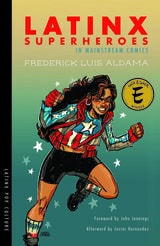
Latinx Superheroes in Mainstream Comics
Frederick Luis Aldama; Foreword by John Jennings; Afterword by Javier Hernandez
University of Arizona Press, 2017
Whether good or evil, beautiful or ugly, smart or downright silly, able-bodied or differently abled, gay or straight, male or female, young or old, Latinx superheroes in mainstream comic book stories are few and far between. It is as if finding the Latinx presence in the DC and Marvel worlds requires activation of superheroic powers.
Latinx Superheroes in Mainstream Comics blasts open barriers with a swift kick. It explores deeply and systematically the storyworld spaces inhabited by brown superheroes in mainstream comic book storyworlds: print comic books, animation, TV, and film. It makes visible and lets loose the otherwise occluded and shackled. Leaving nothing to chance, it sheds light on how creators (authors, artists, animators, and directors) make storyworlds that feature Latinos/as, distinguishing between those that we can and should evaluate as well done and those we can and should evaluate as not well done.
The foremost expert on Latinx comics, Frederick Luis Aldama guides us through the full archive of all the Latinx superheros in comics since the 1940s. Aldama takes us where the superheroes live—the barrios, the hospitals, the school rooms, the farm fields—and he not only shows us a view to the Latinx content, sometimes deeply embedded, but also provokes critical inquiry into the way storytelling formats distill and reconstruct real Latinos/as.
Thoroughly entertaining but seriously undertaken, Latinx Superheroes in Mainstream Comics allows us to truly see how superhero comic book storyworlds are willfully created in ways that make new our perception, thoughts, and feelings.
Latinx TV in the Twenty-First Century
Edited by Frederick Luis Aldama
University of Arizona Press, 2022
In this volume, editor Frederick Luis Aldama brings together leading experts who show how Latinx TV is shaped by historical, social, cultural, regional, and global contexts. Contributors address head on harmful stereotypes in Latinx representation while giving key insights to a positive path forward. TV narratives by and about Latinx people exist across all genres. In this century, we see Latinx people in sitcoms, sci-fi, noir, soap operas, rom-coms, food shows, dramas, action-adventure, and more. Latinx people appear in television across all formats, from quick webisodes, to serialized big-arc narratives, to animation and everything in between. The diverse array of contributors to this volume delve into this rich landscape of Latinx TV from 2000 to today, spanning the ever-widening range of genres and platforms.
Latinx TV in the Twenty-First Century argues that Latinx TV is not just television—it’s an entire movement. Digital spaces and streaming platforms today have allowed for Latinx representation on TV that speaks to Latinx people and non-Latinx people alike, bringing rich and varied Latinx cultures into mainstream television and addressing urbanization, immigration, family life, language, politics, gender, sexuality, class, race, and ethnicity.
Once heavily underrepresented and harmfully stereotypical, Latinx representation on TV is beginning to give careful nuance to regional, communal, and familial experiences among U.S. Latinx people. This volume unpacks the negative implications of older representation and celebrates the progress of new representation, recognizing that television has come a long way, but there is still a lot of important work to do for truly diverse and inclusive representation.