Results by title
4030 books match the query 'Language Arts & Disciplines' and 224 start with l
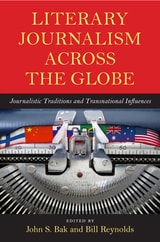
Literary Journalism across the Globe
Journalistic Traditions and Transnational InfluencesJohn S. Bak
University of Massachusetts Press, 2011
At the end of the nineteenth century, several countries were developing journalistic traditions similar to what we identify today as literary reportage or literary journalism. Yet throughout most of the twentieth century, in particular after World War I, that tradition was overshadowed and even marginalized by the general perception among democratic states that journalism ought to be either “objective,” as in the American tradition, or “polemical,” as in the European. Nonetheless, literary journalism would survive and, at times, even thrive. How and why is a story that is unique to each nation.
Though largely considered an Anglo-American phenomenon today, literary journalism has had a long and complex international history, one built on a combination of traditions and influences that are sometimes quite specific to a nation and at other times come from the blending of cultures across borders. These essays examine this phenomenon from various international perspectives, documenting literary journalism's rich and diverse heritage and describing its development within a global context.
In addition to the editors, contributors include David Abrahamson, Peiqin Chen, Clazina Dingemanse, William Dow, Rutger de Graaf, John Hartsock, Nikki Hessell, Maria Lassila-Merisalo, Edvaldo Pereira Lima, Willa McDonald, Jenny McKay, Sonja Merljak Zdovc, Sonia Parratt, Norman Sims, Isabel Soares,and Soenke Zehle.
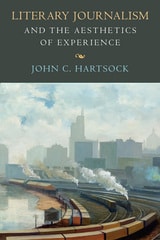
Literary Journalism and the Aesthetics of Experience
John C. Hartsock
University of Massachusetts Press, 2016
Proponents and practitioners of narrative literary journalism have sought to assert its distinctiveness as both a literary form and a type of journalism. In Literary Journalism and the Aesthetics of Experience, John C. Hartsock argues that this often neglected kind of journalism—exemplified by such renowned works as John Hersey's Hiroshima, James Agee's Let Us Now Praise Famous Men, and Joan Didion's Slouching Towards Bethlehem—has emerged as an important genre of its own, not just a hybrid of the techniques of fiction and the conventions of traditional journalism.
Hartsock situates narrative literary journalism within the broader histories of the American tradition of “objective” journalism and the standard novel. While all embrace the value of narrative, or storytelling, literary journalism offers a particular “aesthetics of experience” lacking in both the others. Not only does literary journalism disrupt the myths sustained by conventional journalism and the novel, but its rich details and attention to everyday life question readers' cultural assumptions. Drawing on the critical theories of Nietzsche, Bakhtin, Benjamin, and others, Hartsock argues that the aesthetics of experience challenge the shibboleths that often obscure the realities the other two forms seek to convey.
At a time when print media appear in decline, Hartsock offers a thoughtful response to those who ask, “What place if any is there for a narrative literary journalism in a rapidly changing media world?”
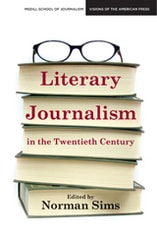
Literary Journalism in the Twentieth Century
Norman Sims
Northwestern University Press, 2008
This wide-ranging collection of critical essays on literary journalism addresses the shifting border between fiction and non-fiction, literature and journalism.
Literary Journalism in the Twentieth Century addresses general and historical issues, explores questions of authorial intent and the status of the territory between literature and journalism, and offers a case study of Mary McCarthy’s 1953 piece, "Artists in Uniform," a classic of literary journalism.
Sims offers a thought-provoking study of the nature of perception and the truth, as well as issues facing journalism today.
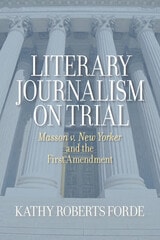
Literary Journalism on Trial
Masson v. New Yorker and the First AmendmentKathy Roberts Forde
University of Massachusetts Press, 2008
In November 1984, Jeffrey Masson filed a libel suit against writer Janet Malcolm and the New Yorker, claiming that Malcolm had intentionally misquoted him in a profile she wrote for the magazine about his former career as a Freud scholar and administrator of the Freud archives. Over the next twelve years the case moved up and down the federal judicial ladder, at one point reaching the U.S. Supreme Court, as lawyers and judges wrestled with questions about the representation of “truth” in journalism and, by extension, the limits of First Amendment protections of free speech. Had a successful Freudian scholar actually called himself an “intellectual gigolo” and “the greatest analyst who ever lived?" Or had a respected writer for the New Yorker knowingly placed false, self-damning words in her subject's mouth?
In Literary Journalism on Trial, Kathy Roberts Forde explores the implications of Masson v. New Yorker in the context of the history of American journalism. She shows how the case represents a watershed moment in a long debate between the advocates of traditional and literary journalism and explains how it reflects a significant intellectual project of the period: the postmodern critique of objectivity, with its insistence on the instability of language and rejection of unitary truth in human affairs. The case, Forde argues, helped widen the perceived divide between ideas of literary and traditional journalism and forced the resolution of these conflicting conceptions of truth in the constitutional arena of libel law. By embracing traditional journalism's emphasis on fact and objectivity and rejecting a broader understanding of truth, the Supreme Court turned away from the First Amendment theory articulated in previous rulings, opting to value less the free, uninhibited interchange of ideas necessary to democracy and more the “trustworthiness” of public expression. The Court's decision in this case thus had implications that reached beyond the legal realm to the values and norms expressed in the triangular relationship between American democracy, First Amendment principles, and the press.
Literary Translation in Latin America in the Twenty-First Century
Bridging Experiences, Theories and CulturesEdited by Dirce Waltrick do Amarante and Letícia Maria Vieira de Souza Goellner
University College London, 2026
Encompassing hegemonic, nonhegemonic, and pidgin languages, this compilation explores the state of literary translation studies in Latin America.
Literary Translation in Latin America in the Twenty-First Century provides an in-depth exploration of the current landscape of literary translation studies and translation practices across Latin America. The unparalleled linguistic diversity of Latin America, with nearly five hundred languages spoken, makes translation a vital aspect of daily life. This volume aims to contribute to the analysis from a Latin American perspective, presenting a fresh reading of translation theories that originate in Latin America, as well as theoretical reflections and practical examples of literary translation by poets and artists situated in the continent.
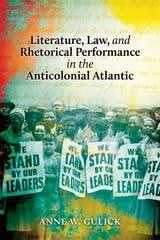
Literature, Law, and Rhetorical Performance in the Anticolonial Atlantic
Anne W. Gulick
The Ohio State University Press, 2016
Responses to this question take shape across the black Atlantic from Haiti to South Africa, in texts ranging from Haiti’s Declaration of Independence and work by C. L. R. James to South Africa’s Freedom Charter, Aimé Césaire’s poem Notebook of a Return to the Native Land, and Ngugi wa Thiong’o’s A Grain of Wheat. These texts constitute a robust transatlantic tradition of challenging colonial and imperial authority through rhetorical performance. Drawing on the cosmopolitan aspirations and emancipatory energies of the political declaration, this tradition aims to radically reinvent the possibilities for law and political belonging in the postcolonial future.
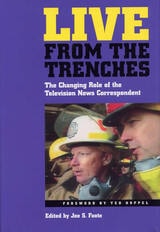
Live From the Trenches
The Changing Role of the Television News CorrespondentEdited by Joe S. Foote. Foreword by Ted Koppel
Southern Illinois University Press, 1998
From Edward R. Murrow to "Sixty Minutes" and CNN, the television news correspondent has become a fixture of American journalism in the latter half of the twentieth century. The correspondent's role has changed, however, as centralized control, changing technology, "infotainment," and profit margin have influenced the way that television networks operate and television news is reported.
In spite of the flood of literature dealing with the American television networks, the evening anchors, and prime-time personalities, little has been written about the "the foot soldier of network news." Live from the Trenches fills that gap, providing the first examination of television news correspondents and their work, with much of the analysis coming from the correspondents themselves.
The correspondents:
Jim Bittermann, a former ABC Paris correspondent, has been the CNN Paris correspondent since 1996. He received a National News Emmy for his coverage of the 1988 Sudan famine.
Chris Bury, correspondent for "Nightline" since 1993, has covered foreign and domestic stories from Waco to Whitewater.
Michael Murrie, after a dozen years in television news at KSDK in St. Louis, is an associate professor and director of the Telecommunications Master's Program for the Department of Radio-Television at Southern Illinois University at Carbondale.
Roger O'Neil, NBC News Denver bureau chief and correspondent since 1983, was the lead reporter for NBC during the Oklahoma City bombing trial of Timothy McVeigh.
Walter C. Rodgers, bureau chief and correspondent in Jerusalem, joined CNN in 1993 as the Berlin correspondent. Prior to joining CNN, he worked for ABC for twelve years.
Marlene Sanders broke barriers for women throughout her career and has won three Emmies. As a correspondent at ABC News in 1964, she was the first woman to anchor a prime-time network newscast.
George Strait is the primary ABC News correspondent for medical and health news. Among his many awards are the Alfred I. duPont Award and Gold Medal Award from the National Association of Black Journalists.
Ed Turner is CNN's first editor-at-large. Based in Washington, he represents the CNN News Group globally.
Garrick Utley joined CNN in 1997 after thirty years covering more than seventy countries for ABC.
Lives in Two Languages
An Exploration of Identity and CultureLinda Watkins-Goffman
University of Michigan Press, 2001
Lives in Two Languages focuses on the experience of multicultural authors--like Richard Rodriguez, Amy Tan, Eva Hoffman, Chang-rae Lee, and Julia Alvarez--whose experiences can be related to anyone who has moved from one culture or subculture to another. As such, this text is an excellent comprehensive introduction to the multicultural experience for teachers and educators in all disciplines, as well as of interest to anyone interested in language culture and psychological process of identity.
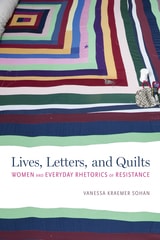
Lives, Letters, and Quilts
Women and Everyday Rhetorics of ResistanceVanessa Kraemer Sohan
University of Alabama Press, 2020
In Lives, Letters, and Quilts: Women and Everyday Rhetorics of Resistance, Vanessa Kraemer Sohan applies a translingual and transmodal framework informed by feminist rhetorical practice to three distinct case studies that demonstrate women using unique and effective rhetorical strategies in political, religious, and artistic contexts. These case studies highlight a diverse set of actors uniquely situated by their race, gender, class, or religion, but who are nevertheless connected by their capacity to envision and recontextualize the seemingly ordinary means and materials available to them in order to effectively persuade others.
The Great Depression provides the backdrop for the first case study, a movement whereby thousands of elderly citizens proselytized and fundraised for a monthly pension plan dreamt up by a California doctor in the hopes of lifting themselves out of poverty. Sohan investigates how the Townsend Plan’s elderly supporters—the Townsendites—worked within and across language, genre, mode, and media to enable them for the first time to be recognized by others, and themselves, as a viable political constituency.
Next, Sohan recounts the story of Quaker minister Eliza P. Kirkbride Gurney who met President Abraham Lincoln in 1862. Their subsequent epistolary exchanges concerning conscientious objectors made such an impression on him that one of her letters was rumored to be in his pocket the night of his assassination. Their exchanges and Gurney’s own accounts of her transnational ministry in her memoir provide useful examples of how, throughout history, women rhetors have adopted and transformed typically underappreciated forms of rhetoric—such as the epideictic—for their particular purposes.
The final example focuses on the Gee’s Bend quiltmakers—a group of African American women living in rural Alabama who repurpose discarded work clothes and other cast-off fabrics into the extraordinary quilts for which they are known. By drawing on the means and materials at hand to create celebrated works of art in conditions of extreme poverty, these women show how marginalized artisans can operate both within and outside the bounds of established aesthetic traditions and communicate the particulars of their experience across cultural and economic divides.
Living Chronic
Agency and Expertise in the Rhetoric of DiabetesLora Arduser
The Ohio State University Press, 2017
Diabetes, referred to as an epidemic for more than a decade, remains one of our most significant health issues in the twenty-first century. Because self-management is an important component of living with the disease, the biomedical concept of patient agency has long stressed notions of individual responsibility and autonomy. However, dramatic shifts in both health care and cultural practices call for a reassessment of traditional definitions of patient agency.
Lora Arduser’s Living Chronic: Agency and Expertise in the Rhetoric of Diabetes answers this call with a unique rhetorical examination of one of the most critical issues in contemporary health: how we live and work with being chronic. Through her perceptive analysis of the discourse of both people with diabetes and health care providers, Arduser presents a new model for patient agency—one that advocates for a relational, fluid concept of agency that blurs the boundaries between medical experts and patients. Her thought-provoking use of bodily and rhetorical plasticity crafts a multidimensional picture of patient agency that profoundly affects how rhetorical scholars, people living with chronic illness, and health care providers can forge patient-centered discourse and practices.
Living Translation
Gayatri Chakravorty Spivak
Seagull Books, 2022
Living Translation offers a powerful perspective on the work of distinguished thinker and writer Gayatri Chakravorty Spivak, revealing how, throughout her long career, she has made translation a central concern of the comparative humanities.
Starting with her landmark “Translator’s Preface” to Jacques Derrida’s Of Grammatology in 1976, and continuing with her foreword to Mahasweta Devi’s Draupadi and afterword to Devi’s Chotti MundaandHis Arrow, Spivak has tackled questions of translatability. She has been interested in interrogating the act of translation from the ground up and at the political limit. She sees at play at border checkpoints, at sites of colonial pedagogy, in acts of resistance to monolingual regimes of national language, at the borders of minor literature and schizo-analysis, in the deficits of cultural debt and linguistic expropriation, and, more generally, at theory’s edge, which is to say, where practical criticism yields to theorizing in untranslatables. This volume also addresses how Spivak’s institution-building as director of comparative literature at the University of Iowa—and in her subsequent places of employment—began at the same time. From this perspective, Spivak takes her place within a distinguished line-up of translator-theorists who have been particularly attuned to the processes of cognizing in languages, all of them alive to the coproductivity of thinking, translating, writing.
Living in the Rock N Roll Mystery
Reading Context, Self, and Others as CluesH. L. Goodall, Jr.
Southern Illinois University Press, 1991
Mystery, rather than “problem,” provides the context that the cultural ethnographer best uses to approach the experience of both the living and the writing of culture. In this work, H. L. Goodall, Jr., continues his discussion of the cultural ethnographer as detective through an investigation of what he calls the “rock n roll mystery.”
Using Bakhtin’s notion of “Carnival,” Goodall positions rock n roll as an important aspect of the American cultural experience using its lyrics and rhythm as a force of resistance to the dominant bureaucratic order. He argues that interpretive ethnography, where sentences use rhythms and emotions along with words to construct a work, parallels rock n roll in its creation of multiple voices struggling for creative and interpretive presence and space in the text. As there is no privileged text in the social life of rock n roll, there is no privileged voice in the writing of interpretive ethnography. It is, instead, a reading and writing method within the field of communication and the field of cultural studies that challenges the “existing wisdom.”
Goodall invites the reader to join him in the role of the detective who confronts, enters, and then participates in the mysteries of living. Through the use of his interpretive method, Goodall is able to move under the skin of experience to disclose the relationship among self, other(s), and context, an understanding only achieved by “going beneath the often cosmetic surfaces of cultural traffic to where symbols mingle with the driven stuff of life.” Because the “stuff of life” is laid out on the pages of this book, Goodall’s text is as compelling as a good novel and in some ways more intimate.
Local Constraints vs. Economy
David E. Johnson and Shalom Lappin
CSLI, 1999

Local History Reference Collections for Public Libraries
Kathy Marquis
American Library Association, 2015
Local Organic
Food Rhetorics and Community Writing for ImpactVeronica House
Utah State University Press, 2025
Local Organic offers writing and rhetoric faculty and graduate students an ecological methodology to produce, teach, and theorize writing to help communities engage with a wide array of social issues and to work toward individual and community-level impacts.
Logic and Representation
Robert C. Moore
CSLI, 1993
Logic, Information and Agency
Johan van Benthem
CSLI, 2025
Everything we do is driven by information, but the dynamic process of acquiring information and adjusting our views based on it has seldom been put at the center place in logic, and there are few textbooks introducing readers to this line of work. The present book introduces the reader to major logical techniques for studying information dynamics and interaction between agents, based on a variety of intuitive scenarios as well as recent research. Readers will learn styles of modeling, as well as the basic features of the new logical systems emanating from this line of work. All the separate strands in the book are brought together in a comprehensive study of information flow and action in games, forming a logic-based complement to standard perspectives in game theory.
Logic, Language and Computation
Edited by Jerry Seligman and Dag Westerståhl
CSLI, 1996
Logic, Language and Computation, Volume 3
Edited by Patrick Blackburn, Nick Braisby, Lawrence Cavedon, and Atsushi Shimoji
CSLI, 2001
The book contains contributions to a general theory of information, while also tackling specific problems from artificial intelligence, formal semantics, cognitive psychology, and the philosophy of mind. There is focus on the dynamics of information flow, and also a consideration of static approaches to information content; both quantitative and qualitative approaches are represented.
Logic, Language and Philosophy
An Introduction to Standard LogicFenrong Liu and Martin Stokhof
CSLI, 2024
This book explores the systematic and formal study of reasoning. It introduces the core systems of logic, discusses a portion of its extensions, and illustrates the application of logic in philosophy and linguistics utilizing classical and contemporary sources. In doing so, it provides the students with a rich set of tools along with first-hand experience regarding their applications in the study of rationality and meaning. With lots of exercises, and study and discussion questions, it provides a complete set of materials for courses for a variety of audiences at different levels.
Logical Reasoning with Diagrams and Sentences
Using HyperproofDave Barker-Plummer, Jon Barwise, and John Etchemendy
CSLI, 2016
Unlike traditional formal treatments of reasoning, this package uses both graphical and sentential representations to reflect common situations in everyday reasoning where information is expressed in many forms, such as finding your way to a location using a map and an address. It also teaches students how to construct and check the logical validity of a variety of proofs—of consequence and non-consequence, consistency and inconsistency, and independence—using an intuitive proof system which extends standard proof treatments with sentential, graphical, and heterogeneous inference rules, allowing students to focus on proof content rather than syntactic structure. Building upon the widely used Tarski’s World and Language, Proof and Logic courseware packages, Logical Reasoning with Diagrams and Sentences contains more than three hundred exercises, most of which can be assessed by the Grade Grinder online assessment service; is supported by an extensive website through which students and instructors can access online video lectures by the authors; and allows instructors to create their own exercises and assess their students’ work.
Logical Reasoning with Diagrams and Sentences is an expanded revision of the Hyperproof courseware package.
Looking Back at the Arkansas Gazette
An Oral HistoryRoy Reed
University of Arkansas Press, 2009
Louder Than Bombs
A Life with Music, War, and PeaceEd Vulliamy
University of Chicago Press, 2020
Describing the artists, songs, and concerts that most influenced him, Vulliamy brings together the two largest threads of his life—music and war. Louder Than Bombs covers some of the most important musical milestones of the past fifty years, from Jimi Hendrix playing “Machine Gun” at the Isle of Wight Festival in 1970 to the Bataclan in Paris under siege in 2015. Vulliamy was present for many of these historic moments, and with him as our guide, we see them afresh, along the way meeting musicians like B. B. King, Graham Nash, Patti Smith, Daniel Barenboim, Gustavo Dudamel, and Bob Dylan. Vulliamy peppers the book with short vignettes—which he dubs 7" singles—recounting some of his happiest memories from a lifetime with music. Whether he’s working as an extra in the Vienna State Opera’s production of Aida, buying blues records in Chicago, or drinking coffee with Joan Baez, music is never far from his mind. As Vulliamy discovers, when horror is unspeakable, when words seem to fail us, we can turn to music for expression and comfort, or for rage and pain. Poignant and sensitively told, Louder Than Bombs is an unforgettable record of a life bursting with music.
Lowering the Boom
Critical Studies in Film SoundEdited by Jay Beck and Tony Grajeda
University of Illinois Press, 2007
As the first collection of new work on sound and cinema in over a decade, Lowering the Boom addresses the expanding field of film sound theory and its significance in rethinking historical models of film analysis. The contributors consider the ways in which musical expression, scoring, voice-over narration, and ambient noise affect identity formation and subjectivity. Lowering the Boom also analyzes how shifting modulation of the spoken word in cinema results in variations in audience interpretation. Introducing new methods of thinking about the interaction of sound and music in films, this volume also details avant-garde film sound, which is characterized by a distinct break from the narratively based sound practices of mainstream cinema. This interdisciplinary, global approach to the theory and history of film sound opens the eyes and ears of film scholars, practitioners, and students to film's true audio-visual nature.
Contributors are Jay Beck, John Belton, Clark Farmer, Paul Grainge, Tony Grajeda, David T. Johnson, Anahid Kassabian, David Laderman, James Lastra, Arnt Maasø, Matthew Malsky, Barry Mauer, Robert Miklitsch, Nancy Newman, Melissa Ragona, Petr Szczepanik, Paul Théberge, and Debra White-Stanley.