Results by title
22279 books match the query 'Social Science' and 714 start with l
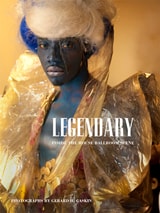
Legendary
Inside the House Ballroom SceneGerard H. Gaskin
Duke University Press, 0
From the quiet backstage, to the shimmering energies of the runway. to the electricity of the crowd, Gaskin's photographs take us to the ball. Legendary, comprised of photos taken at events in the New York city area, Philadelphia, Richmond, and Washington, D.C., is a collaboration between Gaskin, a camera-laden outsider who has been attending balls for twenty years, and the house members who let him enter the intimate world of ball culture. In addition to an introduction by Deborah Willis, Legendary includes an essay, "The Queer Undercommons," by Frank Roberts.

Legends of the Northern Paiute
as told by Wilson WewaWilson Wewa
Oregon State University Press, 2017
The legends in this volume were recorded, transcribed, reviewed, and edited by Wilson Wewa and James Gardner. Each legend was recorded, then read and edited out loud, to respect the creativity, warmth, and flow of Paiute storytelling. The stories selected for inclusion include familiar characters from native legends, such as Coyote, as well as intriguing characters unique to the Northern Paiute, such as the creature embodied in the Smith Rock pinnacle, now known as Monkey Face, but known to the Paiutes in Central Oregon as Nuwuzoho the Cannibal.
Wewa’s apprenticeship to Northern Paiute culture began when he was about six years old. These legends were passed on to him by his grandmother and other tribal elders. They are now made available to future generations of tribal members, and to students, scholars, and readers interested in Wewa’s fresh and authentic voice. These legends are best read and appreciated as they were told—out loud, shared with others, and delivered with all of the verve, cadence, creativity, and humor of original Paiute storytellers on those clear, cold winter nights in the high desert.

Legends of the Warring States
Persuasions, Romances, and Stories from <em>Chan-kuo Ts'e</em>J. I. Crump
University of Michigan Press, 1998
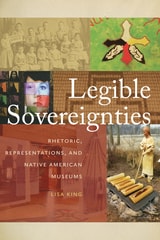
Legible Sovereignties
Rhetoric, Representations, and Native American MuseumsLisa King
Oregon State University Press, 2017
King tracks the exhibit spaces at the Saginaw Chippewa Indian Tribe of Michigan’s Ziibiwing Center, Haskell Indian Nation University’s Cultural Center and Museum, and the Smithsonian’s Washington, DC branch of the National Museum of the American Indian over their first ten years, from their opening until the summer of 2014. Far from formulaic, each site has developed its own rhetorical approaches to reaching its public, revealing multiple challenges and successes in making Native self-representation legible and accessible.
Through documentation and analysis of the inaugural exhibits and recent installations, interviews with curators and staff, and investigation into audience reception of these spaces, Legible Sovereignties argues that there can be no single blanket solution for effective Indigenous self-representation. Instead, Legible Sovereignties demonstrates the nuanced ways in which each site must balance its rhetorical goals and its audience's needs, as well as its material constraints and opportunities, in order to reach its visitors and have Indigenous voices heard.

Legions of Boom
Filipino American Mobile DJ Crews in the San Francisco Bay AreaOliver Wang
Duke University Press, 2015
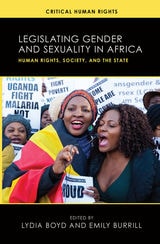
Legislating Gender and Sexuality in Africa
Human Rights, Society, and the StateEdited by Lydia Boyd and Emily Burrill
University of Wisconsin Press, 2020
Legislating Gender and Sexuality in Africa details how legal efforts in the continent can often be moralizing enterprises, illuminating how these processes are closely tied to notions of ethics, personhood, and citizenship. The contributors provide new appraisals of recent events, with fresh arguments about the relationships between local and global fights for rights. This interdisciplinary approach will appeal to scholars in African studies, anthropology, history, and gender studies.

Legislating the French Family
Feminism, Theater, and Republican Politics: 1870-1920Jean Elisabeth Pedersen
Rutgers University Press, 2003

Legitimacy and Criminal Justice
An International PerspectiveTom R. Tyler
Russell Sage Foundation, 2007
Legitimacy of Philanthropic Foundations
United States and European PerspectivesKenneth Prewitt
Russell Sage Foundation, 2006
Legitimating Life
Adoption in the Age of Globalization and Biotechnologyvan Wichelen, Sonja
Rutgers University Press, 2019
Legitimating New Religions
Lewis, James R
Rutgers University Press, 2003
James R. Lewis has written the first book to deal explicitly with the issue of how emerging religions legitimate themselves. He contends that a new religion has at least four different, though overlapping, areas where legitimacy is a concern: making converts, maintaining followers, shaping public opinion, and appeasing government authorities. The legitimacy that new religions seek in the public realm is primarily that of social acceptance. Mainstream society's acknowledgement of a religion as legitimate means recognizing its status as a genuine religion and thus recognizing its right to exist. Through a series of wide-ranging case studies Lewis explores the diversification of legitimation strategies of new religions as well the tactics that their critics use to de-legitimate such groups. Cases include the Movement for Spiritual Inner Awareness, Native American prophet religions, spiritualism, the Church of Christ-Scientist, Scientology, Church of Satan, Heaven's Gate, Unitarianism, Hindu reform movements, and Soka Gakkai, a new Buddhist sect.
Since many of the issues raised with respect to newer religions can be extended to the legitimation strategies deployed by established religions, this book sheds an intriguing new light on classic questions about the origin of all religions.

Leisure and Death
An Anthropological Tour of Risk, Death, and DyingAdam Kaul
University Press of Colorado, 2018
This anthropological study examines the relationship between leisure and death, specifically how leisure practices are used to meditate upon—and mediate—life. Considering travelers who seek enjoyment but encounter death and dying, tourists who accidentally face their own mortality while vacationing, those who intentionally seek out pleasure activities that pertain to mortality and risk, and those who use everyday leisure practices like social media or dogwalking to cope with death, Leisure and Death delves into one of the most provocative subsets of contemporary cultural anthropology.
These nuanced and well-developed ethnographic case studies deal with different and distinct examples of the intertwining of leisure and death. They challenge established conceptions of leisure and rethink the associations attached to the prospect of death. Chapters testify to encounters with death on a personal and scholarly level, exploring, for example, the Cliffs of Moher as not only one of the most popular tourist destinations in Ireland but one of the most well-known suicide destinations as well, and the estimated 30 million active posthumous Facebook profiles being repurposed through proxy users and transformed by continued engagement with the living. From the respectful to the fascinated, from the macabre to the morbid, contributors consider how people deliberately, or unexpectedly, negotiate the borderlands of the living.
An engaging, timely book that explores how spaces of death can be transformed into spaces of leisure, Leisure and Death makes a significant contribution to the burgeoning interdisciplinary literature on leisure studies and dark tourism. This book will appeal to students, scholars, and laypeople interested in tourism studies, death studies, cultural studies, heritage studies, anthropology, sociology, and marketing.
Contributors: Kathleen M. Adams, Michael Arnold, Jane Desmond, Keith Egan, Maribeth Erb, James Fernandez, Martin Gibbs, Rachel Horner-Brackett, Shingo Iitaka, Tamara Kohn, Patrick Laviolette, Ruth McManus, James Meese, Bjorn Nansen, Stravoula Pipyrou, Hannah Rumble, Cyril Schafer
Lend Me Your Ear
Brenda Jo Brueggemann
Gallaudet University Press, 1999

Leon Forrest
Introductions and InterpretationsJohn G. Cawelti
University of Wisconsin Press, 1997

Les Guerilleres
Monique Wittig. Translated from the French by David Le Vay
University of Illinois Press, 2007
One of the most widely read feminist texts of the twentieth century, and Monique Wittig’s most popular novel, Les Guérillères imagines the attack on the language and bodies of men by a tribe of warrior women. Among the women’s most powerful weapons in their assault is laughter, but they also threaten literary and linguistic customs of the patriarchal order with bullets. In this breathtakingly rapid novel first published in 1969, Wittig animates a lesbian society that invites all women to join their fight, their circle, and their community. A path-breaking novel about creating and sustaining freedom, the book derives much of its energy from its vaunting of the female body as a resource for literary invention.
Lesbian & Bisexual Identities
Kristin G. Esterberg
Temple University Press, 1997
In interviews conducted over a four-year time period, women describe the lesbian community they live in; how they see its structure, its social groups, its informal rules and norms for behavior; and their places inside -- or on the margins of -- the community. Lesbian and Bisexual Identities reveals how women fall in and out of love, how they "perform" lesbian or bisexual identity through clothing, hairstyle, body language, and talk, and many other aspects typically not considered. The women present a variety of accounts. Some consider themselves "lesbian from birth" and have constructed their lives accordingly, while others have experienced significant shifts in their identities, depending on the influences of feminism, progressive politics, the visibility of the lesbian community, and other factors.
Esterberg offers vivid accounts that defy the stereotypes so commonly offered. Lesbian and Bisexual Identities not only presents women's stories in their own words, it moves beyond storytelling to understand how these accounts resonate with social science theories of identity and community.
Lesbian Death
Desire and Danger between Feminist and QueerMairead Sullivan
University of Minnesota Press, 2022
Engaging with fears of lesbian death to explore the value of lesbian beyond identity
The loss of lesbian spaces, as well as ideas of the lesbian as anachronistic has called into question the place of lesbian identity within our current culture. In Lesbian Death, Mairead Sullivan probes the perception that lesbian status is in retreat, exploring the political promises—and especially the failures—of lesbian feminism and its usefulness today.
Lesbian Death reads how lesbian is conceptualized in relation to death from the 1970s onward to argue that lesbian offers disruptive potential. Lesbian Death examines the rise of lesbian breast cancer activism in San Francisco in conversation with ACT UP, the lesbian separatist manifestos “The C.L.I.T. Papers,” the enduring specter of lesbian bed death, and the weaponization of lesbian identity against trans lives.
By situating the lesbian as a border figure between feminist and queer, Lesbian Death offers a fresh perspective on the value of lesbian for both feminist and queer projects, even if her value is her death.

Lesbian Empire
Radical Crosswriting in the TwentiesGay Wachman
Rutgers University Press, 2001
Wachman places at the center of this tradition Sylvia Townsend Warner's achievement in undermining the inhibitions that faced women writing about forbidden love. She discusses Warner's use of crosswriting to transpose the otherwise unrepresentable lives of invisible lesbians into narratives about gay men, destabilizing the borders of race, class, and gender and challenging the codes of expression on which imperialist patriarchy and capitalism depended.
Lesbian Potentiality and Feminist Media in the 1970s
Jed Samer
Duke University Press, 2022

Lesbian Psychologies
EXPLORATIONS AND CHALLENGESEdited by the Boston Lesbian Psychologies Collective
University of Illinois Press, 1987
Lesbian Rabbis
The First GenerationRebecca T. Alpert, Sue Levi Elwell, and Shirley Idelson
Rutgers University Press, 2001
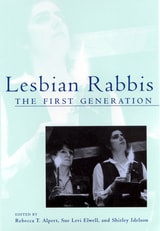
Lesbian Rabbis: The First Generation documents a monumental change in Jewish life as eighteen lesbian rabbis reflect on their experiences as trailblazers in Judaism's journey into an increasingly multicultural world. In frank and revealing essays, the contributors discuss their decisions to become rabbis and describe their experiences both at the seminaries and in their rabbinical positions. They also reflect on the dilemma whether to conceal or reveal their sexual identities to their congregants and superiors, or to serve specifically gay and lesbian congregations. The contributors consider the tensions between lesbian identity and Jewish identity, and inquire whether there are particularly "lesbian" readings of traditional texts. These essays also ask how the language of Jewish tradition touches the lives of lesbians and how lesbianism challenges traditional notions of the Jewish family.
"'Today I am completely 'out' personally and professionally, and yet I have learned that the 'coming out' process never ends. Even today, I find myself in professional situations in which yet again I must reveal that I am a lesbian, yet again I must prove myself worthy of functioning professionally in the 'straight' world. I still encounter moments of awkwardness, some hostility, and some sense of exclusion as I negotiate the pathways of my professional life."-Rabbi Leila Gal Berner, from Lesbian Rabbis: The First Generation
Lesbian Rule
Cultural Criticism and the Value of DesireAmy Villarejo
Duke University Press, 2003
Integrating cinema studies, queer and feminist theory, and cultural studies, Villarejo illuminates the contexts within which the lesbian is rendered visible. Toward that end, she analyzes key portrayals of lesbians in public culture, particularly in documentary film. She considers a range of films—from documentaries about Cuba and lesbian pulp fiction to Exile Shanghai and The Brandon Teena Story—and, in doing so, brings to light a nuanced economy of value and desire.

Lesbian Trouble
Feminism, Heterosexuality, and the French Women's Liberation MovementIlana Eloit
Duke University Press, 2027

Lesbians in Early Modern Spain
Sherry Velasco
Vanderbilt University Press, 2011
The women in these accounts, stories, and cases range from internationally famous transgendered celebrities to lesbian criminals, from those suspected of "special friendships" in the convent to ordinary villagers.
Velasco argues that the diverse and recurrent representations of lesbian desire provide compelling evidence of how different groups perceived intimacy between women as more than just specific sex acts. At times these narratives describe complex personal relationships and occasionally characterize these women as being of a certain "type," suggesting an early modern precursor to what would later be recognized as divergent lesbian, bisexual, and transgender identities.

Lesbians on Television
New Queer Visibility & the Lesbian NormalKate McNicholas Smith
Intellect Books, 2020
A look at the emergence of queer women characters in popular storytelling and the wide-ranging effects of this mainstream representation.
The twenty-first century has seen LGBTQ+ rights emerge at the forefront of public discourse and national politics in ways that would once have been hard to imagine. In Lesbians on Television, Kate McNicholas Smith maps concurrent contemporary shifts in lesbian visibility within popular media, focusing on the small screens of Europe and North America. Central to these shifts has been a re-imagining of queer lives—or a “new queer visibility”—as LGBTQ+ characters have become increasingly visible within popular culture. Kate McNicholas Smith explores this increased visibility through the lens of television, and in doing so, she identifies a “new lesbian normal”—a normalization of lesbian subjects that both helps and hinders those it represents.
Structured around five central case studies of popular British and American television shows featuring lesbian, bisexual, and queer women characters—The L Word, Skins, Glee, Coronation Street, and The Fosters—the book develops a detailed analysis of the shaping of a new “lesbian normal” through representations of LGBTQ+ figures and examines their televisual representation and reception. Presenting critical queer and feminist theory alongside empirical research that includes interviews and multi-platform media analyses, McNicholas Smith works to untangle the social, political, and cultural implications of new visibility in a period of significant social change in the LGBTQ+ experience.
Lesser Harms
The Morality of Risk in Medical ResearchSydney A. Halpern
University of Chicago Press, 2004
Today's scientists follow federal guidelines for research on human subjects developed during the 1960s and 1970s. But long before these government regulations, medical investigators observed informal rules when conducting human research. They insisted that the dangers of natural disease should outweigh the risks of a medical intervention, and they struggled to accurately assess the relative hazards. Halpern explores this logic of risk in immunization controversies extending as far back as the eighteenth century. Then, focusing on the period between 1930 and 1960, she shows how research physicians and their sponsors debated the moral quandaries involved in moving vaccine use from the laboratory to the clinic.
This probing work vividly describes the efforts of clinical investigators to balance the benefits and dangers of untested vaccines, to respond to popular sentiment about medical hazards, and to strategically present risk laden research to sponsors and the public.
Lesson Plans
The Institutional Demands of Becoming a TeacherEveritt, Judson G.
Rutgers University Press, 2017
In Lesson Plans, Judson G. Everitt takes readers into the everyday worlds of teacher training, and reveals the complexities and dilemmas teacher candidates confront as they learn how to perform a job that many people assume anybody can do. Using rich qualitative data, Everitt analyzes how people make sense of their prospective jobs as teachers, and how their introduction to this profession is shaped by the institutionalized rules and practices of higher education, K-12 education, and gender. Trained to constantly adapt to various contingencies that routinely arise in schools and classrooms, teacher candidates learn that they must continually try to reconcile the competing expectations of their jobs to meet students’ needs in an era of accountability. Lesson Plans reveals how institutions shape the ways we produce teachers, and how new teachers make sense of the multiple and complicated demands they face in their efforts to educate students.
Lessons and Legacies XIV
The Holocaust in the Twenty-First Century; Relevance and Challenges in the Digital AgeEdited and with an introduction by Tim Cole and Simone Gigliotti
Northwestern University Press, 2021
The Holocaust in the Twenty-First Century: Relevance and Challenges in the Digital Age challenges a number of key themes in Holocaust studies with new research. Essays in the section “Tropes Reconsidered” reevaluate foundational concepts such as Primo Levi’s gray zone and idea of the muselmann. The chapters in “Survival Strategies and Obstructions” use digital methodologies to examine mobility and space and their relationship to hiding, resistance, and emigration. Contributors to the final section, “Digital Methods, Digital Memory,” offer critical reflections on the utility of digital methods in scholarly, pedagogic, and public engagement with the Holocaust.
Although the chapters differ markedly in their embrace or eschewal of digital methods, they share several themes: a preoccupation with the experiences of persecution, escape, and resistance at different scales (individual, group, and systemic); methodological innovation through the adoption and tracking of micro- and mezzohistories of movement and displacement; varied approaches to the practice of Saul Friedländer’s “integrated history”; the mainstreaming of oral history; and the robust application of micro- and macrolevel approaches to the geographies of the Holocaust. Taken together, these chapters incorporate gender analysis, spatial thinking, and victim agency into Holocaust studies. In so doing, they move beyond existing notions of perpetrators, victims, and bystanders to portray the Holocaust as a complex and multilayered event.
Lessons from "Take Me Home, Country Roads"
Identity, (Be)Longing, and Imagined LandscapesSarah L. Morris
West Virginia University Press, 2025
This book examines “Country Roads” as it illuminates a universal sense of belonging to place even as it obscures the literality of the place it names. In examining “Country Roads” as anthem, text, artifact, and rhetoric, this work untangles ideas related to place, belonging, identity, and pedagogy. Sarah L. Morris uses the Welsh term hiraeth, which is an existential longing for an idealized, sometimes imaginary home, as a governing framework for this work. She explores the song in various contexts, such as how it pertains to West Virginia geography and heritage and the diversity of these beliefs, external perceptions of the state, concepts of home and belonging, and the song as a phenomenon across different media platforms. “Take Me Home, Country Roads,” while being about West Virginia, has registered as a global phenomenon.

Lessons from East Asia
Danny M. Leipziger, Editor
University of Michigan Press, 2001
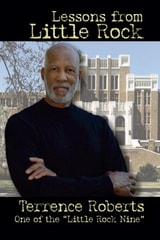
Lessons from Little Rock
Terrance Roberts
Butler Center for Arkansas Studies, 2009
Lessons from Sarajevo
A War Stories PrimerJim Hicks
University of Massachusetts Press, 2013
Hicks explores the limitations of the sentimental tradition in war representation and asks how the work of artists and writers can help us to move beyond the constraints of that tradition. Ranging from Walt Whitman's writings on the Civil War to the U.S. wars in Iraq and Afghanistan, and focusing on the innovative and creative artistic expressions arising out of the wars of the former Yugoslavia, Hicks examines how war has been perceived, described, and interpreted. He analyzes the limitations on knowledge caused by perspective and narrative position and looks closely at the distinct yet overlapping roles of victims, observers, and aggressors. In the end, he concludes, war stories today should be valued according to the extent they make it impossible for us to see these positions as assigned in advance, and immutable.
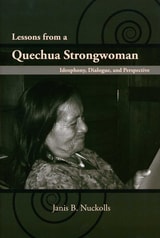
Lessons from a Quechua Strongwoman
Ideophony, Dialogue, and PerspectiveJanis B. Nuckolls
University of Arizona Press, 2010
This book is a fascinating look at ideophones—words that communicate succinctly through imitative sound qualities. They are at the core of Quechua speakers’ discourse—both linguistic and cultural—because they allow agency and reaction to substances and entities as well as beings. Nuckolls shows that Luisa Cadena’s utterances give every individual, major or minor, a voice in her narrative. Sometimes as subtle as a barely felt movement or unintelligible sound, the language supports an amazingly wide variety of voices.
Cadena’s narratives and commentaries on everyday events reveal that sound imitation through ideophones, representations of dialogues between humans and nonhumans, and grammatical distinctions between a speaking self and an other are all part of a language system that allows for the possibility of shared affects, intentions, moral values, and meaningful, communicative interactions between humans and nonhumans.
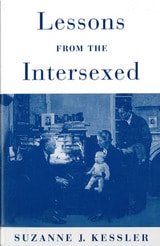
Lessons from the Intersexed
Kessler, Suzanne J
Rutgers University Press, 1998
From the moment intersexuality-the condition of having physical gender markers (genitals, gonads, or chromosomes) that are neither clearly female nor male-is suspected and diagnosed, social institutions are mobilized in order to maintain the two seemingly objective sexual categories. Infants' bodies are altered, and what was "ambiguous" is made "normal." Kessler's interviews with pediatric surgeons and endocrinologists reveal how the intersex condition is normalized for parents and she argues that the way in which intersexuality is managed by the medical and psychological professions displays our culture's beliefs about gender and genitals.
Parents of intersexed children are rarely heard from, but in this book they provide another perspective on reasons for genital surgeries and the quality of medical and psychological management. Although physicians educate parents about how to think about their children's condition, Kessler learned from parents of intersexed children that some parents are able to accept atypical genitals. Based on analysis of the medical literature and interview with adults who had received treatment as interesexed children, Kessler proposes new approaches for physicians to use in talking with parents and children. She also evaluates the appearance of a politicized vanguard, many of who are promoting an intersexual identity, who seek to alter the way physicians respond to intersexuality.
Kessler explores the possibilities and implications of suspending a commitment to two "natural" genders and addresses gender destabilization issues arising from intersexuality. She thus compels readers to re-think the meaning of gender, genitals, and sexuality.
"This is a brave book. Kessler says things that need to be said, and she says them clearly, concisely, and with respect for the people whose lives are most affected by the questions she confronts. A must read for anyone concerned with intersex issues." --Holly Devor, author of Gender Blending: Confronting the Limits of Duality and FTM: Female-to-Male Transsexuals in Society.
"While the physician's response to an infant with ambiguous genitalia has been to produce categories like the 'successful vagina' and the 'good enough penis,' Kessler takes her cues from intersexuals themselves. This book is a brilliant and long overdue call for the reevaluation of gender variability." --Judith Halberstam, author of Female Masculinity
"Fascinating in what it tells us not only about situation in which sex assignment is uncertain but about the astonishingly weak empirical foundations on which the medical orthodoxies of binary sex and gender are built. A must for anyone interested in the ways widely accepted social beliefs and scientific explanations generate and reinforce each other." --Ruth Hubbard, author of The Politics of Women's Biology and Exploding the Gene Myth
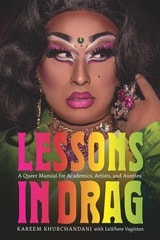
Lessons in Drag
A Queer Manual for Academics, Artists, and AuntiesKareem Khubchandani with LaWhore Vagistan
Brandeis University Press, 2025
Lessons in Drag brings to life a vibrant and thought-provoking dialogue between scholar Kareem Khubchandani and his drag persona LaWhore Vagistan. Beginning with an intimate interview, the book unfolds in alternating chapters where the two exchange insights, stories, and critiques. Khubchandani delves into the lessons LaWhore’s drag practice offers about academia—shaping his approaches to research, teaching, and writing—while Vagistan reveals how Khubchandani’s scholarship influences her performances, inspiring her understanding of fashion, music, divas, and aunties. Together, their reflections and conversations weave a compelling tapestry of drag’s instructive power. Witty, bold, and deeply personal, Lessons in Drag is both an invitation to explore drag as a practice and a celebration of its transformative potential.
Lessons in Leadership
Steve Adubato, PhD
Rutgers University Press, 2016
Lessons in Modern Hebrew
Level 1Edna Amir Coffin
University of Michigan Press, 1977
Lessons in Mortality
Doctors and Patients Struggling TogetherAllen B. Weisse, M.D.
University of Missouri Press, 2006
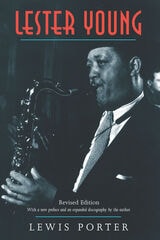
Lester Young
Lewis Porter
University of Michigan Press, 2005
". . . a schematic of unparalleled insight and detail."
---Down Beat
"A monumental work."
---Dizzy Gillespie
". . . a major contribution to jazz scholarship . . . for its illumination of Lester Young's music and for setting the biographical record straight."
---Dan Morgenstern
Several new biographies of Lester Young have been published in the years since Lewis Porter's Lester Young first appeared, but none have supplanted or even attempted the in-depth study that Porter brings to his subject's music. With the same care and scholarship that characterized his John Coltrane, Porter analyzes the music that made Lester Young "the most original tenor sax in jazz."
In addition to helping us understand Lester Young's playing and stylistic evolution, Porter's analysis demonstrates that Young's playing at the end of his career did not mark a serious decline over his earlier style, as many critics have claimed.
Let Me Live
Angelo Herndon
University of Michigan Press, 2007
Let Me Live tells the remarkable story of Angelo Herndon, a coal miner who worked as a labor organizer in Alabama and Georgia in the 1930s. Herndon led a racially integrated march of the unemployed in 1932 and was subsequently arrested when Communist Party literature was found in his bedroom. His trial made only small headlines at first, but eventually an international campaign to free him emerged, thanks to the efforts of the Communist Party and of labor unions interested in protecting the right to organize in the South. Herndon was finally set free by the U.S. Supreme Court, with the help of well-known leaders including C. Vann Woodward, Thurgood Marshall, A. Philip Randolph, and Whitney North Seymour, Sr.
Written while Herndon was in prison, Let Me Live tells the story behind his arrest and his struggle through the courts. It also describes his early life as a young boy in poverty, as a laborer in the Kentucky mines, and as a construction gang worker and traces the birth and development of his passion for the Communist Party. Originally published in 1937, this is the first new edition of Let Me Live since 1969, when Howard N. Meyer rescued it from obscurity. The book features texts from the Georgia and U.S. Supreme Court decisions, the text of Herndon’s speech, and newspaper editorials from the era. A substantive and thought-provoking introduction by Marlon B. Ross of the University of Virginia sheds light on this unique story and its importance to our understanding of the intersection of race and class in America—past and present.
“A book which every thoughtful American may do well to read. It is moving and challenging as the story of one man’s life and the question of one man’s fate.”
—New York Times

Let Me Take You Down
Penny Lane and Strawberry Fields ForeverJonathan Cott
University of Minnesota Press, 2024
The conception, creation, recording, and significance of the Beatles’ “Penny Lane” and “Strawberry Fields Forever”
John Lennon wrote “Strawberry Fields Forever” in Almería, Spain, in fall 1966, and in November, in response to that song, Paul McCartney wrote “Penny Lane” at his home in London. A culmination of what was one of the most life-altering and chaotic years in the Beatles’ career, these two songs composed the 1967 double A-side 45 rpm record that has often been called the greatest single in the history of popular music and was, according to Beatles producer George Martin, “the best record we ever made.”
In Let Me Take You Down: Penny Lane and Strawberry Fields Forever, Jonathan Cott recounts the conception and creation of these songs; describes the tumultuous events and experiences that led the Beatles to call it quits as a touring band and redefine themselves solely as recording artists; and details the complex, seventy-hour recording process that produced seven minutes of indelible music. In writing about these songs, he also focuses on them as inspired artistic expressions of two unique ways of experiencing and being in the world, as Lennon takes us down to Strawberry Fields and McCartney takes us back to Penny Lane.
In order to gain new vistas and multiple perspectives on these multifaceted songs, Cott also engages in conversation with five remarkable people: media artist Laurie Anderson; guitarist Bill Frisell; actor Richard Gere; Jungian analyst Margaret Klenck; and urban planner, writer, and musician Jonathan F. P. Rose. The result is a wide-ranging, illuminating exploration of the musical, literary, psychological, cultural, and spiritual aspects of two of the most acclaimed songs in rock and roll history.
Let Me Tell You Where I've Been
New Writing by Women of the Iranian DiasporaPersis M. Karim
University of Arkansas Press, 2006

Let Something Good Be Said
Speeches and Writings of Frances E. WillardFrances E. Willard. Edited by Carolyn De Swarte Gifford and Amy R. Slagell
University of Illinois Press, 2007
Celebrated as the most famous woman in America at the time of her death in 1898, Frances E. Willard was a leading nineteenth-century American temperance and women's rights reformer and a powerful orator. President of Evanston College for Ladies (before it merged with Northwestern University) and then professor of rhetoric and aesthetics and the first dean of women at Northwestern, Willard is best known for leading the Woman's Christian Temperance Union (WCTU), America's largest women's organization. The WCTU shaped both domestic and international opinion on major political, economic, and social reform issues, including temperance, women's rights, and the rising labor movement. In what Willard regarded as her most important and far-reaching reform, she championed a new ideal of a powerful, independent womanhood and encouraged women to become active agents of social change. Willard's reputation as a powerful reformer reached its height with her election as president of the National Council of Women in 1888.
This definitive collection follows Willard's public reform career, providing primary documents as well as the historical context necessary to clearly demonstrate her skill as a speaker and writer who addressed audiences as diverse as political conventions, national women's organizations, teen girls, state legislators, church groups, and temperance advocates. Including Willard's representative speeches and published writings on everything from temperance and women's rights to the new labor movement and Christian socialism, Let Something Good Be Said is the first volume to collect the messages of one of America's most important social reformers who inspired a generation of women to activism.

Let Them Eat Junk
How Capitalism Creates Hunger and ObesityRobert Albritton
Pluto Press, 2009
Respected economist Robert Albritton argues that the capitalist system, far from delivering on the promise of cheap, nutritious food for all, has created a world where 25% of the world population are over-fed and 25% are hungry. This malnourishment of 50% of the world's population is explained systematically, a refreshing change from accounts that focus on cultural factors and individual greed. Albritton details the economic relations and connections that have put us in a situation of simultaneous oversupply and undersupply of food.
This explosive book provides yet more evidence that the human cost of capitalism is much bigger than those in power will admit.

Let There Be Night
Testimony on Behalf of the DarkPaul Bogard
University of Nevada Press, 2008
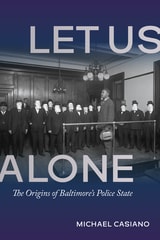
Let Us Alone
The Origins of Baltimore's Police StateMichael Casiano
University of Illinois Press, 2025
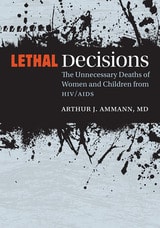
Lethal Decisions
The Unnecessary Deaths of Women and Children from HIV/AIDSArthur J. Ammann
Vanderbilt University Press, 2017
Inexplicably, the World Health Organization recommended withholding treatment for the majority of HIV-infected individuals in poor countries, and clinical researchers embarked on studies to evaluate inferior treatment approaches even while the pandemic continued to claim the lives of millions of women and children. Why did it take an additional twenty years for international health organizations to recommend the treatment and prevention measures that had had such a profound impact on the pandemic in wealthy countries? The surprising answers are likely to be debated by medical historians and ethicists.
At last, in 2015, came a universal call for treating all HIV-infected individuals with triple-combination antiretroviral drugs. But this can only be accomplished if the mistakes of the past are rectified. The book ends with recommendations on how the pediatric HIV/AIDS epidemic can finally be brought to an end.

Lethal Injection
Capital Punishment in Texas during the Modern EraBy Jon Sorensen and Rocky LeAnn Pilgrim
University of Texas Press, 2006
Few state issues have attracted as much controversy and national attention as the application of the death penalty in Texas. In the years since the death penalty was reinstated in 1976, Texas has led the nation in passing death sentences and executing prisoners. The vigor with which Texas has implemented capital punishment has, however, raised more than a few questions. Why has Texas been so fervent in pursuing capital punishment? Has an aggressive death penalty produced any benefits? Have dangerous criminals been deterred? Have rights been trampled in the process and, most importantly, have innocents been executed? These important questions form the core of Lethal Injection: Capital Punishment in Texas during the Modern Era.
This book is the first comprehensive empirical study of Texas's system of capital punishment in the modern era. Jon Sorensen and Rocky Pilgrim use a wealth of information gathered from formerly confidential prisoner records and a variety of statistical sources to test and challenge traditional preconceptions concerning racial bias, deterrence, guilt, and the application of capital punishment in this state. The results of their balanced analysis may surprise many who have followed the recent debate on this important issue.
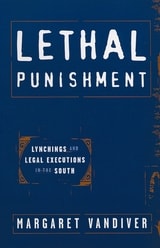
Lethal Punishment
Lynchings and Legal Executions in the SouthVandiver, Margaret
Rutgers University Press, 2005
Why did some offenses in the South end in mob lynchings while similar crimes led to legal executions? Why did still other cases have nonlethal outcomes? In this well-researched and timely book, Margaret Vandiver explores the complex relationship between these two forms of lethal punishment, challenging the assumption that executions consistently grew out of-and replaced-lynchings.
Vandiver begins by examining the incidence of these practices in three culturally and geographically distinct southern regions. In rural northwest Tennessee, lynchings outnumbered legal executions by eleven to one and many African Americans were lynched for racial caste offenses rather than for actual crimes. In contrast, in Shelby County, which included the growing city of Memphis, more men were legally executed than lynched. Marion County, Florida, demonstrated a firmly entrenched tradition of lynching for sexual assault that ended in the early 1930s with three legal death sentences in quick succession.
With a critical eye to issues of location, circumstance, history, and race, Vandiver considers the ways that legal and extralegal processes imitated, influenced, and differed from each other. A series of case studies demonstrates a parallel between mock trials that were held by lynch mobs and legal trials that were rushed through the courts and followed by quick executions.
Tying her research to contemporary debates over the death penalty, Vandiver argues that modern death sentences, like lynchings of the past, continue to be influenced by factors of race and place, and sentencing is comparably erratic.
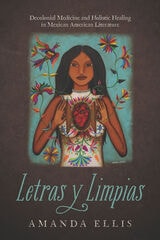
Letras y Limpias
Decolonial Medicine and Holistic Healing in Mexican American LiteratureAmanda Ellis
University of Arizona Press, 2021
Ellis explores the curandera in relationship to decoloniality, bioethics, and the topic of healing while recognizing the limitations and spiritual shortcomings of Western medicine. Ellis argues that our contemporary western health-care system does not know how to fully grapple with illnesses that patients face. Ellis reads the curandera’s perennial representation as an ongoing example of decolonial love useful for deconstructing narrow definitions of health and personhood, and for grappling with the effects of neoliberalism and colonialism on the health-care industry.
Letras y Limpias draws from Chicana feminist theory to assert the importance of the mindbodyspirit connection. Ellis conveys theoretical insights about the continual reimagining of the figure of the curandera as a watermark across Mexican American literary texts. This literary figure points to the oppressive forces that create susto and reminds us that healing work requires specific attention to colonialism, its legacy, and an intentional choice to carry forward the traditional practices rooted in curanderismo passed on from prior generations. By turning toward the figure of the curandera, readers are better poised to challenge prevailing ideas about health, and imagine ways to confront the ongoing problems that coloniality creates. Letras y Limpias shows how the figure of the curandera offers us ways to heal that have nothing to do with copays or medical professionals refusing care, and everything to do with honoring the beauty and complexity of any, every, and all humans.