Results by title
79 books match the query 'Avant-garde (Aesthetics)' and 4 start with m
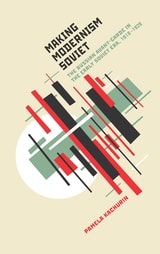
Making Modernism Soviet
The Russian Avant-Garde in the Early Soviet Era, 1918-1928Pamela Kachurin
Northwestern University Press, 2013
Making Modernism Soviet provides a new understanding of the ideological engagement of Russian modern artists such as Kazimir Malevich, Alexander Rodchenko, and Vera Ermolaeva with the political and social agenda of the Bolsheviks in the chaotic years immediately following the Russian Revolution. Focusing on the relationship between power brokers and cultural institutions under conditions of state patronage, Pamela Kachurin lays to rest the myth of the imposition of control from above upon a victimized artistic community. Drawing on extensive archival research, she shows that Russian modernists used their positions within the expanding Soviet arts bureaucracy to build up networks of like-minded colleagues. Their commitment to one another and to the task of creating a socially transformative visual language for the new Soviet context allowed them to produce some of their most famous works of art. But it also contributed to the "Sovietization" of the art world that eventually sealed their fate.
[more]
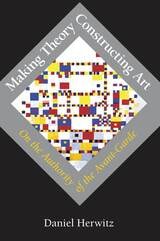
Making Theory/Constructing Art
On the Authority of the Avant-GardeDaniel Herwitz
University of Chicago Press, 1993
Artists and critics regularly enlist theory in the creation and assessment of artworks, but few have scrutinized the art theories themselves. Here, Daniel examines and critiques the norms, assumptions, historical conditions, and institutions that have framed the development and uses of art theory.
Spurred by the theoretical claims of Arthur Danto, a leader in the philosophy of the avant-garde, Herwitz reexamines the art and theory of major figures in the avant-garde movement including John Cage, Jean-François Lyotard, Jean Baudrillard, and Andy Warhol.
Spurred by the theoretical claims of Arthur Danto, a leader in the philosophy of the avant-garde, Herwitz reexamines the art and theory of major figures in the avant-garde movement including John Cage, Jean-François Lyotard, Jean Baudrillard, and Andy Warhol.
[more]
Modernism - Dada - Postmodernism
Richard Sheppard
Northwestern University Press, 1999
This new collection updates, integrates, and contextualizes Richard Sheppard's essays on the historical avant-garde. Sheppard examines responses of modernist writers, artists, and philosophers to a changed sense of reality and human nature. With its combination of previously published and new essays and its perspective on the theoretical avant-garde-modernism debate in the U.S., the volume provides the specialist and the general reader insight into European scholarly discourse on this hotly debated subject.
[more]
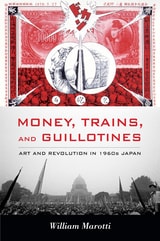
Money, Trains, and Guillotines
Art and Revolution in 1960s JapanWilliam Marotti
Duke University Press, 2013
During the 1960s a group of young artists in Japan challenged official forms of politics and daily life through interventionist art practices. William Marotti situates this phenomenon in the historical and political contexts of Japan after the Second World War and the international activism of the 1960s. The Japanese government renewed its Cold War partnership with the United States in 1960, defeating protests against a new security treaty through parliamentary action and the use of riot police. Afterward, the government promoted a depoliticized everyday world of high growth and consumption, creating a sanitized national image to present in the Tokyo Olympics of 1964. Artists were first to challenge this new political mythology. Marotti examines their political art, and the state's aggressive response to it. He reveals the challenge mounted in projects such as Akasegawa Genpei's 1,000-yen prints, a group performance on the busy Yamanote train line, and a plan for a giant guillotine in the Imperial Plaza. Focusing on the annual Yomiuri Indépendant exhibition, he demonstrates how artists came together in a playful but powerful critical art, triggering judicial and police response. Money, Trains, and Guillotines expands our understanding of the role of art in the international 1960s, and of the dynamics of art and policing in Japan.
[more]