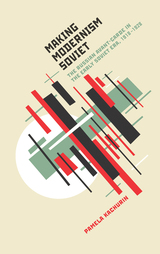
Making Modernism Soviet: The Russian Avant-Garde in the Early Soviet Era, 1918-1928
Northwestern University Press, 2013
Cloth: 978-0-8101-2928-3 | Paper: 978-0-8101-3130-9 | eISBN: 978-0-8101-6726-1
Library of Congress Classification N6988.5.M64K33 2013
Dewey Decimal Classification 709.470904
Cloth: 978-0-8101-2928-3 | Paper: 978-0-8101-3130-9 | eISBN: 978-0-8101-6726-1
Library of Congress Classification N6988.5.M64K33 2013
Dewey Decimal Classification 709.470904
ABOUT THIS BOOK | AUTHOR BIOGRAPHY | REVIEWS | TOC | REQUEST ACCESSIBLE FILE
ABOUT THIS BOOK
Making Modernism Soviet provides a new understanding of the ideological engagement of Russian modern artists such as Kazimir Malevich, Alexander Rodchenko, and Vera Ermolaeva with the political and social agenda of the Bolsheviks in the chaotic years immediately following the Russian Revolution. Focusing on the relationship between power brokers and cultural institutions under conditions of state patronage, Pamela Kachurin lays to rest the myth of the imposition of control from above upon a victimized artistic community. Drawing on extensive archival research, she shows that Russian modernists used their positions within the expanding Soviet arts bureaucracy to build up networks of like-minded colleagues. Their commitment to one another and to the task of creating a socially transformative visual language for the new Soviet context allowed them to produce some of their most famous works of art. But it also contributed to the "Sovietization" of the art world that eventually sealed their fate.
See other books on: Art, Soviet | Artists and museums | Avant-garde (Aesthetics) | Modernism (Art) | Russian Avant - Garde
See other titles from Northwestern University Press