Results by title
235 books match the query 'Books and reading' and 14 start with m

MATTERS OF FACT
READING NONFICTION OVER THE EDGEDANIEL W. LEHMAN
The Ohio State University Press, 1998

Making American Boys
Boyology and the Feral TaleKenneth B. Kidd
University of Minnesota Press, 2005
Making Americans
Children's Literature from 1930 to 1960Gary D. Schmidt
University of Iowa Press, 2013
Although some later critics have argued that the books published in this era offered a vision of a safe, secure, simple world without injustice or unhappy endings, Gary D. Schmidt shows that the progressive political agenda shared by many Americans who wrote, illustrated, published, and taught children’s books had a powerful effect. Authors like James Daugherty, Laura Ingalls Wilder, Lois Lenski, Ingri and Edgar Parin D’Aulaire, Virginia Lee Burton, Robert McCloskey, and many others addressed directly and indirectly the major social issues of a turbulent time: racism, immigration and assimilation, sexism, poverty, the Great Depression, World War II, the atomic bomb, and the threat of a global cold war.
The central concern that many children’s book authors and illustrators wrestled with was the meaning of America and democracy itself, especially the tension between individual freedoms and community ties. That process produced a flood of books focused on the American experience and intent on defining it in terms of progress toward inclusivity and social justice. Again and again, children’s books addressed racial discrimination and segregation, gender roles, class differences, the fate of Native Americans, immigration and assimilation, war, and the role of the United States in the world. Fiction and nonfiction for children urged them to see these issues as theirs to understand, and in some ways, theirs to resolve. Making Americans is a study of a time when the authors and illustrators of children’s books consciously set their eyes on national and international sights, with the hope of bringing the next generation into a sense of full citizenship.
Managing Readers
Printed Marginalia in English Renaissance BooksWilliam W. E. Slights
University of Michigan Press, 2001
The recent revolution in the protocols of reading brought on by computer technology has forced questions about the nature of book-based knowledge in our global culture. Managing Readers traces changes in the protocols of annotation and directed reading--from medieval religious manuscripts and Renaissance handbooks for explorers, rhetoricians, and politicians to the elegant clear-text editions of the Enlightenment and the hypertexts of our own time. Developing such concepts as textual authority, generic difference, and reader-response, Slights demonstrates that printed marginalia were used to confirm the authority of the text and to undermine it, to supplement "dark" passages, and to colonize strategic hermeneutic spaces. The book contains twenty-two illustrations of pages from rare-book archives that make immediately clear how distinctive the management of the reading experience was during the first century-and-a-half of printing in England.
William W. E. Slights is Professor of English, University of Saskatchewan. He is also author of Ben Jonson and the Art of Secrecy.

Mark Twain in Japan
The Cultural Reception of an American IconTsuyoshi, Ishihara
University of Missouri Press, 2005
Best known for his sharp wit and his portrayals of life along the banks of the Mississippi River, Mark Twain is indeed an American icon, and many scholars have examined how he and his work are perceived in the United States. In Mark Twain in Japan, however, Tsuyoshi Ishihara explores how Twain’s uniquely American work is viewed in a completely different culture.
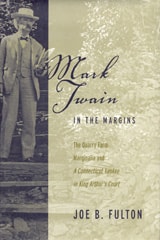
Mark Twain in the Margins
The Quarry Farm Marginalia and a Connecticut Yankee in King Arthur's CourtJoe B. Fulton
University of Alabama Press, 2007
Revealing the notes behind the novel and the scholar behind the legend.
The common characterization of Mark Twain as an uneducated and improvisational writer took hold largely because of the novelist's own frequent claims about his writing practices. But using recently discovered evidence--Twain's marginal notes in books he consulted as he worked on A Connecticut Yankee in King Arthur's Court—Joe Fulton argues for a reconsideration of scholarly views about Twain's writing process, showing that this great American author crafted his novels with careful research and calculated design.
Fulton analyzes Twain's voluminous marginalia in the copies of Macaulay's History of England, Carlyle's History of the French Revolution, and Lecky's History of the Rise of Rationalism and England in the Eighteenth Century available to Twain in the library of Quarry Farm, the New York farm where the novelist and his family routinely spent their summers. Comparing these marginal notes to entries in Twain's writing journal, the manuscript of Connecticut Yankee, and the book as published in 1889, Fulton establishes that Twain's research decisively influenced the novel. Fulton reveals Twain to be both the writer from experience he claimed to be and the careful craftsman that he attempted to downplay. By redefining Twain's aesthetic, Fulton reinvigorates current debates about what constitutes literary realism.
Fulton's transcriptions of the marginalia appear in an appendix; together with his analysis, they provide a valuable new resource for Twain scholars.
Martial
The World of the EpigramWilliam Fitzgerald
University of Chicago Press, 2007
In this age of the sound bite, what sort of author could be more relevant than a master of the epigram? Martial, the most influential epigrammatist of classical antiquity, was just such a virtuoso of the form, but despite his pertinence to today’s culture, his work has been largely neglected in contemporary scholarship. Arguing that Martial is a major author who deserves more sustained attention, William Fitzgerald provides an insightful tour of his works, shedding new and much-needed light on the Roman poet’s world—and how it might speak to our own.
Writing in the late first century CE—when the epigram was firmly embedded in the social life of the Roman elite—Martial published his poems in a series of books that were widely read and enjoyed. Exploring what it means to read such a collection of epigrams, Fitzgerald examines the paradoxical relationship between the self-enclosed epigram and the book of poems that is more than the sum of its parts. And he goes on to show how Martial, by imagining these books being displayed in shops and shipped across the empire to admiring readers, prophetically behaved like a modern author. Chock-full of epigrams itself—in both Latin and English versions—Fitzgerald’s study will delight classicists, literary scholars, and anyone who appreciates an ingenious witticism.
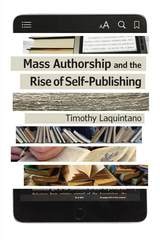
Mass Authorship and the Rise of Self-Publishing
Timothy Laquintano
University of Iowa Press, 2016
Drawing on eight years of research and interviews with more than eighty self-published writers, Mass Authorship avoids the polemics, instead showing how writers are actually thinking about and dealing with this brave new world. Timothy Laquintano compares the experiences of self-publishing authors in three distinct genres—poker strategy guides, memoirs, and romance novels—as well as those of writers whose self-published works hit major bestseller lists. He finds that the significance of self-publishing and the challenge it presents to traditional publishing depend on the aims of authors, the desires of their readers, the affordances of their platforms, and the business plans of the companies that provide those platforms.
In drawing a nuanced portrait of self-publishing authors today, Laquintano answers some of the most pressing questions about what it means to publish in the twenty-first century: How do writers establish credibility in an environment with no editors to judge quality? How do authors police their copyrights online without recourse to the law? How do they experience Amazon as a publishing platform? And how do they find an audience when, it sometimes seems, there are more writers than readers?
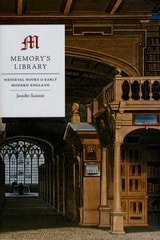
Memory's Library
Medieval Books in Early Modern EnglandJennifer Summit
University of Chicago Press, 2008
In Jennifer Summit’s account, libraries are more than inert storehouses of written tradition; they are volatile spaces that actively shape the meanings and uses of books, reading, and the past. Considering the two-hundred-year period between 1431, which saw the foundation of Duke Humfrey’s famous library, and 1631, when the great antiquarian Sir Robert Cotton died, Memory’s Library revises the history of the modern library by focusing on its origins in medieval and early modern England.
Summit argues that the medieval sources that survive in English collections are the product of a Reformation and post-Reformation struggle to redefine the past by redefining the cultural place, function, and identity of libraries. By establishing the intellectual dynamism of English libraries during this crucial period of their development, Memory’s Library demonstrates how much current discussions about the future of libraries can gain by reexamining their past.
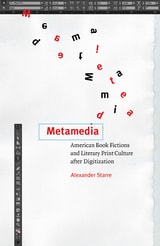
Metamedia
American Book Fictions and Literary Print Culture after DigitizationAlexander Starre
University of Iowa Press, 2015
Combining sustained textual analysis with impulses from the fields of book history, media studies, and systems theory, Starre explains the aesthetics and the cultural work of complex material fictions, such as Mark Z.Danielewski’s House of Leaves (2000), Chip Kidd’s The Cheese Monkeys (2001), Salvador Plascencia’s The People of Paper (2005), Reif Larsen’s The Selected Works of T. S. Spivet (2009), and Jonathan Safran Foer’s Tree of Codes (2010). He also broadens his analysis beyond the genre of the novel in an extensive account of the influential literary magazine McSweeney’s Quarterly Concern and its founder, Dave Eggers.
For this millennial generation of writers and publishers, the computer was never a threat to print culture, but a powerful tool to make better books. In careful close readings, Starre puts typefaces, layouts, and cover designs on the map of literary criticism. At the same time, the book steers clear of bibliophile nostalgia and technological euphoria as it follows writers, designers, and publishers in the process of shaping the surprising history of literary bookmaking after digitization.

Mind-Bending Mysteries and Thrillers for Teens
A Programming and Readers' Advisory GuideAmy Alessio
American Library Association, 2014
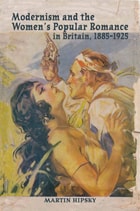
Modernism and the Women’s Popular Romance in Britain, 1885–1925
Martin Hipsky
Ohio University Press, 2011
Today’s mass-market romances have their precursors in late Victorian popular novels written by and for women. In Modernism and the Women’s Popular Romance Martin Hipsky scrutinizes some of the best-selling British fiction from the period 1885 to 1925, the era when romances, especially those by British women, were sold and read more widely than ever before or since.
Recent scholarship has explored the desires and anxieties addressed by both “low modern” and “high modernist” British culture in the decades straddling the turn of the twentieth century. In keeping with these new studies, Hipsky offers a nuanced portrait of an important phenomenon in the history of modern fiction. He puts popular romances by Mrs. Humphry Ward, Marie Corelli, the Baroness Orczy, Florence Barclay, Elinor Glyn, Victoria Cross, Ethel Dell, and E. M. Hull into direct relationship with the fiction of Virginia Woolf, Katherine Mansfield, James Joyce, and D. H. Lawrence, among other modernist greats.
Multiethnic Books for the Middle-School Curriculum
Cherri Jones
American Library Association, 2013
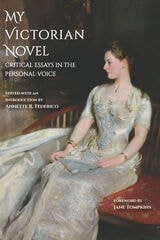
My Victorian Novel
Critical Essays in the Personal VoiceAnnette R. Federico
University of Missouri Press, 2020
These are essays in the original sense of the word, attempts: individual and experiential approaches to literary works that have subjective meanings beyond social facts. By reflecting on their own histories with novels taught, studied, researched, and re-experienced in different contexts over many years, the contributors reveal how an aesthetic object comes to inhabit our critical, pedagogical, and personal lives.
By inviting scholars to share their experiences with a favorite novel without the pressure of an analytical agenda, the sociable essays in My Victorian Novel seek to restore some vitality to the act of literary criticism, and encourage other scholars to talk about the importance of reading in their lives and the stories that have enchanted and transformed them.
The novels in this collection include:
Jane Eyre by Charlotte Brontë
The Duke’s Children by Anthony Trollope
The Adventures of Sherlock Holmes by Arthur Conan Doyle
The Newcomes by William Makepeace Thackeray
Middlemarch by George Eliot
Daniel Deronda by George Eliot
The Return of the Native by Thomas Hardy
Vanity Fair by William Makepeace Thackeray
North and South by Elizabeth Gaskell
Bleak House by Charles Dickens
David Copperfield by Charles Dickens
New Grub Street by George Gissing
The Pickwick Papers by Charles Dickens
Dracula by Bram Stoker
Wuthering Heights by Emily Brontë