Results by title
105 books match the query 'Community life' and 8 start with m
MAKING SENSE OF THE CITY
LOCAL GOVERNMENT, CIVIC CULTURE, AND COMMUNITY LIFE IN URBAN AMERICAROBERT B. FAIRBANKS
The Ohio State University Press, 2001
Making Sense of the City explores the ways in which urbanites have attempted to confront the challenges of urban life during the nineteenth and twentieth centuries. In the spirit of Zane L. Miller, whom this volume honors, the nine contributors focus closely on the words and actions of individuals, institutions, and organizations who participated in the public discourse about what the city was or could be. Through an examination of such topics as city charters, city planning texts, neighborhood organizations, municipal recreation programs, urban government reforms, urban identity, and fair housing campaigns, the authors offer insight into the process through which ideas about the nature of the city have affected action in the urban environment.
Contributing authors are
- Robert B. Fairbanks
- Patricia Mooney-Melvin
- Judith Spraul-Schmidt
- Alan I. Marcus
- Robert A. Burnham
- Andrea Tuttle Kornbluh
- Bradley D. Cross
- Charles F. Casey-Leininger
- Roger W. Lotchin
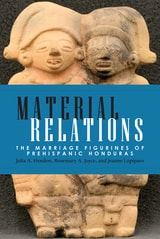
Material Relations
The Marriage Figurines of Prehispanic HondurasJulia A. Hendon
University Press of Colorado, 2014
They examine the production, use, and disposal of marriage figurines from six sites—Campo Dos, Cerro Palenque, Copán, Currusté, Tenampua, and Travesia—and explore their role in rituals and ceremonies, as well as in the forming of social bonds and the celebration of relationships among communities. They find evidence of historical traditions reproduced over generations through material media in social relations among individuals, families, and communities, as well as social differences within this network of connected yet independent settlements.
Material Relations provides a new and dynamic understanding of how social houses functioned via networks of production and reciprocal exchange of material objects and will be of interest to Mesoamerican archaeologists, anthropologists, and art historians.
Medina by the Bay
Scenes of Muslim Study and SurvivalMaryam Kashani
Duke University Press, 2023
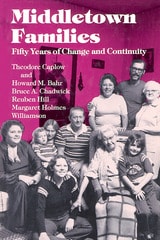
Middletown families
fifty years of change and continuityTheodore. Caplow
University of Minnesota Press, 1982
Modern Bonds
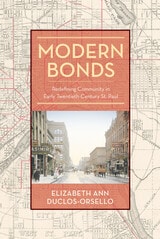
Redefining Community in Early Twentieth-Century St. PaulElizabeth Ann Duclos-Orsello
University of Massachusetts Press, 2018
What does community mean, exactly? In this interdisciplinary study, Elizabeth Ann Duclos-Orsello takes seriously the concept of community as an object of historical analysis.
Focusing on St. Paul, Minnesota, from 1900 to 1920, Modern Bonds explores the diverse ways that its people renegotiated private and public affiliations during a period of modernization. The book examines a wide range of subjects and materials, including photographs from an African American family, fictional depictions of middle-class women, built environments that created enclaves of immigrants, and public festivals designed to unite all citizens. As Duclos-Orsello demonstrates, it was in this period that a complex set of activities, policies, and practices led to new understandings of community that continue to shape life today.
Modern Bonds
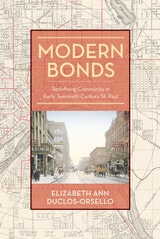
Redefining Community in Early Twentieth-Century St. PaulElizabeth Ann Duclos-Orsello
University of Massachusetts Press, 2018
What does community mean, exactly? In this interdisciplinary study, Elizabeth Ann Duclos-Orsello takes seriously the concept of community as an object of historical analysis.
Focusing on St. Paul, Minnesota, from 1900 to 1920, Modern Bonds explores the diverse ways that its people renegotiated private and public affiliations during a period of modernization. The book examines a wide range of subjects and materials, including photographs from an African American family, fictional depictions of middle-class women, built environments that created enclaves of immigrants, and public festivals designed to unite all citizens. As Duclos-Orsello demonstrates, it was in this period that a complex set of activities, policies, and practices led to new understandings of community that continue to shape life today.
Murder Scenes
Normality, Deviance, and Criminal Violence in Weimar BerlinSace Elder
University of Michigan Press, 2010
---Kenneth Ledford, Case Western Reserve University
Music Making Community
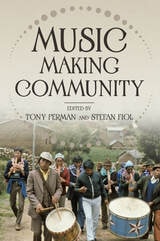
Edited by Tony Perman and Stefan Fiol
University of Illinois Press, 2024
Making music offers enormous possibilities--and faces significant limitations--in its power to generate belonging and advance social justice. Tony Perman and Stefan Fiol edit essays focused on the forms of interplay between music-making and community-making as mutually creative processes. Contributors in the first section look at cases where music arrived in settings with little or no sense of community and formed social bonds that lasted beyond its departure. In the sections that follow, the essayists turn to stable communities that used musical forms to address social needs and both forged new social groups and, in some cases, splintered established communities. By centering the value of difference in productive feedback dynamics of music and community while asserting the need for mutual moral indebtedness, they foreground music’s potential to transform community for the better.
Contributors: Stephen Blum, Joanna Bosse, Sylvia Bruinders, Donna A. Buchanan, Rick Deja, Veit Erlmann, Stefan Fiol, Eduardo Herrera, David A. McDonald, Tony Perman, Thomas Solomon, and Ioannis Tsekouras