Results by title
75 books match the query 'Confederate States of America' and 5 start with m
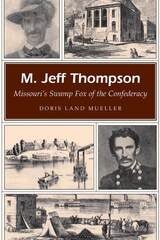
M. Jeff Thompson
Missouri's Swamp Fox of the ConfederacyDoris Land Mueller
University of Missouri Press, 2007
In the treacherous swamps of southeast Missouri, a different kind of Civil War was waged.
Meriwether Jeff Thompson was one of the most intriguing but least-known Missouri participants in the Civil War. He and his troops traveled fast and light to harass Union forces, materializing out of the countryside to surprise the enemy and evading the traps set for them by Northern commanders. Early in the war, Union General Ulysses S. Grant gave Thompson the name “Swamp Fox” for his exploits in the Bootheel region. This book now tells his story—an adventure that will be appreciated by readers of all ages. Doris Mueller has produced a meticulously researched account of Thompson’s life, from his Virginia boyhood and early successes to his wartime exploits and postwar life. When the war began, Thompson left his adopted city of St. Joseph—where he had served as mayor—to fight for the Confederacy. He was elected brigadier general in the First Military District of Southeast Missouri and led poorly equipped and loosely trained men in skirmishes and raids, often using guerrilla tactics. He was captured in August 1863. After being released twelve months later in a prisoner exchange, he joined Sterling Price’s ill-fated raid into Missouri. After the war, he was one of the first Southern leaders to seek reinstatement as a U.S. citizen and worked to allay hostilities among fellow Southerners.
Thompson was also known as the “Poet Laureate of the Marshes,” and Mueller includes numerous excerpts from his writings about his experiences. Her account not only provides a wealth of little-known biographical details about this important Missourian but also offers insight into the state’s unique experiences during that bloody era, personalizing events through the life of this brave soldier.
Scorned by the Northern press for impudence, but beloved as a leader by his men, Thompson was courageous in battle, often to the point of recklessness, making him a constant thorn in the side of Union forces; after the war he was an oft-maligned model for reconciliation. Doris Mueller’s recounting of his life is an action-adventure story that will delight readers as it attests to his important role in Missouri’s heritage.

Mary Chesnut's Civil War Epic
Julia A. Stern
University of Chicago Press, 2009
A genteel southern intellectual, saloniste, and wife to a prominent colonel in Jefferson Davis’s inner circle, Mary Chesnut today is remembered best for her penetrating Civil War diary. Composed between 1861 and 1865 and revised thoroughly from the late 1870s until Chesnut’s death in 1886, the diary was published first in 1905, again in 1949, and later, to great acclaim, in 1981. This complicated literary history and the questions that attend it—which edition represents the real Chesnut? To what genre does this text belong?—may explain why the document largely has, until now, been overlooked in literary studies.
Julia A. Stern’s critical analysis returns Chesnut to her rightful place among American writers. In Mary Chesnut’s Civil War Epic, Stern argues that the revised diary offers the most trenchant literary account of race and slavery until the work of Faulkner and that, along with his Yoknapatawpha novels, it constitutes one of the two great Civil War epics of the American canon. By restoring Chesnut’s 1880s revision to its complex, multidecade cultural context, Stern argues both for Chesnut’s reinsertion into the pantheon of nineteenth-century American letters and for her centrality to the literary history of women’s writing as it evolved from sentimental to tragic to realist forms.
Matchless Organization
The Confederate Army Medical DepartmentGuy R. Hasegawa, Foreword by F. Terry Hambrecht
Southern Illinois University Press, 2021
Despite the many obstacles it had to overcome—including a naval blockade, lack of a strong industrial base, and personnel unaccustomed to military life—the Richmond-based Confederate Army Medical Department developed into a robust organization that nimbly adapted to changing circumstances. In the first book to address the topic, Guy R. Hasegawa describes the organization and management of the Confederate army’s medical department. At its head was Surgeon General Samuel Preston Moore, a talented multitasker with the organizational know-how to put in place qualified medical personnel to care for sick and wounded Confederate soldiers.
Hasegawa investigates how political considerations, personalities, and, as the war progressed, the diminishing availability of human and material resources influenced decision-making in the medical department. Amazingly, the surgeon general’s office managed not only to provide care but also to offer educational opportunities to its personnel and collect medical and surgical data for future use, regardless of constant and growing difficulties.
During and after the war, the medical department of the Confederate army was consistently praised as being admirably organized and efficient. Although the department was unable to match its Union counterpart in manpower and supplies, Moore’s intelligent management enabled it to help maintain the fighting strength of the Confederate army.
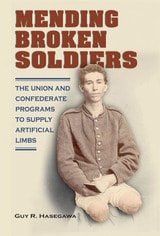
Mending Broken Soldiers
The Union and Confederate Programs to Supply Artificial LimbsGuy R. Hasegawa
Southern Illinois University Press, 2012
Guy R. Hasegawa presents the first volume to explore the wartime provisions made for amputees in need of artificial limbs—programs that were the forebears of modern governmental efforts to assist in the rehabilitation of wounded service members. Hasegawa offers a comprehensive look at the artificial-limb industry, including detailed descriptions of the ingenious designs employed by manufacturers; illustrations and photographs of period prosthetics; accounts of the rapid advancement of medical technology during the Civil War; and in-depth examinations of the companies that manufactured limbs for soldiers and bid for contracts, including at least one still in existence today. An intriguing account of innovation, determination, humanitarianism, and the devastating toll of battle, Mending Broken Soldiers provides a fascinating glimpse into groundbreaking military health programs during the most tumultuous years in American history.
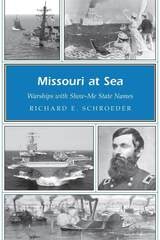
Missouri at Sea
Warships with Show-Me State NamesRichard E. Schroeder
University of Missouri Press, 2004
For each vessel, a brief history is supplied, and the book is illustrated with many extraordinary images and photographs taken from official U.S. government records and archives. Schroeder begins his volume with the first St. Louis and other small early ships that were symbolic of America’s modest nineteenth-century commercial and political ambitions. The first Missouri, one of the earliest American steamships, depicts the United States’ move into the industrial and technological revolution of the nineteenth century.
Another Federal St. Louis and a Confederate Missouri highlight the Mississippi River Civil War campaign. Schroeder then turns to America’s rise as a global military power at the beginning of the twentieth century with stories of the St. Louis in the Spanish-American War and the first battleship Missouri of Teddy Roosevelt’s Great White Fleet. The dominance of the U.S. Navy during World War II in the Pacific theater is illustrated by the fourth and most famous of all the ships to bear the name Missouri, whose deck was the site for the Japanese surrender.
The advanced technological achievements of the mid-twentieth century are represented by the nuclear submarines named for one of Missouri’s favorite sons and for its capital: Daniel Boone and Jefferson City. Also highlighted in the volume is the 5,000-crew nuclear aircraft carrier Harry S. Truman, along with smaller ships named for Missouri war heroes. Missouri at Sea will appeal to those readers interested in naval history and technology or Missouri history.