Results by title
244 books match the query 'Crime' and 11 start with m
Making Hate A Crime
From Social Movement to Law EnforcementValerie Jenness
Russell Sage Foundation, 2001
Marked
Race, Crime, and Finding Work in an Era of Mass IncarcerationDevah Pager
University of Chicago Press, 2007
Nearly every job application asks it: have you ever been convicted of a crime? For the hundreds of thousands of young men leaving American prisons each year, their answer to that question may determine whether they can find work and begin rebuilding their lives.
The product of an innovative field experiment, Marked gives us our first real glimpse into the tremendous difficulties facing ex-offenders in the job market. Devah Pager matched up pairs of young men, randomly assigned them criminal records, then sent them on hundreds of real job searches throughout the city of Milwaukee. Her applicants were attractive, articulate, and capable—yet ex-offenders received less than half the callbacks of the equally qualified applicants without criminal backgrounds. Young black men, meanwhile, paid a particularly high price: those with clean records fared no better in their job searches than white men just out of prison. Such shocking barriers to legitimate work, Pager contends, are an important reason that many ex-prisoners soon find themselves back in the realm of poverty, underground employment, and crime that led them to prison in the first place.
“Using scholarly research, field research in Milwaukee, and graphics, [Pager] shows that ex-offenders, white or black, stand a very poor chance of getting a legitimate job. . . . Both informative and convincing.”—Library Journal
“Marked is that rare book: a penetrating text that rings with moral concern couched in vivid prose—and one of the most useful sociological studies in years.”—Michael Eric Dyson
Medieval Crime and Social Control
Barbara A. Hanawalt
University of Minnesota Press, 1998
Uses historical and literary insights to consider crime and punishment in the Middle Ages.
Crime is a matter of interpretation, and never was this truer than in the Middle Ages, when societies faced with new ideas and pressures were continually forced to rethink what a crime was-and what was a crime. This collection undertakes a thorough exploration of shifting definitions of crime and changing attitudes toward social control in medieval Europe.
These essays-by leading specialists in European history and literature-reveal how various forces in medieval society interacted and competed in interpreting and influencing mechanisms for social control. They also demonstrate how well the different methods of history and literature combine to illuminate these developments.The essays show how the play with boundaries between legitimate and illegitimate actions took place not only in laws and courts, but also in the writing of social commentators such as John Fortescue and Jean Gerson, in the works of authors such as William Langland and Geoffrey Chaucer, and in popular literature such as sagas and romances. Drawing on a wide range of historical and literary sources-legal treatises, court cases, statutes, poems, romances, and comic tales-the contributors consider topics including fear of crime, rape and violence against women, revenge and condemnations of crime, learned dispute about crime and social control, and legal and political struggles over hunting rights. Their work shows how medieval society also defined its boundaries in contested spaces such as taverns and forests and in the different rules applying to the behavior and treatment of men and women.Contributors: Christopher Cannon, Oxford U; Elizabeth Fowler, Yale U; Louise O. Fradenburg, U of California, Santa Barbara; Claude Gauvard, Sorbonne; James H. Landman, U of North Texas; William Perry Marvin, Colorado State U; William Ian Miller, U of Michigan; Louise Mirrer, CUNY; Walter Prevenier, U of Ghent.ISBN 0-8166-3168-9 Cloth $49.95xxISBN 0-8166-3169-7 Paper $19.95x268 pages 5 7/8 x 9 JanuaryMedieval Cultures Series, volume 16Translation inquiries: University of Minnesota Press
More God, Less Crime
Why Faith Matters and How It Could Matter MoreByron Johnson
Templeton Press, 2012
In More God, Less Crime renowned criminologist Byron R. Johnson proves that religion can be a powerful antidote to crime. The book describes how faith communities, congregations, and faith-based organizations are essential in forming partnerships necessary to provide the human and spiritual capital to effectively address crime, offender rehabilitation, and the substantial aftercare problems facing former prisoners. There is scattered research literature on religion and crime but until now, there has never been one publication that systematically and rigorously analyzes what we know from this largely overlooked body of research in a lay-friendly format. The data shows that when compared to current strategies, faith-based approaches to crime prevention bring added value in targeting those factors known to cause crime: poverty, lack of education, and unemployment. In an age of limited fiscal resources, Americans can’t afford a criminal justice system that turns its nose up at volunteer efforts that could not only work better than the abysmal status quo, but also save billions of dollars at the same time. This book provides readers with practical insights and recommendations for a faith-based response that could do just that.

Murder Scenes
Normality, Deviance, and Criminal Violence in Weimar BerlinSace Elder
University of Michigan Press, 2010
---Kenneth Ledford, Case Western Reserve University
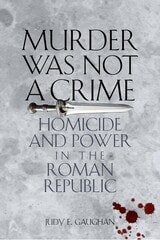
Murder Was Not a Crime
Homicide and Power in the Roman RepublicBy Judy E. Gaughan
University of Texas Press, 2009
Embarking on a unique study of Roman criminal law, Judy Gaughan has developed a novel understanding of the nature of social and political power dynamics in republican government. Revealing the significant relationship between political power and attitudes toward homicide in the Roman republic, Murder Was Not a Crime describes a legal system through which families (rather than the government) were given the power to mete out punishment for murder.
With implications that could modify the most fundamental beliefs about the Roman republic, Gaughan's research maintains that Roman criminal law did not contain a specific enactment against murder, although it had done so prior to the overthrow of the monarchy. While kings felt an imperative to hold monopoly over the power to kill, Gaughan argues, the republic phase ushered in a form of decentralized government that did not see itself as vulnerable to challenge by an act of murder. And the power possessed by individual families ensured that the government would not attain the responsibility for punishing homicidal violence.
Drawing on surviving Roman laws and literary sources, Murder Was Not a Crime also explores the dictator Sulla's "murder law," arguing that it lacked any government concept of murder and was instead simply a collection of earlier statutes repressing poisoning, arson, and the carrying of weapons. Reinterpreting a spectrum of scenarios, Gaughan makes new distinctions between the paternal head of household and his power over life and death, versus the power of consuls and praetors to command and kill.
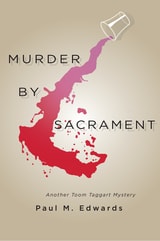
Murder by Sacrament
Another Toom Taggart MysteryPaul M. Edwards
Signature Books, 2014
Taggart is annoyed at having to navigate the political structure of the bureaucracy, but he cannot bring himself to leave. He is able to teach, and he likes his proximity to Church archives, local bookstores, and the woman who, according to fate, is still seeing the policeman from The Angel Acronym. All the major characters are back, and Taggart’s romantic rival is given the new murder case, meaning that he has to rely once again on Taggart for his knowledge of the Church’s secrets. This gives both men a reason to keep an eye on the other, making for entertaining situations in a funny, insider send-up of the RLDS community.
Murder in Ancient China
Two Judge Dee MysteriesRobert van Gulik
University of Chicago Press, 2013
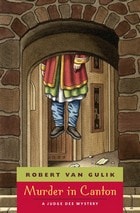
Murder in Canton
A Judge Dee MysteryRobert van Gulik
University of Chicago Press, 1966
Murder in Canton takes place in the year 680, as Judge Dee, recently promoted to lord chief justice, is sent incognito to Canton to investigate the disappearance of a court censor. With the help of his trusted lieutenants Chiao Tai and Tao Gan, and that of a clever blind girl who collects crickets, Dee solves a complex puzzle of political intrigue and murder through the three separate subplots "the vanished censor," "the Smaragdine dancer," and "the Golden Bell."
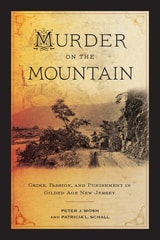
Murder on the Mountain
Crime, Passion, and Punishment in Gilded Age New JerseyPeter J. Wosh
Rutgers University Press, 2022
Was Margaret the calculating murderess and adulteress portrayed by the press? Or was she a battered wife pushed to the edge? Or was she, as she claimed to the end, innocent? Murder on the Mountain considers all sides of this fascinating and mysterious true crime story. In turn, it examines why this murder trial became front-page news, as it resonated with public discussions about capital punishment, mental health, anti-immigrant sentiment, domestic violence, and women’s independence. This is a gripping and thought-provoking study of a murder that shocked the nation.
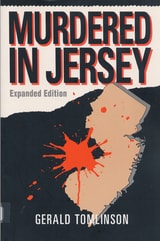
Murdered in Jersey
Expanded EditionGerald Tomlinson
Rutgers University Press, 1994