Results by title
434 books match the query 'Criticism & Theory' and 19 start with m
M/E/A/N/I/N/G
An Anthology of Artists' Writings, Theory, and CriticismSusan Bee and Mira Schor, eds.
Duke University Press, 2000
With its emphasis on artists’ perspectives of aesthetic and social issues, this anthology provides a unique opportunity to enter into the fray of the most hotly contested art issues of the past few decades: the visibility of women artists, sexuality and the arts, censorship, art world racism, the legacies of modernism, artists as mothers, visual art in the digital age, and the rewards and toils of a lifelong career in art. The stellar cast of contributing artists and art writers includes Nancy Spero, Richard Tuttle, David Humphrey, Thomas McEvilley, Laura Cottingham, Johanna Drucker, David Reed, Carolee Schneemann, Whitney Chadwick, Robert Storr, Leon Golub, Charles Bernstein, and Alison Knowles.
This compelling and theoretically savvy collection will be of interest to artists, art historians, critics, and a general audience interested in the views of practicing artists.
Machine in the Studio
Constructing the Postwar American ArtistCaroline A. Jones
University of Chicago Press, 1996
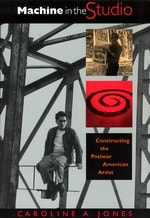
"Jones manages to analyze art works in their historical, political, and conceptual context, giving them a thickness of description rarely possible in standard art history. . . . This is one of the best books on the period I have read so far. To paraphrase Clement Greenberg, it gives contemporary art history a good name."—Serge Guilbaut, Bookforum
"Though we are some 30 years past the events of the '60s, our world is still largely responding to them, as this marvelous book amply demonstrates."—David McCarthy, New Art Examiner
Making History Move
Five Principles of the Historical FilmKim Nelson
Rutgers University Press, 2024
Making Memory Matter
Strategies of Remembrance in Contemporary ArtLisa Saltzman
University of Chicago Press, 2006
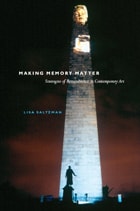
In an ancient account of painting’s origins, a woman traces the shadow of her departing lover on the wall in an act that anticipates future grief and commemoration. Lisa Saltzman shows here that nearly two thousand years after this story was first told, contemporary artists are returning to similar strategies of remembrance, ranging from vaudevillian silhouettes and sepulchral casts to incinerated architectures and ghostly processions.
Exploring these artists’ work, Saltzman demonstrates that their methods have now eclipsed painting and traditional sculpture as preeminent forms of visual representation. She pays particular attention to the groundbreaking art of Krzysztof Wodiczko, who is known for his projections of historical subjects; Kara Walker, who creates powerful silhouetted images of racial violence in American history; and Rachel Whiteread, whose work centers on making casts of empty interior spaces. Each of the artists Saltzman discusses is struggling with the roles that history and memory have come to play in an age when any historical statement is subject to question and doubt. In identifying this new and powerful movement, she provides a framework for understanding the art of our time.
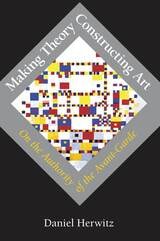
Making Theory/Constructing Art
On the Authority of the Avant-GardeDaniel Herwitz
University of Chicago Press, 1993
Spurred by the theoretical claims of Arthur Danto, a leader in the philosophy of the avant-garde, Herwitz reexamines the art and theory of major figures in the avant-garde movement including John Cage, Jean-François Lyotard, Jean Baudrillard, and Andy Warhol.
Making the Modern
Industry, Art, and Design in AmericaTerry Smith
University of Chicago Press, 1993

Manifesto of Artistic Research
Silvia Henke, Dieter Mersch, Nicolaj van der Meulen, Thomas Strässle, and Jörg Wiesel
Diaphanes, 2020
Meaning in the Visual Arts
Erwin Panofsky
University of Chicago Press, 1983
The papers in this volume represent a cross-section of Panofsky's major work. Included are selections from his well-known Studies in Iconology and The Life and Art of Albrecht Dürer, plus an introduction and an epilogue—"The History of Art as a Humanistic Discipline" and "Three Decades of Art History in the United States: Impressions of a Transplanted European"—as well as pieces written especially for this collection. All display Panofsky's vast erudition and deep commitment to a humanistic conception of art and art history.
Medium Cool, Volume 101
Andrew McNamara and Peter Krapp, eds.
Duke University Press, 0
Contributors. Keith Broadfoot, Rex Butler, Patrick Crogan, Wolfgang Ernst, Gary Hall, Rosemary Hawker, Peter Krapp, Catherine Liu, John MacArthur, Andrew McNamara, Toni Ross, Lisa Trahair, Georg Stanitzek, Georg Christoph Tholen, Lisa Trahair, Samuel Weber, Simon Morgan Wortham
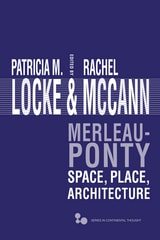
Merleau-Ponty
Space, Place, ArchitecturePatricia M. Locke
Ohio University Press, 2015
Phenomenology has played a decisive role in the emergence of the discourse of place, now indispensable to many disciplines in the humanities and social sciences, and the contribution of Merleau-Ponty’s thought to architectural theory and practice is well established. Merleau-Ponty: Space, Place, Architecture is a vibrant collection of original essays by twelve eminent philosophers who mine Merleau-Ponty’s work to consider how we live and create as profoundly spatial beings. The resulting collection is essential to philosophers and creative artists as well as those concerned with the pressing ethical issues of our time.
Each contributor presents a different facet of space, place, or architecture. These essays carve paths from Merleau-Ponty to other thinkers such as Irigaray, Deleuze, Ettinger, and Piaget. As the first collection devoted specifically to developing Merleau-Ponty’s contribution to our understanding of place and architecture, this book will speak to philosophers interested in the problem of space, architectural theorists, and a wide range of others in the arts and design community.
Contributors: Nancy Barta-Smith, Edward S. Casey, Helen Fielding, Lisa Guenther, Galen A. Johnson, Randall Johnson, D. R. Koukal, Suzanne Cataldi Laba, Patricia M. Locke, Glen Mazis, Rachel McCann, David Morris, and Dorothea Olkowski.
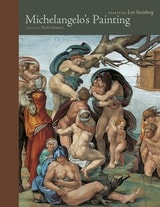
Michelangelo's Painting
Selected EssaysLeo Steinberg
University of Chicago Press, 2019
For half a century, Steinberg delved into Michelangelo’s work, revealing the symbolic structures underlying the artist’s highly charged idiom. This volume of essays and unpublished lectures elucidates many of Michelangelo’s paintings, from frescoes in the Sistine Chapel to the Conversion of St. Paul and the Crucifixion of St. Peter, the artist’s lesser-known works in the Vatican’s Pauline Chapel; also included is a study of the relationship of the Doni Madonna to Leonardo.
Steinberg’s perceptions evolved from long, hard looking. Almost everything he wrote included passages of old-fashioned formal analysis, but always put into the service of interpretation. He understood that Michelangelo’s rendering of figures, as well as their gestures and interrelations, conveys an emblematic significance masquerading under the guise of naturalism. Michelangelo pushed Renaissance naturalism into the furthest reaches of metaphor, using the language of the body to express fundamental Christian tenets once expressible only by poets and preachers.
Leo Steinberg was one of the most original art historians of the twentieth century, known for taking interpretive risks that challenged the profession by overturning reigning orthodoxies. Michelangelo’s Painting is the second volume in a series that presents Steinberg’s writings, selected and edited by his longtime associate Sheila Schwartz.
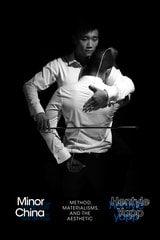
Minor China
Method, Materialisms, and the AestheticHentyle Yapp
Duke University Press, 2021
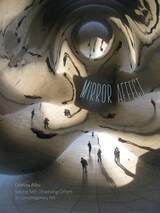
Mirror Affect
Seeing Self, Observing Others in Contemporary ArtCristina Albu
University of Minnesota Press, 2016
For decades, contemporary artworks with reflective properties have stimulated public forms of spectatorship. According to Cristina Albu, these artworks, which can include elements such as mirrors, live video feedback, or sensors, draw attention to affective interdependence and mechanisms of social control.
In Mirror Affect, Albu provides a historical account of mirroring processes in contemporary art and offers insight into the phenomenological and sociopolitical concerns that have inspired artists to stage processes of affective, perceptual, and behavioral mirroring between art viewers. Beginning with the 1960s, Albu charts the rise of interpersonal modes of art spectatorship. She reveals contemporary artists’ strategic use of reflective and responsive interfaces to instill doubt in visual representation and appeal to active scrutiny of the changing social dynamics. She suggests that the mirroring processes envisioned by contemporary artists such as Joan Jonas, Dan Graham, Lynn Hershman Leeson, Olafur Eliasson, and Rafael Lozano-Hemmer trigger visual disjunctions to upset narcissistic inclinations. They invite viewers to see themselves in relation to others and to ponder their role within complex social systems.
From sculpture and performance to art and technology projects, video art, and installation art, Mirror Affect analyzes forms of interpersonal spectatorship, revising and expanding current historiographies of participatory art.
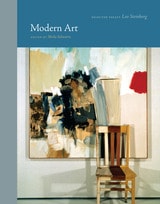
Modern Art
Selected EssaysLeo Steinberg
University of Chicago Press, 2023
Leo Steinberg was one of the most original art historians of the twentieth century, known for taking interpretive risks that challenged the profession by overturning reigning orthodoxies. In essays and lectures ranging from old masters to modern art, he combined scholarly erudition with eloquent prose that illuminated his subject and a credo that privileged the visual evidence of the image over the literature written about it. His writings, sometimes provocative and controversial, remain vital and influential reading. Steinberg’s perceptions evolved from long, hard looking at his objects of study. Almost everything he wrote included passages of formal analysis that were always put into the service of interpretation.
Following the series publication on Pablo Picasso, this volume focuses on other modern artists, including Cézanne, Monet, Matisse, Max Ernst, Jasper Johns, Robert Rauschenberg, Roy Lichtenstein, Hans Haacke, and Jeff Koons. Included are seven unpublished lectures and essays, Steinberg’s landmark essay “Encounters with Rauschenberg,” a survey of twentieth-century sculpture, and an examination of the role of authorial predilections in critical writing. The final chapter presents a collection of Steinberg’s humorous pieces, witty forays penned for his own amusement.
Modern Art is the fifth and final volume in a series that presents Steinberg’s writings, selected and edited by his longtime associate Sheila Schwartz.

Modernism, Catastrophe, Utopianism
Hal Foster
Prickly Paradigm Press, 2027
In this collection of essays, Hal Foster reflects on how modernism's utopian frameworks can be reactivated in the face of recent political challenges.
In both contemporary art and politics since COVID-19, the discourses of modernism and modernity have been challenged by unexpected developments. The convergences between left-wing indigeneity and right-wing nativism, and the political right's appropriation of transgression—long a strategy of the left—point to essential challenges of the modernist project. The five essays of Modernism, Catastrophe, Utopia reflects on such developments, seeking to parse the elements of modernist discourse that remain valid or can be repurposed, and those which must be jettisoned. Literary and cultural critic Hal Foster shows how the constructive, even utopian dimension of modernism might be remotivated in the face of ecological catastrophe, potentially liberating us from a melancholic fixation on our traumatic past.

Monochrome Multitudes
Art of One Color from Albers to ZeislerEdited by Orianna Cacchione and Christine Mehring
University of Chicago Press, 2027
A vividly illustrated volume tracing the monochrome as a fundamental yet expansive strategy in twentieth- and twenty-first-century art.
Exploring a fantastic range of monochromatic artworks, Monochrome Multitudes upends traditional accounts of abstraction, revisits modernist ideas, and reveals the creative possibilities and global resonance of a seemingly reductive art form.
Bringing together examples spanning five continents, the book considers how artists such as El Anatsui, Mark Bradford, Lygia Clark, Lucio Fontana, Ellsworth Kelly, Yayoi Kusama, Kasimir Malevich, Gerhard Richter, Betye Saar, Amanda Williams, Haegue Yang, as well as little-known early cartoonists have experimented with monochrome compositions. Scholars of art history, film, music, law, disability studies, astrophysics, neurobiology, mathematics, and more reflect on monochrome artworks that build on foundational components of modernism. Together, they illuminate often overlooked cultural, political, racial, and gendered meanings of artworks; reveal the significance of materials ranging from fiber, wall paint, and videotape, to footballs, pantyhose, and candy; and engage North American art in a global dialog extending into Europe, Asia, Latin America, and Africa. Artworks are presented in monochromatic groupings—yellow, blue, white, red, gray, and black—and thematic sections trace connections across topics such as the body, the environment, urban space, sound, and media.
Monumental Opacity
Commemorations of Enslaved ResistanceSarah Juliet Lauro
University of Minnesota Press, 2027
A groundbreaking exploration of how opaque monuments demand respectful commemoration of enslaved lives
In an era of debate over how monuments should function and whose stories they should tell, Monumental Opacity asks us to consider how some commemorations withhold information to resist appropriation. Sarah Juliet Lauro posits that monuments, broadly defined, that shape public memories of slavery and its resistance could employ intentional obfuscation as an insurgent strategy to protect the self-emancipation of the enslaved person and combat visual possession by curious visitors.
Construing opacity as a form of opposition that renders its subject unapprehendable to viewers, Lauro explores how this concept plays out in museums devoted to the history of slavery, as well as in literature, film, art, countermovements, and protests, with particular attention to artistic works by Kara Walker and Kerry James Marshall and literary works by Victor Hugo and Herman Melville. Opaque commemorations of rebels and freedom fighters create an unbridgeable distance between the spectator and the history they represent. In that space, we are called to consider all that we don’t know about the figures we celebrate and their choice to resist their own objectification, thereby fostering a deeper sense of recognition.
Monumental Opacity is a timely and necessary call to reconsider the very act of commemoration and what it accomplishes. Offering a powerful aesthetic of subversion, Lauro inspires us to think about how—and why—history can be made unconsumable, protected from a voracious public.
Retail e-book files for this title are screen-reader friendly with images accompanied by short alt text and/or extended descriptions.
Moving Focus
Essays on Indian ArtK. G. Subramanyan
Seagull Books, 2024
Written between the early 1960s and the mid-1970s, the articles and lectures collected in Moving Focus reflect on some of the major concerns of the practicing artist and scholar of modern Indian art: tradition and modernism, the question of the image, and the use of art criticism. The collection also includes essays on the work of Rabindranath Tagore, Abanindranath Tagore, Binodebehari Mukherjee, Ramkinker Baij, and Amrita Sher-Gil. Together, they deal with the focal changes taking place in the contemporary art situation—a period of great significance in terms of cultural development, just about a decade and a half after India’s hard-won Independence—and seek to put them in perspective. The analytical essays of K. G. Subramanyan, one of India's most celebrated artists, remain as relevant and useful today as they were when this collection first appeared decades ago, and are perfectly suited to introducing the non-specialist to Indian modernism and its global concerns.
Subramanyan played a pivotal role in shaping India’s artistic identity after Independence. Mani-da, as he was fondly called, seamlessly blended elements of modernism with folk expression in his works, spanning paintings, murals, sculptures, prints, set designs, and toys. Beyond his visual artistry, his writings have laid a solid foundation for understanding the demands of art on the individual. In the year of his centenary, Seagull is proud to publish his writings in special new editions.
Myself and My Aims
Writings on Art and CriticismKurt Schwitters
University of Chicago Press, 2021
As the first anthology in English of the critical and theoretical writings of this influential artist, Myself and My Aims makes the case for Schwitters as one of the most creative thinkers of his generation. Including material that has never before been published, this volume presents the full range of his prolific writing on the art and attitudes of his time, joining existing translations of his children’s stories, poetry, and fiction to give new readers unprecedented access to his literary imagination. With an accessible introduction by Megan R. Luke and elegant English translations by Timothy Grundy, this book will prove an exceptional resource for artists, scholars, and enthusiasts of his art.