50 books match the query 'Culture in motion pictures' and 6 start with m
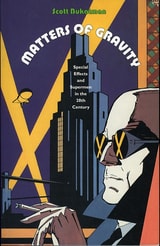
cover of Matters of Gravity: Special Effects and Supermen in the 20th Century

Matters of Gravity

Special Effects and Supermen in the 20th Century

Scott Bukatman

Duke University Press, 2003

The headlong rush, the rapid montage, the soaring superhero, the plunging roller coaster—Matters of Gravity focuses on the experience of technological spectacle in American popular culture over the past century. In these essays, leading media and cultural theorist Scott Bukatman reveals how popular culture tames the threats posed by technology and urban modernity by immersing people in delirious kinetic environments like those traversed by Plastic Man, Superman, and the careening astronauts of 2001: A Space Odyssey and The Right Stuff. He argues that as advanced technologies have proliferated, popular culture has turned the attendant fear of instability into the thrill of topsy-turvydom, often by presenting images and experiences of weightless escape from controlled space.

Considering theme parks, cyberspace, cinematic special effects, superhero comics, and musical films, Matters of Gravity highlights phenomena that make technology spectacular, permit unfettered flights of fantasy, and free us momentarily from the weight of gravity and history, of past and present. Bukatman delves into the dynamic ways pop culture imagines that apotheosis of modernity: the urban metropolis. He points to two genres, musical films and superhero comics, that turn the city into a unique site of transformative power. Leaping in single bounds from lively descriptions to sharp theoretical insights, Matters of Gravity is a deft, exhilarating celebration of the liberatory effects of popular culture.
[more]
cover of Metaphysical Media: The Occult Experience in Popular Culture

Metaphysical Media

The Occult Experience in Popular Culture

Emily D. Edwards

Southern Illinois University Press, 2005

Considered sinister by Western religious traditions and bizarre in mainstream America, supernatural beliefs and the rituals of occult traditions are often publicly disparaged. But they are paradoxically embraced and exposed by popular culture, in television shows such as Bewitched and in movies from The Wizard of Oz to The Craft, according to Emily D. Edwards. Metaphysical Media: The Occult Experience in Popular Culture is an in-depth discussion of the media’ s presentation of a wide spectrum of the occult that also serves as a comprehensive sourcebook of movies and television programs that deal with supernatural characters and themes. 


Metaphysical Media focuses on the blurred definitions of topics associated with the occult as they are presented in popular culture to show moving-image media as devices that help structure an understanding of the supernatural world. Edwards examines what media treatment of supernatural subjects and the very characteristics of the media themselves reveal about the persistence of the occult. She maintains that popular art has always had a close association with the paranormal or supernatural— sometimes in illustration of an ideology, sometimes in ridicule of it, and sometimes as invocation itself.

Beginning with an overview of the role of the media in contemporary society and in its use of the occult, Metaphysical Media looks at the properties of media technology that extend human senses beyond biological boundaries. Edwards then discusses specific media treatment of topics related to the occult, including witchcraft, atavism, reincarnation, out-of-body experiences, and lycanthropy. She outlines the interplay of media and folklore regarding taboos about the handling of the dead and investigates media stories about creatures that cross the boundaries between human, beast, and god. 
[more]
cover of Mob Culture: Hidden Histories of the American Gangster Film

Mob Culture

Hidden Histories of the American Gangster Film

Grieveson, Lee

Rutgers University Press, 2005

Sinister, swaggering, yet often sympathetic, the figure of the gangster has stolen and murdered its way into the hearts of American cinema audiences. Despite the enduring popularity of the gangster film, however, traditional criticism has focused almost entirely on a few canonical movies such as Little Caesar, Public Enemy, and The Godfather trilogy, resulting in a limited and distorted understanding of this diverse and changing genre.

Mob Culture offers a long-awaited, fresh look at the American gangster film, exposing its hidden histories from the Black Hand gangs of the early twentieth century to The Sopranos. Departing from traditional approaches that have typically focused on the "nature" of the gangster, the editors have collected essays that engage the larger question of how the meaning of criminality has changed over time. Grouped into three thematic sections, the essays examine gangster films through the lens of social, gender, and racial/ethnic issues.

Destined to become a classroom favorite, Mob Culture is an indispensable reference for future work in the genre.

[more]
cover of Movie Migrations: Transnational Genre Flows and South Korean Cinema

Movie Migrations

Transnational Genre Flows and South Korean Cinema

Hye Seung Chung and David Scott Diffrient

Rutgers University Press, 2015
As the two billion YouTube views for “Gangnam Style” would indicate, South Korean popular culture has begun to enjoy new prominence on the global stage. Yet, as this timely new study reveals, the nation’s film industry has long been a hub for transnational exchange, producing movies that put a unique spin on familiar genres, while influencing world cinema from Hollywood to Bollywood. 
 
Movie Migrations is not only an introduction to one of the world’s most vibrant national cinemas, but also a provocative call to reimagine the very concepts of “national cinemas” and “film genre.” Challenging traditional critical assumptions that place Hollywood at the center of genre production, Hye Seung Chung and David Scott Diffrient bring South Korean cinema to the forefront of recent and ongoing debates about globalization and transnationalism. In each chapter they track a different way that South Korean filmmakers have adapted material from foreign sources, resulting in everything from the Manchurian Western to The Host’s reinvention of the Godzilla mythos. 
 
Spanning a wide range of genres, the book introduces readers to classics from the 1950s and 1960s Golden Age of South Korean cinema, while offering fresh perspectives on recent favorites like Oldboy and Thirst. Perfect not only for fans of Korean film, but for anyone curious about media in an era of globalization, Movie Migrations will give readers a new appreciation for the creative act of cross-cultural adaptation. 
 

[more]
cover of Movies & Mass Culture

Movies & Mass Culture

Belton, John

Rutgers University Press, 1995
Movies and Mass Culture looks at the ways in which American identity shapes and is shaped by motion pictures. Movies serve not only as texts that document who we think we are or were, but they also reflect changes in our self-image, tracing the transformation from one kind of America to another. They assist audiences in negotiating major changes in identity, carrying them across difficult periods of cultural transition so that a more or less coherent national identity again emerges. Films thus help their viewers to span the gaps and fissures that cultural changes cause, allowing passage over any disjointedness that in some way might disrupt our sense of what we believe in as a nation. This volume examines this process, illustrating the ways in which films aided America's transition from an agrarian to an industrial economy; from a nation of producers to one of consumers; and from a community of individuals to a mass society.
[more]
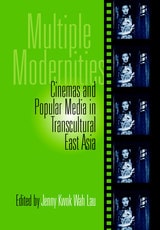
cover of Multiple Modernities: Cinemas & Popular Media In Transcultural East Asia

Multiple Modernities

Cinemas & Popular Media In Transcultural East Asia

Jenny Lau

Temple University Press, 2002

Multiple Modernities explores the cultural terrain of East Asia. Arguing that becoming modern happens differently in different places, the contributors examines popular culture—most notable cinema and television—to see how modernization, as both a response to the West and as a process that is unique in its own right in the region, operates on a mass level.Included in this collection are significant explorations of popular culture in East Asia, including Chinese new cinema and rock music, Korean cinema, Taiwanese television, as well as discussions of alternative arts in general.While each essay focuses on specific nations or cinemas, the collected effect of reading them is to offer a comprehensive, in-depth picture of how popular culture in East Asia operates to both generate and reflect the immense change this significant region of the world is undergoing.
[more]