Results by title
193 books match the query 'Empire' and 8 start with m
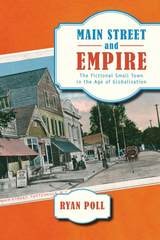
Main Street and Empire
The Fictional Small Town in the Age of GlobalizationPoll, Ryan
Rutgers University Press, 2012
In Main Street and Empire, Ryan Poll addresses this need, arguing that the small town, as evoked by the image of “Main Street,” is not a relic of the past but rather a metaphorical screen upon which America’s “everyday” stories and subjects are projected on both a national and global scale.
Bringing together a broad selection of texts—from Thornton Wilder’s Our Town, Grace Metalious’s Peyton Place, and Peter Weir’s The Truman Show to the speeches of William McKinley, Ronald Reagan, Sarah Palin, and Barack Obama—Poll examines how the small town is used to imagine and reproduce the nation throughout the twentieth- and into the twenty-first century. He contends that the dominant small town, despite its innocent, nostalgic appearance, is central to the development of the U.S. empire and global capitalism.
Manifest Perdition
Shipwreck Narrative And The Disruption Of EmpireJosiah Blackmore
University of Minnesota Press, 2002
A new take on a famous collection of shipwreck narratives that places them at the center of resistance to colonialism
Shipwreck, death, and survival; terror, hunger, and salvation—these are the experiences of the passengers onboard merchant Portuguese ships sailing the high seas in the sixteenth and seventeenth centuries. And this is the stuff of the stories committed to print by survivors upon their return to the homeland. These Portuguese shipwreck narratives, rescued for all time in the eighteenth century by Bernardo Gomes de Brito in História Trágico-Marítima (1735-36), or The Tragic History of the Sea, are the subject of Manifest Perdition, a work that reveals their important—and until now, largely ignored—place in literary history.
In this book we see how the dramatic, compelling, and often gory accounts of shipwreck, depicting a world out of control, challenge state-sponsored versions of events in the prevailing historiographic culture. Written during the heyday of Iberian maritime expansion and colonialism, the shipwreck narrative builds an alternative historical record to the vision and reality of empire elaborated by the official chroniclers of the realm. Manifest Perdition presents both theoretical considerations this genre and close readings of several texts, readings that disclose a poetics of the shipwreck text, of how survivors characteristically yet multifariously narrated their world. Included is a study of the medieval Iberian poetic predecessors of the shipwreck tale, as well as an exploration of the Portuguese Inquisition’s attempt to commandeer and steer the reading of the unruly narratives. The book engages issues of literary theory, historiography, and colonialism to portray the Portuguese shipwreck narrative for the first time as both a product of and a resistance to the prolific culture of sixteenth- and seventeenth-century expansionist history.
Manifest Technique
Hip Hop, Empire, and Visionary Filipino American CultureMark R. Villegas
University of Illinois Press, 2021
Filipino Americans have been innovators and collaborators in hip hop since the culture’s early days. But despite the success of artists like Apl.de.Ap of the Black Eyed Peas and superstar producer Chad Hugo, the genre’s significance in Filipino American communities is often overlooked. Mark R. Villegas considers sprawling coast-to-coast hip hop networks to reveal how Filipino Americans have used music, dance, and visual art to create their worlds. Filipino Americans have been exploring their racial position in the world in embracing hip hop’s connections to memories of colonial and racial violence. Villegas scrutinizes practitioners’ language of defiance, placing the cultural grammar of hip hop within a larger legacy of decolonization.
An important investigation of hip hop as a movement of racial consciousness, Manifest Technique shows how the genre has inspired Filipino Americans to envision and enact new ideas of their bodies, their history, and their dignity.
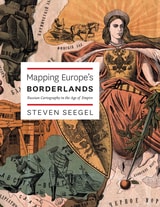
Mapping Europe's Borderlands
Russian Cartography in the Age of EmpireSteven Seegel
University of Chicago Press, 2012
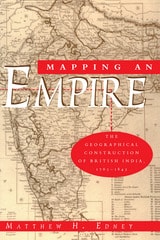
Mapping an Empire
The Geographical Construction of British India, 1765-1843Matthew H. Edney
University of Chicago Press, 1997
"There is much to be praised in this book. It is an excellent history of how India came to be painted red in the nineteenth century. But more importantly, Mapping an Empire sets a new standard for books that examine a fundamental problem in the history of European imperialism."—D. Graham Burnett, Times Literary Supplement
"Mapping an Empire is undoubtedly a major contribution to the rapidly growing literature on science and empire, and a work which deserves to stimulate a great deal of fresh thinking and informed research."—David Arnold, Journal of Imperial and Commonwealth History
"This case study offers broadly applicable insights into the relationship between ideology, technology and politics. . . . Carefully read, this is a tale of irony about wishful thinking and the limits of knowledge."—Publishers Weekly
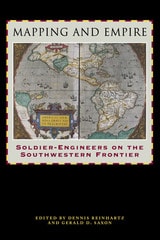
Mapping and Empire
Soldier-Engineers on the Southwestern FrontierEdited by Dennis Reinhartz and Gerald D. Saxon
University of Texas Press, 2005
From the sixteenth through the mid-nineteenth centuries, Spain, then Mexico, and finally the United States took ownership of the land from the Gulf Coast of Texas and Mexico to the Pacific Coast of Alta and Baja California—today's American Southwest. Each country faced the challenge of holding on to territory that was poorly known and sparsely settled, and each responded by sending out military mapping expeditions to set boundaries and chart topographical features. All three countries recognized that turning terra incognita into clearly delineated political units was a key step in empire building, as vital to their national interest as the activities of the missionaries, civilian officials, settlers, and adventurers who followed in the footsteps of the soldier-engineers.
With essays by eight leading historians, this book offers the most current and comprehensive overview of the processes by which Spanish, Mexican, and U.S. soldier-engineers mapped the southwestern frontier, as well as the local and even geopolitical consequences of their mapping. Three essays focus on Spanish efforts to map the Gulf and Pacific Coasts, to chart the inland Southwest, and to define and defend its boundaries against English, French, Russian, and American incursions. Subsequent essays investigate the role that mapping played both in Mexico's attempts to maintain control of its northern territory and in the United States' push to expand its political boundary to the Pacific Ocean. The concluding essay draws connections between mapping in the Southwest and the geopolitical history of the Americas and Europe.
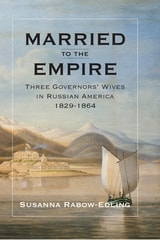
Married to the Empire
Three Governors' Wives in Russian America 1829-1864Susanna Rabow-Edling
University of Alaska Press, 2015
Elisabeth von Wrangell, Margaretha Etholén, and Anna Furuhjelm were three of eight governors' wives who took up this domestic mantle. Married to the Empire tells their stories using their own words and though extraordinary research by Susanna Rabow-Edling. All three were young and newly wed when they left Russia for the furthest outpost of the empire, and all three went through personal and cultural struggles as they worked to adjust to life in the colony. Their trials offer a little-heard female history of Russian Alaska, while illuminating the issues that arose while trying to reconcile expectations of womanhood with the realities of frontier life.
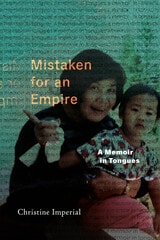
Mistaken for an Empire
A Memoir in TonguesChristine Imperial
The Ohio State University Press, 2023