Results by title
434 books match the query 'Ethics & Moral Philosophy' and 26 start with m
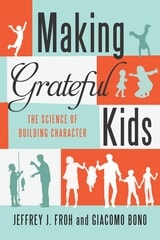
Making Grateful Kids
The Science of Building CharacterJeffrey Froh
Templeton Press, 2014
If there was a new wonder drug on the market that got kids to behave better, improve their grades, feel happier, and avoid risky behaviors, many parents around the world would be willing to empty their bank accounts to acquire it. Amazingly, such a product actually does exist. It’s not regulated by the FDA, it has no ill side-effects, and it’s absolutely free and available to anyone at any time. This miracle cure is gratitude.
Over the past decade, science has shown that gratitude is one of the most valuable and important emotions we possess, and it is a virtue that anyone can cultivate. In fact, researchers have developed many different methods people can use to foster an attitude of gratitude, and the science shows that many of them really work.
In Making Grateful Kids, two of the leading authorities on gratitude among young people, Jeffrey J. Froh and Giacomo Bono, introduce their latest and most compelling research, announce groundbreaking findings, and share real-life stories from adults and youth to show parents, teachers, mentors, and kids themselves how to achieve greater life satisfaction through gratitude. Most importantly perhaps, they expand on this groundbreaking research to offer practical and effective common-sense plans that can be used in day-to-day interactions between kids and adults to enhance success and wellbeing.
Their unique, scientifically-based approach for producing grateful youth works whether these kids are very young elementary school students or troubled teenagers. Not only does the purposeful practice of gratitude increase their happiness, but the research indicates that grateful kids also report more self-discipline, fulfilling relationships, and engagement with their schools and communities when compared to their less grateful counterparts. After reading Making Grateful Kids, parents, teachers, and anyone who works with youth will be able to connect more meaningfully with kids so that all parties can focus on the things that matter most and, in turn, create a more cooperative and thriving society.

Martin Heidegger
George Steiner
University of Chicago Press, 1987
Acquaintance with the work of Martin Heidegger is indispensable to an understanding of contemporary thought and culture. His work has had a profound influence on a number of disciplines, including theology, Sartrean existentialism, linguistics, Hellenic studies, the structuralist and hermeneutic schools of textual interpretation, literary theory, and literature itself. With characterisitc lucidity and style, George Steiner makes this philosopher’s immensely difficult body of work accessible to the general reader. The breadth of Steiner’s learning and interests also allows him to place Heidegger in a broader Continental literary-cultural context. In a new Introduction, Steiner addresses language and philosophy and the rise of Nazism
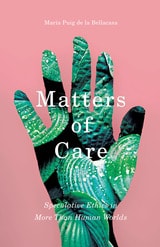
Matters of Care
Speculative Ethics in More than Human WorldsMaría Puig de la Bellacasa
University of Minnesota Press, 2017
To care can feel good, or it can feel bad. It can do good, it can oppress. But what is care? A moral obligation? A burden? A joy? Is it only human? In Matters of Care, María Puig de la Bellacasa presents a powerful challenge to conventional notions of care, exploring its significance as an ethical and political obligation for thinking in the more than human worlds of technoscience and naturecultures.
Matters of Care contests the view that care is something only humans do, and argues for extending to non-humans the consideration of agencies and communities that make the living web of care by considering how care circulates in the natural world. The first of the book’s two parts, “Knowledge Politics,” defines the motivations for expanding the ethico-political meanings of care, focusing on discussions in science and technology that engage with sociotechnical assemblages and objects as lively, politically charged “things.” The second part, “Speculative Ethics in Antiecological Times,” considers everyday ecologies of sustaining and perpetuating life for their potential to transform our entrenched relations to natural worlds as “resources.”
From the ethics and politics of care to experiential research on care to feminist science and technology studies, Matters of Care is a singular contribution to an emerging interdisciplinary debate that expands agency beyond the human to ask how our understandings of care must shift if we broaden the world.
Meaning, Decision, and Norms
Themes from the Work of Allan GibbardEds. Billy Dunaway and David Plunkett
Michigan Publishing Services, 2021
This volume is not a collection of artifacts from past decades of philosophy. Instead, it is a collection of essays that each make a significant contribution to contemporary work in philosophy. This reflects the fact that Gibbard’s work has not only had a massive influence on past discussion in philosophy but also continues to influence new directions of philosophical research.
With contributions from:
Sara Aronowitz, Simon Blackburn, Paul Boghossian, David Braddon-Mitchell, Nate Charlow, Stephen Darwall, Jamie Dreier, Billy Dunaway, Melissa Fusco, Sona Ghosh, Allan Gibbard, Bill Harper, Paul Horwich, Zoë Johnson King, Tristram McPherson, Howard Nye, Lauren Olin, Caleb Perl, David Plunkett, Peter Railton, Connie Rosati, Mark Schroeder, Alex Silk, Daniel J. Singer, Brian Skyrms, and Seth Yalcin.
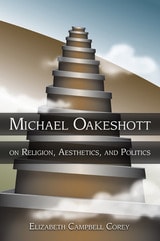
Michael Oakeshott on Religion, Aesthetics, and Politics
Elizabeth Campbell Corey
University of Missouri Press, 2006
For much of his career, British political philosopher Michael Oakeshott was identified with Margaret Thatcher’s conservative policies. He has been called by some a guru to the Tories, while others have considered him one of the last proponents of British Idealism. Best known for such books as Experience and Its Modes and Rationalism in Politics, Oakeshott has been the subject of numerous studies, but always with an emphasis on his political thought.
Gnosticism and considers both thinkers’ treatment of Hobbes to delineate their philosophical differences.

Minimal Ethics for the Anthropocene
Joanna Zylinska
Michigan Publishing Services, 2014

Modern Jewish Ethics since 1970
Writings on Methods, Sources, and IssuesEdited by Jonathan K. Crane, Emily A. Filler, and Mira Beth Wasserman
Brandeis University Press, 2025
These deliberate juxtapositions are to encourage scholars and students to develop similar meta-ethical analyses on Jewish ethics, broadly construed. Jewish ethics is not just a set of propositions or principles; nor can it be reduced to a single trajectory of thought or abstracted as an elaborate system of ideas. Jewish ethics is the field of study that engages Jewish texts, ideas, history, and experience in conversations about values and virtues, justice and good judgment, human relations and responsibilities. This volume presents some of those conversations to spark many more.
Monad and Thou
Phenomenological Ontology Of Human BeingHiroshi Kojima
Ohio University Press, 2000
The genesis for this volume was in the bombing of Japan during World War II, where the author, as a young boy, watched the bombers overhead, speculating about the lives of the pilots and their relationship with those huddled on the ground.
From this disturbing diorama, Professor Hiroshi Kojima, the translator of Martin Buber into Japanese, unfolds a new approach to Buber’s “I-Thou” relation, drawing upon insights from Husserl, Heidegger, and others in the tradition of continental philosophy to extend and deepen Buber’s thought.
In chapters that reflect upon a wide range of phenomena—from religion, science, and technology, to imagination, embodiment, and power—Professor Kojima articulates a conception of what it means to be a human being that stands as an alternative to atomism and alienation of the modern world. Analyses of haiku and other aspects of Japanese culture demonstrate how Kojima’s theory can illuminate the spiritual traditions of both East and West.
Original in its thought and revealing in its insight into Japanese thought and culture, Monad and Thou represents the life’s work of one of Japan’s great thinkers.
Money For Change
Social Movement Philanthropy at the Haymarket People's FundSusan A. Ostrander
Temple University Press, 1997
Within this fascinating behind-the-scenes account, Ostrander argues that the "social relations of philanthropy" are more important and more varied than previously understood. Written at a time when Haymarket was dealing with crisis, this book tells a story of organizational change as the Fund moved from an informal collective to a more formal structure; it is also the story of a struggle to build a multi-race, multi-class, gender-equal organization. Ostrander details these ongoing struggles and addresses the larger issue of how fundraising can itself be a kind of social movement organizing among the progressive people with wealth who continue to be Haymarket's main donors.
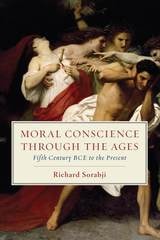
Moral Conscience through the Ages
Fifth Century BCE to the PresentRichard Sorabji
University of Chicago Press, 2014
Sorabji examines an impressive breadth of topics: the longing for different kinds of freedom of conscience, the proper limits of freedom itself, protests at conscience’s being ‘terrorized,’ dilemmas of conscience, the value of conscience to human beings, its secularization, its reliability, and ways to improve it. These historical issues are alive today, with fresh concerns about topics such as conscientious objection, the force of conscience, or the balance between freedoms of conscience, religion, and speech. The result is a stunningly comprehensive look at a central component of our moral understanding.
Moral Imagination
Implications of Cognitive Science for EthicsMark Johnson
University of Chicago Press, 1993
Expanding his innovative studies of human reason in Metaphors We Live By and The Body in the Mind, Johnson provides the tools for more practical, realistic, and constructive moral reflection.

Moral Philosophy Of Moore
Robert Peter Sylvester, edited by Ray Perkins, Jr. and R. W. Sleeper, foreword by Tom Regan
Temple University Press, 1990
This study of G. E. Moore’s work in moral philosophy draws upon a close examination of the early essays that preceded the writing of Principia Ethica in order to ground the author’s view that Moore’s famous "naturalistic fallacy argument" of Principia has been widely misunderstood. At the time of his death in 1986, Robert Peter Sylvester was in the process of preparing this book for publication. That process has been brought to completion by Ray Perkins, Jr., and R. W. Sleeper. Sylvester’s reappraisal of the moral philosophy of G. E. Moore argues that criticism of the work of this major twentieth-century British philosopher has been based on misinterpretation of his unified position. He treats Moore’s ideas about "What is Good?", "What things are Good?" and "What ought we to do?" as forming a coherent system.
To bring this work up to date since the author’s death, the editors have provided a bibliographic essay following each chapter in which recent scholarship is discussed.

Moral Principles
John Dewey. Preface by Sidney Hook
Southern Illinois University Press, 1975
Moral Problems in Higher Education
Steven Cahn
Temple University Press, 2011
Moral Problems in Higher Education brings together key essays that explore ethical issues in academia. The editor and contributors-all noted philosophers and educators-consider such topics as academic freedom and tenure, free speech on campus, sexual harassment, preferential student admissions, affirmative action in faculty appointments, and the ideal of a politically neutral university. Chapters address possible restrictions on research because of moral concerns, the structure of peer review, telling the truth to colleagues and students, and concerns raised by intercollegiate athletics.
Cahn selects two key readings in each area to offer a readable introductory guide to these critical subjects for students studying academic ethics and higher education policy. In addition to the selections and a general introduction, Cahn provides study questions for use in the classroom.
Contributors include Scott F. Aikin, Derek Bok, William G. Bowen, Myles Brand, Richard T. DeGeorge, Paul D. Eisenberg, Leslie Pickering Francis, Martin P. Golding, Philip Kitcher, Charles R. Lawrence III, David Lewis, Paul J. Olscamp, Nancy Tuana, David Shatz, George Sher, Robert L. Simon, Robert B. Talisse, Stephan Thernstrom, Abigail Thernstrom, Laurence Thomas, Robert Paul Wolff, and the editor.
Moral Responsibility and Persons
Eugene Schlossberger
Temple University Press, 1992
Challenging traditional philosophical views of moral responsibility, Eugene Schlossberger argues that we are responsible not so much for what we do as for who we are. He explores what it means to be a person, concluding that personhood is the sum of beliefs and values—which are by no means entirely within our control. Consequently, the voluntariness of our acts—or even whether we act at all—is irrelevant to the moral evaluation of us as persons. Schlossberger contends that we are to be judged morally on the basis of what we are, our "world-view," rather than what we do.
In Moral Responsibility and Persons Schlossberger disputes various received philosophical positions. His challenging and entertaining account also examines psychology and its view of the nature of personhood, as well as insanity and the "personality" of animals, children, and computers. He explores the validity of emotions we may feel in response to others—especially gratitude and resentment. And finally, Schlossberger tackles the inevitable implications of his position in the area of crime and punishment.
Moral Responsibility and the Boundaries of Community
Power and Accountability from a Pragmatic Point of ViewMarion Smiley
University of Chicago Press, 1992
In an argument both compelling and provocative, Marion Smiley demonstrates how attributions of blame—far from being based on an objective process of factual discovery—are instead judgments that we ourselves make on the basis of our own political and social points of view. She argues that our conception of responsibility is a singularly modern one that locates the source of blameworthiness in an individual's free will. After exploring the flaws inherent in this conception, she shows how our judgments of blame evolve out of our configuration of social roles, our conception of communal boundaries, and the distribution of power upon which both are based.
The great strength of Smiley's study lies in the way in which it brings together both rigorous philosophical analysis and an appreciation of the dynamics of social and political practice. By developing a pragmatic conception of moral responsibility, this work illustrates both how moral philosophy can enhance our understanding of social and political practices and why reflection on these practices is necessary to the reconstruction of our moral concepts.
Moral Spaces
Rethinking Ethics And World PoliticsDavid Campbell
University of Minnesota Press, 1999

Morality by Design
Technology's Challenge to Human ValuesWade Rowland
Intellect Books, 2019
In guiding the reader through Enlightenment-era rationalist thought as it pertained to human nature and the foundations of morality, Rowland provides a coherent, intellectually sound, and intuitively appealing alternative to the nihilistic views popularized by contemporary radical relativism. Morality by Design ultimately seeks to convince readers that there is such a thing as moral fact, and that they do indeed have what it takes to make robust and durable moral judgments.
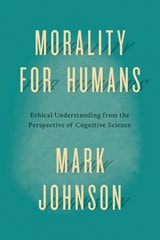
Morality for Humans
Ethical Understanding from the Perspective of Cognitive ScienceMark Johnson
University of Chicago Press, 2014
Ethical naturalism is not just a revamped form of relativism. Indeed, Johnson attempts to overcome the absolutist-versus-relativist impasse that has been one of the most intractable problems in the history of philosophy. He does so through a careful and inclusive look at the many ways we reason about right and wrong. Much of our moral thought, he shows, is automatic and intuitive, gut feelings that we follow up and attempt to justify with rational analysis and argument. However, good moral deliberation is not limited merely to intuitive judgments supported after the fact by reasoning. Johnson points out a crucial third element: we imagine how our decisions will play out, how we or the world would change with each action we might take. Plumbing this imaginative dimension of moral reasoning, he provides a psychologically sophisticated view of moral problem solving, one perfectly suited for the embodied, culturally embedded, and ever-developing human creatures that we are.
Morality within the Limits of Reason
Russell Hardin
University of Chicago Press, 1988
Morality, Responsibility, and the University
Studies in Academic Ethicsedited by Steven M. Cahn
Temple University Press, 1992
Moralizing Technology
Understanding and Designing the Morality of ThingsPeter-Paul Verbeek
University of Chicago Press, 2011
Morals, Reason, and Animals
S. Sapontzis
Temple University Press, 1992

Mortality and Morality
A Search for Good After AuschwitzHans Jonas
Northwestern University Press, 1996

My Father's House
On Will Barnet's PaintingThomas Dumm
Duke University Press, 2014
Dumm first became acquainted with Barnet and his paintings in 2008. Given his scholarly focus on the lives of ordinary people, he was immediately attracted to the artist's work. When they met, Dumm and Barnet began a friendship and dialogue that lasted until the painter's death in 2012, at the age of 101. This book reflects the many discussions the two had concerning the series of paintings, Barnet's family, his early life in Beverly, and his eighty-year career as a prominent New York artist. Reading the almost gothic paintings in conversation with the writers and thinkers key to both his and Barnet's thinking—Emerson, Spinoza, Dickinson, Benjamin, Cavell, Nietzsche, Melville—Dumm's haunting meditations evoke broader reflections on family, mortality, the uncanny, and the loss that comes with remembrance.
My Many Selves
The Quest for a Plausible HarmonyWayne C. Booth
Utah State University Press, 2006
His memoir, My Many Selves, is both an incisive self-examination and a creative approach to retelling his life. Writing his autobiography became a quest to harmonize the diverse, discordant parts of his identity and resolve the conflicts in what he thought and believed. To see himself clearly and whole, he broke his self down, personified the fragments, uncovered their roots in his life, and engaged his multiple identities and experiences in dialogue. Basic to his story and to its lifelong concerns with ethics and rhetoric was his youth in rural Utah. He valued that background, while acknowledging its ambiguous influence on him, and continued to identify himself as Mormon, though he renounced most Latter-day Saint doctrines.
Wayne Booth died in October 2005, soon after completing work on his autobiography.