Results by title
316 books match the query 'Ethnomusicology' and 48 start with m
Macau and Catholic Sacred Music Across the Sino-Western Divide
Jen-yen Chen
University of Michigan Press, 2026
Drawing from sound studies and musicological methods, Chen argues that Chinese descriptions of Catholic sounds in Macau, including the ringing of church bells, the playing of the organ, and choral singing, illuminate spatial, sonic, and ideological mobilities that reconfigure Chinese and European identities. Macau and Catholic Music Across the Sino-Western Divide also extends to contemporary times to explore how present day members of Macau’s Catholic community position themselves in relation to the historical narratives often told about their city, cultivating a rich individuality of identity that refuses conformity to fixed notions of Asianness or Westernness.
Making It Up Together
The Art of Collective Improvisation in Balinese Music and BeyondLeslie A. Tilley
University of Chicago Press, 2019
Through two contrasting Balinese case studies—of the reyong gong chime’s melodic norot practice and the interlocking drumming tradition kendang arja—Tilley proposes and tests analytical frameworks for examining collectively improvised performance. At the micro-level, Tilley’s analyses offer insight into the note-by-note decisions of improvising performers; at the macro-level, they illuminate larger musical, discursive, structural, and cultural factors shaping those decisions. This multi-tiered inquiry reveals that unpacking how performers play and imagine as a collective is crucial to understanding improvisation and demonstrates how music analysis can elucidate these complex musical and interactional relationships.
Highlighting connections with diverse genres from various music cultures, Tilley’s examinations of collective improvisation also suggest rich potential for cross-genre exploration. The surrounding discussions point to larger theories of communication and interaction, creativity and cognition that will be of interest to a range of readers—from ethnomusicologists and music theorists to cognitive psychologists, jazz studies scholars, and improvising performers. Setting new parameters for the study of improvisation, Making It Up Together opens up fresh possibilities for understanding the creative process, in music and beyond.
Making Mexican Rock
Censorship, Journalism, and Popular Music after AvándaroAndrew J. Green
Vanderbilt University Press, 2024
Yet in light of the failures of successive democratically elected governments in Mexico, these histories are worth critically revisiting and updating. What stories about music censorship can be told after Mexico’s transition to multi-party democracy? Placing history and ethnography into dialogue, Making Mexican Rock explores historical and recent experiences of censorship and repression against popular music, focusing on the independent rock scene (or “escena independiente”) in Mexico City.
Informed by the so-called new censorship theory, ethnomusicologist Andrew J. Green challenges historical accounts that equate acts of censorship with state activity. The open-ended account of censorship assumed here helps us to understand, instead, how conceptions of censorship and expressive freedom transformed toward the end of single-party rule; how practices of policing live rock adapted to neoliberal securitization; and how histories of rock censorship have been invoked by those seeking to construct and protect emergent music scenes. Making Mexican Rock thus both decenters histories of music censorship from the state, and extends them into the country’s recent history.
Making Music Indigenous
Popular Music in the Peruvian AndesJoshua Tucker
University of Chicago Press, 2019
Making Value
Music, Capital, and the SocialTimothy D. Taylor
Duke University Press, 2024
Mande Music
Traditional and Modern Music of the Maninka and Mandinka of Western AfricaEric Charry
University of Chicago Press, 2000

Masters of Contemporary Brazilian Song
MPB, 1965-1985By Charles A. Perrone
University of Texas Press, 1993
Masters of Contemporary Brazilian Song is a critical study of MPB (música popular brasileira), a term that refers to varieties of urban popular music of the 1960s and 1970s, incorporating samba, Bossa Nova, and new materials.
Masters of the Sabar
Wolof Griot Percussionists of SenegalPatricia Tang
Temple University Press, 2006
Maya Achi Marimba Music In Guatemala
Sergio Navarrete Pellicer
Temple University Press, 2005
Mbira's Restless Dance
An Archive of ImprovisationPaul F. Berliner and Cosmas Magaya
University of Chicago Press, 2020
Mbira’s Restless Dance is written to be played. This two-volume, spiral-bound set features musical transcriptions of thirty-nine compositions and variations, annotated with the master player’s advice on technique and performance, his notes and observations, and commentary by Berliner. Enhanced with extensive website audiovisuals, Mbira’s Restless Dance is in effect a series of masterclasses with Magaya, suitable for experienced mbira players and those learning the fundamentals.
Together with Berliner's The Art of Mbira, in which he provides an indispensable historical and cultural guide to mbira in a changing world, Mbira's Restless Dance breaks new ground in the depth and specificity of its exploration of an African musical tradition, and in the entwining of the authors’ collaborative voices. It is a testament to the powerful relationship between music and social life—and the rewards of lifelong musical study, performance, and friendship.
Men and Popular Music in Algeria
The Social Significance of RaïBy Marc Schade-Poulsen
University of Texas Press, 1999
Raï music is often called the voice of the voiceless in Algeria, a society currently swept by tragic conflict. Raï is the voice of Algerian men, young men caught between generations and classes, in political strife, and in economic inequality. In a ground-breaking study, anthropologist Marc Schade-Poulsen uses this popular music genre as a lens through which he views Algerian society, particularly male society. He situates raï within Algerian family life, moral codes, and broader power relations.
Schade-Poulsen did his research in the 1990s, in clubs, recording studios, at weddings, and with street musicians. He describes the history of raï, which emerged in the late 1970s and spread throughout North Africa at the same time the Islamist movement was growing to become the most potent socio-political movement in Algeria.
Outsiders consider raï to be Western in origin, but Schade-Poulsen shows its Islamic roots as well. The musicians do use Western instruments, but the music itself mixes Algerian popular songs and rhythms with the beat of American disco, Egyptian modalities, Moroccan wedding tunes, and the songs of Julio Iglesias. The lyrics deal with male-female relationships but also with generational relationships and the problems of youth, as they struggle to find a place in a conflicted society.
The study, in its innovative approach to music as a template of society, helps the reader understand the two major movements among today's Algerian youth: one toward the mosque and the other toward the West.

Mishearing Home
A Sinophone Poetics of SoundYun Emily Wang
Duke University Press, 2027
Modern Noise, Fluid Genres
Popular Music in Indonesia, 1997–2001Jeremy Wallach
University of Wisconsin Press, 2008
Mongolian Sound Worlds
Edited by Jennifer C. Post, Sunmin Yoon, and Charlotte D'Evelyn
University of Illinois Press, 2022
A merger of expert scholarship and eyewitness experience, Mongolian Sound Worlds illuminates a diverse and ever-changing musical culture.
Contributors: Bayarsaikhan Badamsuren, Otgonbaayar Chuulunbaatar, Andrew Colwell, Johanni Curtet, Charlotte D’Evelyn, Tamir Hargana, Peter K. Marsh, K. Oktyabr, Rebekah Plueckhahn, Jennifer C. Post, D. Tserendavaa, and Sunmin Yoon
More Than Friends
Muslim-Jewish Intimacy in Algerian MusicJonathan Glasser
University of Chicago Press, 2027
Explores the Muslim-Jewish relationship through music in Algeria and its diaspora.
Today, more than six decades after the departure of Jews from Algeria to France at the moment of decolonization, music remains a compelling site for remembering Muslim-Jewish intimacy before the moment of rupture. In this way, music works against dominant discourses of Muslim-Jewish conflict and Jewish outsider status, instead presenting music as a sign of Muslim-Jewish brotherhood and of Jewish rootedness in North Africa. Yet digging deeper into the lived past and its relation to contemporary memory uncovers the fragility of brotherhood as well as competing ways to read Muslim-Jewish intimacy around music, some of which edge into rivalry, hierarchy, and difference. In More than Friends, Jonathan Glasser draws on historical archives and ethnographic research in Algeria and in France to weigh these multiple interpretations of the Muslim-Jewish past, ultimately offering an alternative, more resilient way of imagining what it means to be intimate through music.
Moving Away from Silence
Music of the Peruvian Altiplano and the Experience of Urban MigrationThomas Turino
University of Chicago Press, 1993
Turino's ethnography is the first large-scale study to concentrate on the pervasive effects of migration on Andean people and their music. Turino uses the musical traditions of Conima, Peru as a unifying thread, tracing them through the varying lives of Conimeos in different locales. He reveals how music both sustains and creates meaning for a people struggling amid the dramatic social upheavals of contemporary Peru.
Moving Away from Silence contains detailed interpretations based on comparative field research of Conimeo musical performance, rehearsals, composition, and festivals in the highlands and Lima. The volume will be of great importance to students of Latin American music and culture as well as ethnomusicological and ethnographic theory and method.
Music Grooves
Essays and DialoguesCharles Keil and Steven Feld
University of Chicago Press, 1994
Music Grooves ranges from jazz, blues, polka, soul, rock, world beat, rap, karaoke, and other familiar genres to major scholarly debates in music theory, ethnomusicology, and popular culture studies. The authors develop and create links between the fields of ethnomusicology and popular culture studies and relate the contents of musics from America, Greece, Cuba, Africa, and Papua New Guinea to artists as diverse as James Brown, Aretha Franklin, L'il Wally Jagiello, Bo Diddley, Walt Solek, Madonna, Paul Simon, Miles Davis, Thelonious Monk, and Billie Holiday.
Keil and Feld offer a fascinating view of the shaping of central ideas and terms in ethnomusicology such as "engendered feeling," "interpretive moves," "participatory discrepancies," "iconicity of style," "people's music," "schizophonia," and "lift-up-over sounding." From Keil's critique of Leonard Meyer's musicological approach to Feld's recent work on world beat, this volume covers an array of vital issues in media studies, musicology and ethnomusicology, popular culture, anthropology, and sociology. It will interest anyone concerned with the nature and meaning of music in the modern world.
Music Making Community
Edited by Tony Perman and Stefan Fiol
University of Illinois Press, 2024
Making music offers enormous possibilities--and faces significant limitations--in its power to generate belonging and advance social justice. Tony Perman and Stefan Fiol edit essays focused on the forms of interplay between music-making and community-making as mutually creative processes. Contributors in the first section look at cases where music arrived in settings with little or no sense of community and formed social bonds that lasted beyond its departure. In the sections that follow, the essayists turn to stable communities that used musical forms to address social needs and both forged new social groups and, in some cases, splintered established communities. By centering the value of difference in productive feedback dynamics of music and community while asserting the need for mutual moral indebtedness, they foreground music’s potential to transform community for the better.
Contributors: Stephen Blum, Joanna Bosse, Sylvia Bruinders, Donna A. Buchanan, Rick Deja, Veit Erlmann, Stefan Fiol, Eduardo Herrera, David A. McDonald, Tony Perman, Thomas Solomon, and Ioannis Tsekouras
Music Scenes
Local, Translocal, and VirtualAndy Bennett
Vanderbilt University Press, 2004
Music Talent & Performance
Conservatory Cultural SystemHenry Kingsbury
Temple University Press, 2001
Author Henry Kingbury, a conservatory-trained pianist and music educator turned anthropologist forgoes the traditional ethnomusicologist approach of looking at a non-Western musical culture to focus on the "field" of an American conservatory. The result is a penetrating look at the distinction between teaching music and the nurturing of musicality. Kingsbury offers an innovative anthropological analysis of the western notion of "talent" and its cultural character, noting that many non-western societies have no such concept. Furthermore, he examines various contexts in which music is produced, experienced, and evaluated. His discussion includes the dynamics of orchestra rehearsals in the conservatory, "master class" lessons with a distinguished performer-pedagogue, the ritual characteristics of solo recitals, and an interpretive analysis of stage fright.
Ultimately, Kingsbury argues that music "is highly shifting and indeterminate in meaning," a concept that has important implications for all interpreters of culture and for the artists themselves.
Music and Conflict
Edited by John Morgan O'Connell and Salwa El-Shawan Castello-Branco
University of Illinois Press, 2010
Music and Cultural Rights
Edited by Andrew N. Weintraub and Bell Yung
University of Illinois Press, 2009
Contributors are Nimrod Baranovitch, Adriana Helbig, Javier F. Leon, Ana María Ochoa, Silvia Ramos, Helen Rees, Felicia Sandler, Amy Ku'uleialoha Stillman, Ricardo D. Trimillos, Andrew N. Weintraub, and Bell Yung.
Music and Digital Media
A Planetary AnthropologyEdited by Georgina Born
University College London, 2022
Offering a radically new theoretical framework for understanding digital media through music, this volume redresses anthropology’s frequent oversight of music as a topic of study. By positioning music as an expansive subject for digital anthropology, Georgina Born demonstrates how the field can build interdisciplinary links to music and sound studies, digital media studies, and science and technology studies. Music and Digital Media includes five original ethnographies spanning pop, folk, and crossover musical genres throughout Kenya, Argentina, India, Canada, and the UK. A further three chapters engage experimentally with the platforms of music-making and distribution, presenting pioneering ethnographies of an extra-legal peer-to-peer site and the streaming platform Spotify, a series of prominent internet-mediated music genres, and the first ethnography of a global software package, the interactive music platform Max MSP.
Music and Gender
Perspectives from the MediterraneanEdited by Tullia Magrini
University of Chicago Press, 2003
From Spanish flamenco to Algerian raï, Greek rebetika to Turkish pop music, Sephardi and Berber songs to Egyptian belly dancers, the contributors cover an exceedingly wide range of geographic and musical territories. Individual essays examine musical behavior as representation, assertion, and sometimes transgression of gender identities; compare men's and women's roles in specific musical practices and their historical evolution; and explore how music and gender relate to such issues as ethnicity, nationality, and religion. Anyone studying the musics or cultures of the Mediterranean, or more generally the relations between gender and the arts, will welcome this book.
Contributors:
Caroline Bithell, Joaquina Labajo, Jane C. Sugarman, Carol Silverman, Goffredo Plastino, Gail Holst-Warhaft, Edwin Seroussi, Marie Virolle, Terry Brint Joseph, Deborah Kapchan, Karin van Nieuwkerk, Svanibor Pettan, Martin Stokes, Philip V. Bohlman
Music and Genre
New DirectionsGeorgina Born and David Brackett, editors
Duke University Press, 2027
Music and German National Identity
Celia Applegate and Pamela Potter
University of Chicago Press, 2002
This book explores the questions of how music came to be associated with German identity, when and how Germans came to be regarded as the "people of music," and how music came to be designated as "the most German art." Drawing on the expertise of leading scholars in German history, musicology, and German literature, the essays assembled here examine philosophy, literature, politics, and social currents, as well as the creation and performance of folk music, art music, church music, jazz, and pop to explore the ways in which music has continued to play a central role in the German national imagination and in shaping German identity.
Music and Musical Thought in Early India
Lewis Rowell
University of Chicago Press, 1992
In Indian culture, music forms an integral part of a broad framework of ideas that includes philosophy, cosmology, religion, literature, and science. Rowell works with the known theoretical treatises and the oral tradition in an effort to place the technical details of musical practice in their full cultural context. Many quotations from the original Sanskrit appear here in English translation for the first time, and the necessary technical information is presented in terms accessible to the nonspecialist. These features, combined with Rowell's glossary of Sanskrit terms and extensive bibliography, make Music and Musical Thought in Early India an excellent introduction for the general reader and an indispensable reference for ethnomusicologists, historical musicologists, music theorists, and Indologists.
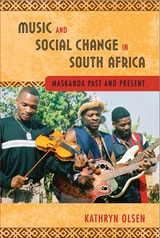
Music and Social Change in South Africa
Maskanda Past and PresentKathryn Olsen
Temple University Press, 2014
Working closely with translated song lyrics and musical notation-and applying musical and socio-political analysis to this music and its cultural context-Olsen argues that maskanda offers insight into how the post-apartheid ideal of social transformation is experienced by those who were marginalized for most of the twentieth century.
Drawing on a decade of research, Olsen strives to demystify the Zulu part of contemporary experience in South Africa and to reveal some of the complexities of the social, economic, and political landscape of contemporary South Africa.
Music and the Making of Portugal and Spain
Nationalism and Identity Politics in the Iberian PeninsulaEdited by Matthew Machin-Autenrieth, Salwa el-Shawan Castelo-Branco, and Samuel Llano
University of Illinois Press, 2023
What does music in Portugal and Spain reveal about the relationship between national and regional identity building? How do various actors use music to advance nationalism? How have state and international heritage regimes contributed to nationalist and regionalist projects? In this collection, contributors explore these and other essential questions from a range of interdisciplinary vantage points. The essays pay particular attention to the role played by the state in deciding what music represents Portuguese or Spanish identity. Case studies examine many aspects of the issue, including local recording networks, so-called national style in popular music, and music’s role in both political protest and heritage regimes. Topics include the ways the Salazar and Franco regimes adapted music to align with their ideological agendas; the twenty-first-century impact of UNESCO’s Intangible Cultural Heritage program on some of Portugal and Spain's expressive practices; and the tensions that arise between institutions and community in creating and recreating meanings and identity around music.
Contributors: Ricardo Andrade, Vera Marques Alves, Salwa El-Shawan Castelo-Branco, Cristina Sánchez-Carretero, José Hugo Pires Castro, Paulo Ferreira de Castro, Fernán del Val, Héctor Fouce, Diego García-Peinazo, Leonor Losa, Josep Martí, Eva Moreda Rodríguez, Pedro Russo Moreira, Cristina Cruces Roldán, and Igor Contreras Zubillaga
Music and the New Global Culture
From the Great Exhibitions to the Jazz AgeHarry Liebersohn
University of Chicago Press, 2019
Music and the Racial Imagination
Edited by Ronald M. Radano and Philip V. Bohlman
University of Chicago Press, 2001
Each essay follows the lead of the substantial introduction, which reviews the history of race in European and American, non-Western and global musics, placing it within the contexts of the colonial experience and the more recent formation of "world music." Offering a bold, new revisionist agenda for musicology in a postmodern, postcolonial world, this book will appeal to students of culture and race across the humanities and social sciences.
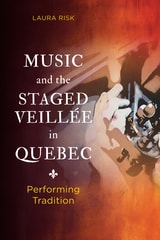
Music and the Staged Veillée in Quebec
Performing TraditionLaura Risk
University of Illinois Press, 2026
Fiddlers, step dancers, storytellers, traditional singers, and folklorists staged Montreal’s first veillée in 1919. All that was missing, announced one of the organizers, was a magic carpet to transport the audience into the countryside and a kiss of forgetfulness to erase the woes of modern life.
Laura Risk tells the story of the veillées and explores how these commercial performances of idealized rural life became part of Quebec’s cultural heritage. Her in-depth examinations of key performances and recordings follow traditional music and dance from the stage onto radio, records and other audio media, and television. Throughout, Risk documents how veillées redefined folklore in twentieth-century Quebec and illuminates how their distinctive framing of traditional musicians and repertoire impacts the performance and reception of the music to the present day.
Astute and evocative, Music and the Staged Veillée in Quebec reveals the music, dancing, call-and-response songs, and extramusical associations winding through century-long conversations about nation, culture, and identity in Quebec.
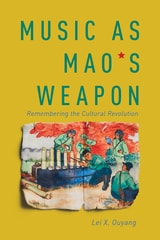
Music as Mao's Weapon
Remembering the Cultural RevolutionLei X. Ouyang
University of Illinois Press, 2022
China's Cultural Revolution (1966-1976) produced propaganda music that still stirs unease and, at times, evokes nostalgia. Lei X. Ouyang uses selections from revolutionary songbooks to untangle the complex interactions between memory, trauma, and generational imprinting among those who survived the period of extremes. Interviews combine with ethnographic fieldwork and surveys to explore both the Cultural Revolution's effect on those who lived through it as children and contemporary remembrance of the music created to serve the Maoist regime. As Ouyang shows, the weaponization of music served an ideological revolution but also revolutionized the senses. She examines essential questions raised by this phenomenon, including: What did the revolutionization look, sound, and feel like? What does it take for individuals and groups to engage with such music? And what is the impact of such an experience over time?
Perceptive and provocative, Music as Mao's Weapon is an insightful look at the exploitation and manipulation of the arts under authoritarianism.
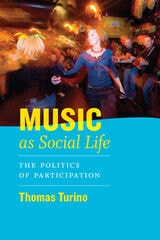
Music as Social Life
The Politics of ParticipationThomas Turino
University of Chicago Press, 2008
Turino begins by developing tools to think about the special properties of music and dance that make them fundamental resources for connecting with our own lives, our communities, and the environment. These concepts are then put into practice as he analyzes various musical examples among indigenous Peruvians, rural and urban Zimbabweans, and American old-time musicians and dancers. To examine the divergent ways that music can fuel social and political movements, Turino looks at its use by the Nazi Party and by the American civil rights movement. Wide-ranging, accessible to anyone with an interest in music’s role in society, and accompanied by a compact disc, Music as Social Life is an illuminating initiation into the power of music.
Music in the World
Selected EssaysTimothy D. Taylor
University of Chicago Press, 2017
In addition to chapters on music, capitalism, and globalization, Music in the World includes previously unpublished essays on the continuing utility of the concept of culture in the study of music, a historicization of treatments of affect, and an essay on value and music. Taken together, Taylor’s essays chart the changes in different kinds of music in twentieth- and twenty-first-century music and culture from a variety of theoretical perspectives.
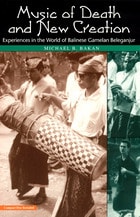
Music of Death and New Creation
Experiences in the World of Balinese Gamelan BeleganjurMichael B. Bakan
University of Chicago Press, 1999
Building from his own experiences as a beleganjur drummer, Bakan also takes us inside a distant musical world and into the lives of musicians connecting across vast cultural divides. Rich with musical examples, photographs, and an accompanying compact disc, Music of Death and New Creation is an unprecedented exploration of how music embodies and shapes life in contemporary Indonesia and beyond.
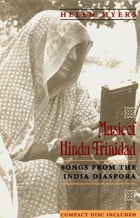
Music of Hindu Trinidad
Songs from the India DiasporaHelen Myers
University of Chicago Press, 1998
Myers details the musical repertory of Felicity, which is based largely on north Indian genres including the traditional Bhojpuri folk songs and drumming styles brought by the first indentured laborers in 1845. In her engaging exploration of the fate of Indian classical music and new popular styles such as Hindi calypso, soca, and chutney, she even finds herself at the ancestral home of Trinidadian V. S. Naipaul in India. Copiously illustrated and accompanied by a compact disk, Music of Hindu Trinidad is a model ethnographic study.
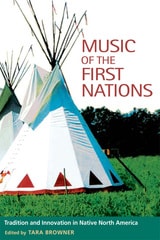
Music of the First Nations
Tradition and Innovation in Native North AmericaEdited by Tara Browner
University of Illinois Press, 2009
This unique anthology presents a wide variety of approaches to an ethnomusicology of Inuit and Native North American musical expression. Contributors include Native and non-Native scholars who provide erudite and illuminating perspectives on aboriginal culture, incorporating both traditional practices and contemporary musical influences. Gathering scholarship on a realm of intense interest but little previous publication, this collection promises to revitalize the study of Native music in North America, an area of ethnomusicology that stands to benefit greatly from these scholars' cooperative, community-oriented methods.
Contributors are T. Christopher Aplin, Tara Browner, Paula Conlon, David E. Draper, Elaine Keillor, Lucy Lafferty, Franziska von Rosen, David Samuels, Laurel Sercombe, and Judith Vander.

Music, Culture, and Experience
Selected Papers of John BlackingJohn Blacking
University of Chicago Press, 1995
This volume brings together in one convenient source eight of Blacking's most important theoretical papers along with an extensive introduction by the editor. Drawing heavily on his fieldwork among the Venda people of South Africa, these essays reveal his most important theoretical themes such as the innateness of musical ability, the properties of music as a symbolic or quasi-linguistic system, the complex relation between music and social institutions, and the relation between scientific musical analysis and cultural understanding.
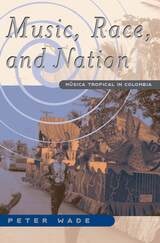
Music, Race, and Nation
Musica Tropical in ColombiaPeter Wade
University of Chicago Press, 2000
Wade's fresh look at the way music transforms and is transformed by ideologies of race, nation, sexuality, tradition, and modernity is the first book-length study of Colombian popular music.

Music, Research, and Activism
Prospects and Projects in Northern EuropeEdited by Kim Ramstedt, Susanna Välimäki, Sini Mononen, and Kaj Ahlsved
Intellect Books, 2025
Can music research drive social and ecological change? Music, Research, and Activism: Prospects and Projects in Northern Europe argues that it can—and must. This bold collection studies the emerging activist turn in music studies, where researchers and artists engage directly in public debates and cultural movements.
By questioning systemic inequalities in the music industry and exploring the role of music education in an era of climate crisis, the contributors to this volume reflect on how their work can serve eco-social justice. Drawing on their diverse experiences as educators, critics, DJs, producers, and community organizers, they offer a compelling vision of music research as an agent of transformation.
Rooted in the independent research network Suoni, this volume speaks to music scholars and students eager to rethink the role of music in shaping a more equitable world. Engaging and accessible, it challenges us to ask: What does social responsibility look like in music research today?

Music, Style, and Aging
Growing Old Disgracefully?Andy Bennett
Temple University Press, 2013
For many aging followers of rock, punk, and other contemporary popular genres, music is ingrained in their identities. Its meaning is highly personal and intertwined with the individual's biographical development. Bennett studies these fans and how they have changed over time--through fashions, hairstyles, body modification, career paths, political orientations, and perceptions of and by the next generation.
The significance of popular music for these fans is no longer tied exclusively to their youth. Bennett illustrates how the music? that "mattered" to most people in their youth continues to play an important role in their adult lives--a role that goes well beyond nostalgia.
Musica Nortena
Mexican Americans Creating a Nation Between NationsCathy Ragland
Temple University Press, 2009
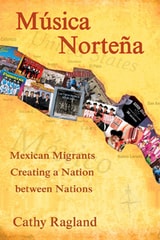
Música norteña, a musical genre with its roots in the folk ballad traditions of northern Mexico and the Texas-Mexican border region, has become a hugely popular musical style in the U.S., particularly among Mexican immigrants. Featuring evocative songs about undocumented border-crossers, drug traffickers, and the plight of immigrant workers, música norteña has become the music of a "nation between nations." Música Norteña is the first definitive history of this transnational music that has found enormous commercial success in norteamérica.
Cathy Ragland, an ethnomusicologist and former music critic, serves up the fascinating fifty-year story of música norteña, enlivened by interviews with important musicians and her own first-hand observations of live musical performances. Beyond calling our attention to musical influences, ragland shows readers the social and economic forces at work behind the music. By comparing música norteña with other popular musical forms, including conjunto tejano, she helps us understand and appreciate the musical ties that bind the Mexican diaspora.
Musical Ethics and Islam
The Art of Playing the NeyBanu Senay
University of Illinois Press, 2020
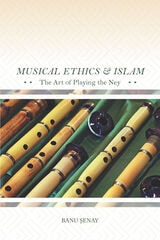
Banu Şenay documents the years-long training required to become a neyzen—a player of the ney. The process holds a transformative power that invites students to create a new way of living that involves alternative relationships with the self and others, changing perceptions of the city, and a dedication to craftsmanship. Şenay visits reed harvesters and travels from studios to workshops to explore the practical processes of teaching and learning. She also becomes an apprentice ney-player herself, exploring the desire for spirituality that encourages apprentices and masters alike to pursue ney music and its scaffolding of Islamic ethics and belief.
Musical Journeys in Sumatra
Margaret Kartomi
University of Illinois Press, 2012
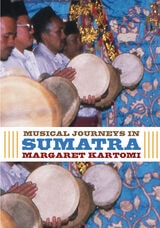
Although Sumatra is the sixth largest island in the world and home to an estimated 44 million Indonesians, its musical arts and cultures have not been the subject of a book-length study until now. Documenting and explaining the ethnographic, cultural, and historical contexts of Sumatra's performing arts, Musical Journeys in Sumatra also traces the changes in their style, content, and reception from the early 1970s onward.
Having dedicated almost forty years of scholarship to exploring the rich and varied music of Sumatran provinces, Margaret Kartomi provides a fascinating ethnographic record of vanishing musical genres, traditions, and practices that have become deeply compromised by the pressures of urbanization, rural poverty, and government policy. This deeply informed collection showcases the complex diversity of Indonesian music and includes field observations from six different provinces: Aceh, North Sumatra, Riau, West Sumatra, South Sumatra, and Bangka-Belitung. Featuring photographs and original drawings from Kartomi's field observations of instruments and performances, Musical Journeys in Sumatra provides a comprehensive musical introduction to this neglected, very large island, with its hundreds of ethno-linguistic-musical groups.
Musical Ritual in Mexico City
From the Aztec to NAFTABy Mark Pedelty
University of Texas Press, 2004
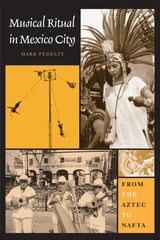
On the Zócalo, the main square of Mexico City, Mexico's entire musical history is performed every day. "Mexica" percussionists drum and dance to the music of Aztec rituals on the open plaza. Inside the Metropolitan Cathedral, choristers sing colonial villancicos. Outside the National Palace, the Mexican army marching band plays the "Himno Nacional," a vestige of the nineteenth century. And all around the square, people listen to the contemporary sounds of pop, rock, and música grupera. In all, some seven centuries of music maintain a living presence in the modern city.
This book offers an up-to-date, comprehensive history and ethnography of musical rituals in the world's largest city. Mark Pedelty details the dominant musical rites of the Aztec, colonial, national, revolutionary, modern, and contemporary eras, analyzing the role that musical ritual played in governance, resistance, and social change. His approach is twofold. Historical chapters describe the rituals and their functions, while ethnographic chapters explore how these musical forms continue to resonate in contemporary Mexican society. As a whole, the book provides a living record of cultural continuity, change, and vitality.
Musicophilia in Mumbai
Performing Subjects and the Metropolitan UnconsciousTejaswini Niranjana
Duke University Press, 2020

My Voice Is My Weapon
Music, Nationalism, and the Poetics of Palestinian ResistanceDavid A. McDonald
Duke University Press, 2013