Results by title
96 books match the query 'Games & Activities' and 9 start with m

M is for Monster
Sherry M. Lindquist
Arizona Center for Medieval and Renaissance Studies, 2000
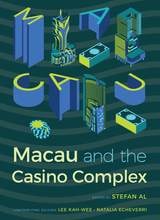
Macau and the Casino Complex
Stefan Al
University of Nevada Press, 2018
In only a decade, Macau has exploded from a sleepy backwater to the world’s casino capital. It was bound to happen. Macau, a former Portuguese colony that became a special administrative region within the People’s Republic of China in 1999, was the only place in China where gambling was legal. With a consumer base of 1.3 billion mainland Chinese deprived of casino gambling, and the world’s largest growing consumer class, international corporations rushed in to enter the games. As a result, the casino influx has permanently transformed the Macau peninsula: its ocean reclaimed, hillside excavated, roads congested, air polluted, and glimmering hotel towers tossed into the skyline, dwarfing the 19th century church towers.
Essays by a number of experts give a deeper insight on topics ranging from the myth of the Chinese gambler, the role of feng shui in casino design, the city’s struggle with heritage conservation, the politics of land reclamation, and the effect of the casino industry on the public realm. Drawings and photographs in vivid color visualize Macau’s patchwork of distinct urban enclaves: from downtown casinos, their neon-blasting storefronts eclipsing adjacent homes and schools, to the palatial complexes along a new highway, a Las Vegas-style strip. They also reveal how developers go to great lengths to impress the gambler with gimmicks such as fluorescent lighting, botanic gardens, feng shui dragon statues, cast members’ costumes, Chinese art imitations, and crystal chandelier-decked elevators. It is a book that helps readers grasp the complex process of the development of the casino industry and its overall impact on the social and architectural fabric of the first and last colonial enclave in China.

Made in Asia/America
Why Video Games Were Never (Really) about UsChristopher B. Patterson and Tara Fickle, editors
Duke University Press, 2024
Contributors. Matthew Seiji Burns, Edmond Y. Chang, Naomi Clark, Miyoko Conley, Toby Đỗ, Anthony Dominguez, Tara Fickle, Sarah Christina Ganzon, Yuxin Gao, Domini Gee, Melos Han-Tani, Huan He, Matthew Jungsuk Howard, Rachael Hutchinson, Paraluman (Luna) Javier, Sisi Jiang, Marina Ayano Kittaka, Minh Le, Haneul Lee, Rachel Li, Christian Kealoha Miller, Patrick Miller, Keita C. Moore, Souvik Mukherjee, Christopher B. Patterson, Pamela (Pam) Punzalan, Takeo Rivera, Yasheng She, D. Squinkifer, Lien B. Tran, Prabhash Ranjan Tripathy, Emperatriz Ung, Gerald Voorhees, Yizhou (Joe) Xu, Robert Yang, Mike Ren Yi
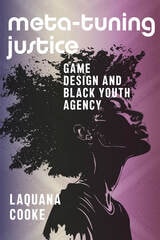
Meta-Tuning Justice
Game Design and Black Youth AgencyLaquana Cooke
University of Massachusetts Press, 2026
Exploring how Black youth are reshaping game design to dismantle stereotypes and spark social change
In the early 2000s, digital gaming rose to cultural and economic prominence. Communities of color, however, and especially Black youth, were largely excluded from gaming culture. The rare Black character in games tended to reinforce stereotypes, while racial bias was often surreptitiously embedded in game design platforms—what decolonial scholars call “whitestream” computing. Progressive game design education initiatives and new technologies have recently begun to dismantle these barriers. Yet, because biases remain, historically excluded young people still need to actively reconfigure these digital spaces to fully develop and convey their own perspectives.
In Meta-Tuning Justice, digital rhetoric scholar Laquana Cooke explores how Black youth express cultural identity and challenge dominant narratives through innovative game design. Cooke introduces the Transformative Constructionist Learning (TCL) paradigm and its core theory of “meta-tuning”—the idea that students are better able to adjust to new challenges through trial-and-error and experimentation in educational environments that correspondingly adjust to their evolving learning needs. In contrast to traditional education practices, which assume the neutrality of technology, Cooke approaches it as a tool for social transformation. Drawing on the TCL paradigm, she explores how the unique cultural algorithms and expressions (like popping and locking dance forms) that inform the programming and designs of Black youth represent a powerful form of resistance and creation.
Through rich ethnographic case studies across multiple educational settings, and with gaming as its experimental center, this book presents a compelling vision of how TCL and meta-tuning can help make technologies more equitable. Cooke’s innovative study offers insights crucial to scholars and practitioners in game studies, Science and Technology Studies, STEM education, and racial equity in digital learning.
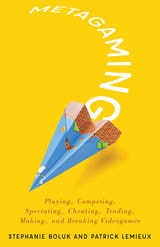
Metagaming
Playing, Competing, Spectating, Cheating, Trading, Making, and Breaking VideogamesStephanie Boluk
University of Minnesota Press, 2017
The greatest trick the videogame industry ever pulled was convincing the world that videogames were games rather than a medium for making metagames. Elegantly defined as “games about games,” metagames implicate a diverse range of practices that stray outside the boundaries and bend the rules: from technical glitches and forbidden strategies to Renaissance painting, algorithmic trading, professional sports, and the War on Terror. In Metagaming, Stephanie Boluk and Patrick LeMieux demonstrate how games always extend beyond the screen, and how modders, mappers, streamers, spectators, analysts, and artists are changing the way we play.
Metagaming uncovers these alternative histories of play by exploring the strange experiences and unexpected effects that emerge in, on, around, and through videogames. Players puzzle through the problems of perspectival rendering in Portal, perform clandestine acts of electronic espionage in EVE Online, compete and commentate in Korean StarCraft, and speedrun The Legend of Zelda in record times (with or without the use of vision). Companies like Valve attempt to capture the metagame through international e-sports and online marketplaces while the corporate history of Super Mario Bros. is undermined by the endless levels of Infinite Mario, the frustrating pranks of Asshole Mario, and even Super Mario Clouds, a ROM hack exhibited at the Whitney Museum of American Art.
One of the only books to include original software alongside each chapter, Metagaming transforms videogames from packaged products into instruments, equipment, tools, and toys for intervening in the sensory and political economies of everyday life. And although videogames conflate the creativity, criticality, and craft of play with the act of consumption, we don’t simply play videogames—we make metagames.
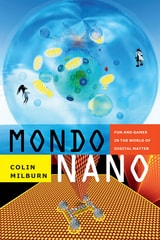
Mondo Nano
Fun and Games in the World of Digital MatterColin Milburn
Duke University Press, 2015
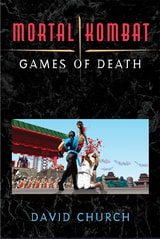
Mortal Kombat
Games of DeathDavid Church
University of Michigan Press, 2022
This book traces Mortal Kombat’s history as an American product inspired by both Japanese video games and Chinese martial-arts cinema, its successes and struggles in adapting to new market trends, and the ongoing influence of its secret-strewn narrative world. After outlining the specific elements of gameplay that differentiated Mortal Kombat from its competitors in the coin-op market, David Church examines the various martial-arts films that inspired its Orientalist imagery, helping explain its stereotypical uses of race and gender. He also posits the games as a cultural landmark from a moment when public policy attempted to intervene in both the remediation of cinematic aesthetics within interactive digital games and in the transition of public gaming spaces into the domestic sphere. Finally, the book explores how the franchise attempted to conquer other forms of media in the 1990s, lost ground to a new generation of 3D games in the 2000s, and has successfully rebooted itself in the 2010s to reclaim its legacy.
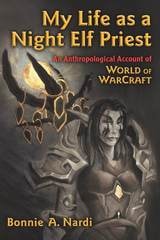
My Life as a Night Elf Priest
An Anthropological Account of World of WarcraftBonnie A. Nardi
University of Michigan Press, 2010
"Ever since the creators of the animated television show South Park turned their lovingly sardonic gaze on the massively multiplayer online game World of Warcraft for an entire episode, WoW's status as an icon of digital culture has been secure. My Life as a Night Elf Priest digs deep beneath the surface of that icon to explore the rich particulars of the World of Warcraft player's experience."
—Julian Dibbell, Wired
"World of Warcraft is the best representative of a significant new technology, art form, and sector of society: the theme-oriented virtual world. Bonnie Nardi's pioneering transnational ethnography explores this game both sensitively and systematically using the methods of cultural anthropology and aesthetics with intensive personal experience as a guild member, media teacher, and magical quest Elf."
—Lisa Nakamura, University of Illinois
World of Warcraft rapidly became one of the most popular online world games on the planet, amassing 11.5 million subscribers—officially making it an online community of gamers that had more inhabitants than the state of Ohio and was almost twice as populous as Scotland. It's a massively multiplayer online game, or MMO in gamer jargon, where each person controls a single character inside a virtual world, interacting with other people's characters and computer-controlled monsters, quest-givers, and merchants.
In My Life as a Night Elf Priest, Bonnie Nardi, a well-known ethnographer who has published extensively on how theories of what we do intersect with how we adopt and use technology, compiles more than three years of participatory research in Warcraft play and culture in the United States and China into this field study of player behavior and activity. She introduces us to her research strategy and the history, structure, and culture of Warcraft; argues for applying activity theory and theories of aesthetic experience to the study of gaming and play; and educates us on issues of gender, culture, and addiction as part of the play experience. Nardi paints a compelling portrait of what drives online gamers both in this country and in China, where she spent a month studying players in Internet cafes.
Bonnie Nardi has given us a fresh look not only at World of Warcraft but at the field of game studies as a whole. One of the first in-depth studies of a game that has become an icon of digital culture, My Life as a Night Elf Priest will capture the interest of both the gamer and the ethnographer.
Bonnie A. Nardi is an anthropologist by training and a professor in the Department of Informatics in the Donald Bren School of Information and Computer Sciences at the University of California, Irvine. Her research focus is the social implications of digital technologies. She is the author of A Small Matter of Programming: Perspectives on End User Computing and the coauthor of Information Ecologies: Using Technology with Heart and Acting with Technology: Activity Theory and Interaction Design.
Cover art by Jessica Damsky
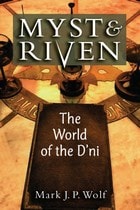
Myst and Riven
The World of the D'niMark J.P. Wolf
University of Michigan Press, 2011
“Myst and Riven is well-written, interesting, on-topic, insightful, and a real pleasure to read.”
—Edward Castronova, Indiana University
Video games have become a major cultural force, and within their history, Myst and its sequel Riven stand out as influential examples. Myst and Riven: The World of the D’ni is a close analysis of two of the most popular and significant video games in the history of the genre, investigating in detail their design, their functionality, and the gameplay experience they provide players. While scholarly close analysis has been applied to films for some time now, it has only rarely been applied at this level to video games. Mark J. P. Wolf uses elements such as graphics and sound, the games’ mood and atmosphere and how they are generated, the geography and design of the digital worlds, and the narrative structures of the games to examine their appeal to both critical and general audiences, their legacy, and what made them great.
Myst and Riven is the inaugural book in the Landmark Video Games series, edited by Mark J. P. Wolf and Bernard Perron, which is the first series to examine individual video games of historical significance.