Results by title
184 books match the query 'Hispanic Americans' and 8 start with m
Making Hispanics
How Activists, Bureaucrats, and Media Constructed a New AmericanG. Cristina Mora
University of Chicago Press, 2014
Some argue that these cultures are fundamentally similar and that the Spanish language is a natural basis for a unified Hispanic identity. But Mora shows very clearly that the idea of ethnic grouping was historically constructed and institutionalized in the United States. During the 1960 census, reports classified Latin American immigrants as “white,” grouping them with European Americans. Not only was this decision controversial, but also Latino activists claimed that this classification hindered their ability to portray their constituents as underrepresented minorities. Therefore, they called for a separate classification: Hispanic. Once these populations could be quantified, businesses saw opportunities and the media responded. Spanish-language television began to expand its reach to serve the now large, and newly unified, Hispanic community with news and entertainment programming. Through archival research, oral histories, and interviews, Mora reveals the broad, national-level process that led to the emergence of Hispanicity in America.
Making the MexiRican City
Migration, Placemaking, and Activism in Grand Rapids, MichiganDelia Fernández-Jones
University of Illinois Press, 2023
A Choice Outstanding Academic Title for 2023
Large numbers of Latino migrants began to arrive in Grand Rapids, Michigan, in the 1950s. They joined a small but established Spanish-speaking community of people from Texas, Mexico, and Puerto Rico. Delia Fernández-Jones merges storytelling with historical analysis to recapture the placemaking practices that these Mexicans, Tejanos, and Puerto Ricans used to create a new home for themselves. Faced with entrenched white racism and hostility, Latinos of different backgrounds formed powerful relationships to better secure material needs like houses and jobs and to recreate community cultural practices. Their pan-Latino solidarity crossed ethnic and racial boundaries and shaped activist efforts that emphasized working within the system to advocate for social change. In time, this interethnic Latino alliance exploited cracks in both overt and structural racism and attracted white and Black partners to fight for equality in social welfare programs, policing, and education.
Groundbreaking and revelatory, Making the MexiRican City details how disparate Latino communities came together to respond to social, racial, and economic challenges.
Making the Mission
Planning and Ethnicity in San FranciscoOcean Howell
University of Chicago Press, 2015
In Making the Mission, Ocean Howell tells the story of how residents of the Mission District organized to claim the right to plan their own neighborhood and how they mobilized a politics of place and ethnicity to create a strong, often racialized identity—a pattern that would repeat itself again and again throughout the twentieth century. Surveying the perspectives of formal and informal groups, city officials and district residents, local and federal agencies, Howell articulates how these actors worked with and against one another to establish the very ideas of the public and the public interest, as well as to negotiate and renegotiate what the neighborhood wanted. In the process, he shows that national narratives about how cities grow and change are fundamentally insufficient; everything is always shaped by local actors and concerns.
Marcha
Latino Chicago and the Immigrant Rights MovementEdited by Amalia Pallares and Nilda Flores-Gonzalez
University of Illinois Press, 2010
Marcha is a multidisciplinary survey of the individuals, organizations, and institutions that have given shape and power to the contemporary immigrant rights movement in Chicago. A city with longstanding historic ties to immigrant activism, Chicago has been the scene of a precedent-setting immigrant rights mobilization in 2006 and subsequent mobilizations in 2007 and 2008.
Positing Chicago as a microcosm of the immigrant rights movement on national level, these essays plumb an extraordinarily rich set of data regarding recent immigrant rights activities, defining the cause as not just a local quest for citizenship rights, but a panethnic, transnational movement. The result is a timely volume likely to provoke debate and advance the national conversation about immigration in innovative ways.
Marriage Vows and Racial Choices
Jessica Vasquez-Tokos
Russell Sage Foundation, 2017
Vasquez-Tokos finds that their experiences in childhood, adolescence, and young adulthood shape their perceptions of race, which in turn influence their romantic expectations. Most Latinos marry other Latinos, but those who intermarry tend to marry whites. She finds that some Latina women who had domineering fathers assumed that most Latino men shared this trait and gravitated toward white men who differed from their fathers. Other Latina respondents who married white men fused ideas of race and class and perceived whites as higher status and considered themselves to be “marrying up.” Latinos who married non-Latino minorities—African Americans, Asian Americans, and Native Americans—often sought out non-white partners because they shared similar experiences of racial marginalization. Latinos who married Latinos of a different national origin expressed a desire for shared cultural commonalities with their partners, but—like those who married whites—often associated their own national-origin groups with oppressive gender roles.
Vasquez-Tokos also investigates how racial and cultural identities are maintained or altered for the respondents’ children. Within Latino-white marriages, biculturalism—in contrast with Latinos adopting a white “American” identity—is likely to emerge. For instance, white women who married Latino men often embraced aspects of Latino culture and passed it along to their children. Yet, for these children, upholding Latino cultural ties depended on their proximity to other Latinos, particularly extended family members. Both location and family relationships shape how parents and children from interracial families understand themselves culturally.
As interracial marriages become more common, Marriage Vows and Racial Choices shows how race, gender, and class influence our marital choices and personal lives.
Metropolitan Latinidad
Transforming American Urban HistoryEdited by A. K. Sandoval-Strausz
University of Chicago Press, 2025
Latino urban history has been underappreciated not only in its own right but for the centrality of its narratives to urban history as a field. A scholarly discipline that has long scrutinized economics, politics, and the built environment has too often framed race as literally Black and white. This has resulted in a fundamental misunderstanding of the full social canvas of American cities since at least the early twentieth century.
Traversing metropolitan areas like Atlanta, Chicago, El Paso, Fort Worth, Los Angeles, Miami, and New York, this collection of essays brings together both established and emerging scholars, including long-time urbanists and academics working in the fields of Latino, borderlands, political, landscape, and religious history. Organized at different scales—including city, suburb, neighborhood, and hemisphere—this impressive body of work challenges long-standing narratives about metropolitan America. The contributors—Llana Barber, Mauricio Castro, Eduardo Contreras, Sandra I. Enríquez, Monika Gosin, Cecilia Sánchez Hill, Felipe Hinojosa, Michael Innis-Jiménez, Max Krochmal, Becky M. Nicolaides, Pedro A. Regalado, Iliana Yamileth Rodriguez, and Thomas J. Sugrue—engage a diverse range of subjects, such as urban rebellions, the suburbanization of Latinos, affordable housing, labor, the built environment, transnationalism, place-making, and religious life. The scholars also explore race within Latino communities, as well as the role that political and economic dynamics have played in creating Latino urban spaces. After reading this book, you will never see American cities the same way again.
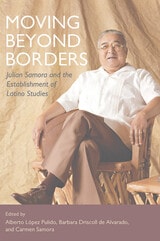
Moving Beyond Borders
Julian Samora and the Establishment of Latino StudiesEdited by Alberto Lopez Pulido, Barbara Driscoll de Alvarado, and Carmen Samora
University of Illinois Press, 2008
Moving Beyond Borders examines the life and accomplishments of Julian Samora, the first Mexican American sociologist in the United States and the founding father of the discipline of Latino studies. Detailing his distinguished career at the University of Notre Dame from 1959 to 1984, the book documents the history of the Mexican American Graduate Studies program that Samora established at Notre Dame and traces his influence on the evolution of border studies, Chicano studies, and Mexican American studies.
Samora's groundbreaking ideas opened the way for Latinos to understand and study themselves intellectually and politically, to analyze the complex relationships between Mexicans and Mexican Americans, to study Mexican immigration, and to ready the United States for the reality of Latinos as the fastest growing minority in the nation. In addition to his scholarly and pedagogical impact, his leadership in the struggle for civil rights was a testament to the power of community action and perseverance. Focusing on Samora's teaching, mentoring, research, and institution-building strategies, Moving Beyond Borders explores the legacies, challenges, and future of ethnic studies in United States higher education.
Contributors are Teresita E. Aguilar, Jorge A. Bustamante, Gilberto Cárdenas, Miguel A. Carranza, Frank M. Castillo, Anthony J. Cortese, Lydia Espinosa Crafton, Barbara Driscoll de Alvarado, Herman Gallegos, Phillip Gallegos, José R. Hinojosa, Delfina Landeros, Paul López, Sergio X. Madrigal, Ken Martínez, Vilma Martínez, Alberto Mata, Amelia M. Muñoz, Richard A. Navarro, Jesus "Chuy" Negrete, Alberto López Pulido, Julie Leininger Pycior, Olga Villa Parra, Ricardo Parra, Victor Rios, Marcos Ronquillo, Rene Rosenbaum, Carmen Samora, Rudy Sandoval, Alfredo Rodriguez Santos, and Ciro Sepulveda.

My Chicano Heart
New and Collected Stories of Love and Other TransgressionsDaniel A. Olivas
University of Nevada Press, 2024
Each story is drawn from Olivas’s nearly twenty-five years of experience writing fiction deeply steeped in Chicano and Mexican culture. Some of the stories are fanciful and full of magic, while others are more realistic, and still others border on noir. All touch upon that most ephemeral and confounding of human emotions: love in all its wondrous forms.