Results by title
71 books match the query 'Human beings' and 6 start with m
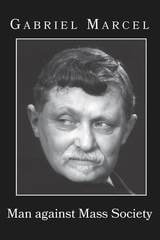
Man against Mass Society
Gabriel Marcel
St. Augustine's Press, 2008
The central theme of this important book is that we are paying the price of an arrogance that refuses to recognize mystery. The author invites the reader to enter into the argument that he holds with himself on a great number of problems. Written in the early 1950s, Marcel’s discussion of these topics are remarkably contemporary, e.g.:
* Our crisis is a metaphysical, not merely social, one.
* What a man is depends partly on what he thinks he is, and a materialistic philosophy turns men into things.
* Can a man be free except in a free country?
* Stoicism is no longer a workable philosophy because today pressure can be put on the mind as well as on the body.
* Technical progress is not evil in itself, but a technique is a means that, regarded as an end, can become either an idol or an excuse for self-idolatry. State control of scientific research, leading to a concentration on new means of destruction, is a calamity.
* Fanaticism is an opinion that refuses to argue, and so the fanatic is an enemy of truth.
* The kind of unification that science is bringing about today is really an ironing out of differences, but the only valuable kind of unity is one that implies a respect for differences.
* We must beware of thinking in terms of great numbers and so blinding ourselves to the reality of individual suffering. Our philosophical approach to being is made possible only by our practical approach to our neighbor.
* We must encourage the spirit of fraternity and distrust the kind of egalitarianism that is based on envy and resentment.
* No man however humble should feel that he cannot spread the light among his friends. No easy solution is offered, but the author conveys his own faith that ultimately love and intelligence will triumph.

Meaning in Motion
New Cultural Studies of DanceJane C. Desmond, ed.
Duke University Press, 1997
Writing from a broad range of perspectives, contributors from disciplines as varied as art history and anthropology, dance history and political science, philosophy and women’s studies chart the questions and challenges that mark this site. How does dance enact or rework social categories of identity? How do meanings change as dance styles cross borders of race, nationality, or class? How do we talk about materiality and motion, sensation and expressivity, kinesthetics and ideology? The authors engage these issues in a variety of contexts: from popular social dances to the experimentation of the avant-garde; from nineteenth-century ballet and contemporary Afro-Brazilian Carnival dance to hip hop, the dance hall, and film; from the nationalist politics of folk dances to the feminist philosophies of modern dance. Giving definition to a new field of study, Meaning in Motion broadens the scope of dance analysis and extends to cultural studies new ways of approaching matters of embodiment, identity, and representation.
Contributors. Ann Cooper Albright, Evan Alderson, Norman Bryson, Cynthia Cohen Bull, Ann Daly, Brenda Dixon Gottschild, Susan Foster, Mark Franko, Marianne Goldberg, Amy Koritz, Susan Kozel, Susan Manning, Randy Martin, Angela McRobbie, Kate Ramsey, Anna Scott, Janet Wolff

Media Hot and Cold
Nicole Starosielski
Duke University Press, 2021
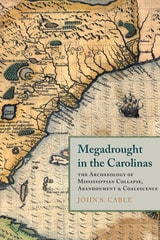
Megadrought in the Carolinas
The Archaeology of Mississippian Collapse, Abandonment, and CoalescenceJohn S. Cable
University of Alabama Press, 2020
A prevailing enigma in American archaeology is why vast swaths of land in the Southeast and Southwest were abandoned between AD 1200 and 1500. The most well-known abandonments occurred in the Four Corners and Mimbres areas of the Southwest and the central Mississippi valley in the twelfth and thirteenth centuries and in southern Arizona and the Ohio Valley during the fifteenth century. In Megadrought in the Carolinas: The Archaeology of Mississippian Collapse, Abandonment, and Coalescence, John S. Cable demonstrates through the application of innovative ceramic analysis that yet another fifteenth-century abandonment event took place across an area of some 34.5 million acres centered on the South Carolina coast.
Most would agree that these sweeping changes were at least in part the consequence of prolonged droughts associated with a period of global warming known as the Medieval Climatic Anomaly. Cable strengthens this inference by showing that these events correspond exactly with the timing of two different geographic patterns of megadrought as defined by modern climate models.
Cable extends his study by testing the proposition that the former residents of the coastal zone migrated to surrounding interior regions where the effects of drought were less severe. Abundant support for this expectation is found in the archaeology of these regions, including evidence of accelerated population growth, crowding, and increased regional hostilities. Another important implication of immigration is the eventual coalescence of ethnic and/or culturally different social groups and the ultimate transformation of societies into new cultural syntheses. Evidence for this process is not yet well documented in the Southeast, but Cable draws on his familiarity with the drought-related Puebloan intrusions into the Hohokam Core Area of southern Arizona during the thirteenth and fourteenth centuries to suggest strategies for examining coalescence in the Southeast. The narrative concludes by addressing the broad implications of late prehistoric societal collapse for today’s human-propelled global warming era that portends similar but much more long-lasting consequences.
Morality and Human Nature
A New Route to Ethical TheoryRobert J. McShea
Temple University Press, 1990
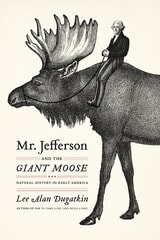
Mr. Jefferson and the Giant Moose
Natural History in Early AmericaLee Alan Dugatkin
University of Chicago Press, 2009
In the years after the Revolutionary War, the fledgling republic of America was viewed by many Europeans as a degenerate backwater, populated by subspecies weak and feeble. Chief among these naysayers was the French Count and world-renowned naturalist Georges-Louis Leclerc de Buffon, who wrote that the flora and fauna of America (humans included) were inferior to European specimens.
Thomas Jefferson—author of the Declaration of Independence, U.S. president, and ardent naturalist—spent years countering the French conception of American degeneracy. His Notes on Virginia systematically and scientifically dismantled Buffon’s case through a series of tables and equally compelling writing on the nature of his home state. But the book did little to counter the arrogance of the French and hardly satisfied Jefferson’s quest to demonstrate that his young nation was every bit the equal of a well-established Europe. Enter the giant moose.
The American moose, which Jefferson claimed was so enormous a European reindeer could walk under it, became the cornerstone of his defense. Convinced that the sight of such a magnificent beast would cause Buffon to revise his claims, Jefferson had the remains of a seven-foot ungulate shipped first class from New Hampshire to Paris. Unfortunately, Buffon died before he could make any revisions to his Histoire Naturelle, but the legend of the moose makes for a fascinating tale about Jefferson’s passion to prove that American nature deserved prestige.
In Mr. Jefferson and the Giant Moose, Lee Alan Dugatkin vividly recreates the origin and evolution of the debates about natural history in America and, in so doing, returns the prize moose to its rightful place in American history.