Results by title
751 books match the query 'International Relations' and 36 start with m

Macedonia
The Politics of Identity and DifferenceJane K. Cowan
Pluto Press, 2000
Made Under Pressure
Literary Translation in the Soviet Union, 1960–1991Natalia Kamovnikova
University of Massachusetts Press, 2019
Natalia Kamovnikova chronicles the literary translation process from the selection of foreign literary works to their translation, censorship, final approval, and publication. Interviews with Soviet translators of this era provide insight into how the creative work of translating and the practical work of publishing were undertaken within a politically restricted environment, and recall the bonds of community and collaboration that they developed.

Making Endless War
The Vietnam and Arab-Israeli Conflicts in the History of International LawBrian Cuddy and Victor Kattan, Editors
University of Michigan Press, 2023
Making Endless War is built on the premise that any attempt to understand how the content and function of the laws of war changed in the second half of the twentieth century should consider two major armed conflicts, fought on opposite edges of Asia, and the legal pathways that link them together across time and space. The Vietnam and Arab-Israeli conflicts have been particularly significant in the shaping and attempted remaking of international law from 1945 right through to the present day. This carefully curated collection of essays by lawyers, historians, philosophers, sociologists, and political geographers of war explores the significance of these two conflicts, including their impact on the politics and culture of the world’s most powerful nation, the United States of America. The volume foregrounds attempts to develop legal rationales for the continued waging of war after 1945 by moving beyond explaining the end of war as a legal institution, and toward understanding the attempted institutionalization of endless war.
Making Human
World Order and the Global Governance of Human DignityMatthew S. Weinert
University of Michigan Press, 2015
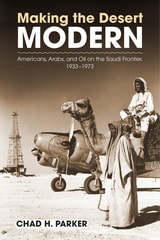
Making the Desert Modern
Americans, Arabs, and Oil on the Saudi Frontier, 1933–1973Chad Parker
University of Massachusetts Press, 2015
In 1933 American oilmen representing what later became the Arabian American Oil Company (Aramco) signed a concession agreement with the Saudi Arabian king granting the company sole proprietorship over the oil reserves in the country's largest province. As drilling commenced and wells proliferated, Aramco soon became a major presence in the region. In this book Chad H. Parker tells Aramco's story, showing how an American company seeking resources and profits not only contributed to Saudi “nation building” but helped define U.S. foreign policy during the early Cold War.
In the years following World War II, as Aramco expanded its role in Saudi Arabia, the idea of “modernization” emerged as a central component of American foreign policy toward newly independent states. Although the company engaged in practices supportive of U.S. goals, its own modernizing efforts tended to be pragmatic rather than policy-driven, more consistent with furthering its business interests than with validating abstract theories. Aramco built the infrastructure necessary to extract oil and also carved an American suburb out of the Arabian desert, with all the air-conditioned comforts of Western modern life. At the same time, executives cultivated powerful relationships with Saudi government officials and, to the annoyance of U.S. officials, even served the monarchy in diplomatic disputes. Before long the company became the principal American diplomatic, political, and cultural agent in the country, a role it would continue to play until 1973, when the Saudi government took over its operation.
Making the Modern Middle East
Second EditionT.G. Fraser, Andrew Mango, and Robert McNamara
Gingko, 2015
This fully revised and updated second edition of The Makers of the Modern Middle East traces those changes and the ensuing history of the region through the rest of the twentieth century and on to the present. Focusing in particular on three leaders—Emir Feisal, Mustafa Kemal, and Chaim Weizmann—the book offers a clear, authoritative account of the region seen from a transnational perspective, one that enables readers to understand its complex history and the way it affects present-day events.
Making the World Global
U.S. Universities and the Production of the Global ImaginaryIsaac A. Kamola
Duke University Press, 2019
Making the World Safe for Capitalism
How Iraq Threatened the US Economic Empire and had to be DestroyedChristopher Doran
Pluto Press, 2012
The Iraq war defined the first decade of the twenty-first century – leading to mass protests and raising profound questions about domestic politics and the use of military force. Yet most explanations of the war have a narrow focus either on political personalities or oil.
Christopher Doran provides a unique perspective, arguing that the drive to war came from the threat Iraq might pose to American economic hegemony if the UN sanctions regime was ended. Doran argues that this hegemony is rooted in third world debt and corporate market access. It was protection of these arrangements that motivated US action, not Iraq’s alleged weapons of mass destruction or a simplistic desire to seize its oil.
This book will provide new insights on the war which still casts a shadow over global politics, and will have wide appeal to all those concerned about the Middle East, world peace and global development.
Managing the Counterrevolution
The United States and Guatemala, 1954–1961Stephen M. Streeter
Ohio University Press, 2001
The Eisenhower administration’s intervention in Guatemala is one of the most closely studied covert operations in the history of the Cold War. Yet we know far more about the 1954 coup itself than its aftermath. This book uses the concept of “counterrevolution” to trace the Eisenhower administration’s efforts to restore U.S. hegemony in a nation whose reform governments had antagonized U.S. economic interests and the local elite.
Comparing the Guatemalan case to U.S.-sponsored counterrevolutions in Iran, the Dominican Republic, Brazil, and Chile reveals that Washington’s efforts to roll back “communism” in Latin America and elsewhere during the Cold War represented in reality a short-term strategy to protect core American interests from the rising tide of Third World nationalism.
Measuring the Correlates of War
J. David Singer and Paul F. Diehl, Editors
University of Michigan Press, 1991

Mechanicity
The Material Force of Code in International PoliticsVic Castro
University of Michigan Press, 2027
Despite their seeming relegation to the digital world, code and software can have material, large-scale, and even violent effects. In just one example, the NotPetya ransomware paralyzed one-fifth of world maritime trade in 2017. Mechanicity is a philosophical investigation of what happens when the force of language merges with material force, and what this means for the great ideas of politics: political action, international anarchy, and the very concept of sovereign state.
In this book, Vic Castro returns to Thomas Hobbes’s idea of the mechanical as a force both determinate and unruly, just like machines and software, and examines the human body—both in Hobbes’s political philosophy and in mishaps of genetic code—as that which brings together language and materiality in political society. To develop the framework of mechanicity, Castro also revives the Copenhagen School’s poststructuralist realism, the Derridian approach to traditional International Relations, and particularly actor-network theory (ANT). Using the case studies on Apple’s 2016 encrypted iPhone and NSO Group’s Pegasus spyware, Mechanicity shows how software is not just constrained to immaterial cyberspace; it also reshapes the physical world and the politics possible therein.

Meddling in Middle Europe
Britain and the 'Lands Between' 1919-1925Miklos Lojkó
Central European University Press, 2006
Mediterranean Security at the Cross Roads, Volume 8
Nikolaos Stavrou and Raymond C. Ewing
Duke University Press, 0
The potential role of NATO is controversial but crucial to the future of the Mediterranean. Some contributors suggest that the southward expansion of NATO could be an important first step toward stability, while others argue that the Mediterranean should be treated as an integrated geostrategic region, with a central place in Western security considerations.
Highlighting this issue is a foreword by former U.S. Secretary of State George P. Schultz, and a piece focusing on NATO in the Mediterranean by Javier Solana, the Secretary General of NATO. Other essays discuss the comparative experience of UNPROFOR and IFOR in the former Yugoslavia; the role of Italy in the future of the Mediterranean; the economic challenges facing the Middle East; and the role of Israel and its relationship to its neighbors. Mediterranean Security at the Crossroads is one of the first in-depth looks at this region from a strictly post—Cold War perspective.

Mediterranean Security at the Crossroads
A ReaderNikolaos A. Stavrou, ed.
Duke University Press, 1999
New essays in this expanded volume include a reflection by former President Jimmy Carter on the causes of war and their links to human suffering, a prophetic analysis of the post-Cold War environment in the Mediterranean by former U.N. Secretary General Boutros-Boutros Ghali, an essay on the strategic significance of Turkey in the eastern Mediterranean by the former Turkish ambassador to the United States, and, in light of recent events in Kosovo and elsewhere in the former Yugoslavia, a piece on the issue of Balkan security by the editor. Introducing the volume is a foreword by former U.S. Secretary of State George P. Schultz and an essay focusing on NATO in the Mediterranean by Javier Solana, the Secretary General of NATO. Central to the Mediterranean debate is the question of NATO’s role in its future. Some contributors suggest that the southward expansion of NATO could be an important first step toward stability, while others argue that the Mediterranean should be treated as an integrated geostrategic region, with a central place in Western security considerations. Other essays discuss the comparative experience of UNPROFOR and IFOR in the former Yugoslavia; the role of Italy in the future of the Mediterranean; the economic challenges facing the Middle East; and the role of Israel and its relationship to its neighbors.
Mediterranean Security at the Crossroads is one of the first in-depth looks at this region from a strictly post-Cold War perspective.
Contributors. Hanan Bar-On, Ted Galen Carpenter, Jimmy Carter, Charles G. Cogan, Gregorios Demestichas, Boutros-Boutros Ghali, Carlo Jean, Nuzhet Kandemir, Nicolai A. Kovalsky, William H. Lewis, Peter H. Liotta, John A. MacInnis, Phebe Marr, Matthew Nimetz, George P. Schultz, Javier Solana, Richard F. Staar, Nikolaos A. Stavrou, George Vella, W. Bruce Weinrod
Mercenaries
An African Security DilemmaEdited by Abdel-Fatau Musah and J. Kayode Fayemi
Pluto Press, 1999

Metternich's Diplomacy at its Zenith, 1820-1823
Austria and the Congresses of Troppau, Laibach, and VeronaBy Paul W. Schroeder
University of Texas Press, 1962
What Metiernich wanted at the peak of his career, why he wanted it, and the methods by which he achieved his goals are questions brilliantly answered in this survey and analysis of the Austrian chancellor's diplomacy during the period when he was the pre-eminent figure in European politics.
Metternich's single-minded objective during 1820–1823 was to preserve the Austrian hegemony he had gained in Central Europe after long wars, enormous effort, and great sacrifice. If the internal security and international-power position secured by Austria at the Congress of Vienna were to be defended against the impact of widespread revolution in Europe, it was imperative that peace in Europe and the status quo be maintained. This required an unyielding opposition to all political movements that might disturb the equilibrium, especially French chauvinism and the spread of French constitutional ideas.
A one-man distillate of the doctrine of absolute monarchy, Metternich was the relentless foe of any cause, just or unjust, that threatened European repose. Hence, when the revolution in Naples seriously menaced Austrian hegemony in Italy, Metternich determined that the constitutional regime in Naples must be overthrown by an Austrian armed force, an absolute monarchy restored, and an Austrian army of occupation kept there. Nor did he scruple to use duplicity, secret negotiation, trickery, or deceit against ally and adversary alike in his effort to enlist them in the common cause of all thrones. At the Congress of Troppau, Metternich succeeded not only in defeating Russian ideas for peaceful intervention and a moderate constitution at Naples, but also in converting Tsar Alexander to thoroughly conservative views, thereby making Russia a powerful supporter of Austrian policies and knowingly alienating England, formerly Austria's closest ally.
Paul W. Schroeder brings to this bookexceptional scholarship and an objectivity hard to attain when dealing with a personality. Although Metternich, as Schroeder sees him, doubtless helped to maintain European peace and order, his real greatness consisted not in his European principles, but in his ability to defend Austrian interests under the guise of European principles. The evidence, gathered from documentary material in the Haus Hof- und Staatsarchiv in Vienna, has forced the author to the conclusion that Metternich was no real statesman. The very qualities that distinguished him as a brilliant diplomat—keen vision, cogent analysis, fertility of expedients, farsightedness, flexibility, and firmness of purpose—were converted into those of blindness to reality, superficial analysis, sterility of expedients, dogmatism, and failure of will when confronted with fundamental problems of state and society.

Mexican Foreign Policy at the Turn of the Twenty-first Century
How Domestic a Foreign Policy?Ana Covarrubias
University of London Press, 2005

Mexico and the United States in the Oil Controversy, 1917–1942
By Lorenzo Meyer; translated by Muriel Vasconcellos
University of Texas Press, 1977
From reviews of the Spanish edition:
“Meyer’s perceptive commentary on Mexican power politics presents new insights into the petroleum lobbies in Mexico City and Washington. With unbiased empathy he shows the validity of Mexico’s complaints about foreigners’ deriving an overabundance of profit from a nonrenewable natural resource. He understands United States history and never abuses his license to criticize.” —Hispanic American Historical Review
“This useful addition to the literature on twentieth-century Mexican–United States diplomatic relations is a scholarly work, worthy of consideration by all students of the subject.”—American Historical Review
Mexico and the United States in the Oil Controversy, 1917–1942 explores the relationship between the United States and Mexico during the first half of the twentieth century, with special attention to the Mexican nationalization of the oil industry. Relying on Mexican archival material never before analyzed, the author presents a unique perspective on the period following the Mexican Revolution and Mexico’s efforts to diminish its economic dependency on the United States. This work not only describes the political and economic struggle between the Mexican government and the U.S. oil companies but also serves to illustrate in general the nature of dependency between Latin American countries and the United States. It will be of interest not only to Mexican specialists but also to diplomatic and economic historians.

Militarized Currents
Toward a Decolonized Future in Asia and the PacificSetsu Shigematsu
University of Minnesota Press, 2010
Military Intervention after the Cold War
The Evolution of Theory and PracticeAndrea Kathryn Talentino
Ohio University Press, 2005
Military Intervention After the Cold War explores how and why this change took place, looking at how both ideas and actions changed in the post-Cold War period to make military intervention a tool of international security and a defining characteristic of the international system. Although it is often touted as a strategy to rebuild collapsed states, the examples of success are few and far between. Andrea Kathryn Talentino argues that standards of human rights and responsible governance have become part of the definition of international security. She addresses questions that are vital in the post-9/11 world, where weak and collapsed states are recognized as permissive and at times supportive environments for criminal actors.
The specter of terrorism has placed even greater emphasis on the need to understand why military intervention happens and how it could be more effective. With the news full of stories on intervention and nation-building, scholars, graduate and undergraduate students, and readers interested in understanding global interdependence will find Military Intervention After the Cold War an indispensable book.Andrea Kathryn Talentino is an assistant professor of international relations at Tulane University, New Orleans.The author of numerous articles on military intervention and post- conflict rebuilding, she is currently focusing on the link between nation-building and political violence.
Military Occupation and Diplomacy
Soviet Troops in Romania, 1944–1958Sergiu Verona
Duke University Press, 1992
Drawing on declassified archival material in the United States and the United Kingdom, the author considers Khrushchev’s reversal of Stalinist expansionism by examining the motivation, function, and operation of the initial occupation of Romania; the complex involvement of Soviet diplomacy and its perception by the United States and other Western powers; the process by which Khrushchev decided to withdraw Soviet troops from that country; and the impact of this decision on Soviet policy. Verona extends his analysis, providing comparisons between Khrushchev’s and Gorbachev’s approaches to Eastern Europe, noting that similarities exist not only in domestic policies but in the realm of foreign policy as well.
Millennial Reflections on International Studies
Michael Brecher and Frank P. Harvey, Editors
University of Michigan Press, 2002
Forty-five prominent scholars engage in self-critical, state-of-the-art reflection on international studies to stimulate debates about successes and failures and to address the larger question of progress in the discipline. Written especially for the collection, these essays are in hardcover in the form of an easy-to-use handbook, and in paperback as a number of separate titles, each of which consists of a particular thematic cluster to merge with the range of topics taught in undergraduate and graduate courses in international studies.
The themes addressed are realism, institutionalism, critical perspectives, feminist theory and gender studies, methodology (formal modeling, quantitative, and qualitative), foreign policy analysis, international security and peace studies, and international political economy.
This collection provides an accessible and wide-ranging survey of the issues in the field as well as an invaluable bibliography, and will undoubtedly determine the shape of future research in international studies for the millennium.
Paperbacks for course adoption:
Realism and Institutionalism in International Studies
Michael Brecher and Frank P. Harvey, Editors
Conflict, Security, Foreign Policy, and International Political Economy:Past Paths and Future Directions in International Studies
Michael Brecher and Frank P. Harvey, Editors
Evaluating Methodology in International Studies
Frank P. Harvey and Michael Brecher, Editors
Critical Perspectives in International Studies
Frank P. Harvey and Michael Brecher, Editors
Contributors are: Steve J. Brams, Davis B. Bobrow, Michael Cox, Robert W. Cox, Bruce Bueno de Mesquita, Joseph M. Grieco, Ernst B. Haas , Peter M. Haas, Kal J. Holsti, Ole R. Holsti, Patrick James, Robert O. Keohane, Edward A. Kolodziej, Louis Kriesberg Robert T. Kudrle, David A. Lake, Yosef Lapid, Russell Leng , Jack S. Levy, L. H. M. Ling, Zeev Maoz, Lisa L. Martin, John J. Mearsheimer, Manus I. Midlarsky, Linda B. Miller, Helen Milner , Michael Nicholson, Joseph Nye, V. Spike Peterson , Jan Jindy Pettman, James Lee Ray , James Rosenau, Harvey Starr, J. David Singer, Steve Smith, Christine Sylvester, J. Ann Tickner, John Vasquez, Yaacov Y. I. Vertzberger, R. B. J. Walker, Stephen G. Walker , Jonathan Wilkenfeld, Oran Young, Marysia Zalewski, and Dina A. Zinnes.
Michael Brecher is R. B. Angus Professor of Political Science, McGill University, and former president of the International Studies Association.
Frank P. Harvey is Professor of Political Science and Director, Center for Foreign Policy Studies, Dalhousie University.
Mimetic Politics
Dyadic Patterns in Global PoliticsRoberto Farneti
Michigan State University Press, 2015

Ministers of Fire
A NovelMark Harril Saunders
Ohio University Press, 2012
Kabul, Afghanistan, 1979: CIA station chief Lucius Burling, an idealistic but flawed product of his nation’s intelligence establishment, barely survives the assassination of the American ambassador. Burling’s reaction to the murder, and his desire to understand its larger meaning, propel him on a journey of intrigue and betrayal that will reach its ultimate end in the streets of Shanghai, months after 9/11. A Chinese dissident physicist may (or may not) be planning to sell his country’s nuclear secrets, and in his story Burling, now living quietly as consul, recognizes the fingerprints of a covert operation, one without the obvious sanction of the Agency. The dissident’s escape draws the violent attention of the Chinese internal security service, and as Burling is drawn inexorably into their path, he must face the ghosts of his past misadventures and a present world of global trafficking, fragile alliances, and the human need for connection above all.
Reminiscent of the best work of Graham Greene and John le Carré, Ministers of Fire extends the spy thriller into new historical, political, and emotional territory.
Minority Memory, Identity, and Reconciliation
The Turkish Muslim Minority of Greece and the Greek Orthodox Minority of TürkiyeGül M. Gür
University of Michigan Press, 2025
Drawing from the personal stories of members of these two minority communities regarding their struggle with displacement, discrimination, and cultural assimilation, as well as comprehensive historical analysis, this book examines how historical traumas, national policies, and sociopolitical dynamics have influenced contemporary minority memory and identity formation. By incorporating interviews with community leaders, civil society representatives, and state officials, this book offers a rich, multifaceted perspective on the processes of memory and identity formation that underscores the broader implications of these processes for international relations in the region and minority rights. Gül M. Gür pulls together theories of nationalism, collective memory, and narrative practice to highlight the unique process of minority memory work and its role in sustaining minority identity and their advocacy efforts.
Mixed Emotions
Beyond Fear and Hatred in International ConflictAndrew A. G. Ross
University of Chicago Press, 2013
From passionate protests to poignant speeches, Andrew A. G. Ross analyzes high-emotion events with an eye to how they shape public sentiment and finds that there is no single answer. The politically powerful play to the public’s emotions to advance their political aims, and such appeals to emotion also often serve to sustain existing values and institutions. But the affective dimension can produce profound change, particularly when a struggle in the present can be shown to line up with emotionally resonant events from the past. Extending his findings to well-studied conflicts, including the War on Terror and the violence in Rwanda and the Balkans, Ross identifies important sites of emotional impact missed by earlier research focused on identities and interests.
Mobilizing the Faithful
Militant Islamist Groups and Their ConstituenciesStefan Malthaner
Campus Verlag, 2011
One of the keys to dealing with militant Islamic groups is understanding how they work with, relate to, and motivate their constituencies. Mobilizing the Faithful offers a pair of detailed case studies—of the Egyptian groups al-Jamaa al-Islamiyya and al-Jihad and Lebanon's Hizbullah—to identify typical forms of support relationships, development patterns, and dynamics of both radicalization and restraint. The insights it offers into the crucial relationship between militants and the communities from which they arise are widely applicable to violent insurgencies not only in the Middle East but around the world.
Models of Strategic Choice in Politics
Peter C. Ordeshook, Editor
University of Michigan Press, 1989

Models, Numbers, and Cases
Methods for Studying International RelationsDetlef F. Sprinz and Yael Wolinsky-Nahmias, Editors
University of Michigan Press, 2004
Detlef Sprinz is a Senior Fellow at the Department of Global Change and Social Systems of the Potsdam Institute for Climate Impact Research and teaches on the Faculty of Social Science at the University of Potsdam, Germany.
Yael Wolinsky-Nahmias is Senior Lecturer and Associate Chair in the Department of Political Science at Northwestern University.
Modern China-Myanmar Relations
Dilemmas of Mutual DependenceDavid I. Steinberg and Hongwei Fan
National University of Singapore Press, 2012
Modern China’s Foreign Policy
Werner Levi
University of Minnesota Press, 1953
Modern China's Foreign Policy was first published in 1953. Minnesota Archive Editions uses digital technology to make long-unavailable books once again accessible, and are published unaltered from the original University of Minnesota Press editions.
What are China's objectives in world affairs and what course will she pursue to achieve her goals? These are the questions of vital concern to the Western democracies, questions that can be approached intelligently only from a knowledge of how China's foreign policy has developed.
In this illuminating and carefully documented book, Professor Levi analyzes china's attitudes and actions toward the rest of the world and clarifies many motivations behind her behavior, past and present.
He traces the development of her foreign relations from the beginning of the modern era of Chinese contacts with Westerners, a little more than hundred years ago. The emphasis, however, is on the twentieth century, and particularly on the years since the peace settlements of World War I.
The complex balance of relationships between China and the United States, on the one hand, and China and the Soviet Union, on the other, since the end of World War II is discussed in detail. Communist doctrine, notwithstanding its apparent rigidity, is shown to be a conveniently adjustable tool, capable of adaptation to the needs and strategies of present-day China.
An integral part of the account is the attempt to single out and interpret the internal forces -- cultural, social, and economic -- that have influenced and shaped China's external policies. Thus, it is shown that the determinants of China's foreign policy have often been pressures and complexities within the country and that and understanding of the Chinese people and their traditions is essential to nations in their dealings with China.
Modernity and Power
A History of the Domino Theory in the Twentieth CenturyFrank Ninkovich
University of Chicago Press, 1994
To emphasize the central role of symbolism and ideological assumptions in twentieth-century American statesmanship, Ninkovich focuses on the domino theory—a theory that departed radically from classic principles of political realism by sanctioning intervention in world regions with few financial or geographic claims on the national interest. Ninkovich insightfully traces the development of this global strategy from its first appearance early in the century through the Vietnam war.
Throughout the book, Ninkovich draws on primary sources to recover the worldview of the policy makers. He carefully assesses the coherence of their views rather than judge their actions against "objective" realities. Offering a new alternative to realpolitic and economic explanations of foreign policy, Modernity and Power will change the way we think about the history of U.S. international relations.
Monetary Divergence
Domestic Policy Autonomy in the Post-Bretton Woods EraDavid H. Bearce
University of Michigan Press, 2007
"In a meticulously researched study, David Bearce demonstrates that, contrary to predictions, financial globalization has not resulted in a systematic convergence of national monetary policies. The book is a must-read for students of the political economy of international finance. Highlighting the critical role of partisan politics in determining policy outcomes, Bearce adds a new and important dimension to our understanding of the impacts of international capital mobility in the contemporary era."
—Benjamin Jerry Cohen, University of California, Santa Barbara
"Bearce offers a compelling analysis of partisan economic policy in an open economy. By analyzing both fiscal and monetary policies, Bearce extends our understanding of how the electoral imperative conditions policy behavior. His conclusions will have to be addressed in any
future debate about the topic."
—William Bernhard, University of Illinois at Urbana-Champaign
"Interest group divisions over exchange rates and macroeconomic policy have been at the center of international political economy research for about 20 years. Political scientists have studied these cleavages, focusing on the policy interests of various industry groups. On a separate but parallel track, another group of researchers explored the relationship between partisan politics and macroeconomic policy choices. In this exceptionally well researched book, Bearce integrates these two analytical traditions. Noting that industry groups are typically important organized constituents in left-wing and right-wing political parties, Bearce demonstrates how macroeconomic policy outcomes in advanced countries vary systematically with the alternation of political parties in government."
—J. Lawrence Broz, University of California, San Diego
David H. Bearce is Assistant Professor of Political Science at the University of Pittsburgh.

Moral Spaces
Rethinking Ethics And World PoliticsDavid Campbell
University of Minnesota Press, 1999

More or Less Afraid of Nearly Everything
Homeland Security, Borders, and Disasters in the Twenty-First CenturyBenjamin Rohrbaugh
University of Michigan Press, 2020
Throughout the twentieth century, the United States did not experience national security domestically; it defended its borders by conducting military, foreign policy, and intelligence operations internationally, and then separated these activities from domestic law enforcement with bright legal lines. In the twenty-first century, U.S. national security no longer occurs exclusively outside of the nation. The U.S. government is beginning to respond to this change, and the establishment of the Department of Homeland Security is merely the first step in an organizational and strategic realignment that will be a long, difficult, and mistake-filled process. More or Less Afraid of Nearly Everything is an accessible and engaging guide to homeland security, particularly migration and border security, that makes innovative arguments about the American government and keeping citizens safe, and provides practical solutions to real-world problems.

Multipolarity
The Promise of DisharmonyEdited by Peter W. Schulze
Campus Verlag, 2018