527 books match the query 'Labor' and 25 start with m
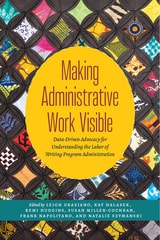
cover of Making Administrative Work Visible: Data-Driven Advocacy for Understanding the Labor of Writing Program Administration

Making Administrative Work Visible

Data-Driven Advocacy for Understanding the Labor of Writing Program Administration

Leigh Graziano

Utah State University Press, 2023

Making Administrative Work Visible brings together voices from graduate students, associated faculty, administrative staff, and tenured and tenure-track faculty at community colleges, regional state universities, liberal arts colleges, private colleges, and research-intensive institutions across the country to speak to the challenges, both named and unnamed, faced by those who do writing program administration work. These authors call explicit attention to this work and examine WPAs’ lived labor experiences and research methodologies to truly understand the scope of lived WPA labor.
 
The collection has three parts, each of which focuses on the most confounding challenges facing WPAs as well as the most compelling sites of their contributions to administration, labor in higher education, and the discipline’s collective obligation to forwarding the goals of social justice and advocacy: Advocating through Representations of WPA Labor, Advocating by Accounting for Time and Labor, and Advocating in and through Complex Institutional Contexts. The chapters use data to share and track the work functions, job titles, grand narratives, program assessments, tenure and promotion, email practices, and more undertaken by WPAs in their administrative capacities. Chapters also surface narratives for future data and studies to be done by other scholars.
 
By taking up and answering questions about the range of WPA work—and the invisibility of much of that work—Making Administrative Work Visible creates avenues toward accounting for and acknowledging the complex activity systems in which WPAs lead the work of the university and advocate for data-driven strategies needed to sustain this foundational area of higher education.
 
Contributors: Kamila Albert, Brooke Anderson, Sheila Carter-Tod, Amy Cicchino, Ana Cortés Lagos, Kristi Murray Costello, Jennifer Cunningham, Ryan Dippre, Kimberly Emmons, Genevieve García de Müeller, Jill Gladstein, Caleb González, Michael Healy, Lyra Hilliard, Kristine Johnson, Seth Kahn, Rita Malenczyk, Troy Mikanovich, Lilian Mina, Angela Mitchell, Greer Murphy, Kate Navickas, Michael Neal, Patti Poblete, Jan Rieman, Heather Robinson, Katelyn Stark, Mary Stewart, Natalie Stillman-Webb, Lizbett Tinoco, Lisa Tremain, Martha Wilson Schaffer
 
[more]
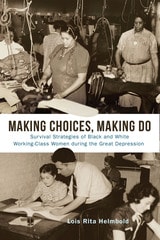
cover of Making Choices, Making Do: Survival Strategies of Black and White Working-Class Women during the Great Depression

Making Choices, Making Do

Survival Strategies of Black and White Working-Class Women during the Great Depression

Lois Rita Helmbold

Rutgers University Press, 2023
Making Choices, Making Do is a comparative study of Black and white working-class women’s survival strategies during the Great Depression. Based on analysis of employment histories and Depression-era interviews of 1,340 women in Chicago, Cleveland, Philadelphia, and South Bend and letters from domestic workers, Lois Helmbold discovered that Black women lost work more rapidly and in greater proportions. The benefits that white women accrued because of structural racism meant they avoided the utter destitution that more commonly swallowed their Black peers. When let go from a job, a white woman was more successful in securing a less desirable job, while Black women, especially older Black women, were pushed out of the labor force entirely. Helmbold found that working-class women practiced the same strategies, but institutionalized racism in employment, housing, and relief assured that Black women worked harder, but fared worse. Making Choices, Making Do strives to fill the gap in the labor history of women, both Black and white. The book will challenge the limits of segregated histories and encourage more comparative analyses.


[more]
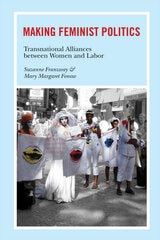
cover of Making Feminist Politics: Transnational Alliances between Women and Labor

Making Feminist Politics

Transnational Alliances between Women and Labor

Suzanne Franzway and Mary Margaret Fonow

University of Illinois Press, 2011
In this timely and detailed examination of the intersections of feminism, labor politics, and global studies, Suzanne Franzway and Mary Margaret Fonow reveal the ways in which women across the world are transforming labor unions in the contemporary era. Situating specific case studies within broad feminist topics, Franzway and Fonow concentrate on union feminists mobilizing at multiple sites, issues of wages and equity, child care campaigns, work-life balance, and queer organizing, demonstrating how unions around the world are broadening their focuses from contractual details to empowerment and family and feminist issues. By connecting the diversity of women's experiences around the world both inside and outside the home and highlighting the innovative ways women workers attain their common goals, Making Feminist Politics lays the groundwork for recognition of the total individual in the future of feminist politics within global union movements.
[more]
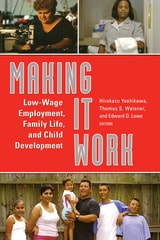
cover of Making It Work: Low-Wage Employment, Family Life, and Child Development

Making It Work

Low-Wage Employment, Family Life, and Child Development

Hirokazu Yoshikawa

Russell Sage Foundation, 2006

Low-skilled women in the 1990s took widely different paths in trying to support their children. Some held good jobs with growth potential, some cycled in and out of low-paying jobs, some worked part time, and others stayed out of the labor force entirely. Scholars have closely analyzed the economic consequences of these varied trajectories, but little research has focused on the consequences of a mother's career path on her children's development. Making It Work, edited by Hirokazu Yoshikawa, Thomas Weisner, and Edward Lowe, looks past the economic statistics to illustrate how different employment trajectories affect the social and emotional lives of poor women and their children. Making It Work examines Milwaukee's New Hope program, an experiment testing the effectiveness of an anti-poverty initiative that provided health and child care subsidies, wage supplements, and other services to full-time low-wage workers. Employing parent surveys, teacher reports, child assessment measures, ethnographic studies, and state administrative records, Making It Work provides a detailed picture of how a mother's work trajectory affects her, her family, and her children's school performance, social behavior, and expectations for the future. Rashmita Mistry and Edward D. Lowe find that increases in a mother's income were linked to higher school performance in her children. Without large financial worries, mothers gained extra confidence in their ability to parent, which translated into better test scores and higher teacher appraisals for their children. JoAnn Hsueh finds that the children of women with erratic work schedules and non-standard hours—conditions endemic to the low-skilled labor market—exhibited higher levels of anxiety and depression. Conversely, Noemi Enchautegui-de-Jesus, Hirokazu Yoshikawa, and Vonnie McLoyd discover that better job quality predicted lower levels of acting-out and withdrawal among children. Perhaps most surprisingly, Anna Gassman-Pines, Hirokazu Yoshikawa, and Sandra Nay note that as wages for these workers rose, so did their marriage rates, suggesting that those worried about family values should also be concerned with alleviating poverty in America. It is too simplistic to say that parental work is either "good" or "bad" for children. Making It Work gives a nuanced view of how job quality, flexibility, and wages are of the utmost importance for the well-being of low-income parents and children.
[more]
cover of Making It: Success in the Commercial Kitchen

Making It

Success in the Commercial Kitchen

Ellen T. Meiser

Rutgers University Press, 2025

The restaurant industry is one of the few places in America where workers from lower-class backgrounds can rise to positions of power and prestige. Yet with over four million cooks and food-preparation workers employed in America’s restaurants, not everyone makes it to the high-status position of chef. What factors determine who rises the ranks in this fiercely competitive pressure-cooker environment? 

Making It explores how the career path of restaurant workers depends on their accumulation of kitchen capital, a cultural asset based not only on their ability to cook but also on how well they can fit into the workplace culture and negotiate its hierarchical structures. After spending 120 hours working in a restaurant kitchen and interviewing fifty chefs and cooks from fine-dining establishments and greasy-spoon diners across the country, sociologist Ellen Meiser discovers many strategies for accumulating kitchen capital. For some, it involves education and the performance of expertise; others climb the ranks by controlling their own emotions or exerting control over coworkers. Making It offers a close and personal look at how knowledge, power, and interpersonal skills come together to determine who succeeds and who fails in the high-pressure world of the restaurant kitchen.  
 
[more]
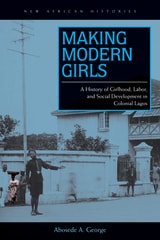
cover of Making Modern Girls: A History of Girlhood, Labor, and Social Development in Colonial Lagos

Making Modern Girls

A History of Girlhood, Labor, and Social Development in Colonial Lagos

Abosede A. George

Ohio University Press, 2014

Winner of the 2015 Aidoo-Snyder Book Prize for outstanding book on African women's experiences. (African Studies Association)
Honorable Mention, New York African Studies Association Book Prize

In Making Modern Girls, Abosede A. George examines the influence of African social reformers and the developmentalist colonial state on the practice and ideology of girlhood as well as its intersection with child labor in Lagos, Nigeria. It draws from gender studies, generational studies, labor history, and urban history to shed new light on the complex workings of African cities from the turn of the twentieth century through the nationalist era of the 1950s.

The two major schemes at the center of this study were the modernization project of elite Lagosian women and the salvationist project of British social workers. By approaching children and youth, specifically girl hawkers, as social actors and examining the ways in which local and colonial reformers worked upon young people, the book offers a critical new perspective on the uses of African children for the production and legitimization of national and international social development initiatives.

Making Modern Girls demonstrates how oral sources can be used to uncover the social history of informal or undocumented urban workers and to track transformations in practices of childhood over the course of decades. George revises conventional accounts of the history of development work in Africa by drawing close attention to the social welfare initiatives of late colonialism and by highlighting the roles that African women reformers played in promoting sociocultural changes within their own societies.
[more]
cover of Making Work Pay

Making Work Pay

Bruce D. Meyer

Russell Sage Foundation, 2001
Since its inception under President Ford in 1975, the Earned Income Tax Credit (EITC) has become the largest antipoverty program for the non-elderly in the United States. In 1998, more than nineteen million families received EITC payments, and the program lifted over four million Americans above the poverty line. Despite the rapid growth of the EITC throughout the 1990s, little has been written about how the program works or how it affects low-income families. Making Work Pay provides the first full-scale examination of the EITC, exploring its effects on income distribution, poverty, work, and marriage. Making Work Pay opens with a history of the EITC—its emergence in the 1970s as a pro-work, low-cost antipoverty program and its expansion through the 1980s and 1990s. The central chapters in the volume look at the substantial impact of the EITC on work incentives in recent years and show that the program, in combination with welfare reform and a strong economy, has led to an unprecedented increase in the employment of single mothers. In one study, researchers conclude that the EITC—with its stipulation that one family member be a wage earner—was the most important change in work incentives for single mothers between 1984 and 1996, a period when the employment rate of single mothers rose sharply. Several chapters outline proposals for reforming the program, addressing the concerns by policymakers about the work disincentives that rise as benefits fall with increasing income. Finally, Making Work Pay examines how EITC recipients view the credit and what they do with it once they get it. The contributors find that not only does EITC's lump-sum payment increase consumption but it also allows recipients to make changes in economic status. Many families use the end-of-the-year payment as a form of forced savings, enabling them to save for home improvement, a new car, or other purchases to improve their lives, and providing the extra economic cushion needed to move beyond mere day-to-day survival. Comprehensive in scope, Making Work Pay is an indispensable resource for policymakers, administrators, and researchers seeking to understand the ramifications of the country's largest programs for aiding the working poor.
[more]
cover of Making the Work-Based Safety Net Work Better: Forward-Looking Policies to Help Low-Income Families

Making the Work-Based Safety Net Work Better

Forward-Looking Policies to Help Low-Income Families

Carolyn J. Heinrich

Russell Sage Foundation, 2009
Work first. That is the core idea behind the 1996 welfare reform legislation. It sounds appealing, but according to Making the Work-Based Safety Net Work Better, it collides with an exceptionally difficult reality. The degree to which work provides a way out of poverty depends greatly on the ability of low-skilled people to maintain stable employment and make progress toward an income that provides an adequate standard of living. This forward-looking volume examines eight areas of the safety net where families are falling through and describes how current policies and institutions could evolve to enhance the self-sufficiency of low-income families. David Neumark analyzes a range of labor market policies and finds overwhelming evidence that the minimum wage is ineffective in promoting self-sufficiency. Neumark suggests the Earned Income Tax Credit is a much more promising policy to boost employment among single mothers and family incomes. Greg Duncan, Lisa Gennetian, and Pamela Morris find no evidence that encouraging parents to work leads to better parenting, improved psychological health, or more positive role models for children. Instead, the connection between parental work and child achievement is linked to parents' improved access to quality child care. Rebecca Blank and Brian Kovak document an alarming increase in the number of single mothers who receive neither wages nor public assistance and who are significantly more likely to suffer from medical problems of their own or of a child. Time caps and work hour requirements embedded in benefits policies leave some mothers unable to work and ineligible for cash benefits. Marcia Meyers and Janet Gornick identify another gap: low-income families tend to lose financial support and health coverage long before they earn enough to access employer-based benefits and tax provisions. They propose building "institutional bridges" that minimize discontinuities associated with changes in employment, earnings, or family structure. Steven Raphael addresses a particularly troubling weakness of the work-based safety net—its inadequate provision for the large number of individuals who are or were incarcerated in the United States. He offers tractable suggestions for policy changes that could ease their transition back into non-institutionalized society and the labor market. Making the Work-Based Safety Net Work Better shows that the "work first" approach alone isn't working and suggests specific ways the social welfare system might be modified to produce greater gains for vulnerable families.
[more]
cover of Making the World Safe for Workers: Labor, the Left, and Wilsonian Internationalism

Making the World Safe for Workers

Labor, the Left, and Wilsonian Internationalism

Elizabeth McKillen

University of Illinois Press, 2018
 
In this intellectually ambitious study, Elizabeth McKillen explores the significance of Wilsonian internationalism for workers and the influence of American labor in both shaping and undermining the foreign policies and war mobilization efforts of Woodrow Wilson's administration. McKillen highlights the major fault lines and conflicts that emerged within labor circles as Wilson pursued his agenda in the context of Mexican and European revolutions, World War I, and the Versailles Peace Conference. As McKillen shows, the choice to collaborate with or resist U.S. foreign policy remained an important one for labor throughout the twentieth century. In fact, it continues to resonate today in debates over the global economy, wars in Iraq and Afghanistan, and the impact of U.S. policies on workers at home and abroad.

[more]
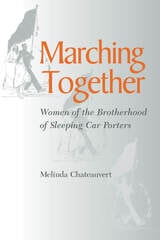
cover of Marching Together: Women of the Brotherhood of Sleeping Car Porters

Marching Together

Women of the Brotherhood of Sleeping Car Porters

Melinda Chateauvert

University of Illinois Press, 1998

The Brotherhood of Sleeping Car Porters (BSCP) was the first national trade union for African Americans. Standard BSCP histories focus on the men who built the union. Yet the union's Ladies' Auxiliary played an essential role in shaping public debates over black manhood and unionization, setting political agendas for the black community, and crafting effective strategies to win racial and economic justice. 

Melinda Chateauvert explores the history of the Ladies' Auxiliary and the wives, daughters, and sisters of Pullman porters who made up its membership and used the union to claim respectability and citizenship. As she shows, the Auxiliary actively educated other women and children about the labor movement, staged consumer protests, and organized local and national civil rights campaigns ranging from the 1941 March on Washington to school integration to the Montgomery Bus Boycott. Chateauvert also sheds light on the plight of Pullman maids, who—relegated to the Auxiliary—found their problems as working women neglected in favor of the rhetoric of racial solidarity.
[more]
cover of Marginal Workers, Marginal Jobs: The Underutilization of American Workers

Marginal Workers, Marginal Jobs

The Underutilization of American Workers

By Teresa A. Sullivan

University of Texas Press, 1978

Unemployment levels have received a great deal of attention and discussion in recent years. However, another labor category—underemployment—has virtually been ignored. Underutilized or underemployed workers are those who are experiencing inadequate hours of work, insufficient levels of income, and mismatch of occupation and skills. Marginal Workers, Marginal Jobs addresses two principal issues: how can we measure underemployment, and how can we explain its prevalence?

To answer the first question, Teresa Sullivan examines yardsticks in use, demonstrates their inadequacy, and develops a different measure that is easy to interpret and is usable by both demographers and economists. In answering the second, she analyzes 1960 and 1970 census data to determine the relative effects of population composition and job structure on levels of employment.

One of the important contributions of Sullivan's study is to distinguish between marginal workers and marginal jobs in explaining underutilization. Previous explanations, including the widely used dual market theory, have not stressed this analytic distinction. In addition, her work accounts separately for the various types of marginality and seeks to show the condition of workers who are marginal on more than one count—for example, those who are both young and black, or old and female.

A provocative study based on large samples of the U.S. population, this book raises important questions about a critical subject and makes a significant contribution to the theory of underutilization.
[more]
cover of Markets and Medicine: The Politics of Health Care Reform in Britain, Germany, and the United States

Markets and Medicine

The Politics of Health Care Reform in Britain, Germany, and the United States

Susan Giaimo

University of Michigan Press, 2002

Are advanced industrialized countries converging on a market response to reform their systems of social protection? By comparing the health care reform experiences of Britain, Germany, and the United States in the 1990s, Susan Giaimo explores how countries pursue diverse policy responses and how such variations reflect distinctive institutions, actors, and reform politics in each country.
In Britain, the Thatcher government's plan to inject a market into the state-administered national health service resulted in a circumscribed experiment orchestrated from above. In Germany, the Kohl government sought to repair defects in the corporatist arrangement with doctors and insurers, thus limiting the market experiment and designing it to enhance the solidarity of the national health insurance system. In the United States, private market actors foiled Clinton's bid to expand the federal government's role in the private health care system through managed competition and national insurance. But market reform continued, albeit led by private employers and with government officials playing a reactive role. Actors and institutions surrounding the existing health care settlement in each country created particular reform politics that either militated against or fostered the deployment of competition.
The finding that major transformations are occurring in private as well as public systems of social protection suggests that studies of social policy change expand their focus beyond statutory welfare state programs. The book will interest political scientists and policymakers concerned with welfare state reform in advanced industrial societies; social scientists interested in the changing balance among state, market, and societal interests in governance; and health policy researchers, health policymakers, and health care professionals.
Susan Giaimo is an independent scholar. She completed her Ph.D. in Political Science at the University of Wisconsin-Madison. She also earned an MSc in Politics from the London School of Economics and Political Science, with the Politics and Government of Western Europe as the branch of study. After completing her doctorate, she was a postdoctoral fellow in the Robert Wood Johnson Foundation Scholars in Health Policy Research Program, University of California at Berkeley, and the Robert Bosch Foundation Scholars Program in Comparative Public Policy and Comparative Institutions, American Institute for Contemporary German Studies, Johns Hopkins University. She taught in the Political Science Department at Massachusetts Institute of Technology for five years. During that period she won the Society for the Advancement of Socio-Economics Founder's Prize for "Adapting the Welfare State: The Case of Health Care Reform in Britain, Germany, and the United States," a paper she coauthored with Philip Manow. She has also worked for health maintenance organizations (HMOs) and medical practices in the United States.
[more]
cover of Marx and the Robots: Networked Production, AI, and Human Labour

Marx and the Robots

Networked Production, AI, and Human Labour

Florian Butollo

Pluto Press, 2022

Marxist discourse around automation has recently become waylaid with breathless techno-pessimist dystopias and fanciful imaginations of automated luxury communism. This collection of essays by both established veterans of the field and new voices is a refreshingly sober materialist reflection on recent technological developments within capitalist production.

It covers a broad range of digital aspects now proliferating across our work and lives, including chapters on the digitalization of agriculture, robotics in the factory and the labor process on crowdworking platforms. It looks to how 20th century Marxist predictions of the 'workerless factory' are, or are not, coming true, and how 'Platform Capitalism' should be understood and critiqued.

Through rich empirical, theoretical and historical material, this book is necessary reading for those wanting a clear overview of our digital world.
[more]
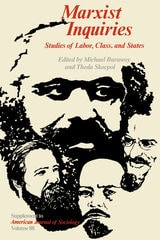
cover of Marxist Inquiries: Studies of Labor, Class, and States

Marxist Inquiries

Studies of Labor, Class, and States

Edited by Michael Burawoy and Theda Skocpol

University of Chicago Press, 1983

This collection exemplifies the resurgence of Marxist ideas in contemporary social research. Its purpose is neither to cover all the areas of Marxist research nor to survey alternative Marxist perspectives or schools. Rather the volume assembles nine examples of the most interesting work being done today by younger sociologists who are seriously pursuing the rich and provocative arguments to be found in the ongoing Marxist tradition. All contributions build upon or react to Marxist theoretical perspectives. They employ such diverse research techniques as participant observation, statistical analysis, interviewing, and the examination of archives of public documents. Among the topics covered:

– the economic bases of state policies and their determination by social and political struggles;
–  the politcal reshaping of international economic order;
– industrial work in relation to other institutions (such as education, patriarchy, and citizenship);
– the transformation of class structures in capitalist and state-socialist societies.

Published as a supplement to American Journal of Sociology, these studies constitute essential reading both for those sociologists who see Marxism as a powerful framework for understanding capitalist societies and for those who may not be committed to working within the Marxist tradition but nevertheless want to see Marxist hypotheses fully researched and debated.

[more]
cover of Meditación Fronteriza: Poems of Love, Life, and Labor

Meditación Fronteriza

Poems of Love, Life, and Labor

Norma Elia Cantú

University of Arizona Press, 2019

This collection is a beautifully crafted exploration of life in the Texas-Mexico borderlands. Written by Norma Elia Cantú, the award-winning author of Canícula, this collection carries the perspective of a powerful force in Chicana literature—and literature worldwide.

The poems are a celebration of culture, tradition, and creativity that navigates themes of love, solidarity, and political transformation. Deeply personal yet warmly relatable, these poems flow from Spanish to English gracefully. With Gloria Anzaldúa’s foundational work as an inspiration, Meditación Fronteriza unveils unique images that provide nuance and depth to the narrative of the borderlands.

Poems addressed to talented and influential women such as Gwendolyn Brooks and Adrienne Rich, among others, pour gratitude and recognition into the collection. While many of the poems in Meditación Fronteriza are gentle and inviting, there are also moments that grieve for the state of the borderlands, calling for political resistance.
[more]
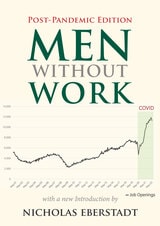
cover of Men without Work: Post-Pandemic Edition (2022)

Men without Work

Post-Pandemic Edition (2022)

Eberstadt, Nicholas

Templeton Press, 2022

Nicholas Eberstadt’s landmark 2016 study, Men Without Work, cast a spotlight on the collapse of work for men in modern America. Rosy reports of low unemployment rates and “full or near full employment” conditions, he contends, were overlooking a quiet, continuing crisis: Depression-era work rates for American men of “prime working age” (25–54).
   The grim truth: over six million prime-age men were neither working nor looking for work. Conventional unemployment measures ignored these labor force dropouts, but their ranks had been rising relentlessly for half a century. Eberstadt’s unflinching analysis was, in the words of The New York Times, “an unsettling portrait not just of male unemployment, but also of lives deeply alienated from civil society.”
   The famed American work ethic was once near universal: men of sound mind and body took pride in contributing to their communities and families. No longer, warned Eberstadt. And now—six years and one catastrophic pandemic later—the problem has not only worsened: it has seemingly been spreading among prime-age women and workers over fifty-five.
   In a brand new introduction, Eberstadt explains how the government’s response to Covid-19 inadvertently exacerbated the flight from work in America. From indiscriminate pandemic shutdowns to almost unconditional “unemployment” benefits, Americans were essentially paid not to work.
   Thus today, despite the vaccine rollouts, inexplicable numbers of working age men and women are sitting on the sidelines while over 11 million jobs go unfilled. Current low rates of unemployment, touted by pundits and politicians, are grievously misleading. The truth is that fewer prime-age American men are looking for readily available work than at any previous juncture in our history. And others may be catching the “Men Without Work” virus too.
   Given the devastating economic impact of the Covid calamity and the unforeseen aftershocks yet to come, this reissue of Eberstadt’s groundbreaking work is timelier than ever.
[more]
cover of Men, Women, and Work: Class, Gender, and Protest in the New England Shoe Industry, 1780-1910

Men, Women, and Work

Class, Gender, and Protest in the New England Shoe Industry, 1780-1910

Mary H. Blewett

University of Illinois Press, 1988

Mary H. Blewett's award-winning look at the men and women working in the shoe factories of Lynn, Massachusetts, explores the sexual division of labor and gender relationships in the workplace.
[more]
cover of Mexican Immigration to the United States

Mexican Immigration to the United States

Edited by George J. Borjas

University of Chicago Press, 2007

From debates on Capitol Hill to the popular media, Mexican immigrants are the subject of widespread controversy.  By 2003, their growing numbers accounted for 28.3 percent of all foreign-born inhabitants of the United States. Mexican Immigration to the United States analyzes the astonishing economic impact of this historically unprecedented exodus. Why do Mexican immigrants gain citizenship and employment at a slower rate than non-Mexicans? Does their migration to the U.S. adversely affect the working conditions of lower-skilled workers already residing there? And how rapid is the intergenerational mobility among Mexican immigrant families?

This authoritative volume provides a historical context for Mexican immigration to the U.S. and reports new findings on an immigrant influx whose size and character will force us to rethink economic policy for decades to come. Mexican Immigration to the United States will be necessary reading for anyone concerned about social conditions and economic opportunities in both countries.

[more]
cover of Milking in the Shadows: Migrants and Mobility in America’s Dairyland

Milking in the Shadows

Migrants and Mobility in America’s Dairyland

Keller, Julie C

Rutgers University Press, 2019

Migrant workers live in a transnational world that spans the boundaries of nation-states. Yet for undocumented workers, this world is complicated by inflexible immigration policies and the ever-present threat of enforcement. Workers labeled as “illegals” wrestle with restrictive immigration policies, evading border patrol and local police as they risk their lives to achieve economic stability for their families. For this group of workers, whose lives in the U.S. are largely defined by their tenuous legal status, the sacrifices they make to get ahead entail long periods of waiting, extended separation from family, and above all, tremendous uncertainty around a freedom that many of us take for granted—everyday mobility. In Milking in the Shadows, Julie Keller takes an in-depth look at a population of undocumented migrants working in the American dairy industry to understand the components of this labor system. This book offers a framework for understanding the disjuncture between the labor desired by employers and life as an undocumented worker in America today.
[more]
cover of Mind and Labor on the Farm in Black-Earth Russia, 1861-1914

Mind and Labor on the Farm in Black-Earth Russia, 1861-1914

David Kerans

Central European University Press, 2001

Did Tsarist Russia's political and industrial backwardness result from its rigid and archaic agrarian structure? Did the Russian revolution stem in large part from a parasitical elite's exploitation of an enormous peasant class? Was the Russian peasantry itself backward and 'dark' as a result? The attention contemporaries and historians have lavished on these questions has enshrined them as fundamental issues in Russian history. This text endeavours to recast our understanding of the agrarian problem by uncovering the history of both the physical and mental dimensions of agriculture. Employing literary, agronomic and statistical information on peasant labour and culture, this book also offers new perspectives on the limitations of traditional agriculture to adapt to a rapidly changing economic geography, such as that of late nineteenth and early twentieth century Russia. By taking a ground level view of the evolution of Russian agricultural technique, the author arrives at a very different understanding of the agrarian problem. The book identifies both the achievements and limitations of peasant farmers in adapting farming practices to the economic and technological challenges of the half century preceding the revolution. Most importantly, the book delves deeply into peasant life and culture to demonstrate how and why farming imrovements did not pass determinable levels.
[more]
cover of Minimum Wages in Central and Eastern Europe: From Protection to Destitution

Minimum Wages in Central and Eastern Europe

From Protection to Destitution

Guy Standing

Central European University Press, 1995
Since the late 1980s, incomes have fallen sharply in most countries of Central and Eastern Europe, while unemployment and poverty rates have risen dramatically. In most countries during that period, the statutory minimum wage has been supposed to be an anchor of the social protection system and the wage structure, protecting the low-paid and those dependent on state benefits. Unfortunately for those affected, the level of the minimum wage has been allowed to drop to well below the "poverty level" and has ceased to protect anyone. This book considers the evidence and the implications of this development, and recommends a series of reforms.
[more]
cover of Monitoring Sweatshops: Workers, Consumers, And The

Monitoring Sweatshops

Workers, Consumers, And The

Jill Esbenshade

Temple University Press, 2004
Monitoring Sweatshops offers the first comprehensive assessment of efforts to address and improve conditions in garment factories. Jill Esbenshade describes the government's efforts to persuade retailers and clothing companies to participate in private monitoring programs. She shows the different approaches to monitoring that firms have taken, and the variety of private monitors employed, from large accounting companies to local non-profits. Esbenshade also shows how the efforts of the anti-sweatshop movement have forced companies to employ monitors overseas as well. When monitoring is understood as the result of the withdrawal of governments from enforcing labor standards as well as the weakening of labor unions, it becomes clear that the United States is experiencing a shift from a social contract between workers, businesses, and government to one that Jill Esbenshade calls the social responsibility contract. She illustrates this by presenting the recent history of monitoring, with considerable attention to the most thorough of the Department of Labor's programs, the one in Los Angeles. Esbenshade also explains the maze of alternative approaches being employed worldwide to decide the questions of what should be monitored and by whom.
[more]
cover of Mothering for Capital: Labor, Race, and Child "Value" in Neoliberalism

Mothering for Capital

Labor, Race, and Child "Value" in Neoliberalism

Maria Kromidas

Vanderbilt University Press, 2026

Mothering for Capital offers a bold new interpretation about the crisis of motherhood in neoliberalism. It documents how the drive of capital stealthily subsumes mothering, tethering women’s work, care, and socialization of children, as well as their wishes, fears, and understandings of themselves as mothers, to the imperatives of value accumulation. Through the framework of “good” parenting that maximizes the odds of a child’s “success” in a precarious future, capital orients mothers to cultivate a set of specific cognitive, social, emotional, and psychological traits that shape children as future labor power, the ideal manageable yet self-managed subject. The child is the site of capital’s most audacious aspirations—to flatten and empty human life of all that is superfluous or dangerous to capital. What is ultimately at stake, Kromidas argues, is the subordination or emancipation of the human subject, and Mothering for Capital tracks this hidden terrain of struggle.
[more]
cover of Moving Up or Moving On: Who Gets Ahead in the Low-Wage Labor Market?

Moving Up or Moving On

Who Gets Ahead in the Low-Wage Labor Market?

Fredrik Andersson

Russell Sage Foundation, 2005

For over a decade, policy makers have emphasized work as the best means to escape poverty. However, millions of working Americans still fall below the poverty line. Though many of these "working poor" remain mired in poverty for long periods, some eventually climb their way up the earnings ladder. These success stories show that the low wage labor market is not necessarily a dead end, but little research to date has focused on how these upwardly mobile workers get ahead. In Moving Up or Moving On, Fredrik Andersson, Harry Holzer, and Julia Lane examine the characteristics of both employees and employers that lead to positive outcomes for workers. Using new Census data, Moving Up or Moving On follows a group of low earners over a nine-year period to analyze the behaviors and characteristics of individuals and employers that lead workers to successful career outcomes. The authors find that, in general, workers who "moved on" to different employers fared better than those who tried to "move up" within the same firm. While changing employers meant losing valuable job tenure and spending more time out of work than those who stayed put, workers who left their jobs in search of better opportunity elsewhere ended up with significantly higher earnings in the long term—in large part because they were able to find employers that paid better wages and offered more possibilities for promotion. Yet moving on to better jobs is difficult for many of the working poor because they lack access to good-paying firms. Andersson, Holzer, and Lane demonstrate that low-wage workers tend to live far from good paying employers, making an improved transportation infrastructure a vital component of any public policy to improve job prospects for the poor. Labor market intermediaries can also help improve access to good employers. The authors find that one such intermediary, temporary help agencies, improved long-term outcomes for low-wage earners by giving them exposure to better-paying firms and therefore the opportunity to obtain better jobs. Taken together, these findings suggest that public policy can best serve the working poor by expanding their access to good employers, assisting them with job training and placement, and helping them to prepare for careers that combine both mobility and job retention strategies. Moving Up or Moving On offers a compelling argument about how low-wage workers can achieve upward mobility, and how public policy can facilitate the process. Clearly written and based on an abundance of new data, this book provides concrete, practical answers to the large questions surrounding the low-wage labor market.
[more]